
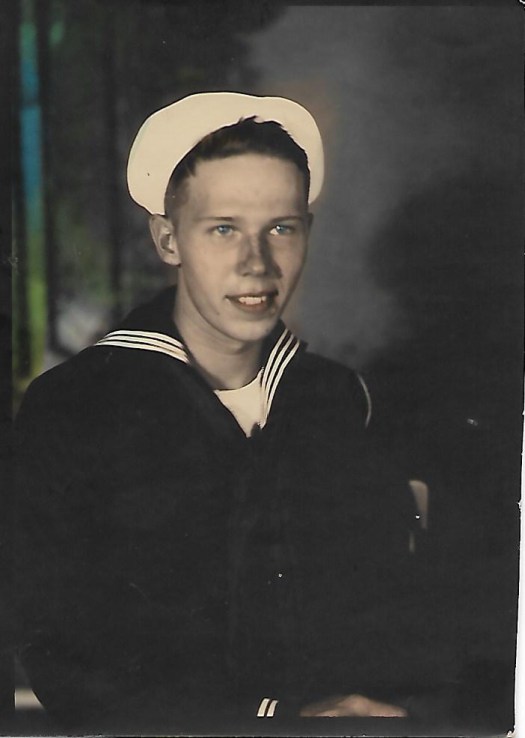
The winds of war swept smoke over the Pacific and the Atlantic, shrouding America in the grim scent of burning flesh and shattered towns. No American could turn away from the truth that lay ahead.
With his basic training done, my father, Johnny, boarded a troop ship headed for Pearl Harbor, Hawaii. The voyage lasted a week, maybe more. He met many young men like him, all seventeen, their fathers signing the papers for them to join the Navy. They were bonded by youth, their love for their country, and the call of duty that carried them forward.
In Los Angeles, my grandmother Bertha accepted, somewhat, that her only boy was going to war. She kept busy writing letters to him before he made it to the islands. Her frantic behavior brought back the elixirs. Sister Aimee’s healing failed, yet no one in the family dared to take her back for a tune-up.
After arriving in Hawaii and settling into his barracks, the post carrier handed him two dozen letters, all from Mama. He did not need to read them; he understood their essence: “Come home, I need you, I might die soon.” It was all self-inflated nonsense, and for the first time, he recognized it and turned away. From then on, he would burn or tear the letters into shreds, neither reading nor answering a single one. The umbilical cord, though long, had been severed.
The islands of Hawaii were beautiful, like a dream each young man held close. The mountains rose with dignity, green forests swayed softly, and the beaches called out their enticing embrace. It was difficult to accept that an island paradise could be in such turmoil. Yet, reality ousted the vision.
Johnny stood on the fantail of a destroyer, the sea raging with anger, trapped between the allure of paradise and the blood-soaked chaos of war, all within a day’s sail. He reconsidered his reluctance to write and penned a few letters: one to his mother, sister, and father, in case he didn’t return to safe harbor.
Hollywood portrayed war in a way that seemed clean and tidy. The soldiers and sailors donned uniforms that were always crisp, and wounds were mere shadows, with no blood to mar the screen. But for Johnny, the truth of war came crashing down on the third day out at sea. His ship, along with four others, escorted an aircraft carrier that was suddenly attacked by Japanese planes. They struck the carrier twice, and Johnny’s destroyer was caught in the crossfire, taking a torpedo hit that crippled its forward compartments. Though the ship still moved, it was ordered to return to Pearl for repairs. Fear didn’t manifest itself until he was awakened in his bunk, shaking and praying that he had made the right choice. At that moment, he realized that death was a real option.
Discover more from Notes From The Cactus Patch
Subscribe to get the latest posts sent to your email.
 Notes From The Cactus Patch
Real writing. Spoke with a few WWII vets still in when I first made staff. The NCO club loosened-up their memories. Stark.
LikeLike
Thank you Espie. My uncle on my mothers side, her older brother joined the Navy and was in the battle of Iwo Jima. After the war, he became a mean alchaholic. Looking back, he was likely suffering from PTSD. He saw things that were horrific. He was a gunner on a destroyer and shot down quite a few Zero’s. Once in a while, if the moon lighting the porch was bright and the breeze was cool, he would go back to that time and tell us kids about that battle.
LikeLiked by 1 person
Dad only talked once about Guadalcanal. After my return from service. I never asked for more. I understood too well.
LikeLike
My grandfather fought in the trenches in France, sometimes hand to hand. He was gassed twice and wounded bad enough to send him home. Near the end of his life, dying from cancer caused by the gas, he talked about his time in the war.
LikeLiked by 1 person
We’re talking about real men who fought “honorable” wars. Most with stories never told, stories they’d rather not share with themselves again.
LikeLiked by 1 person
This chapter took on a more sinister tone of course…I can’t imagine what they were going through. I’m glad he did write the letters though. When you are in that position I’m sure most would.
LikeLiked by 1 person
Dad, said, that when that first battle against the Zero’s was over, all the new recruits realized their battle cherry had been popped. It must have been beyond anything those young men had ever witnessed. I’ll be writing more about the time in Pearl Harbor in the next chapter, and it won’t be as dark.
LikeLike
Johnny, your father, was a brave young man. Even seasoned seamen become unnerved by the horrifying tragedies of war. Thankfully, his destroyer made it back with young recruits all suddenly grown up.
LikeLike
Nancy, those young men had to grow up fast, perhaps too fast, but they swallowed their fear and sallied forth.
LikeLiked by 1 person
They were courageous indeed.
LikeLike