Just Another Day Full Of Things


Before I kicked the smoking habit, I look better now

Old people do odd things: I know this firsthand. I’m good at it. A few months ago, the urge to gather and distribute my personal items to family and friends took hold. 2 am in the wee hours, wide awake, I wrote a list of my treasures and who might be the recipient when I assume room temperature. I found that over the years, I have accumulated more useless crap that no one would want.

My tool shed, art studio, storage shed, and junk pile will likely go to the nice folks at the local Goodwill store. The handicap shower chair and the two walkers will stay. The nice walker, the one with four wheels, a handbrake, and a seat, will likely be my new ride. Some guys get a Corvette; I get a souped-up walker. My friend Mooch says he can add a battery-powered motor to make the baby run 30 MPH.

A few weeks back, I bought back one of my acoustic guitars that I sold to Mooch when Momo and I moved to Georgetown, Texas in 2008. It’s a real beaut: a Gibson-made Epiphone E J160 e. Only fifty of them were made in Bozeman, Montana, likely by some of the Yellowstone Dutton family. Now, I have one guitar for each of my three grandchildren, of whom two play guitar.

Us’un humans collect things throughout our lives; it’s our nature. At the time, we might have needed them, but eventually, the things become useless “things” taking up space.

Momo and I are taking a road trip in mid-April. Back to Marfa and Fort Davis, Texas, the Big Bend Chihuahuan Desert. God’s country, big sky and brilliant stars. Marfa is our go-to escape. The town is full of eccentric street-rat crazy folks, and we enjoy interacting with them. I plan to interview a few while sitting at the bar in Planet Marfa, where most of them congregate nightly to swap lies and tell tall tales. I fit right in, my kind of folks, and I need fodder for my stories and yarns. I may fill my pickup full of “things” and give them to the characters I meet. Folks like free stuff and can give the things to their friends down the line.

Sundays, Beer, and Life Lessons from the Grocery Store


My Veteran

I wrote this story in 2012 when I first entered the blogging world and the Cactus Patch. Long forgotten, I ran across it this morning and felt it needed a re-tread. You meet some nice folks at your local grocery store, and it’s a good place to learn about life.

Sunday, the Sabbath, the seventh day of creation, is a time for rest and reflection. For more than fifty years, I have believed and found no fault with any of those holy descriptions.

Religious quotes take on different meanings over the years, and these days, if you took to the street and stopped any male between the ages of 18 and 30, and posed the question, What did God accomplish on the seventh day? Without missing a beat, his answer would probably be that he created football- what else? I can’t disagree with that. Historically speaking, it’s plausible that a few thousand years ago, on some vacant lot in Jerusalem, a group of kids were tossing around an inflated camel bladder. That is, until their mothers made them cease the silly game, afraid that they would break their little necks. With that ancient parental declaration, the game ceased and was lost to mankind until sometime in the late 19th century. It makes a man wonder what else was lost.

A few Sundays ago, I invited a couple of buddies over to watch the big game, Dallas against the Eagles.  Father Frank, our benevolent and supportive priest at ” Our Lady of Perpetual Repentance”,  gave most of the men an early discharge from mass so we could make it home for the kickoff. Quietly, the men filed out of the chapel, exiting to feminine hisses of ” blasphemer, sinners”. As I departed, my lovely wife, Momo, offered me a lip-quivering snarl. I thought it best not to point out that she had a piece of her breakfast bagel stuck between her front teeth.

Arriving home, I warmed up the flat screen and headed for the kitchen. I opened the fridge, but there was no beer. I went to the pantry, no chips, no bean dip, no nothing. I panicked. One hour to kickoff. I made it to the H-E-B grocery in record time.

I found the store overrun with packs of wandering males, lost and searching for the items on their list.

The chip aisle was a mosh pit—the dip cabinet was empty, and there was one frozen pizza left. “It‘s mine,” I yelled. Frantically, I headed for the beer section. The bodies were five deep, grabbing anything cold and alcoholic. I waded into the melee.

Beside me was an old gentleman, who looked to be in his nineties, in tow to a shriveled up wife of about the same age. He reached into the cooler and pulled out a six-pack of his favorite brew and placed it in their cart, next to the frozen dinners and the case of Metamucil. His wife, aghast, announced, “You know we can’t afford that on your pension, put it right back, now!” The old man offered a weak defense, ” It’s only a six pack and you know I have to have my beer when I watch my Cowboys”. Not to be. She stared him down, and he returned the treasure.

I noticed he wore an ancient Don Meredith jersey and a ball cap with a veterans patch, Airborne, it read, WWII, the real boys- boots on the ground after falling a mile- a soldier’s soldier, tough as boiled leather.

Do you know that feeling when something needs to be said but you can’t spit it out?

I wanted to blurt out,  “Don’t let that dried-up old Battle Axe take away your beer. Damn, you fought on the beaches and the fields of France, you killed Nazis, dodged bullets with your name on them, thumbed your nose at the Third Reich and Mussolini. You held your mortally wounded buddies as they drew their last breath, calling for their mother, as they started their journey home. You deserve to have your beer, tell the old Battle Axe to take a hike”.  I couldn’t say it. It would have made no difference, so I grabbed my beer and moved on. I watched them as they shuffled down the aisle, he slowly pushing the cart, she berating.

I needed some shampoo, so I made my way over to that aisle. There, in front of the beauty lotions, stood the old couple. Ms. Battle Axe was tossing bottles of creams, lotions, and astringents into their cart like a conveyor belt, and it seemed that their pension covered those items.

As I neared their cart, the old man, with perfect timing pipes up, ” you know we can’t afford all those expensive lotions on my pension, put that crap back!”

Battle Axe wheels around on her snow white Rockport walking shoe and fired back,” I need these things to make me look beautiful for you .”

The old veteran squinted his eyes, snarled his lip, and said, “Yeah, well, a six-pack of beer accomplishes the same thing, and it’s a hell of a lot cheaper.”

Everyone on the isle witnessed their exchange. Their chuckles, impossible to stifle. Embarrassed, the old couple, with crimson faces aglow, retreated down the aisle.

I caught up with them and offered my hand to the feisty old fellow. He shook my hand and gracefully accepted my impromptu, sputtering speech of appreciation for his service. My words finally exhausted, he looked me in the eye, winked, and gave my hand one last shake, squeezing my fingers like a small vice. We both smiled.

Without hesitation, I took my case of beer, stuffed a twenty-dollar bill in the cardboard, and dropped it into their cart.

Battle Axe said, “He doesn’t need that”.

In my most polite and official manner,  I  replied,

” It’s compliments of the  Dallas Cowboys, Mam”, and with that, I turned and walked away.

The old veteran yelled out, ” Sonny boy, hey son”

As I turned to face him, he raised a gnarled old fist and yelled, ” Go Cowboys!”. I returned the salute and continued on my way.

A Grandfather’s War Stories: Realities Beyond Hollywood


Honor And Duty In 1918

I wrote this back in 2020; hope you enjoy.

My grandfather, in 1917-18, served in the Army and the war to end all wars: World War 1. He fought in the mud and bacteria filled trenches in France: wounded twice and gassed once. He killed Germans in close hand to hand combat with a bayonet and a knife, never forgetting the look on the faces. He lost friends in vicious battles. There was no time to grieve or pay respects. That would come later in life.

Looking back through my childhood relationship with him, he likely suffered from what we now call PTSD. My Grandmother said he was a different man after that war, and at times, not a good one.

He refused to talk about the fighting and killing until I was around ten-years-old, and he was dying from Lymphoma cancer. His doctors at the VA Hospital said it was caused by the gassing he received in the war. He knew that I might someday go to war, so he wanted to let me know it was not like the movies.

We sat for a many hours one afternoon a few weeks before his passing. His descriptions of battle and the things he had done for his own survival was beyond anything I could imagine. I was young, and war to me was black and white movies. James Cagney in “The Fighting 69th,” or John Wayne and a host of others playing army, like my neighborhood friends and I did. No one really died, and when shot, there was no blood or screaming.

The last few days of his life were spent in and out of reality, reliving those battles as he lay in a veteran’s hospital in Dallas. My father, a veteran himself, was the recipient of my grandfathers last horrors. Those days my father sat by his bed, listening to the nightmare his father had carried for all those years, had a profound effect on him.

John Henry Strawn made sure I knew what real honor and duty were about. It followed him for a lifetime.

Chapter 18. Fort Worth Legends: A Young Musician’s Rise Under Bob Wills


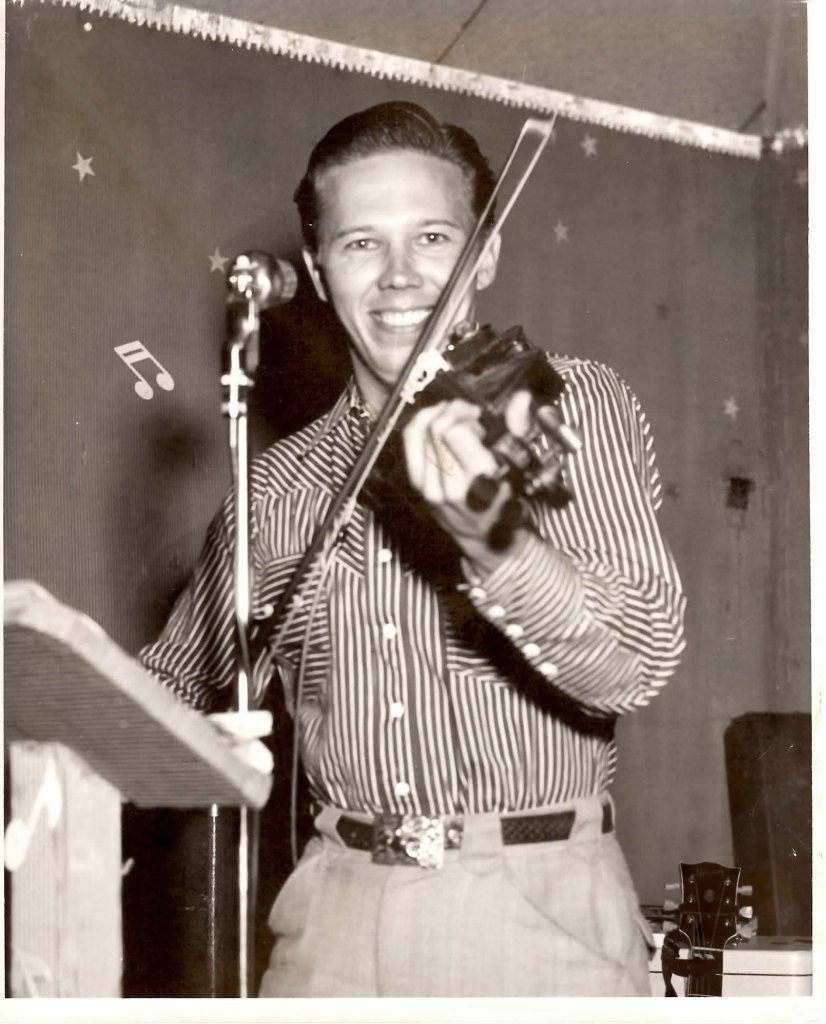
Johnny Strawn, around 1948, Fort Worth, Texas

My grandfather, John Henry, walked to his job at the furniture shop. Years ago, the same place had closed down, driven by the Depression, forcing him to move his family to California for work. Now, twelve years later, he has taken giant steps back, from a good job in Los Angeles to once more building furniture for an hour’s wage. Defeat weighs heavily in his heart. Middle age has come, and the future is murky. So, doing what men do, he keeps walking, counting his steps to nowhere. There are many to blame, but he alone bears the burden of his failures.

The iced ground crunches under his shoes. The cold goes to his bones. His jacket is no match for this weather. He favors the feel of the ground beneath his feet over the Ford sedan in the garage, which is idle most of the time and now a home for mice and other wandering critters.

After the upsetting homecoming with his father, Johnny walked a few blocks to the small neighborhood grocery store to call his best friend, Dick Hickman. His father remained firm in his decision about the telephone, vowing to never have one in the house. The old man viewed the contraption as a rattlesnake in a bag. Lousy news reached him in time enough; no reason to expedite misery.

Two sisters from Germany ran the store, always open, even when the ice storm howled outside. They preferred work to idleness; a dollar was worth more than knitting by the stove. They missed their homeland, but not the darkness that had settled under Hitler’s shadow. Johnny walked in and felt the warmth; they had known him since he was a boy. Following a few hearty hugs and cheek kisses, he was offered a mug of coffee, hot and strong with bourbon and a hint of cinnamon, a taste of what once was.

Dick and Johnny had forged a bond on the playground one morning; Dick was trapped by older boys, their intentions were dark, and Dick knew he was in for a ruckus. Johnny, a full head smaller than Dick, added his small fist for ammunition. A few busted lips and a bloody nose ended the altercation, and the boys would be bound for life by bloody noses and skint knuckles.

Dicks mother, a woman of stern Christian resolve, lived simply, her heart full of faith. Father Hickman was a ghost of a man, suddenly appearing from nowhere, then off again to somewhere. Mother Hickman, as she was called, gave what little extra money they had to Preacher J. Frank Norris, the charismatic leader of the First Baptist Church of Fort Worth.

Nice clothes were a luxury during the Depression, and most children at R. Vickery’s school wore hand-me-downs or worse. Dick wore the yellow welfare pants distributed by the Salvation Army, a sign that his folks were poor. Mother Hickman saw nice clothing as a sign of waste, except when it came to her Sunday fashions. Johnny had a pair of those detestable canvas pants but refused to wear them; the old dungarees with patches did just fine.

Both boys felt the weight of loss when the Strawn family left for the promised land. They exchanged a few postcards during the years in California. Nevertheless, they adhered to the unspoken rule that young men did not write to one another. This was a relic of manly notions of the time. A line or two every six months was enough. Both joined the Navy around the same time, meeting briefly in Pearl Harbor. Then came the seriousness of war. Young sailors, they carried on.

Dick arrived at the two sisters’ store to fetch Johnny. His transportation was a rattle-trap Cushman motor scooter. It refused to stop on the icy street. The scooter slid on its side into the curb and threw Dick off of the beast. The ride to Dick’s apartment was a jolt, far worse than the taxi. Johnny vowed to buy a car when the weather cleared, maybe one for his buddy, too. He held a tidy wad of cash from Hawaii.

A brotherly deal was struck. Johnny would share Dick’s large apartment on Galveston Street, splitting the rent and bills evenly. They were friends again, but now men, and they had different thoughts, dreams, and needs. Dick was courting a young woman from Oklahoma and doing a miserable job of it. Still, marriage lingered in the air, heavy like the rich aroma of brewing coffee, the kind they both drank too much of. Dick took his poison with cream and sugar; Johnny preferred his black and strong.

Johnny’s goal was to play music for a living, and this was the right city to make that happen. He joined the musicians’ union and sent a message to Bob Wills that he was back in Fort Worth.

Wills was now the celebrated band leader of the western swing band, The Texas Playboys. He remembered that meeting at the radio show in Bakersfield, California, long ago. The boy stood out. It was no small feat because Wills was the finest fiddle player in country music.

Bob Wills was not a man known for kindness. He could be brash and indifferent to fans and bandmates alike. Yet, for Johnny, he made an exception. Bob took the young man under his wing, becoming a mentor to my father. A few calls were made, and the boot was in the door. Johnny secured auditions at some of Fort Worth’s best clubs, and each went well. Bob invited him to rehearse with the Playboys. It was there he met men who would soon be legends in country music. A few years later, he would find himself in that circle.

Uncovering Family Roots: My Journey with Ancestry.com


That’s Funny…You Don’t Look Like An Indian

I celebrated my birthday a while back, and my sister gifted me with an Ancestry.com account. For years, I have been curious about where my family roots sprouted from and who they really are. I knew about the crazy aunts and rowdy cowboys in old Fort Worth, but was interested in the other gray ghosts from the family’s past.

When the kit arrived, I spat into the tube and sent it away. A few weeks later, I received the results via email. It was not what I had expected.


I look like an Indian, and my mother looked Indian, as did my grandmother, who was an American Indian of some importance. She grew up on the Cherokee reservation in Oklahoma, making Buffalo hide clothing and sleeping in a tepee. She was also more than friends with the famous Chief Quanah Parker. My mother told me that Grandmother and Quanah walked in the misty moonlight by the shores of Lake Minga-Minga more than once. So who is to question that? Ancestry.com, of course. They say I am a full-bore European from bonny Scotland. Not one mention of my Native American genealogy. Furious with the outcome, I call Ancestry and give them a piece of my mind.


I ranted a bit about this and that and how wrong they are. Then, the kind lady told me that Native American heritage is almost impossible to confirm because the tribal councils refuse to comply with DNA testing and release records. She assured me I was an Indian and could go on acting like one if it pleased me. I am better now.


I am pleased to let my family and friends know that I am still related to Belle Starr, Chief Quanah Parker, Chief Grey Squirrel, and Dancing Rain Doe. Our Cherokee heritage is intact, and our war bonnets fly in the wind.


The best part is that as a kid playing cowboys and Indians, I always played Tonto and can now prove I was a real Indian. As Chief Dan George once said, “May the wings of Eagles carry you to a peaceful land full of fat game and cold beer.” Kemosabe.

Father Frank’s Drive-Through Blessings: A Lenten Tale


I’ll Have An Order Of Fries With My Blessing

On Ash Wednesday, I made a somewhat firm decision to give up my beloved Cheetos for Lent. Last year, it was Ding Dongs and Pepsi Cola, and I wound up eating Twinkies and Dr. Pepper after three days, when I fell off the Lent wagon. At least, I stuck with my original plan. 

On my way to see Father Frank, my priest at Our Lady of Perpetual Repentance, I stopped by Walmart for one last Cheetos fix. Standing in line at the checkout, I noticed shoppers with a tiny ink cross on their forehead. Odd. Then, I saw the lady behind me sported a small “Pokemon” sticker on her forehead. She noticed I was staring like a goon and said, “our priest ran out of palm ashes, and this was all he had left. It’s the blessing that counts.” Well, she had a point. When the Holy Father runs out of blessed stuff, he has to make do with available products. 

I headed over to the church, finishing my bag of Cheetos and hiding it under the seat like a teenager does a beer can in the family car. 

Two blocks from the church, the traffic was hardly moving, and I think business must be brisk for the good Father. 

As I inched closer, I saw Father Frank standing at the curb, giving his blessing to the car’s occupants, leaning through the windows, and marking their foreheads. The next car up followed the same protocol. He ran cars through the line like a good day at McDonalds. Then it dawned on me: Father Frank was offering take-out Lent blessings to our flock. What a novel idea, so 2025. 

I pulled up to his curbside church and rolled down my window. The multi-tasking Priest handed me a pamphlet with a prayer, crossed himself, and touched my forehead. ” Go in Peace, my son,” he muttered and gave me the peace sign. “Sorry about running out of ash,” he said.

 ” Back at, you, Father,” I responded and drove away.

When I arrived home, my wife asked me where I had been for so long. I explained the trip to Walmart, the Cheetos binge, and then Father Frank’s take-out Lent blessing and such, thus the extended time frame. She was staring at me like a goon when she asked, ” did you find anything at the garage sale?” 

” What garage sale?” I replied.

She reached up to my forehead and pulled off a small round orange sticker with $1.00 written on it. 

The good Father has to make do with what he has available. It’s the blessing that counts. Right?

The Legend of Little Audie Murphy: A Pig’s Heroic Journey


The farm. Santa Anna, Texas. July of 1955. My two uncles, Jay and Bill, need more to occupy their time. I need them away from me. I’m a six-year-old kid, and their influence is ruining my childhood. They told me Howdy Doody is not real, Santa Claus is dead, and Captain Kangaroo hates kids. I cried for days.


The chaw of Red Man chewing tobacco behind the smokehouse was the last straw. Seeing a kid puking for two hours seemed funny to them.


My grandfather told the two grown kids that a man in Coleman has a pig that won the ” Purple Paw” award. Every year, the governor of Texas bestows the prize on an animal that has performed a heroic act. Who knew there was a hero nearby?


Of course, my two uncles have to see this pig, so they head for Coleman with my cousin Jerry and me in tow. Arriving in Coleman, we stop at the feed store for directions and a Coke.
The owner tells my uncles to be very respectful of the pig since he saved the farmer and his family’s lives. In appreciation, the farmer named the pig “Little Audie Murphy,” after the famous World War 2 hero and movie star. I am more than impressed. This pig is the real deal.

Arriving at the farm, we are met at the gate by the proud farmer. My uncle Bill has a $10.00 bet with Jay that this is a load of bullcrap. They never stop.

Jay wants to hear the pig’s story, so the farmer is more than happy to recount.

The farmer takes a chaw of Red Man and begins, ” I was plowing one day, and my old tractor hits a stump and tips over, trapping me underneath. I’m yelling for help for an hour, and finally, my old pig shows up. The pig grabs a timber and scoots it underneath the tractor, then stands on it so’s the tractor tilts up, and I can scoot out. That porker saved my life.”
I can tell by the look on my uncle’s faces that they think this is B.S.
The farmer continues, ” about a week after that, I’m in town at the domino parlor, and my house catches on fire. My wife and kids are knocked out by the smoke, and the pig pulls them out of the burning house and revives them—a true porcine hero, that pig.”
Now my uncles are impressed. I see a tear trickle from Bill’s eye. I got a lump in my throat.

At this point, we want to see this pig for ourselves, so the farmer takes us to the barn. He stands outside the corral and yells, ” Little Audie, come on out.”


A huge Yorkshire pig wearing a ribbon and gold medal around its neck makes its way out of the barn. I’ve seen pigs before, and this wasn’t any normal pig. He was missing an ear and a front and back leg. Where the legs had been, the pig now sported a homemade wooden prosthesis. He seemed to walk fine and was friendly.

My uncle Jay was shocked and asked the farmer what the hell had happened to the poor pig.


The farmer took a minute to answer that question. Then he smiled and said, ” well, a pig this special, we can’t just eat him all at once.”

The Dreaded Report Card


by Phil Strawn, based on personal experience

There is a school system on the East Coast that is changing its grading system so every student can “feel better” about themselves. This smells suspicious, and is likely extracted from the same rotten education bag as  “everyone gets a trophy.” Every letter grade is now lowered by five points, promoting a grade of “C” to a “B” and so on. Who benefits from this PC madness?

From personal experience, I can tell you that bringing home a low grade on your report card does have negative consequences. The younger you are, the fewer repercussions from your Mother since you are still her baby. As you age, the fear factor increases.

There is nothing that scares a kid more than bringing home the dreaded “F” or even the slightly better “D.”

You slow-walk your way home, looking for every excuse to prolong the firestorm that the small piece of cardboard will create. You’re begging God to intervene and miraculously change that red “F” to an acceptable, blue “C.” Nothing changes, and you accept your fate. God is likely a teacher on the side. With the end nearing, I take a moment to notice the blue sky, the chill of autumn in the air, and the singing of the birds. Even the neighborhood dog that always gives chase sits with sad eyes as I pass. Little things that may be my last moments of life.

With a cheesy fake smile on my face, I hand the report card to my mother, hoping for leniency.

Everything is fine until she sees that miserable sixth letter of the alphabet. Her happy smile fades, and her squinty-eyed mom’s stare paralyzes me.

My young life flashes before my eyes; I’m a goner. In desperation, I blame everything except my own stupidity. I fall to my knees, crawling across the kitchen floor, squeezing out fake tears, begging for forgiveness. She has none of it. The mom court is adjourned. I await my sentence.

Short of having my butt whipped with a Tupperware cake holder, or being sent to the “Dope Farm,” my mother’s go-to threat, I get off well and alive. I cannot watch cartoons for two weeks, play outside for a week, have Hostess cupcakes and Ovaltine, or play Saturday baseball for a month, which is alright; it’s winter, and I am in hibernation mode.

My next report card showed a vast improvement—not one failing grade. The specter of personal failure and my mother’s watchful eyes loomed large, shaping my educational journey. It’s a curious thing, our human desire for high marks—some students hustle and toil beneath the weight of those lofty expectations. But if we lower those standards, those who might shine will find themselves unfairly penalized, while those who merely coast by will come to view diligence as a nuisance.

The Rise Of The Teenage Techno-Zombies


It’s not a real word, but it should be.

I wrote this story some years ago, but I realize it’s as relevant today as it was then, perhaps more.

Recently, Momo and I were standing in a rather long and slow line at a sandwich shop during the lunch hour. We were treated to the bizarre and ridiculous behavior of three millennial teenage women. I hate the term “millennial,” but I guess it’s better than calling them dumb as a bag of rocks, little twits.

Each girl had a cell phone in their hand, tapping away. The man in front of them placed his order, then continued tapping away on his phone. The guy taking his order had his phone in hand, tapping and waiting on his customer. The people behind us were tapping on their phones. Looking down the line toward the checkout, everyone was looking and tapping on their cell phone. This could have been a good “Twilight Zone” episode if Rod Serling had still been around.

I focused on these three and realized they were texting and sending messages and attachments to each other. There was no talking, just communication over the airwaves, mind-melding like Spock. One girl giggled, asking her friend,” Did he really say that to you?” Her friend giggled back. It’s odd how young women communicate with each other. Giggles, tongue clicks, half-spoken words, broken sentences, rolling of the eyes, flicking of the hair. It’s a secret language.

I watched them eat their lunch. All three are eating and tapping away on that damn device. No one looked up or spoke except to take a bite of a sandwich. Then, head down, continuing to tap-tap. Complete social breakdown. I wonder if they can write in cursive? Or do they print like most young people? Cursive is “our language”. Old timers know the value of the free-flowing wrist and a beautiful writing instrument, transposing our thoughts onto paper. These young ones just tap-tap-tap.

I shouldn’t be so hard on this twenty-something generation. After all, I am writing this on a laptop.

Speak A Little Louder, I Can’t Hear You


Old man finishing off what hearing he has left…

I visited my Ear, Nose, and Throat doctor today. He wasn’t in the office, so I saw his PA. She escorted me to an exam room, and two techs checked my old ears for wax buildup and performed several tests by blowing air and a vacuum in both ears. Then, the PA took a microscopic robot thingy and stuck the device in both ears. When someone says, ” Hmm, oh my,” that gets my attention. Medical people have their own language. I should know; Momo is one of them. They use big words and have a secret handshake. She knew the gal from her hospital days; they hugged and did the handshake, then said some big words about my condition. When they got around to the hearing test, I was a nervous wreck.

The hearing test was easy: sit in a sound booth with headphones and a little button to push when you hear a beep. I sat there for a while in silence. Finally, I asked the tech when the test started. She said it started ten minutes ago. I failed miserably; I can’t hear jack shit, deaf as a cave-dwelling Salamander.

The PA showed me the results. She and Momo used some bigger words to describe my condition. Almost deaf in the left ear and coming up fast in the right one, my good ear.

” Doc, isn’t there anything you can do, like a transplant or a microchip or something?” She did that hmm thing again and told me to start learning sign language, stat. Crap, I’m going to be like Helen Keller, deaf and mute; it all goes hand in hand. First, the ears go, then the speech, then I’ll go blind and stagger around the family Christmas dinner, grabbing fist fulls of food off my relative’s plates. And to top it off, the PA says folks with severe hearing loss always get Dementia. So I’ll be deaf, blind, and mute, sitting in a chair with a drool sponge under my chin, and Momo will have to pull me around in a Western Flyer wagon. There has to be a better way to checkout.

I didn’t know that back in the day, standing in front of a Fender Duel Showman amp playing rock music at incredible decibels would destroy my hearing? Hell, I was sixteen and heard everything just fine. Alice Cooper once said that rock music will get you, one way or the other. It took a while, and I didn’t learn my lesson; I spent another twenty years doing the same thing in the 2000s. By the end of my tenure in the American Classics rock band, all of us were almost deaf.

The good news is that these new hearing aids have Bluetooth and Wi-Fi. I can talk on my iPhone hands-free, check my voice and email, listen to my stereo, tune into Police radio, listen to air traffic control, hack other folks’ hearing aids, and listen in on their conversations. It also checks my vital signs and brain function and sends reports back to my doctor, and I can still play music with my church praise band. Who knew going deaf could be so interesting.