Tall Tales and Ripping Yarns from The Great State Of Texas
Author: Phil Strawn
I'm a 7th generation Texan and write about growing up in this great state. Tall tales and ripping yarns are what Texas is about, and I will oblige my readers with these. Most stories are true, some are a total fabrication, and others are a bit of both.
Now the “Rona” has ruined Thanksgiving and is well on the way to destroying Christmas. Santa is no fool; that flimsy mask will not protect him from the vile germ that inhabits every surface in our homes. God forbid he drinks that warm milk and eats those germ-infested homemade cookies, and then brushes against that hot zone of a tree. He won’t last the night, and millions of children will be left presentless.
Our large cities, New York, Chicago, and others are adding Thanksgiving dinner to their list of hit crimes. A family can’t commune and break bread together or go to church on this peaceful day, but a family can have a funeral or go to Walmart or a strip club. How considerate is that?
This year, I will post in the local obituary that our family is mourning the loss of an esteemed member, Thomas Fowl. Visitation and the funeral service will be at our family home on Thanksgiving day. Out of respect for poor Thomas, the family and friends are requested to bring a side dish of comfort food for the attendees. Thomas will be laid out for viewing on a beautiful china platter with all the trimmings. A toast of good wine will be made in his honor. The governor is invited to attend if he pleases. Happy Thanksgiving, one and all.
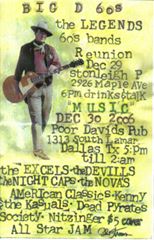
A poster I came up with for our 2006 Big D 60s Legends concert in Dallas. The cream of the crop rock bands from the 60s came out to play one more time.
I haven’t heard a word from my old pal Mooch in over a month, so I dropped by his house yesterday. The older than dirt Dodge pickup sits in the drive, and his lawn was knee-high, so I figured something is not right. Mooch loves his yard like it was his child.
Five minutes of door banging, and Mooch cracks the door and says, “go away, I don’t want any of it.” ” I’m not selling nothing old buddy, what the hell is going on with you,” I say. He opens the door enough for me to get a good look at him, and holy crap, he looks terrible. A white beard, hollow yellow eyes, and a pale complexion. Not the fit and the tanned man that I know.
” I’ve been out of town for a while,” he says. “The wife and I heard that them Antifa folks were paying people to protest and riot, so we went to Portland for a while. We figured, why not, somebody’s got to get paid and it might as well be us. Old peoples got to eat too. We made $3000 a week plus room and board at the Holiday Inn. If we got arrested, there would be an additional $2000 a week for jail time. I made enough to buy a new pickup next month.”
” Where is your wife, Mrs. Mooch,” I say. He looks down at his shoes and mumbles something. I ask him to repeat it. He sort of shifts around and says,
” I left her in jail for a while longer. I figure another month, she will have made enough money and we can pay the house off.” When I return home, I ask my wife if she would consider a visit to Portland.
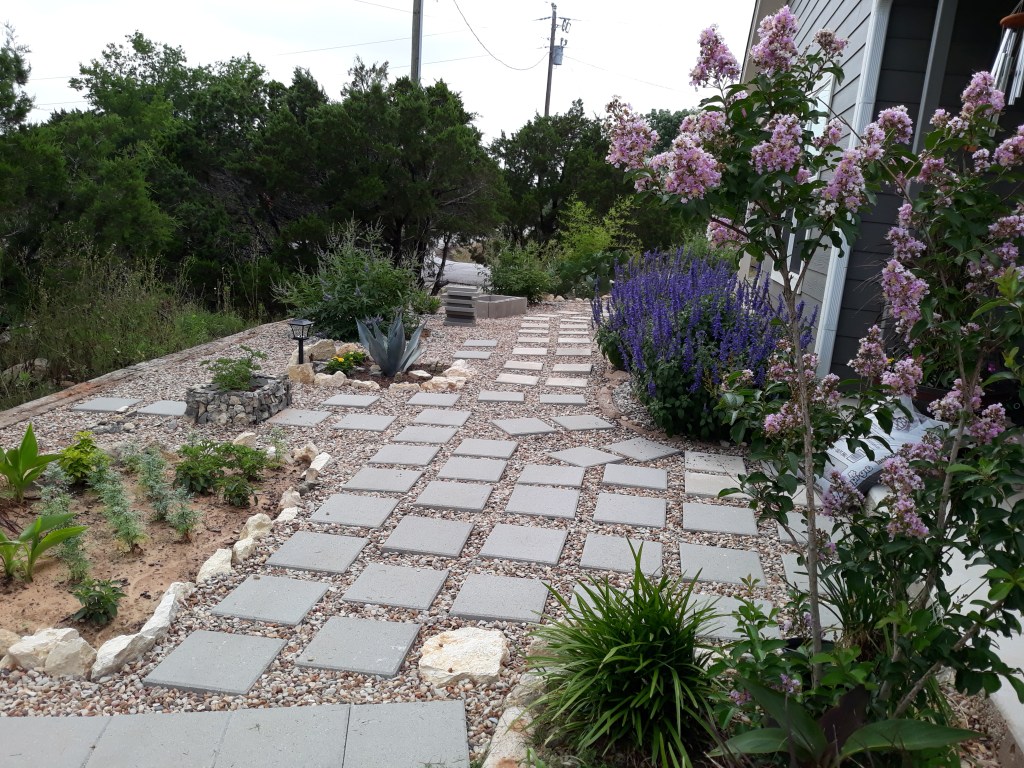
When my wife and I purchased our home, it was newly built. Sitting on a rocky hill facing Comanche Peak, the beginning of the Texas hill country, it was the perfect size for us, and the view was beautiful. The exterior was dirt and rock, a clean slate for a landscaper/ artist. That is how I see myself these days; or did for a short while.
A railroad tie retaining wall was added and backfilled, then dirt for a backyard, then 4 pallets of grass, then more dirt, then a 12 yard load of 1 inch gravel, then 6 yards of decorative pea gravel and I wasn’t even close to installing plants. I should probably mention that I was going through radiation treatment for cancer at the time I was doing this task, and my wife Maureen was working as a nurse here in Granbury. I was trying to get as much done before the high dose radiation kicked my ass, and by some miracle, I succeeded and then collapsed for a few months to recover. The ordeal was only beginning.
Our intent was to install as little as possible, using gravel, rock and native Texas plants to save water and time. The less maintenance the better as you age, but, somewhere during the process, my OCD Artistic Creative gene kicked into full gear. I was helpless and my body went with the flow. There was no sleep; only nightmares of plants multiplying and gathering for a siege. I am the Alamo, the fauna is the army. Every waking hour was spent spreading gravel, digging holes, wrestling with unruly petulant plants and dangerous cactus. I was a slave to the land, and could see no reprieve. By this time, the radiation was taking it’s toll on my body. I looked like Betelgeuse on a good day.
My wife suggested counseling, so I called a local radio plant show, the Dirt Doctor. He told me I was a sick puppy and to sell the house and move or I was going to collapse and expire while holding my Craftsman shovel. He happened to know a guy that would give me a good price. Right?
I called my famous friend Dr. Wu. He suggested I come in for a series of acupuncture treatments and Chinese meditation to rid me of my plant based demons. Neither one did any good. I was still as possessed as Rasputin and the siege of the greenery advanced. I tried to ignore them. It didn’t work. The plants, still in their plastic pots, sent telepathic signals to my tortured brain. They were making a pod person of me so the landscaping could continue when I stroked out.
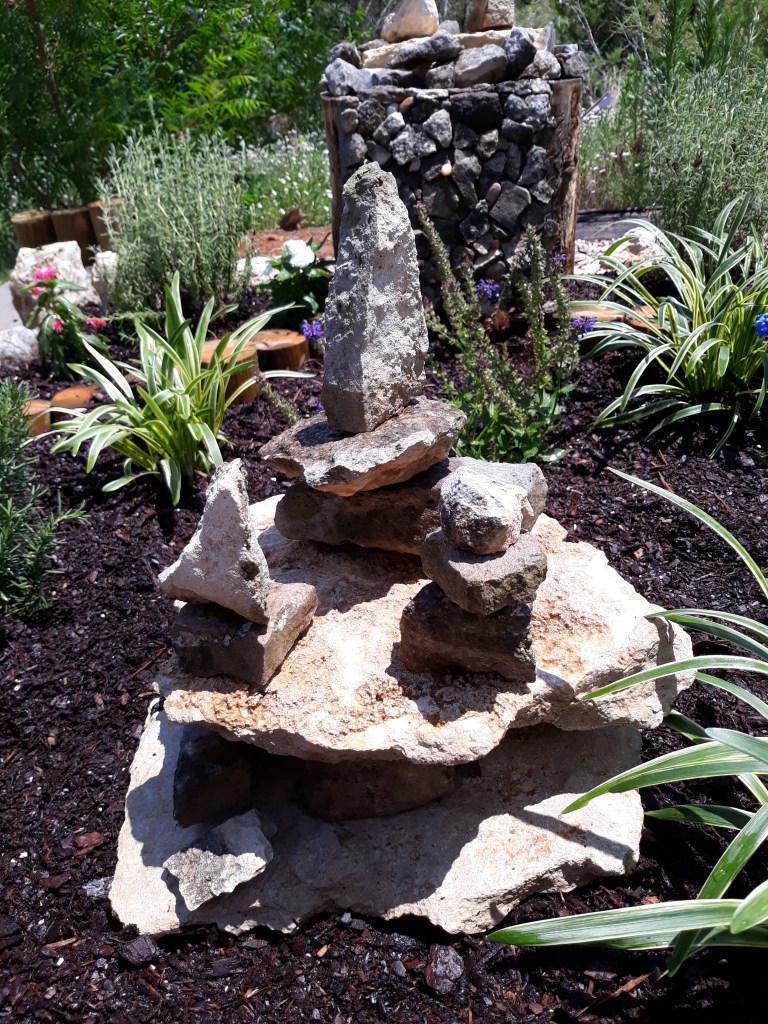
Six Chaste Trees, multiple cacti, Oleanders, Texas Sage, Lantana, flowers, more cactus, Agave’s, Salvia, more cactus, more gravel, rock retaining walls, 100 bags of top soil, large rock stacks and sculptures, bird feeders, Canna’s everywhere, stepping stones to nowhere in particular. A landscape vision out of control. And then, for no apparent reason, we constructed a raised garden using concrete block and 50 bags of soil. The garden didn’t do squat. A few tomato’s, some cucumbers and some okra. It’s back to H.E.B. for veggies.
More later, the remaining plants are knocking on my door and staring into my Ring Doorbell.
This past year or so, I noticed that phone calls from friends and family had dwindled drastically. Not that they were that frequent in years past, but now, the calls have almost ceased. The holidays count for a few, and if there is a surgery or accident, that will bring one or two sympathy or curiosity calls.
One can assume that as you age and become a seasoned person, your friends and family are in the same boat, and you can talk about medical issues and health only so much before your head explodes. My sister, bless her heart, does call every few days to chat about nothing in particular, but she is down from four dogs to one and is easily bored. She watches a lot of Netflix.
My multi-tasking son rarely calls. He lives in North Padre Island, by the beach, surrounded by an impressive collection of “man toys.” He and his wife own a business that keeps them hopping, so I get it. The rest of his time he divides between Cub Scouts and baseball games with my grandson. He is a busy young man and appears to have broken all his fingers on both hands, or lost my phone number. I am considering sending him an amazon package with my picture and a burner cell phone.
My generation X grandson keeps in touch via text, the preferred form of communication for people in their twenties. Sometimes he will answer his phone, and it takes me a second to remember his voice. He sounds much like his father, who passed away seven years ago, and if I am melancholy, it unnerves me a bit, so texting is alright for now. As he ages, actual speaking will replace texting.
My late-late mother, ever the geriatric comedian, in her golden years, remarked on how lonely life can be, and she wouldn’t have anyone to talk with if the telemarketers and scammers stopped calling. I laughed at how ridiculous that sounded, but alas, I may be in that same position.
Medicare enrollment is upon us with a vengeance, and I receive a dozen calls a day, most of which my spam app catches and disperses them back into cellular orbit. I did answer one a few days ago because it displayed a number with fourteen digits, and I was curious who has that many digits. What the hell, have some fun.
The youngish man on the line started his spiel about Medicare, and I could tell he was either “in” or “from” India. I listened for a minute then asked him where his call center might be? he answered, ” Indiana.” Then I asked his name, which he replied, ” Ronnie.” I politely told him that was bull crap, you are in India, and your name is not Ronnie.
He was busted, so he fessed up. Speaking in a pleasant accent, he said, ” yes sir, I am in India, and my name is Aakash. I work at the call center for American Exploitive Insurance.” He seemed like a polite young man, so I continued the conversation. “Tell me, Aakash, do you have Netflix and Amazon Prime in India, and if you do, have you seen Jack Ryan and The Kaminsky Method ?” I enquired. He was quiet for a few seconds then responded, “yes, we have those, but we watch only Bollywood movies here. Our movies have much drama, love love, and shooting guns, then everyone dances and sings happy songs. It’s joyously entertaining. India is a happy place, mostly.” ” And what do you mean by mostly?” I say. I could sense his hesitation and the frustration in his voice, but he needed to vent to someone, and I am three-thousand miles away, and that’s as safe as it gets.
This young telemarketer begins spilling his guts to a stranger, in America, over the telephone, hoping to receive a form of absolution from a non-Catholic, even though I am wearing a black t-shirt and eating Mrs. Pauls fish sticks for lunch so that counts for something. Speaking in a comforting voice, I urge him to continue. He lets it all hang out.
In a desolate cracking voice, he wails, ” my girlfriend lives with me in a tiny, tiny, tiny apartment, and all day, she plays this Brittney Spears person’s records and dances about like a hoochie lady. It is making me a crazy man. Last week for the evening meal, I try to make American Texas Terlingua chili using Indian spices and goat meat, and it gives us both the running bathroom visit for days. We have more nuisance monkeys in our neighborhood than residents. The little mean shit animals dismembered my moped, and then they break into my apartment and eat my James Taylor albums and raid the food closet leaving my home a mess. I have no gun, so I can’t shoot them dead; the mean monkey has more rights than me. I have applied for citizenship in your country, but it takes two lifetimes. I have four degrees from a university but make little money. My life is a hot fresh cow pie residing in the middle of the road.”
I am bewildered by his predicament but yet amused at the absurdity of it all. We exchange pleasantries, and I tell him to call me again next week for another chat, to which he agreed and wished me well.
Who knew telemarketers could be so exciting.
A perspective and opinion from a proud Texan. I’m not sure what is going on with WordPress, but I am re-posting this. The first post was an un-edited version. My apologies to my readers. I blame ” The Rona.”
Dazed and Confused ?
The death of George Floyd is a turning point in our United States of America. I have heard many times from mystic sources of the unknown, that “out of tragedy comes good,” but not always. I believe Churchill spoke these wise words, but it may have been the captain of the Titanic, or perhaps William Travis, and we all know how that ended for him.
The weeks of peaceful protest is gone. We now have groups of anarchists that hi-jacked the Black Lives Matter movement for their use.
America’s soft spongy underbelly lies exposed while thugs and criminals lay waste on our cities and society. Parts of our pristine city blocks look like a war zone. Protesters, bystanders, and business owners that wish to make their point peacefully are attacked and beaten by the infiltrators if they intervene. These hoodlums even had the nerve to destroy and loot a Starbucks in Portland.
It’s a tough pill to swallow when the people that want and need the change in our police departments and city governments or the ones seen on television carrying a shopping cart full of flat screens or a pair of $600.00 Nikes from a looted store. Nothing builds the bridge of peace and brotherhood like looting.
In Austin, Texas, the capital of my home state, a black American capitol policeman, was mobbed and attacked by a group of “keep Austin weird” type of folks. My apologies to Austinites that do not wish to stay weird. They appear, on television, to be young, white, and likely students from our prestigious University of Texas, and they are damn lucky they weren’t shot. Knowing UT, I’m sure there were a few Antifa kiddies in the group to add flavor and support. One can assume that the food trucks on South Congress didn’t do much business that day. All there customers were busy at the capital.
My parents taught me a valuable lesson when I was a young’n. You don’t assault a police officer: in any way, or it is likely to turn out bad for you. Do these young people not have parents to teach them right from wrong? The “everyone gets a trophy, and I want it for free” generation has a lot to learn.
Thank you, Austin, for showing us what you are, pulling back the tye-dyed curtain for us to see the wizard. The “hippy-dippy live music capital of the world persona” you have pushed for decades has soured and gelled into a smelling heap of Whole Foods dumpster refuse. I have friends that live in Austin, so this doesn’t include them unless they were at the dust-up, as mentioned above.
“Keep Austin Weird” was once a fun slogan that the city was proud of owning. I wonder now if that slogan is appropriate? God Bless Davy Crockett and The Alamo.
I have lost count of my days in this government-induced social distancing hysteriademic-in-home prison sentence. Being confined to the cactus patch has made it bearable to a point, but then on some days, I want to run screaming down the county road that runs alongside our home. Our local sheriff, a nice young man, would find me and be obliged to return me to my wife. He’s a youngster, but astute enough to know that old people can go batshit crazy at any time. They don’t need a jail, just a bowl of corn flakes.
It’s been eight weeks since my last haircut, and I can, if needed, pass as a 1970s televangelist or a former musician at Woodstock. I considered asking my grandson to assist me in starting a Youtube channel with a donation button and deliver deep-daily thoughts to the confined masses. I have the required icky look but don’t possess the lack of morals it requires to rip other old people off. So I watch pap on Amazon and Netflix instead.
I have turned into that old guy that sits by the window, awaiting the postman to deliver his junk mail and utility bills. At my age, even grocery store flyers can lend some comfort. It’s quite exciting when you get a coupon for buy one get one free.
The nice young man in India has stopped calling me about my automobile warranty, and the fraternal order of the Hood County Police knows better than to ask me for another donation. My wife has baked every pie and cake imaginable and a few days ago made a banana pudding that would send Aunt Bea to the woodshed.
Young folks are whining and gnashing about being confined and missing their friends and graduations and parties and all that their age group does. Cry babies and pansy asses. They have years ahead of them when things return to normal. So shut up and do your homework on your laptop. And get off my lawn. I hope this mess ends before I do.
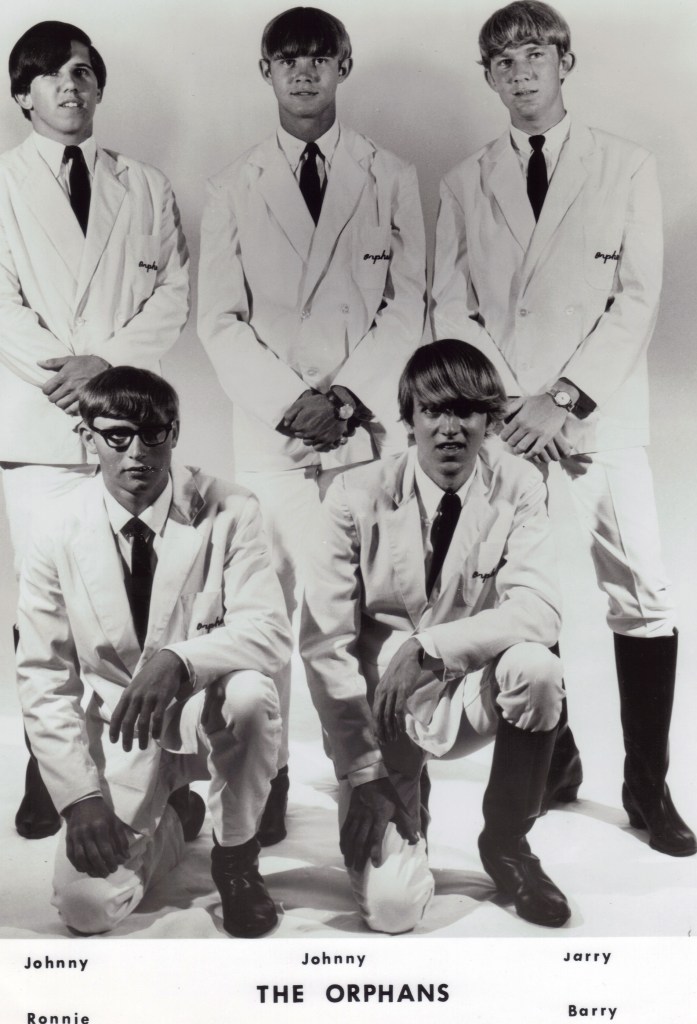
The Orphans 1967. L to R: front-Danny Goode, Jarry Davis, Marshall Sartain, rear-Barry Corbett, and Johnny Strawn
From the Dolphins to the Orphans and then ATNT, Johnny Strawn was a key player to the Dallas music scene in the 1960s. Though still currently performing, Johnny looks back at the time spent in his early bands as “absolutely the best time of my life.” Here are his recollections.
An Interview with Johnny “J.P.” Strawn A Key Contributor To the 60’s Garage Band Days in Dallas, Texas.
[Mike Dugo] How did you first get interested in music?
Johnny Strawn: My father played with the Light Crust Doughboys and Bob Wills in the late forties and through the fifties. I grew up with western swing, jazz and country music, as well as a good dose of the musicians that played it. My father tried his best to discourage me from playing an instrument, but when he realized I just wanted to have fun, and it was ingrained in me, he taught me a few chords on my Gibson J45, and I was hooked.
[Mike Dugo] Was the Orphans your first band?
Johnny Strawn: My first band was The Dolphins, formed around ’64 in Plano. We were together in different forms until we morphed into The Orphans in late ’65.
[Mike Dugo] How did that come about?
Johnny Strawn: Jarry Davis, Barry Corbett and myself formed the original band with a bass player and keyboard player from McKinney Texas – Ronny and Johnny; I can’t recall their last names. We were pretty good, did mainly the top 40 stuff you heard on KLIF and KBOX.
[Mike Dugo] What about the later line-up?
Johnny Strawn: The final version of the 1967 Orphans was Johnny Strawn, vocals and lead guitar – Jarry Davis, vocals and rhythm guitar- Danny Goode, lead vocals and bass – Marshall Sartain, vocals and keyboards- Barry Corbett, vocals
[Mike Dugo] I’ve been in contact with James Goode, whose brother, Danny, was in The Excels with him. I assume this is the same, Danny?
Johnny Strawn: One and the same. Danny did play with the Excels in the early sixties. There was a whole group of musicians from McKinney that played in quite a few bands. Danny and James of course, Billy and Donny Cave, Don McCutchin, Gary Crawford, Joe Copeland, Don Davis, Danny Haynes and others I can’t remember. Plano and McKinney fed off of each other for talent. Whenever someone left a band in one town, the phones started ringing in the other looking for a replacement. We all played together at one time or another.
[Mike Dugo] Where did the band typically practice?
Johnny Strawn: We started out in a vacant storefront in old downtown Plano. Jarry’s mother was a real estate agent and had good connections with the city fathers. She got us a building where we could leave all of our gear and practice anytime we needed. Plano closed the sidewalks at dusk in those days, so evening practice sessions were undisturbed. Most nights in the summer when we did practice, the main street would fill up with kids, parked and listening or sometimes dancing. It was a lot of fun – kind of like a country beach party movie. The only thing missing was the beach. After a while, it got to be a bit much for the city fathers so we turnedJarry’s garage into a studio with soundproofing and carpet.
[Mike Dugo] What type of gigs did you initially land?
Johnny Strawn:We started out playing parties, then school functions, then skating rinks, sock hops, teen dances and then clubs … pretty much in that order.
[Mike Dugo] How would you describe the band’s sound?
Johnny Strawn: Our sound was all over the place. Remember back then, you played a lot of dances, so everything you did was meant to keep them on the dance floor: Soul music, Beatles, Bee Gees, Rascals, Hendrix, Doors, Steppenwolf, Cream, Stones, Vanilla Fudge, Jefferson Airplane. We did a pretty good mix of tunes. We used to change costumes in between sets to go with the music. Jeans and such, then Nehru shirts and beads, then it got a little complicated after a while, and we had to have as much room for wardrobe as equipment.
[Mike Dugo] Did you play any of the local teen clubs?
Johnny Strawn: Oh yeah, we played them all on a regular basis. The Studio Club, LuAnn’s, Strawberry Fields, Phantasmagoria, The Cellar, The Box and some more I can’t remember in Dallas and other cities. We used to do a lot of double bills at The Studio Club and LuAnn’s; that was a big thing back then. I remember playing a lot of them with Southwest F.O.B. We were playing at LuAnn’s one weekend when during the Jimi Hendrix song Fire, our drummer put lighter fluid on his cymbals, lit his drum sticks, then hit the cymbals and ignited them. It got a little out of hand and it burned up his drums. That kind of stuff wouldn’t fly nowadays, but back then, we didn’t think of the repercussions. The crowd loved it, sort of like The Who, only with real fire and smoke. Miss Lou Ann was not pleased and banned us from the club for about six months. We eventually worked our way back into her good graces. Ron Chapman the famous DJ on KLIF and KVIL remembered us as the band that nearly burned down LuAnn’s. Some legacy.
[Mike Dugo] How far was the band’s touring territory?
Johnny Strawn: All of Texas, some of Oklahoma. We didn’t go too far from home in those days. Three of us were still attending high school so traveling during the week was tough.
[Mike Dugo]Did the Orphans participate in any Battle of the Bands?
Johnny Strawn: We did a few that I remember. One (was) at McCord’s Music, and one at the Arnold and Morgan music store. I remember The Dancing Bear, Us Four and maybe the Redwood Page (also competing). We won one of them but placed second at the other.
[Mike Dugo] How did you hook up with Mark Lee? I know he also managed Kenny and The Kasuals?
Johnny Strawn: Mark Lee heard us at the Studio Club and approached us. We signed a contract with him and, after that, we really started getting busy. We played every weekend and some weeknights I recall. He booked us to open for the Iron Butterfly at Strawberry Fields when they did their first tour. We were so stoked; we did one of their songs off the album. The song was Possession, I believe, and we really nailed it. They didn’t appreciate that, and to show us just how much (they didn’t), promptly relieved me of my Vox Wha-Wha peddle and our drummer’s velvet Nehru suit. A hard lesson learned by all. Mark put us up to it knowing it would torque the Iron Butterfly, and afterward, he just howled at the whole scene it created. He tried to see us perform as much as possible, usually at Studio Club or LuAnn’s. I’m not sure where Mark is these days or what he’s up to, but it would be nice to talk to him again. He wasn’t much older than we were – maybe mid-twenties or so.
[Mike Dugo] How popular locally did the Orphans become?
Johnny Strawn: Pretty popular. After signing with Mark Lee, we really took off. We were well known in Texas and Oklahoma.
[Mike Dugo] There was reportedly another local band named The Orphans. Did you ever come into contact with them?
Johnny Strawn:
No, we didn’t.
[Mike Dugo] Did the Orphans ever record any singles?
Johnny Strawn: We recorded a single in 1966 at Summit Sounds on Greenville Ave. The title was “Leader of My Mind.”I wrote the tune – kind of a Byrds’ folk-rock thing with harmonica. It got a little airplay locally and was on the Fashion label. We recorded another single in 1968 after we had changed our names to The ATNT. The title was “No One Told Me About Her” with the flipside of “Cobblestone Street.” Danny Goode, Barry Corbett and I wrote the tunes. The second disk got good airplay locally and in south Texas, but never made much money. It was also on the Fashion label. Artie Glenn and Smokey Montgomery produced both records. They also produced Paul and Paula and Bruce Chanel at the time.
[Mike Dugo]
Why did you change your name to The ATNT? What did it stand for?
Johnny Strawn: Jerry Deaton, a guy our drummer knew, wanted to manage us. We were happy with Mark Lee and turned him down numerous times. I guess he was a little sour about the deal and had the name “The Orphans” copyrighted, and then threatened to sue us if we used it. We liked ATNT {Alice talks “n” talks} and Jerry’s mother was the inspiration for that name. Later, we found out that he had managed another band called the Orphans for a while, so that was the reason for all the drama. He copyrighted the name so we had to change.
[Mike Dugo] Are there any vintage live recordings or unreleased songs?
Johnny Strawn: I still have a few copies of our second
record, “Cobblestone Street”; the first one I assume is lost forever. Barry Corbett, our late drummer, had some 8mm films and some live tape recordings, but now that he’s gone, they may be lost forever.
[Mike Dugo] Did the band make any local TV appearances?
Johnny Strawn: We did the “Mark (Marky Baby) Stevens TV Show” a couple of times over at the WBAP studios. All the film went with Barry. There may be some of that program in a vault somewhere. It was all lip-sync to your record.
[Mike Dugo] Why did the band break up in the ’60s?
Johnny Strawn: I was forced to leave the band over a disagreement with our rhythm guitar player. It was either study to pass my final exams in my senior year or practice. I had to make a choice, so I did. Pretty petty stuff really, but what do you expect from teenagers? The band stayed together a few more months after that and then broke up. Some of the guys continued to play with other groups.
[Mike Dugo] What about you? Did you join or form any bands after ATNT?
Johnny Strawn: I didn’t play too much until about ’74 when I became involved with the progressive country music scene in Austin and Dallas. I played with various people around town and some in south Texas and did some pick-up and studio work. I joined the Trinity River Band in late ’79 and played with them until ’85. I also played with The Light Crust Doughboys from time to time and did some studio work on the five-string banjo. I was fortunate to play on the Light Crust Doughboys album, ” One Hundred-Fifty Years of Texas Music.”
[Mike Dugo]What about today? How often, and where, do you perform?
Johnny Strawn: I am a project manager in commercial construction, and do a lot of painting and artwork – mostly Texas art. After 35 years, Danny Goode, who I played with in ATNT and the Orphans, called me and asked me to be part of their group, The American Classics. I joined them about two years ago and that’s what we do nowadays. The band consists of Danny Goode, bass and lead vocals; John Payne, lead guitar and keyboards; Jordan Welch, drums; and me on rhythm guitar and vocals. We play about once a month or so around Dallas Fort Worth, mostly private parties. We recently played in Deep Ellum, and will probably be back down there soon. We stick to mostly ’60s music – it’s what we know well. It’s good to still be playing rock music at this age. You really never outgrow it.
[Mike Dugo] How do you best summarize your experience with The Orphans?
Johnny Strawn: It was absolutely the best time of my life. How could you not enjoy being a teenager in the ’60s and playing in a popular rock band? The people we met and played with, the experience that we will all carry with us the rest of our lives. It was just a part of life that helped shape us into what we are now – being part of that change in our country, that decade. It was a time of turmoil, but it was also the last year of the innocence we grew up with. Teenagers these days are so hardened. The music then was happy and said a lot. It would move you, whether you played it or danced to it. The music now has a meaner, harder edge, and reflects the times we live in.
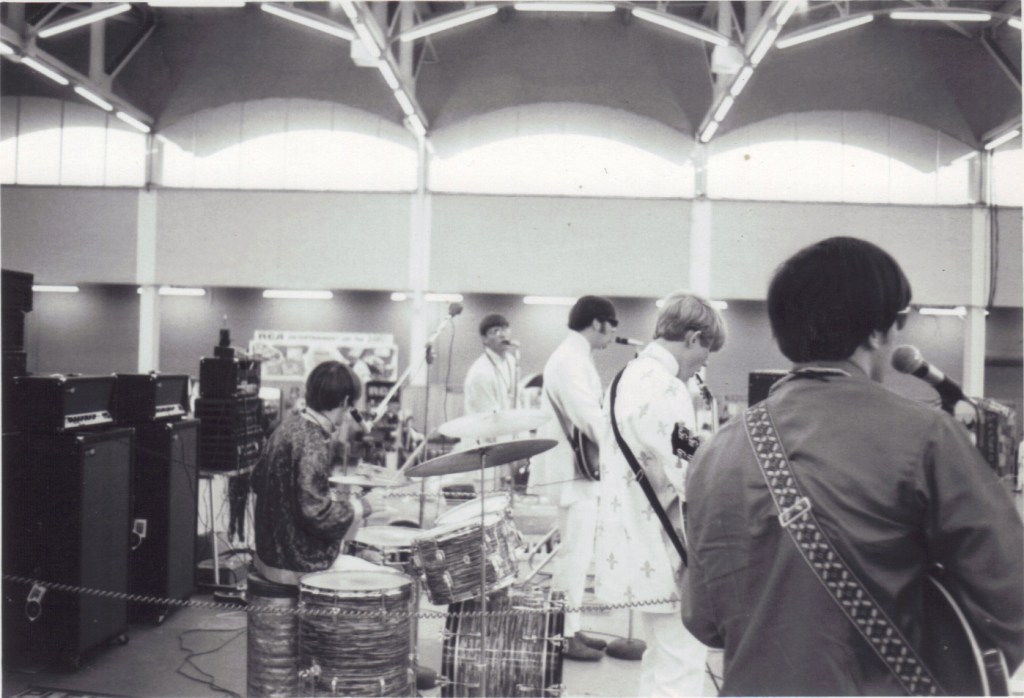
The ATNT playing Flower Fair 1968, Dallas Texas. Foreground: Johnny (Phil) Strawn, Jarry Davis, Barry Corbett (drums) Danny Goode, and Marshall Sartin
Big D 60s musical humans: My friend William Williams has asked me to scribble some text for his website devoted to rock bands in Dallas during the 1960s. To gather information for the text, I am circulating the following questions (and a few random thoughts) in the hope that they might spark memories and inspire participation.
In my view, the 60s did not “end” until about 1973, and in some ways, the period has never ended. Our “generation,” of course, faces the recurring question: Did the 60s seem such a unique period because of the sweeping social and cultural change of the era? Or was it simply due to our youth? I.e., might every generation feel that the world underwent some sort of major transformation during that generation’s “coming of age” or struggle to find/create its own identity? Or some combination of the two explanations?
On a separate sheet(s) of paper, answer as few or as many of the following questions as you wish. Email is okay, too, but printed on preferred. If you hate to type but want to respond, dictate your thoughts onto a cassette and send that. Also, feel free to provide answers to questions that I have not been alert enough to include here….
1. Q: Name.
A: Phil Strawn, but I went by Johnny Strawn back in the sixties.
2.Q: Instrument(s)
. A: In those days, it was strictly guitar, but later on I picked up five- String Banjo and mandolin.
3.Q: In what part(s) of Dallas did you live?
A: I was born, and grew up in Fort Worth Texas, but spent my rebellious and formative teenage years in Plano Texas. My family moved there in 1964 when there was only one red light in the middle of town and the Dairy Queen was considered fine dining. It was the only restaurant in town where your family could enjoy a deep-fried dinner and your dad (or mom) could burn rubber on your way out of the parking lot (after circling three times of course) and no one cared. In the “1964 Plano”, it was a blood rule, If you didn’t live and die football, you better mosey on over to Richardson or Dallas, where all the “city folk lived”.
4. Q: What band(s) were you in?
A: My first band was with a classmate, and friend, Jarry Davis, or “Jarry Boy” as his buddies liked to call him. We called ourselves, The Dolphins, or Blue Dolphins, or The Laughing Dolphins, depending on the mood of the band that particular week. It included myself, Jarry, Ron Miller on drums, and Warren Whitworth on bass. Warren really didn’t play bass; he borrowed one from a cousin and had the largest amplifier.
The only progressions he knew, were in “E”, so everything was in that key (early power chords). We used cheap Silvertone, and worse amps, and these god-awful Japanese electric guitars with five pickups, and a cluster of switches that did nothing. It was impossible to keep them in-tune, so we went with something close. The equipment was crying pitiful, but we managed to sound decent. In late 64 and early 65, Jarry and I formed “The Orphans”, with Barry Corbett on drums. The original spelling was “Orfuns”, but our drummer was “on the outs” with his parents, (as usual) and never the ones to pass on “drama”, we became “The Orphans”, as in, “children without parents”. A few years later, there was another band in Dallas with the same name, and things got sticky with attorneys, copyrights and such, so went switched to “The ATNT”, But that’s another story. We realized during our first practice, that Barry, was “Phil Spector’s twin from a different mother ”. He amazed us with his musical lunacy. This boy could hum notes on a perfect pitch from a dead sleep, and play any instrument or piece of machinery. He once played a song on a lawnmower, and it was pretty darn good! He also was equally versatile on keyboards and Indian Sitar (even had his own makeup tin for the dot on his forehead). On bass guitar, was Johnny Malone, and a keyboard player, Ronny “the frogman”, (can’t remember his last name), both, strong-boned “chicken fried” country boys from McKinney Texas. They were also darn good rockers.
Got to love those jackets and boots
Barry’s father, noticing the improvement in the band, helped us purchase some decent P.A. equipment and new drums for Barry. We begged “Lil’ Spector” to get the gray Ludwigs that Ringo played, but instead, he purchased these “ LSD looking Slingerlands with a “swirl margarita” 3-D finish.” If you wore those cheesy 3-D glasses from 7-11 while looking at them, and the light was right, you could see the “summer of love” two years before it took place. The new drums were complimented with a 1950’s garage sale, rotating colored light, from an aluminum Christmas tree display. We were so impressed with the setup; it became our first light show.
We all had menial to worthless summer jobs of sorts, so we took our paltry wages, stored in tobacco bags, and visited Larry Morgan, at Arnold and Morgan Music in Garland. Larry, noticing our inexperience (as well as our little bags of gold) helped outfit us with new gear. We purchased huge Fender Showman, Custom and Vox amps and Rickenbacker, and Gibson guitars. We were afraid to look at the total, so we handed Larry the money, signed a note, took our spoils and left. We now had the “proper tools of the trade”, so it was time to make some money to pay the debt.
Along with the fall, came high school football in McKinney, and we lost our bassist and keyboards. We put the word on the street for replacements and were surprised when, two “older musicians”, (again from McKinney) auditioned for the spots.
Danny Goode (brother of James Goode) had recently played bass with The Excels, and Marshall Sartain, who was a classically trained pianist, caught in the “throes of musical and parental revolt”, had just purchased a new Farfisa organ. He was a mix of Van Cliburn and Jerry Lee Lewis, and we never knew who would show up at the gigs. He either came looking a little “too sharp”, or like he had been on a week’s bender in Shreveport with his second cousin. He was one hell of a keyboard player and gave “Lil Spector” some friendly but serious competition.
After Danny and Marshall joined, the sound of “The Orphans” was born. It had been a “stick chewing labor”, but the monster it produced was worth the waiting. The first song we played as a group was perfect! causing us all to take a step back to collect ourselves. It was as if we played and sang together for years.
Miss Alice, our manager(Jarry’s mother) was so astonished; she seated herself in an aluminum lawn chair and summoned a cardboard fan and a stiff drink of Jim Beam. Apparently, she suffered an attack of “rock n roll vapors”. Shortly after that, she discovered Valium and was better at dealing with us, and our music.
Armed with fresh talent, and newly seeded dedication, we committed to practicing three nights a week. First, using an old storefront in downtown Plano (until the merchants ran us out) and then, remodeling Jarry’s large garage into a studio complete with soundproofing and air conditioning. Our practices became a social gathering on summer nights. We would walk outside during a break, and find a full-blown street party in front of Jarry’s house. It was somewhat of a “countrified beach party”, complete with beer, muscle cars burning rubber, rock “n” roll and a trail of teenage broken hearts. We agreed life didn’t get any better than this, at least until later on.
5. Q: Musical influences
A: I was raised in a musical family. My late father, Johnny Strawn played the fiddle (violin if you are from north of the Red River) with the Light Crust Doughboys for over 50 years, and with The Red Foley Show known as the Ozark Jubilee broadcast out of Springfield MO. and with Bob Wills and others. We didn’t own a record player or a radio, or need one; we had the real musicians! It was common for; Willie Nelson, Roger Miller, Billy Hudson, Glen Campbell, Paul Blount, Carroll Hubbard, Bob Wills, Smokey Montgomery, Ralph Sanford, Ronnie Dawson, and others to be there playing or visiting when my father was home from the road. My musical influences were all over the map, starting with Country and Western, (or hillbilly) Fort Worth Western Swing, jazz and big band. Later on, with inspiration from Ronnie Dawson and the Big D Jamboree, I latched on to rock n’ roll. I learned an early lesson from Ronnie. If you played guitar on a stage and could shake your ass and sing, you got any girl, any time. It was a simple equation; play guitar and sing, watch girls go “ga-ga”.That’s the real reason Ronnie had that big smile on his face, and any guy that says he didn’t take up guitar to “meet girls”, is a liar. I know.
My sister and I, being babes recently removed from mother’s arms, innocently assumed that everyone lived with a house full of “ goofball musicians” And if you didn’t play an instrument, you “weren’t quite right”. Later on, we learned it was definitely the other way around.
7. Q: What clubs and/or other venues did you play?
A: Starting out, we played the lightweight gigs; school functions, the battle of the bands and private parties given by students, for students. Sometimes, we were lucky and made a few bucks. The times we didn’t were all right with us, because we always wound up with the cutest girls. We booked better-paying gigs, as we became well known; larger school proms, college fraternity parties, company parties, and street dances.
In later 65 into 66, we started playing clubs in Dallas and Fort Worth. The Phantasmagoria, Studio Club, LouAnn’s, The Box, The Cellar in Dallas, and later on Strawberry Fields, Panther Hall, Bronco Bowel, and some clubs in Houston, Oklahoma and Surfside Beach. We played all of the venues in the area, and now, I now wish I had kept better records of “where and when”, because all of those old venues are gone.
8. Q: Were you ever forced to quit playing early at a gig because you played tooloud / played too many original songs / your appearance scared the audience? A: “Turn it down!” Those were the first words spoken by the “adult in charge” of any function we played. They never asked us to stop, but I do remember a few high school principals diving for the power cords because we were making the chaperones (teachers) “writhe in agony”. It never failed, as soon as we struck the first chords of “Satisfaction” or “Gloria”, the old ladies (teachers who were sorry they were chaperones) grabbed their heads and began staggering around like “zombies” from “Night of the Living Dead”. The louder we played, the more they jumped and wailed. We had no idea that music could inflict such pain on anyone “over forty”. Although now, we have personally“ felt the pain.” We played a few original songs, but mainly the current tunes on the radio. No one gave much attention to the original music. If the songs were not on the radio, they didn’t exist. The kids wanted to dance to the tunes they recognized from KLIF or KVIL. We were a polite bunch of clean-cut guys most of the time; we didn’t become “scary” until 1969.
9. Q: Describe any other unusual experiences you may have had while playing a public engagement. A: Good Grief! That could take pages, but I’ll keep it short. Let’s see…playing with strippers at the Phantasmagoria, “musical arson” at Lou Ann’s (these are in the recent recollections on the BigD60’s site). The LouAnn’s weenie roast is my favorite. We were doing Hendrix songs (as were most of the bands in Dallas) and decided to use” real fire” during the song “Fire”. What a brilliant idea that was! Stanley Hall, our equipment manager (pre-roady days) squirted lighter fluid on our drummer’s cymbals so they would ignite when struck with a lighted drumstick. The fluid accidentally dripped onto his drum set, and when it ignited, the drums, as well as cymbals, flamed up. If you can imagine, the crowd, fueled by brown bag booze, whooping it up and urging us on, thinking it was part of our act. We were oblivious to the danger we had created, and kept right on playing, “basking in our moment of artistic adulation”. Lucky for Lou Ann’s, and us, we received a free pass that night. We didn’t burn the place down but learned a life lesson. The wise words of our parents hit us full force, “don’t play with matches, you’ll burn the house down”. The only thing left for us to do was “ shoot our eye out with a BB gun”, and we were working really hard on that one. It was a long time before LouAnn’s asked us back. I think Mark Lee “paid them” to let us return, but they frisked us for matches and lighter fluid at the door.
Another memorable gig was a time we played the high school Christmas Dance in Ennis Texas. We had recently acquired a new ride in the form of a “ lumbering, black Cadillac Hearse”. To that visual, add this; a psychedelic painted equipment trailer, Nehru jackets, Beatle boots, beads, and peace symbol jewelry, semi-long or ratted up hair, and a newly found attitude. We were, (and very proud of it) a girl’s parent’s worst nightmare.
Upon arriving at Ennis High School for the gig, we were welcomed by the stoic social committee, also known as the “defensive line”. The colorful but “ rock n’ roll illiterate” students thought we were “dirty hippies” from Dallas, and gleefully proceeded to harass the band. It didn’t bother us too much. After all, when you wear paisley Nehru shirts and jewelry, you have to expect a little of that.
This warped adulation went on all evening, and after four hours of relentless name-calling, request for songs from Mars, and some rather amusing and inventive heckling, our rhythm guitar player “Jarry Boy”, (a kinder and more gentle guy you’ll never find), had reached his limit. You never know when someone will snap, one second he’s a normal guy, then with no warning, turns into Norman Bates. The band watched amusingly as Jarry stopped playing, and started to shake like a “Chihuahua dog passing a peach pit”. He calmly walked to the front of the stage, gripped his beautiful new Cherry Red Gibson 335 guitar like a Louisville Slugger, and swung it like Roger Maris going for the strike zone. He smacked the main antagonist, a “plug” of a fellow, weighing in at around 250 lb. (and standing about five feet tall) up the side of his head, sending the poor boy staggering into the crowd. It was a mighty blow, and we heard the spine of the beautiful Gibson crack as it was delivered.
To our surprise, when the guitar bounced off of “ the plugs ” head, it produced a beautiful thread of feedback that was so sweet. The rest of the band, never ignoring a good dose of feedback, and being the insensitive dip-sticks we were, launched into a Vanilla Fudge song.
We played beautifully, and with such feeling, while the “butt whooping” was in progress at the edge of the stage. We figured it this way; “Jarry Boy “ needed some theme music while he was in the process of destroying his guitar, “the plugs” head, and our freshmen careers with Mark Lee as musicians. We agreed it was a superior show to the one that The Who had delivered a few months back at Memorial Auditorium. We were positive, Pete Townsend had never assaulted his audience with his guitar. The end of the song signaled the end of the dance, and non-too soon. Ennis was in our rearview mirror in mere minutes with most of the defensive line escorting us out of town. I’m not sure we even picked up or check. We pointed that hearse south, and headed for Dallas, via Houston for more holiday gigs.
Our chaperone, Miss Alice, thought we were “heathen children and should be whooped”. We politely reminded her that it was “her son” who wielded the “Gibson Ball Bat” and administered the “whooping to Opie”. Miss Alice (and the rest of the band) got through that tour and with a lot of help from Jim Beam and branch water.
Arriving back in Dallas a few days later, we rolled up to the Fairmont Hotel, where we were to play a Christmas party for a group of nurses and interns from Methodist Hospital. The concierge tapped on the driver’s window and with a big smile told us to” pick up the body at the loading dock”. We got a lot of funeral jokes. The crowd looked really young, everyone appeared to be well under thirty, and being the “swinging sixties”; they proceeded to act like they were the poster children for “out of control adults gone wild”.
Next door, in a smaller ballroom, a group of Braniff Airline employees (mostly flight attendants and pilots) was having their Christmas shindig… but with no band. Once the music started, it didn’t take them long to crash the party. The tiny airline bottles of booze were everywhere. I had my pockets stuffed like a squirrel’s jaws in October, as did the rest of the band. Adults were dancing on tables, chairs, and even had a “conga line” going on the bar top. We were joined on stage by volunteer go-go dancers (flight attendants and nurses) sort of like the “Sumpin Else” show dancers, but with some moves, Ron Chapman would have censored, and some we hadn’t seen before. The nurses thought we should be more sociable and “have a better time”, so they got the band “commode hugging” drunk. I am sure we sounded awful, but the crowd was so blasted, it didn’t matter. Our drummer and keyboard man turned up missing for a few days. We assumed they were somewhere in Oak Cliff receiving an “intense checkup” or, flying around Texas on Braniff.
10. Q: Contrast the environment for rock bands in the 60s/early 70s with that oftoday. It appears that originality is encouraged today, whereas “back in the day”it was actually discouraged. Why the heck? A: In the sixties, the radio was Top 40 format only. It was AM stations blasting the area with 50,000 Watts of rock music and caffeine crazed DJ’s talking so fast you understood half of what they said. FM “underground rock radio” (as it was tagged) didn’t happen in Dallas until late 67, and then, it was only one station with DJ’s that talked very little and were “oh so cool”.
If a band wanted to work, you played the tunes that were on the radio, and throw in a few of yours in between. The music scene in Dallas was innocent. There wasn’t a “Deep Ellum” to feed and showcase the bands. It was strictly a handful of clubs, private parties, and shows sponsored by the radio stations. A few of the department stores had traveling shows with bands and dancers, sort of a “rock n roll medicine show”, with local DJ’s hawking the store’s products. A lot of the local “disc jockey’s” like Ron Chapman, Ken Dowe, Johnny Dark, Jimmy Rabbit, Marky Baby, and others, did emcee spots at the local clubs and were helpful in getting the local bands known. We always enjoyed doing shows with them. They built you up with this over the top introduction, and by the time you reached the stage, the crowd thought you were The Beatles. It actually made you try a little harder.
Tom Hanks made a movie a few years ago,” That thing you Do”, an accurate film about a garage band in the sixties, that had a hit record and their fifteen minutes of fame. The scene when they heard their record on the radio for the first time is a classic. They stopped their car, jumped out and were dancing around, acting like the kids they were. All so very “sixties”. I know that our band acted just as goofy the first time we heard our song on the radio, and I’m sure that most guys that had a 45 on the radio identified with that scene in the movie.
11. Q: What popular songs of the 60s/early 70s made you want to puke?
A: I couldn’t stand most of the girl groups and the bubble gum tunes, The Archies or “ Come on Down to My Boat Baby”, The Royal Guardsman and the Snoopy songs. They made you want to fall on a sword, or run your car into a wall. But, these bands had tunes on the radio, and most of us didn’t, so as much as we slammed them, we were quietly envious.
12. Q: Did you perform original songs or all covers?
A: The majority of the songs we played covered. In 1968, we started playing more original songs, after our record was getting airplay. For a band to carve out their own signature sound, when you were expected to sound like Sam and Dave on one tune and Jim Morrison and The Doors on the next, was tough. It was confusing, but it made us better musicians. We didn’t stop to think that it took “ real musicianship” to pull that off, unlike today’s musicians that depend entirely on distortion for every song. I feel today’s young artists lack the drive to develop their musical ability any more than a handful of power chords aided by the latest distortion effects units. There are exceptions, but not many.
13. Q: What artists/songs did you really like back then which/who you now cannotstand or just aren’t too crazy about? If any. A: I liked the Beatles, Rick Nelson, Simon and Garfunkel, Tim Buckley, Phil Oachs, Eric Clapton, The Rascals, The Doors, they were just a few. I never could get into the “girl groups” like The Supremes, The Ronettes, etc. it was chick music, and the only reason we ever allowed it on our radios was to pacify our dates. To get to any of “the bases”, you had to suffer through it. Although I dug Dusty Springfield, she had a lot of soul for a blue-eyed blond English girl and great musical arrangements.
14. Q: What, if anything, about being in a rock band in Dallas in the 60s/early 70swas different from being in a rock band during that time in, say, Cleveland,Denver, Seattle, Miami, Baltimore, St. Louis, Atlanta, etc.?
A: We played in Texas and Oklahoma, so I can’t be sure of how different it was in other states. Jarry’s cousin, from Memphis TN, played with The Gentry’s for a while and after hearing us, he commented we were too “hard edge and needed more soul”. Understandable, since everyone in Memphis was rationed a few pounds of it at birth. We always thought our music to be Texas rock n roll. Where else could you hear bands with a singer that sounded like George Jones playing “ Sunshine of Your Love”.
15. Q: Ditto for Dallas compared to the rest of Texas.
A: Dallas bands appeared to be more polished. When we played in south Texas, we were always well received because we played a different selection of music than the home town bands. I think it was more of a local thing that dictated what you played. Dallas was an “Alice inspired rabbit hole” for Texas rock music, look at all the good bands and players that escaped from here, and moved to Austin. Q: Today, of course, Texas music is widely understood as being a unique genre all its own. So many of our best artists are not easily pigeon-holed as rock or country, for instance, which is refreshing in light of the mind-numbing monotony of corporate radio.
16. As regardsDallas rock bands of the 60s/early 70s, do you feel that you/they contributed to that unique nature or mostly responded to trends originating overseas or in New York and California?
A: It all started in Texas. The roll call would take pages, but most of your rock historians have written, and will testify that Texas was ground zero. Those of us who grew up and played the music here already knew that. Buddy Holly, Ronnie Dawson, Bill Haley, Waylon Jennings, Joe Poovey, Bobby Fuller, they were all known as rockers, but they all grew up playing country and could wear either hat with comfort. It was the same for us in Dallas and Fort Worth. We played rock, but could also play a Buck Owens or Willie Nelson tune, and didn’t mind mixing the riffs and phrases together to create a hybrid that was labeled as the Texas sound. In San Antonio and Corpus, they were infusing the Latino border music and really coming up with some hot stuff. (pardon the pun)
Q: How have your own musical tastes changed, if they have, as you have logged more years on the planet?
A: My taste in music hasn’t changed much. I’m still playing classic rock music in a band. And, I have learned to appreciate the older music as I’ve aged. Since the turn of the century, American music has chronicled every decade with its own style that’s easily recognizable as being from that time. I think the 60’s experienced the most drastic shift in music, if only because of the meteoric changes in our society. The Vietnam War fueled the protest songs that changed folk music from “ethereal sweet sing-alongs” to caustic social commentaries. Rock music cast aside the innocent “love songs” and became gritty social anthems that mirrored the displeasure of the youth and the growing anti-war sentiment. Our nation’s young were becoming “anti-everything”. The song lyrics changed from “ sweet Mary Lou I’m so in love with you”, to “ what a field day for the heat, a thousand people in the street”. It was heady stuff. Because of those changes, that decade produced many of the best songs and songwriters in the history of music. They set the musical bar for years to come. I have learned to appreciate those songs for what they are; well written, well-played tunes documenting the “ideals” of a generation that “got the changes they wanted…like them or not”.
17. Q: Is there any music from the old days you’ve heard recently that surprisedyou in some way?
A: I’m assuming the old days, meaning 50’s and 60’? Yes, the music of the Beach Boys has caught my interest again. We didn’t cover any of their songs because the vocals were so difficult. But today, I marvel at what they did on record. The vocal arrangements alone would drive today’s bands to drink, or back to the garage. And, today, when I listen to The Beatles music, it sounds so simple and at times, raw, but try and replicate their songs live, and you realize just how talented and crafty they were. They changed the way we wrote and played. Their work represents songwriting at it’s best, and they challenged a generation of rock musicians to play more than four chords.
18. Q: What factors influenced the breakup of your band(s)? And if you nolonger play music, what led to that? Do you ever desire to start again?
A: Let’s just say this, to this day, I have hard feelings about the breakup of our band. My exit was not handled well considering these guys were my friends. The band stayed together a few more months and then our keyboardist left for a commune and the rest drifted away. It usually ends that way with most groups.
I kept my hand in music, playing progressive- country in the ’70s with different people. I played with The Trinity River Band for five years, but that became too demanding, so I quit and laid the guitar down to concentrate on my family and career. I played with the Light Crust Doughboys on occasion and did studio work on the banjo. I didn’t own a guitar and didn’t want one. When I decided to quit, I cut off the appendages. A severe move for a life long musician. But it was a cleansing of the soul is what I sought.
I started to miss music but didn’t have the heart to again commit to it. Then, two years ago, my old bandmate and friend, Danny Goode contacted me via email from ClassMates.com. After exchanging brief histories of our lives to that point, he asked me if I would like to set in with their band for practice. I didn’t own equipment and wasn’t sure I even wanted to re-visit that place. But, after a little encouragement from Danny, I decided to give it a shot. I borrowed one of John’s guitars and an amp. We played a few tunes, and once again, it was as if we had never stopped. Time stood still for a brief moment, and it felt great. So, I joined the band.
We call ourselves the “American Classics”, and we play 60’s and some early 70’s rock. We stay busy enough to make it fun, but not work. Danny and I played in “The Orphans” together in the ’60s, and John Payne (JP) played in “The Fabulous Sensations” out of Lubbock while Jordan Welch, our drummer played in a Dallas band “The Coachmen”. We played the same songs, so re-visiting them was easy.
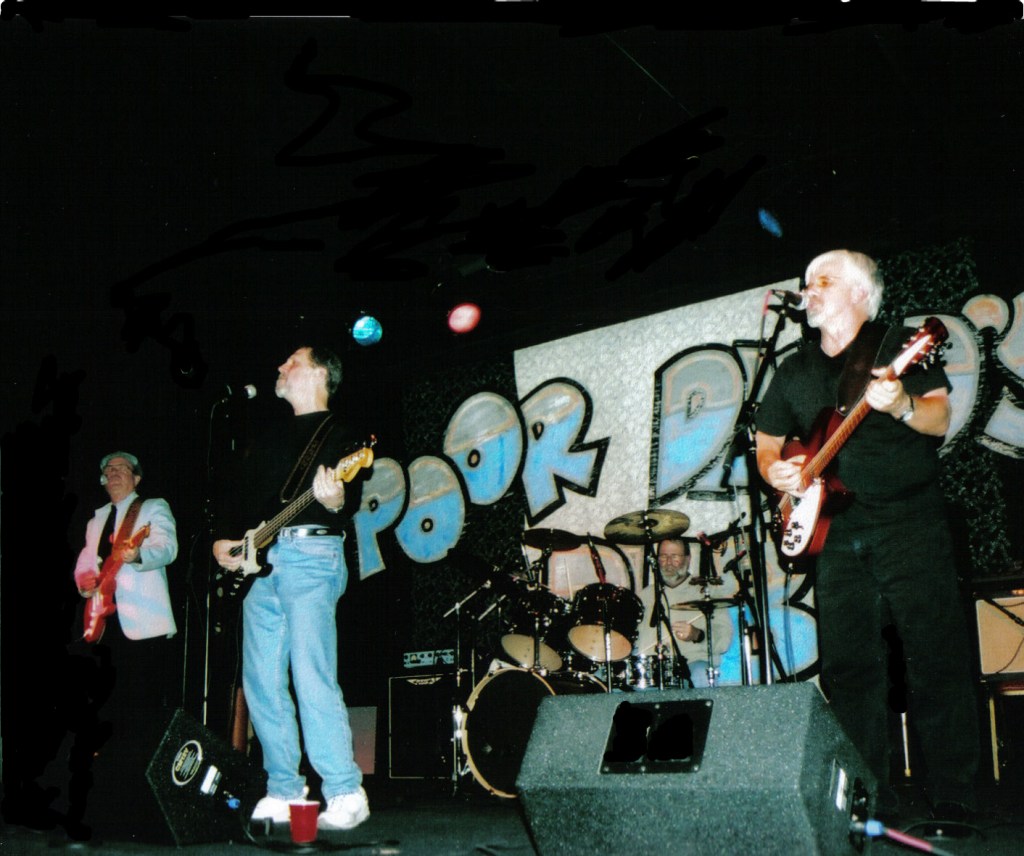
The American Classics today playing Poor Davids Pub, Dallas Texas. Right to left: Phil Strawn on guitar, Danny Goode on bass, John Payne on lead guitar and Jordan Welch on drums
19. Q: As a geezer-in-training, how do you maintain a rock-and-roll attitude?(If that is something you aspire to do.) (Aside from wishing you had the doughto have a dietician and personal trainer follow you around like Mick does.)
A: Poor Mick, someone needs to feed that boy a cheeseburger, or a chicken fried steak. We don’t have a rock-and-roll attitude anymore. We’re having too much fun when we play. To a man, we feel fortunate to still be playing, and doing it well, if not better than back then. We know it won’t last forever so we enjoy every gig and every practice as if it were our last. We figure that we have about five more years before we start to embarrass ourselves. When we need to mount our guitars on our walkers, that’s when we’ll stop.
20. Q: As the years ground by, and punk and grunge and rap and who-knows-what-the-hell-else became popular in the underground and then got co-opted by Madison Avenue, did you ever find yourself wonderingwhat the hell is wrong with kids today?If so, did you wanna slap yourself upside the head?
A: The American “Pop Music” industry has been in the toilet for the last fifteen years, with the exception of country music and some of the smaller “indie” labels that still find talented musicians to record “real music”. To find “good old rock”, you listen to the country artist. It’s the same licks from the ’60s but they’ve added steel guitars and fiddles. I recently heard Cross Canadian Ragweed and was expecting a country band, but these guys rocked. They threw out fantastic 60’s fueled licks with hot country lyrics. I swear the ghost of Jimi Hendrix was in them. Another great band today,“ The Derailers” out of Austin, “rock a billy” with 60’s overtones.
What’s wrong with the music and the kids today? The destruction of our educational system, also known as “ dumbing down”. “Giving in” to students that are not willing to put forth the effort to learn. Once the kids figured out it was socially acceptable to be stupid, the music naturally, fell to the same level.
Grunge rock, a depressing form of music where every band sounded the same, arrived. It was infused by pathetic, morose lyrics written by boys who couldn’t pass a fourth-grade spelling test. These were the “Pied Pipers” that the record industry crammed down the throats of our children, who, (was so addled by years of playing video games while their minds turned to oatmeal) mistakenly believed that “ life imitates art”. After Grunge got a stranglehold, someone in L.A or New York, opened a sewer cover, and out crawled “RAP”. Which is, in no way related to music in theory or sound.
The numbing beat and gutter- laced words, encourages these kids to embrace hatred for everything good and just. You have seven-year-old children going around talking about killing cops, and “ getting some hoe’s”. The Madison Avenue record machine is no different than Enron or others of their ilk. They go, with no moral regret, straight for the jugular to make the buck, and will walk on the bodies to get to the bank. There is little, if any accountability in the mainstream music industry today. Do I sound mad as hell about this? I’m completely disgusted.
21.Q: What was best about the Dallas music scene back then? What was the worst?Name some of your favorite Dallas bands from back then.
A: The music scene in Dallas was young and full of excitement. The kids couldn’t wait for the weekends to pack into places like; The Studio Club or LouAnn’s. The Oaklawn area was full of boutiques and clubs. You could visit Lee Park on most weekends, sit on the grass and listen to free concerts by local bands. Oaklawn was re-inventing itself into the “Height Asbury” of Dallas. Most of the local bands that played the “circuit” knew each other. Dallas was a large city, but enjoyed and embraced a small, but sometimes-cliquish music community. I enjoyed the sounds of The Jackals, The Novas, The Southwest F.O.B., The Coachmen and The Chessmen; those were just a few of the many.
22. Q: Were your parents supportive of your musical endeavors? Conflicts?
A: In our band, all of the parents eventually came around and supported our endeavors. We spent so much time playing that they finally accepted the fact that we were not going to stop. My parents came to our gigs a few times, but usually left doing the zombie head-grab and staggered out the door. They couldn’t take the decibels, and though we would never admit it, we couldn’t either. Everyone in our band now is partially deaf because of the loud music onstage. We play much quieter now.
23. Q: Did rednecks ever pound the dooky out of you for having long hair?
A: Yes they did but in their own inventive way.
I was on the pier one summer night in Port Aransas, 1969. I was walking with this cute girl I had met earlier in the evening. We had been on the beach with friends, sitting around a campfire picking guitars and drinking beer. I wanted to walk on the pier, to check the waves for the next mornings surfing. I had my Gibson (1940’s) J-45 slung over my shoulder, and was looking really cool. As we ambled down the pier, two “big old boys” made a crude remark to the young lady. I should have let it go, but I couldn’t.
My parents had taught me that you didn’t speak that way to a lady. So, with the girl almost in tears, and me not being in my right mind, I approached the offenders. They were sitting on their bait buckets, drinking Lone Star Beer, and trying really hard to keep it from running out of their mouth from lack of teeth.
I volleyed back with a tirade of “eloquent put-downs” that would have made George Carlin proud. I figured after slick words like that, they couldn’t possibly say anything but “ we’re sorry”. I stood there, waiting for the apology I knew wasn’t going to come. When those two boys raised up from their “bait bucket lounger’s”, I was staring into the face’s of “Bubba-Zilla” and his spawn. That’s the first time I was ever conscious of sucking air through my lower orifice.
It was “way too late” for apologies, and, I didn’t have anywhere to run, so I stood there smiling like a raccoon caught raiding the trash can. The girl sensed that she was sharing my last minutes on earth, so she hauled-ass down the pier. The smaller of the “Bubba-Zillas” grabbed me (with my guitar still attached to my body) and did one of these “WWF” moves, spinning me above his head to build up momentum. When I reached launch speed, he sailed me out over the railings, and into the night. For a moment, I had a good form going; spreading out like “Rocky the flying squirrel”. I was hoping to glide toward the beach and lessen the impact into the Gulf of Mexico, thirty feet below.
I was all right with hitting the water; I could swim to the beach if the sharks didn’t get me first. But, In the instant, before I hit, I remembered my Gibson J-45 had taken the flight with me. I was immediately sick. I hit the water like a cowpie dropped from Babe the Giant Blue Ox. It hurt like hell! After floundering around in the surf for a while, I washed up onto the beach, gripping my ruined guitar. Through the mist, I could see the “Bubba-Zillas” illuminated by the lights, whooping it up and stomping around the pier. For a brief moment, I thought about going back up there and “ kicking some butt”, but then my head cleared, and I figured it was time to get a haircut.
I agree that the sixties didn’t end until the early seventies. No one wanted to let go of the music and the feelings that were so much a part of that short ten years. I had a great time. Thanks for asking me to share my memories.
I attended my 50 year high school reunion on Saturday, October 19th. It was held in Plano Texas, the small town where I lived when I graduated a “Plano Wildcat” in 1969. Fifty years on, a town is bound to grow, but Plano has exceeded any of our expectations. Its now a part of Dallas, and that’s not a good thing for our formally small village.
I sent my money to the committee a bit late. Less than thrity days away, I was still unsure if we should attend. Trepidation is one of my worse faults and more often than not these days, it wins more than loses.
My wife, also knowing many of my classmates, urged me to go, or should I say pushed me to attend. She knows me better than myself and what will be good for my soul. She reminded me that I have recently completed cancer treatments and who knows if it will return and then I will have missed this chance. We don’t get many second chances at my age. So, reluctantly, I agreed to strongly consider.
One night, up late, while watching an old black and white melancholy laced movie that reminded me of my childhood, I made the decision to go. My heartstrings were in the right place at the right time, and I just went with it. Trepidation raised its ugly head a few more times in the weeks before, but I fought valiantly and won that battle.
Sitting in the parking lot waiting to enter the venue, once again, I panicked. What if an old friend now looks like the Elephant Man, am I suppose to say “you look great?” What if I don’t remember these people and they don’t remember me? I was to the point of chest pains, but kept that too myself. My wife is a cardiac nurse and I didn’t want her thumping my chest before we entered.
All the doubt and anxiety dissolved the moment we walked through the entry door. I didn’t need name tags to remember names or faces. I assume that during those fifty years, my brain had developed some CGI ability to project how we would look as old folks. There were handshakes, hugs, laughter and reminiscing. The high school antics and experiences were revisited and fondly remembered. There was more laughter than I have heard in years. Prizes, speeches, zingers, they were all thrown about with abandoned.
The ” Memorial” table was the clencher. The pictures of my fallen classmates, forever that age, now gone. Some died early on, some recently, but they were not with us, and that sadden me. Facing mortality is a bitch.
As the class was mounting the stage for the reunion picture, my old friend Jarry fell backward hitting the concrete on his back and taking a hard knock to the head. The jovial mood ceased, and lthough he insisted he was alright, he wasn’t, and 911 was summoned and Jarry was taken away to the hospital for testing. I believe at that moment, the group of us realized that we are not eighteen anymore. We are senior citizens and fragile in this world of hurry up.
God speed to my old classmates, and be careful. I hope to see you again in ten years.







 Notes From The Cactus Patch