The Legend of A. Dillo: Austin’s Musical Muse


I wrote this story in 2012 after a visit to Threadgill’s on Barton Springs Road. During the Armadillo Headquarters days, I often went in and out of Austin and knew many of the musicians responsible for its progressive music scene. No one can remember who, what, or how it started, so why not make it an Armadillo?

A. Dillo influenced a generation of Texas musicians and tunesmiths. On a scorching Saturday in September 1970, a group of dazed and confused hippies found this precocious little Armadillo digging for grubs on the lawn of the state capitol. They were lounging on the grass, sunning themselves, drinking Lone Star beer, and smoking pot, recuperating from a busy week of doing absolutely nothing, which was what they did best.

He was a sad Armadillo, lost and searching for his family unit after being separated from them in Zilker Park a few days earlier during a vicious thunderstorm and a frog-floating flood. A happy reunion was not to be. His mother and father were tits-up on Congress, and his siblings had been lunch for a pack of wild dogs. He was an orphan.

The dazed but kindly hippies were drawn to the friendly little tank. They took him back to their pad just off Congress and raised him as one of their own. He was christened A. Dillo.

One of the more studious hippie chicks in the house was majoring in animal behavior and journalism at the University of Texas and saw a spark of something in the wee critter. Wading into uncharted territory, the twinkle in his tiny red eyes caused the two of them to connect magically. After a few weeks of sputtering starts and misses, she was soon tutoring the ardent little critter in reading and writing.

Within six months, A. Dillo had mastered penmanship and was writing prose. Within a year, he wrote short stories and speeches for the university’s professors and a host of prolific student protesters who hung around the house.

He experimented with strange illicit substances and began hanging out with artist types and deep thinkers, writing about current events, political science, theology, and music with the best of them. He was, in a sense, humanized.

A. Dillo’s popularity grew, and he was invited to give readings of his work at weekend hootenannies, parties, and student gatherings. He was the critter version of Alan Ginsburg.

Being an Armadillo, he had no clothing, only his armored shell, so he employed an artist friend to decorate his tough covering to resemble a fashionable tie-dye t-shirt. He then wore round rose-colored sunglasses and various pins and peace symbols. He was beyond incredibly cool and a perfect fit for Austin. A problem arose within the house. A few of his adopted Bohemian family members harbored a bone of jealousy. Though quietly envious of the little fellow, they accused him of selling out to “the man.” Perplexed and hurt, he asked his tutor who this “man” he sold out to was. She shushed him, explaining it was anyone who did anything better than themselves.

The bad vibes from his former adoring family were a downer, so unable to create and win back their adoration, he packed his few belongings in a Piggly Wiggly grocery bag and returned to Barton Springs and Zilker Park for peace and tranquility among the Oak trees and dancing waters.

While shuffling down Barton Springs Road, he happened upon a recently opened venue called The Armadillo World Headquarters. Delighted to find a place that openly celebrated his kind, he scurried through a hole in the fence and took up residence beneath the beer garden stage, enjoying the clamorous musical atmosphere and the continual supply of spilled Lone Star beer that flowed through the cracks of the wood floor.

A group of guitar-picking musicians who frequented the club’s beer garden befriended A.Dillo, and soon, he was anointed as the “official mascot” of the headquarters. He was cool again but didn’t understand this new scene where long-haired Hippie types wore cowboy hats and listened to country music. He kept copious notes, sensing that a reversal of attitudes was happening. Cowboys and Hippies learning to fraternize in a peaceful manner.

The little poet was inspired by his energizing surroundings and began putting his thoughts and prose to paper. In a moment of trusting innocence, he exposed his talent and shared his library of work with a few of the beer garden musicians, hoping for a morsel of recognition.

The coterie of musicians was so impressed with his talent that, without asking permission, they confiscated his poems and lyrics and made them their own. That this library of written work came from an Armadillo seemed utterly reasonable. After all, it was Austin in the early 70s, and it’s a well-documented fact that if you remember that time, you weren’t really there.

Within a few months, the musicians and wailers at the headquarters were singing songs about Austin and everything Texas. A handful of local artists were drawing A. Dillo’s likeness on their concert posters to promote the rapidly changing musical landscape. The times were a-changing.

Willie Nelson and Waylon Jennings took up residence at the headquarters and became the shaggy royal ambassadors of Austin music. It was a heady time for Texas music.

A. Dillo was heartbroken. He had been bamboozled by the “love your brother and sister” preaching musicians, who were scoundrels, thieves, and false profits. His trust had been violated. The soaring soliloquies, his enlightening prose, his ramblings about Texas, all stolen and plagiarized with no hope of recovery. One cruel musician blatantly took his favorite poem and made a song about “Going Home With The Armadillo.” That was the deepest cut of all. He was a broken critter. ” Oh, the pain of it all,” he wailed.

He soon left the headquarters, again packing his Piggly Wiggly bag and stealing away into the night.

A. Dillo returned to his home burrow in Zilker Park. He reconnected with the inhabitants, giving nightly readings of his new poetry to an enthusiastic and adoring crowd. He was elevated to Homeric status among the park’s animal population, and his name was known to all creatures. He was at peace with himself and his life.

A. Dillo was the unappreciated spark of inspiration for Austin’s progressive music scene of the 1970s. Without his influence and the spread of his stolen words, tunesmiths, musicians, and vocalist all over Austin would still be writing and singing those dreary Three-chord hillbilly songs or tripping out to psychedelic brain fuzz. Jerry Jeff, Willie, Waylon, and the boys would have needed to seek inspiration elsewhere, and the city would not have evolved into Austin as we know it today.

Tall tales have it that some years later, on a stormy night similar to the one that started his journey, A. Dillo was hit by a vehicle while attempting to cross Barton Springs Road.

An elderly lady living in the Shady Grove trailer park scooped up his remains and fed them to her two Chihuahuas. She used the decorated shell as a planter, adorning the steps of her Air-Stream trailer.

The small shell’s bright colors faded over time and sat on the steps of that old trailer for decades. Couples with gray hair walking to one of the many restaurants on the street, grandchildren and dogs in tow, would sometimes notice the shell full of colorful flowers and pause to take a photo. Austinites who had known the little poet or knew the legend would approach the unassuming shrine and pay homage, explaining to their grandchildren the true story of the “real father” of Austin music.
Would You Paint Over A Rembrandt?


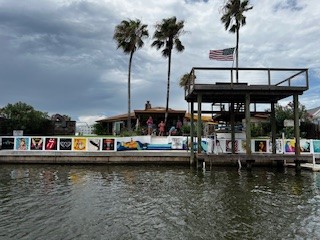
Recently, the saltwater faction of the Strawn clan—my son Wes, his wife Yolli, and grandsons Jett, hired a friend, local artist Jenn Seymour, to paint a mural on their backyard canal bulkhead in North Padre Island, Texas. My oldest grandson, Johnathon, now resides in Corpus, and my granddaughter, Madalyn, was on hand to bolster everyone’s spirits. It’s not their first venture into suburban art; another famous local Corpus Christi mural artist and surfer, John Olvey, painted a large surf mural on their home’s streetside view before he passed away in 2022. Now, the POA, HOA, or whatever this group of whiners calls themselves these days, served my son a letter of violation and demanded the mural be painted over, claiming it is an advertising sign, which is prohibited per their bylaws. The word ‘serve’ is a stretch; they actually taped it to his nice mid-century modern front door, “too yellar” to actually hand it to them in person. I don’t believe this coterie of malcontents thought this one out. Now, it’s taken on its own life form and is spreading like “Pod People.”

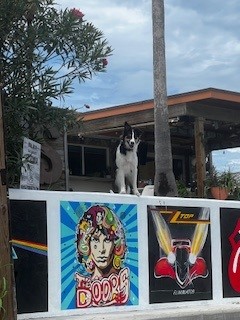
The artwork in question is paintings of the covers of the most classic albums in rock music history: Led Zepplin, Jimi Hendrix, ZZ Top, The Beatles, Bob Marley, The Rolling Stones, Willie Nelson, Selena, Nirvana, and a few others. We picked the albums from his extensive collection, and the artist did her magic aided by acrylic paint, Petoli incense, Red Bull, and 1960s good vibrations. Folks from all over the island, Corpus, and far-away lands have made a pilgrimage by boat, foot, and car to view the masterpieces. Wes and Yolli, being gracious hosts, offer a cold bottle of Texas water and a bite of food and lead them through their home to the backyard bulkhead and dock for a better view of the art. Piper, their border collie, happily greets everyone.

The wheels of justice turned quickly when the downtrodden art connoisseurs were wronged. Within a few days, the local paper, The Island Moon, published a rousing piece praising the artwork and exposing the troglodytic POA. One local television station, KRIS, dispatched a top-notch reporter to shoot film and interview Wes, his kin, the artist Jen Seymour, and Piper, the Border Collie. Momo and I spectated the whole shindig from the covered patio and were mightily entertained by the publicity of the whole affair.

This is the last surface in the compound suitable for decoration. So what now? Maybe three large Mariachis playing frogs on the roof? It could happen…it’s the island.

It’s 1968, And We Are In A Recording Studio


By request, I am again publishing this post, including my 1968 recording of the band I was part of, The A.T.N.T.; formally, we were the Orphans but changed our name at the suggestion of Mark Lee Productions, our manager. Enjoy.

The year was 1968, and the rock band I played in, The A.T.N.T., recorded a 45 at Summit Sounds in Dallas, Texas. The band had been called The Orphans, but a copywriting dispute resulted in a name change. Our then-manager, Mark Lee Productions, wasn’t keen on the idea because we had been under his management and promotion for a year.

The A side is “Cobblestone Street,” written and sung by myself and our drummer Barry Corbett. The B side is ” No One Told Me About Her,” written and sung by our lead singer and bass player, Danny Goode. The two producers, Marvin Montgomery and Artie Glenn, suggested we add horns to get a Chicago Transit Authority sound. Before the brass was added, Cobblestone Street was loud and raw with loud guitars and organs. After adding the horns, we returned to the studio and tweaked the cuts. I purposely untuned my Gibson 335 a bit to give the guitar break a bit of an out-of-tune carnival sound. Marvin, who went by the name of Smokey, was a member of the Light Crust Doughboys since the 1930s and played with Bob Wills. He produced Paul and Paula and Delbert McClinton. Artie Glenn wrote the famous Elvis hit “Crying In The Chapel” and many others; he was also a Light Crust Doughboy western swing musician. These two men were top-shelf record producers, so we listened when they suggested.

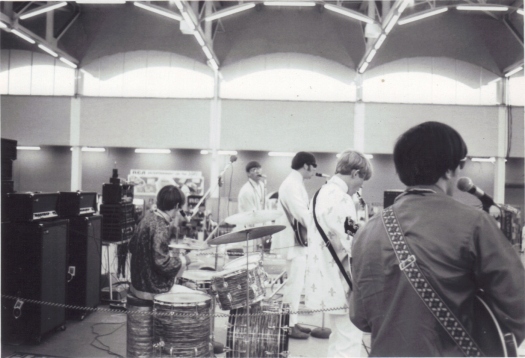
The A.T.N.T. at Flower Fair 1968

Our band members in the above picture are: foreground right John P. Strawn ( me ), then Jarry Davis on rhythm guitar, Barry Corbett on drums, Danny Goode on bass, and Marshall Sartin on keyboards. Barry and Marshall have passed on, but Danny, Jarry, myself, and our wives met for lunch a few weeks back in Fort Worth. It’s obvious why we all have severe hearing loss from the large amplifiers turned up to 11.

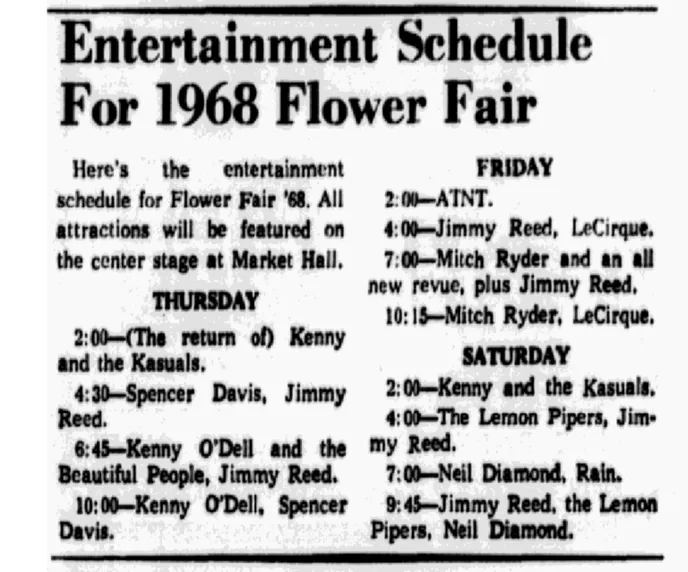
We introduced the songs at Flower Fair 1968 but without the horns. The Doors were supposed to play the event, but last-minute scheduling got sideways, and they couldn’t make it. This was the Spencer Davis Group without Steve Wynwood in the band. LeCirque ( The Smell Of Incense Fills The Air ) was formally known as The Southwest F.O.B. with members England Dan and John Ford Coley, who would later go on to fame as a duo, both local Texas boys. Kenny and the Kasuals were also a local group managed by Mark Lee.

The record received good airplay, but we never made much money. Distribution was the key, although the local radio personalities gave it positive chatter. Hope you enjoy the tunes.

“Getting Zapped…Brown Shoes Don’t Make It” And A “Beach Party On The Ganges”


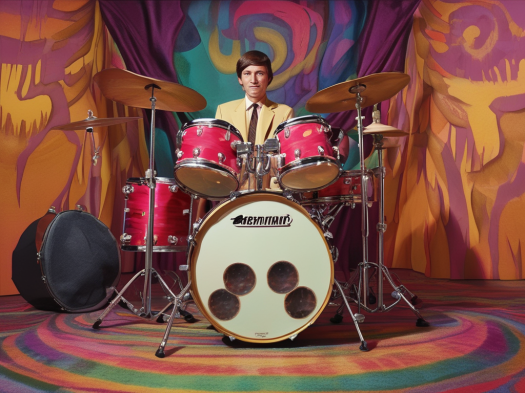
It would be a shame if I didn’t include some local 1960s rock musical history by spotlighting our drummer, Barry Corbett, otherwise known in our tight little musical circle as ” Li’l Spector.” The moniker came about because the boy, at age 15 years old, was a musical genius in the same vein as Brian Wilson, Leonard Bernstein, and Phil Spector: thus his earned nickname. We would never know why he chose the drums as his primary instrument: the guy played an assortment, including Bongo drums, kazoo, paper and comb, Dog House bass, violin, Hurdy Gurdy, guitar, keyboards, Vibes, Trumpet, Piccolo, Harmonica, Juice-Harp, Spoons, Autoharp, Dulcimer, French Horn, Tabla, finger cymbals, gasoline-powered Lawnmower, and Sitar. I’ve probably left a few out; it’s been a while since I thought about this. Barry’s original drums were worn out, so his father purchased him a set of Slingerlands. The finish was all swirling and psychedelic, and if we wore those cheesy 3D glasses from 7-Eleven, we could see the Summer of Love a full year before it happened.

In 1966, our repertoire consisted of The Beatles, The Rolling Stones, Hollies, Paul Revere And The Raiders, The Turtles, and The Byrds. We also played a handful of Beach Boy songs. Our voices were still high, so the Brian Wilson falsetto wasn’t a problem.

The 1966 Orphans in our Paul Revere boots

Unknown to Jarry and I, Barry secretly listened to weird underground music: “Frank Zappa And The Mothers of Invention.” These guys were so whacked out that the radio refused to play them, but Barry would. He adored Zappa and wouldn’t wear brown shoes in brotherhood to the song ” Brown Shoes Don’t Make It.” He was also a newbie-semi-devout disciple of East Indian music, mainly Ravi Shankar and his droning Sitar, thanks to George Harrison and the album Rubber Soul.

We knew Barry had purchased a Sitar from “Pier One,” a Dallas specialty store loved by the Hippies. The store hawked strange goods from India and the Middle East. He called one day and asked that Jarry and myself drop by to hear him play his sitar.

We were surprised when he could coax the part to “Norwegian Wood” out of the goofy instrument, so we agreed to learn the song and let him play it during our next gig at the Richardson Recreation Center the coming Saturday evening. He failed to mention that he had two additional musicians accompany him. He was a tinkerer, so he removed the electric pickups from his Gibson Melody Maker guitar and installed them on the sitar, creating the first electric East Indian instrument. Two Electrovoice condenser microphones were used to amplify his additional musicians.

Our gear was set up, and sound checked an hour before the dance, and in strolls Barry, dressed in a Nehru suit: his girlfriend and a guy about Barry’s age in tow. His followers, wearing a white Sari and a Dhoti, trolled behind him: they carried a small bongo-like drum called a Tabla and two tiny Zildjian cymbals on cute little stands. The guy was carrying an instrument that looked like a cross between a fiddle, a guitar, and a Dulcimer. All three had bright red Bindi dots on their foreheads. Barry was lugging his sitar, drum kit, and a Vox AC30 amplifier. After he set up his drums, he ran a sound check on the electric sitar and stuck the other mic inside the Tabla drum, one next to the little cymbals and the frankeninstrument. They sounded pretty good for a Rube Goldberg rigged setup. The three of us were duly impressed but leary of what might happen. Chaos followed Barry like an afternoon shadow.

The band played the first set to about 300 sweaty teenagers. The building’s air conditioning couldn’t keep up: it was a typical July in Texas.

Barry and the two musicians rolled out a Persian rug, which was likely stolen from his mother’s dining room, and positioned it in front of his drums. The girl lighted incense sticks held in large brass holders. Barry lugs his sitar from behind the stage, plugs it into the Vox amp, and sits in the traditional Shankar crossed-legged position. He is ready to rock. We break into Norwegian Wood, and the three-piece Hindi band sounds darn good but a bit loud. The teenagers move in close and surround the trio. Who are these weirdo-freaks? We finished the tune and received polite applause. A better reception than we had hoped for, but then…

For their second tune, Barry announces they will play Ravi Shankers’ biggest hit: “Beach Party On The Ganges,” a snappy little number sounding like Brian Wilson, and the boys meet Ghandi and crew for a cookout on a crocodile-infested beach. The sitar starts to feedback, and the Tabla drummer and Frankenguitar lose their tempo, not that there was one ever established, and Barry, now in a musical trance, is all over the sitar. The crowd of surrounding teens is transfixed, awed by his Zen Zone musicianship. The two other musicians, lost and toasted, have stopped playing. Lil Spector drives onward in his moment of musical adulation.

The Sitar feedback was incredible, so Barry, still locked in his “Ravi sitting position,” leaned back to reduce the volume on his amp. He leans too far, loses his balance, and falls backward, causing the head of his Sitar to catch a mic stand and break off the long body of the instrument. No one knew that Sitar strings were wound to a deathly tension. When the Sitar broke, the strings popped, winding around Barry’s head into his hair and then into his two other musicians’ long hair. It was a disaster. All three were incapacitated on the rug, unable to move. The crowd hooped and hollard, thinking it was part of the show. The poor Sitar wound up in the dumpster, and his musical disciples left the fold, throwing their red-dot makeup tin at Barry as they stormed out of the Rec Center. At his request, we dropped Norwegian Wood from our setlist.

We Love Rock N Roll..


God save Davy Crockett and the Alamo: Anthony Blinken now thinks he is Jimmy Paige. Maybe he should play “Stairway To Heaven” for his boss?

So You Want To Be A Rock N Roll Star? 1966-67 – Part 2


“So you want to be a rock and roll star?
Then listen now to what I say
Just get an electric guitar
Then take some time and learn how to play”…The Byrds 1967

After the family moved from Fort Worth to Wichita Falls for six painful months and then to Plano, Texas, I met a classmate and fellow guitar player who was also bitten by the “rock-a-rolla” bug. He knew another guy on his block who played guitar and owned a Fender Bassman amp, which automatically made him a band member, and he knew a neighbor across the street who was a drummer with a snare and one cymbal. He also knew a kid with another cheap Japanese guitar that would part with it for $10.00 bucks. I snatched it, bought his Sears amp for another $15.00, and was back in “the biz.” Hours of practice produced twenty songs, which we could repeat at least once or twice if they were shuffled around and changed singers and keys. Our first gig was at the Harrington Park Swimming Pool, Plano, Texas, early summer of 1965.

The Dolphins: left to right: Jarry Boy Davis, Warren Whitworth, Ron Miller, Jay-Roe-Nelson, Phil Strawn

Guitar tuners were not invented yet, so we used a pitch pipe and got as close as possible to A440, and apparently not close enough; we sounded like hammered Racoon crap on grandma’s china plate. It was a humiliating experience. In my playing frenzy, I broke my B string and had to play with five strings, and then our amplifiers went south because the outside temperature was over 100 degrees, and we were in the direct sun. Then, the drummer’s head on his snare split, his cymbal fell over and cracked, and Jerry Nelson, another guitar flanger, tripped on an extension cord and fell flat, damaging his Silvertone guitar. Our third guitar player, Warren, came into contact with water splashed from the pool onto the concrete while touching the strings of his electrified, ungrounded guitar, resulting in a bad electrical shock. Hair frizzed out, smoking from his ears, and burns on his fingers; he finished the gig, not knowing who or where he was. The grand debut ended with sympathetic applause, and the pool manager refused to pay us, which, per our contract, was free burgers and shakes. Warren, our previously electrocuted guitar player, got into a fight with our drummer, and the two rolled around in the gravel parking lot for a while with no clear victor. We thought Warren was a trooper, considering the amount of electricity that had almost fried him an hour before. Bad music tends to piss folks off. The final curtain was when my pal Jarry discovered his Mustang had a flat tire, so we had to call our parents to rescue us. Welcome to the rock n’ roll music business.

From 1966 into 1967, the band continued with better gear, a new drummer and bass player, and a different name. We were now known as “The Orphans.” A strange pick since we were all middle-class guys with full sets of parents, but Barry Corbett, our drummer, thought it sounded tough and a bit rebellious. Barry may have been the biggest rebel of the four members, listening to Frank Zappa and Spike Jones and teaching himself to play the Sitar. George Harrison’s influence led him into the realm of Indian music, which he fully embraced to the point of obsession. He developed a strange Peter Sellers-type accent, wore the red dot on his forehead, and had two high school girls follow him around town wearing white robes, playing with small cymbals attached to their fingers. He was also a rudderless musical genius and would soon lead us into the semi-big time and the really big show.

Alice Davis, Jarry’s mother, was now our official manager and did a wonderful job of it. She knew people and had connections and was not afraid to use them or to press a business contact into hiring her band. We were booked around Dallas and Fort Worth most Friday and Saturday nights. We made some good cash for high school kids but spent all we made on new equipment and clothing. Band members were in constant rotation. Teenage musicians proved to be an unreliable commodity.

Our keyboard and bass player left us for high school football, again, leaving three of us. Calls went out, Alice worked the phones and contacts, and we auditioned two musicians from McKinney, Texas. Danny Goode, a bass player/singer and former member of the Excels, and Marshall Sartin, church organist, classically trained pianist, and blues guitar player. We played a few songs as a five-member band and almost passed out. It was as if the ghost of Phil Spector had brought us into that practice room at this appointed time in the universe, which was strange because Spector was still alive and kicking in Los Angeles.

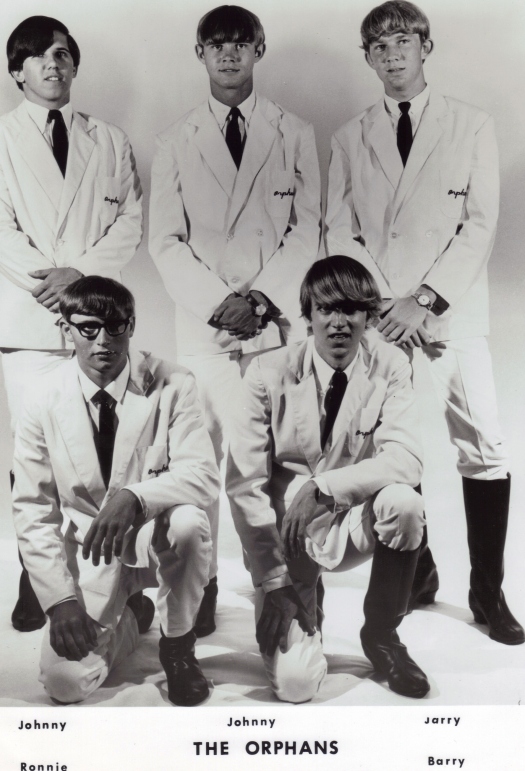
The Orphans. Left to right front: Jarry Davis, Danny Goode. Left to right rear: Barry “Lil Spector” Corbett, Phil Strawn, Marshal Sartin

Miss Alice was religiously overcome with musical emotion and experienced a spell of the rock n’ roll vapors that led to seating herself with a double Jack Daniels and branch water. Barry, our drummer and musical genius, had an epiphany and went to work on arranging our music and vocal parts, showing Marshall how to play them on his Farfisa Organ, which was another strange thing; Jarry and I didn’t know Barry could play the piano, or as we soon found out; the guitar, the trumpet, the sax, or the vibes. We dubbed him “Lil Spector” in honor of the famous Wall of Sound producer.

After the Miss Janelle Bobbie Gentry-infused tenure that ended in a puff of hair spray and perfume, the band took a vote: no females allowed. Marshall was still recovering from a severe case of the Love Fever Hubba Hubba’s, and we needed him in good condition for our upcoming gigs.

Miss Alice grew weary of working the phones, dealing with clubs and booking gigs, her realty business was suffering and needed her attention. She arranged for us to be managed by an upstart agency called Mark Lee Productions of Dallas, Texas. Mark was a go-getter and had more connections than Bell Telephone. His one and only main band, Kenny And The Kasuals, had just released a great 45 that was climbing the charts, so we were excited about working with him. We signed on the dotted line of a ten-page contract that not one of us read. Why bother? We were young and full of piss and vinegar: point us in the direction of the stage and plug us in!

Within twenty-four hours, The Orphans were booked into some of the hottest venues in the DFW: The Studio Club, LuAnns, The Pirates Nook, Phantasmagoria, and Teen A-Go-Go and The Box in Fort Worth. Mark Lee was turning down gigs because he had only two bands. We wouldn’t have a Friday and Saturday night free for two years, and even less free time in the summer when the bookings took up most of each week.

We were booked to play a Christmas party for Parkland Hospital at the famous Adolphus Hotel in downtown Dallas. Pulling up to the front in our 57 Caddie Hearse caused a stir. The bellman politely told us the bodies were picked up at the rear. We got the joke and proceeded to the loading docks. The party turned out to be for the doctors, nurses, and administration folks. In the next ballroom, Braniff Airlines was having their Christmas party, but with no band. It didn’t take long before the airline partiers spilled over into the hospital party, and that’s when it got crazy.

These people, supposedly responsible adults, were dancing on the tables, had a conga line going on the bartop, and we had our own go-go dancers on either side of the stage. Three of us were under the age of 18, but that didn’t stop the inebriated partiers from pumping us full of hooch in the form of cute little airline bottles. By the last set, we had gone from charming and talented to stupid drunk and were glad the gig ended. We couldn’t locate our keyboardist, Marshall, so we loaded up his gear and headed out. He showed up a few days later with some dumb-assed story he couldn’t talk about: the Hubba-Hubba’s got him again.

More to come in Part 3

Stand By For News! And Other Commentary From Texas


I’m so nervous I started smoking again…

Warning! Dear Hearts, the following commentary on social issues is not politically correct in any way. If you are triggered by common words in the English language or by religion and free political speech in the form of comedy, then don’t read any further. I’m warning you one more time.

I attended Momo’s Melody Belle’s choir concert this evening at the Langdon Center in old town Granbury. For a bunch of old gals, they sang well, doing Broadway hits from the 40-50s. I was impressed.

When leaving, the pianist approached me on the front steps and asked me if she could ask a personal question. I said sure, shoot. She says, ” You look like such a free spirit. Are you a Democrat? I said no, and then she told me that she was the chairwoman for the Granbury Democratic Party and asked if I was voting for Trump. I answered yes, and then Momo showed up, and the lady asked her the same. Momo has become a nervous filly lately, and folks should know that the wrong questions are likely to get the wrong answer. I’m the same but with a touch more diplomacy. The encounter did not end well for the pianist.

Free Spirited Momo at The Opera House. She has a 380 Smith & Wesson in that purse

If you have read this far, it’s too late.

A free spirit..now, what does that mean? Maybe because my hair is pretty long, and the mustache makes me look like Wild Bill Cody, or perhaps The Dude, without the bathrobe. The Democrat lady assumed I was an old liberal, burned-out Hippie. Nope, only an old, weird-looking, slightly burned-out ex-rock n-roll musician, conservative. You can’t always go on looks alone: same thing my sixteen-year-old self used to tell my parents.

Old Free Spirit Me at the Opera House. That cane is really a sword and a flame thrower

On another subject dear to my heart: Biden awarded Nancy Pelosi the Medal of Freedom for her courageous behavior on Jan. 6. That’s sort of like making Hitler an honorary Rabbi for his outstanding management of Auschwitz. Old Sniffer has been awfully quiet the past few weeks. Those rioters and anarchists are his voting block, so he has to mollify the little everyone gets a trophy, darlings.

Kudos and salutations to the fraternity young men at UNC and a few other universities for taking it upon themselves to protect our flag. The little candy assed Hamas loving, mask-wearing, latte-drinking, vegan-eating, Birkenstock-wearing, head-scarf-wearing, trans-loving, tongue-pierced, devil-worshiping, police-hating, America-hating grifters were freaked out when young American males told them if they touched the flag, they were dead little Gazaians. We need more of that from the rest of the schools that have been hijacked by socialist teachers and students. A word to the tenured commie professors, ” Don’t mess with Gods chosen people, the Jews. He’s kind of touchy about that.”

The Obama/Biden bunch is trying to pass a sneaky law to allow over a million Gaza refugees into the US. I ask, “Now what in the hell could possibly go wrong with that scenario?” Little terrorist kids in our elementary schools wearing C4 explosive belts. Hamas gunmen rampaging through Walmart? Oh wait…we already know what can go wrong thanks to our open border. This may sound a little over the top, but if these folks come here, it’s likely to happen. But will they be able to vote? Of course, they will.

Grifter Swifter


The original Tortured Poet

After reading all the glowing, foot-kissing reviews of Swifter’s new album, “The Tortured Poet’s Department,” I take back a few of the skews I gave her, but only a few. I had no idea the poor dear had lived such a sad life. I doubt her feet touched the ground until she was five years old, and every spoon in the house was pure silver. A downtrodden, entitled little rich girl confined to her Barbie bedroom writing little kid songs on her half-size Martin guitar. She never played in a bar, a club, or anywhere for that matter, except for her doll babies. Pop’s paid millions to get her into that Nashville brotherhood, which shows us how far that once holy ground has slipped. Did the poor waif have ever have a decent relationship with a male, not counting her current knuckle dragger? Doubt it, so the tortured poet title might fit her, even though what she writes is far from good poetry.

There have been many before her who qualified for the title: Harry Nillson, John Lennon, Bobbie Gentry, James Taylor, and Willie Nelson are a few. The original Homeric tortured poet, Bob Dylan, still holds the title: Swifter is no more than a grifter.

Say It Ain’t So Billy Joe…An Ode To Teenage Love


After a few months of rehearsals and gigs with our new members, Danny and Marshall, Alice, our manager, announced that she had arranged an audition for a female singer for the band. No consulting the boys on this one; it was full ahead. Alice had good ideas, so we rolled with them. She thought some femaliaty would add depth and make us more audience-friendly, since we were a bunch of surly young men with longish hair and the attitude to accompany our looks.

She knew someone who had a neighbor who knew another neighbor of a family who lived next door to a lady who attended church with a woman who had a daughter who sang in the choir at school and did solos at church, so Alice, one step ahead of us, escorted her into the practice room and announced, ” Boys, this is Miss Janelle.”

In walks, this teenage girl with a full-grown woman’s head of long hair piled up in a big bump on top and then down past her shoulders. She was a dead-ringer for Bobbie Gentry. But could she sing?

A TV dinner tray sat by Marshall’s organ, used for drinks and lyric sheets, so the auditioning singer pulled from a Coppertone beach bag a few record albums, a book of lyrics, a TAB cola, and a framed 8×10 autographed photo of Bobbie Gentry. Now we knew why she looked so much like Bobbie Gentry…she dug the gal.

Danny asked Miss Janelle what songs she knew. ”

Do ya’ll know any Dusty Springfield, Petula Clark, Diana Ross, LuLu, Sonny and Cher, Marianne Faithful, April and Nino, Dione Warwick, Lesli Gore, Ronnie Spector?” she asked.

Danny said, “Nope” we are a rock band, not the Ed Sullivan Show.

That kind of busted her bubble a little bit. “Well,” she says, ” How bout some Bobbie Gentry? I just love her and she is my favorite singer in my whole life.” We had already figured that out from the picture and the hair-du.

Our inquisitive drummer, Barry, interrupted her, ” Isn’t that the song where she and the boyfriend throw a baby child off a bridge into the muddy river?”

Miss Janelle whirled around and yelled, ” No, moron, she didn’t throw no itty-bitty-baby off a bridge; it was a bouquet of Mississippi wildflowers to solidify her big love for her man Billy Joe Macallister, but then he got caught dating his aunties pet sheep, causing him to jump off the old bridge into the muddy Tallachee river. Bobbie sent me a letter, along with this picture, explaining the whole song, but I promised to keep it a secret. We’re friends, you know.”

She thinks hard for a minute, then says, ” The only Rock-N-Roll song I know is Gracie Slick’s Somebody To Love. Ya’ll know that one?” We sort of knew it, so we gave it a go.

The lass let loose and was jumping around like Tina Turner, hair flying everywhere, strutting and shimmying, doing the Bug-a-loo, the Monkey, The Watusi, and a few others while singing. When we ended the tune, Marshall, our organ player, was staring her down with those big pansy-boy watery Puss-N-Boots eyes. He clearly had a severe case of the “Hubba Hubba’s” for this gal. Danny told us that this happens about once a week and he will be alright once he gets home and eats his mama’s hot supper. Alice announces she is marvelous and is now part of the band. Okey-dokey.

The next rehearsal, Miss Janelle comes in with red eyes and mascara trails down her cheeks. All sniffily and weepy, she says, ” My boyfriend said I can’t sing with a bunch of degenerate rock musicians. We are in love, big-time, and I must quit the band now.” Still in the grip of the Hubba-Hubba’s, Marshall puts a consoling arm around her shoulders and tells her, “it can’t be all that bad.”

She barks at him, ” Shut up, Moon Doggy….It’s my party, and I’ll cry if I want to.”

And with that, she packed her Coppertone beach bag with her albums, lyrics book, TAB cola, and the autographed picture of Bobbie Gentry and left, leaving the air heavy with teenage perfume, hair spray, and juicy fruit gum. Then…..More to come in my series.

“So You Want To Be A Rock N’Roll Star!” Part 1


Part 1 of a series about becoming a rock n roll musician in the 1960s

Every boy fondly remembers his first; be it a gun, an armpit hair, a pimple, a girlfriend, a school dance, a beer, his first shave, a car, or his first electric guitar. Well, maybe most boys never got an electric guitar, or there would be no Beatles or Beach Boys, and there would not have been anyone hearing or dancing to the music because all the teenage musicians would be on the stage playing for each other; just an opinion. Not me; I did receive one, much like the Japanese-made instrument in the picture. I remember mine had maybe one more pickup and a few more knobs that did nothing, as well as three of the pickups. But it looked so darn cool.

I had graduated from a Gibson J 45 acoustic to needing an electric guitar and amp so I could become the American equivalent of George Harrison: thanks to Ed Sullivans having the Fabs on his variety show and tricking me into believing mere mortal teenagers could replicate the lads from Liverpool. Having been in the music biz, my father knew others who owned music stores. He procured me a nice-looking Japanese-made instrument, along with a Sears amplifier. The neck had no truss rod, so within a week, it warped; a case would have been nice, but nope, it might cost a few bucks. My pop wasn’t known as Mr. Cheap-O because he was a philanthropist. The amp was pure junk: five watts of power on a good day, a 10-inch speaker, which blew out in a few weeks, and it stopped working completely after a month, leaving me to bang away with no sound. It didn’t matter; the strings were a good 1/4 to 1/2 inch from the fretboard, so I could only play for a few minutes before my fingers spasmed and locked up. My left arm had the muscles of Popeye.

Duane Eddy I was not, nor anything near George Harrison. My father, upon examining the condition of my gear, realized his frugal ways may have bitten him and me in the butt. He apologized, sent the guitar to a shop, procured me an even worse amp and the cheesy guitar returned in the same condition. I saw the reflection in my crystal ball, accepted my defeat, and went back to the acoustic, which I couldn’t find, and was told my father had loaned it to one of his cousins for a while. The guitar was missing. It seems the cousin thought it was a gift and sold it to a friend, who sold it to another, and so on. I was now stuck with an unplayable doorstop. Some years later, I did track the J45 down and got it back, only to lose it again in an unfortunate accident involving the Gulf of Mexico. More on that later.