After a trip to Frisco Texas for a doctors visit today, Momo and me stopped off at a local Fort Worth Mexican restaurant for an early supper before taking the cattle trail back to Granbury.
Seated, beers in hand, decompressing from two hours of hell on earth Dallas traffic, our Senorita waitress stopped by to drop a bowl of chips and salsa at our table; the usual fare for Tex-Mex food.
Over the years I have told my readers that my social filters have left on the last train to Clarksville, so I’m apt to blurt out any number of insults to no one in particular. The damn music was so loud I couldn’t understand a word the young miss was saying.
“Miss, can you turn down the music, or maybe give me a tablet and a pen so I can write out my order?” I say.
She was well indoctrinated. “Sir, the music is here to add to the ambiance and to make the food more tasty. We want our customers to think they are in old Mexico enjoying a meal while gazing at the Pacific ocean or the Gulf of America.”
Momo is giving me that ” you had better not say it” look, but I did anyway.
In my best old man I mean business voice I say, ” lookey here, Senorita, your food ain’t that good, and the music sucks, I can’t speak Spanish so why do you think I can understand a word that girl is singing? As far as ambiance, I’m looking out the window at the traffic whizzing by on Hulen Street and there is not a palm tree or a beach, or a dude leading a burro with a margarita machine strapped to its back. It’s Fort Worth Texas, not Cancun.”
Thoroughly insulted, she turns and stomps away. A few minuets later, Dire Straits is playing Money For Nothing. I notice all the folks our age are tapping their feet and digging the music. A few words of wisdom: music doesn’t make the food taste better.
Back in 2020, I penned this true account of one of my favorite childhood tragedies: there were more than a few.
The asphalt parking lot is so hot it’s melting the rubber soles of my PF Flyer “tinny” shoes to the pavement. It’s July of 1957, and there are at least one hundred kids, including our neighborhood coterie of twenty-five, standing on that lot, waiting to see our television idols, Mickey Mud Turtle and Amanda Opossum.
Piggly Wiggly Food hired the puppet duo from Channel 11 for the grand opening of their newest grocery store on Berry Street. With the show’s growing following, the folks at Piggly are betting on a full house because every kid in Fort Worth, Texas, wanted to meet Mickey and Amanda up close and in person.
Without an introduction, the puppets popped up onto the stage of their television theater and launched into their shtick. The jokes are age-appropriate and corny. Birthdays are shouted out, and then more jokes, but with no cartoons to kill time, the felt and cardboard critters are out of material and are bombing like the Hiroshima fat boy.
The Mud Turtle launched into a commercial for Piggly Wiggly, and the Opossum began her’s for Buster Brown Shoes, over-riding Mickey, which in turn made him mad, and he grabbed a small bat with his mouth and popped Amanda Opossum a good one. The kids loved it. Watching the two puppets fight is better than cartoons, any day, hands down.
I feel a tug on my shirt and realize my mother is dragging me into the grocery store. As we pass the back of the puppet theater, the side curtain is halfway open, and there, in living color, are two adults sitting on low stools with their hands stuffed up the butts of our beloved stars. Kids are good at fooling themselves into believing things that aren’t real. I know they are cheesy cardboard and fabric puppets, but destroying my imagination is serious stuff.
Mortified and traumatized from the scene I witnessed, my mother drags me through the air-conditioned store as she completes her shopping. There is no sympathy or coddling from this tough-as-nails woman. She mumbles something about puppets being stupid, and I feel tears forming on my cheeks. I may never recover from this destruction of my childhood.
Leaving the store, we pass the stage, and a man and woman are putting the puppets into their wooden boxes and autographing glossy postcards of the critters. I still have mine.
“A young man is so strong, so mad, so certain, and so lost. He has everything and he is able to use nothing.” Thomas Wolfe
There is no winter like one in Texas. The cold comes with a Blue Norther. It roars down from Canada into the panhandle, gathering tumbleweeds and dust as it goes. It marches south across the flat plains to the Gulf of Mexico. The wet cold cuts deep, biting like the sharp edges of a frozen North Pole. Eskimos would take the first train back home. It is a harsh welcome for a man with tropical-thinned blood.
Johnny’s train pulled into Fort Worth as an ice storm blanketed the city. He had intended to walk two miles from the station. But then he saw a man slip and fall on the ice, and he called for a cab. The ride was rough. It had been over a decade since he faced winter, and now he recalled why he had chosen warmer places to call home.
The house appeared forlorn in winter’s cold, pale light, smaller than he remembered. It was worn out, resembling a sharecropper’s shanty more than his childhood home. He scanned the front porch; no marble angel welcomed him home. Thomas Wolfe was right.
Johnny and his parents left Fort Worth twelve years ago. They set out for California in search of work, to rebuild their lives and forge a future for their children. He was a boy cast into the vast unknown, adrift on the winds of a long journey. This adventure would shape the man he would become. His parents were like ship’s captains, guiding their small crew. He and his dog were the sailors. Their Ford was a proud schooner, and California was the mythical land where treasures lay hidden. They never discovered the chest, yet the treasures came to them in ways they had not anticipated.
Standing on the ice-covered sidewalk, Johnny saw a light in the kitchen window. His father, John Henry, sat at the table. A mug of coffee in his hand. A cigarette slowly burned in an ashtray. His bowl of oatmeal was there too. His mother was absent. She never woke early. Johnny stepped onto the porch and knocked. His father opened the door, and warmth rushed out. After briefly embracing, Johnny settled at the worn table with a steaming mug. The table had seen much—his parents’ fights, their choices, celebrations of childhood, and now his reluctant return. His mother was not sleeping; she had gone to an aunt’s house months ago.
John Henry, sipping his coffee, gave Johnny a brief rundown. Norma, his elder sister, married a schoolmate and now lives in Albuquerque. A second baby was coming soon, or maybe it had already come. John Henry couldn’t remember. His words were hard, filled with the bitterness of a man worn down. Bertha fought with the drinks. The magical elixirs had returned. She wrote letters to their friends in California, a compulsion. Sister Aimee was the one she favored. Norma had taken as much as she could shoulder and left with her husband. Johnny did not expect a joyful reunion, but this was a sorry state of affairs.
Maureen and I visited Luby’s Cafeteria last week for lunch. The smell of the food brought back memories from my childhood.
Back in the 1950s, in Fort Worth, there were Wyatt’s and Luby’s cafeterias. It was always a hard choice for the family. Luby’s had the best deserts, while Wyatt’s always served larger portions. My Dad usually chose Wyatt’s—more bang for the buck. It was the Eisenhower years, and things were tight. That’s back when he was still a Democrat. I was just a hungry kid.
We took our place in line, trays aligned on the metal rail. I scanned the extra-large menu board for my favorite dish but couldn’t find it. I panicked. The platter I came for and have always ordered for decades is “The Luanne Platter,” and they damn well better have it. My blood sugar was low, and I could feel a rant coming on. Maureen rubbed a few drops of “Peace of Mind” lotion under my nose to calm me. Then, in the lower corner of the board, I spotted it. ” The Luann Platter, half portions with a roll – $8.99.” What the hell! It used to be $4.99 with a roll, a drink, and a slice of pie? Retired folk can’t afford those prices.
I approached the smiling lady server and, using my best old man-controlled voice, said,
” I’m not paying $8.99 for a half portion that was $4.99 with a piece of pie the last time I ate at Luby’s,” and I slammed my fist on my tray for effect.
Still smiling, she replied,
” Well,, sir, then you can choose the children’s plate if you are over 65 and/or acting like a child, as of which you appear to be. You have a choice of chicken strips, a hot dog, or spaghetti with 2% milk and a fruit cup. That will set you back $4.99 plus tax. And by the way, The Luanne Platter has been $8.99 since 2001.”
Oh man, the little Pop-Tart was really messing with me now. Her smile had turned to a slight sneer, and her eyes got beady. I leaned over the glass barrier.
” Do you know who Luann Platter is, young lady?” I demanded.
” No, sir. Was she a famous cook or employee of the month or something?” she said. Good Lord, this girl is clueless.
By this point, two other line servers had flanked the young miss in case I went postal. I faced them and, with conviction, said,
” Luanne Platter is the most famous character on the television show, ” King of the Hill.” An animated series set in Garland, Texas, and this dish you serve is named for her. Don’t you know who Hank, Bobby, and Peggy Hill are?”
The three servers’ young faces showed social ignorance. It was useless to explain. I collected my platter, and we proceeded to the checkout.
We sat in our booth, eating our lunch in silence. The food wasn’t as good as it used to be. The good old days are gone for good. My turnip greens were Kale, the most evil weed ever cooked. Maureen’s chicken was rubber faux, and my corn muffin was doughy and awful. We can scratch this one off of our list.
Leaving the cafeteria, a fortyish blond woman in the Luby’s uniform held the door open for us. In a girlish voice, she said,
” Ya’ll come back now.” I noticed her name tag read “Luanne.”
Childhood memories are like teeth; we all have good and rotten ones. If you grew up in Texas in the 1950s, you will identify with some of mine, or maybe not.
I was nine years old before I dined in a Mexican restaurant. I knew they existed because my father and mother enjoyed them, bringing home little mints and matchbooks touting the restaurant’s name. I got the mints, and my parents put the matchbooks in a jar in the kitchen. I dreamed that one day, I might visit one.
In Texas, Mexican food is part of life. It’s one of the major food groups; a boy cannot grow into a man of substance without it. Not having real Mexican food at that young age affected my evolution into a healthy young specimen. I harbored a nervous tick, stuttered sometimes, and had one leg shorter than the other. All those maladies were cured once I ate the real stuff. The medicinal qualities of Mexican food are exceptional.
For many years, I had eaten tacos at my cousin’s house, believing them to be authentic Mexican food. Sadly, they were nowhere near the real deal. Several times over the summer, my cousin Jok’s mother, Berel, would cook tacos and invite the families for a feast. Cold Beer and tongue-scorching Tacos. Pure Texas.
Berel would stand at her massive gas range, a large pot of ground beef, and a cauldron of boiling Crisco, heating the room to cooking temperature. She would drop a tortilla stuffed with meat into the witch’s cauldron, pull it out, and toss it to the pack of wild African dogs sitting around her kitchen table. The dogs, of course, were my cousins and me. My poor mother would leave the room. She could not bear to see her son eat like a feral child: growling, biting, snarling as we consumed the tacos like they were a cooked Wildebeest. That is what I consider Mexican food and proper behavior when consuming it.
Driving Northwest of downtown Fort Worth on Jacksboro Highway, right before you come to the first honkey tonk, you would find “Trashy Juanita’s” Mexican restaurant. Legendary for its tacos, frijoles, and cold Pearl Beer. It was also legendary for things my father would not mention until I was older. Gambling, shooting dice, and generally questionable behavior were part of the after-hours entertainment. It wasn’t on Jacksboro Highway for the view.
The owner of Juanita Batista, Carlita Rosanna Esposito, was not a trashy woman but a middle-aged Latin beauty with a bawdy laugh and sharp wit. The restaurant’s front yard adornments earned the name. Offended at first, she finally accepted her crown and wore it proudly.
Two rust-eaten pick-up trucks, one painted blue and the other yellow, sat abandoned in the front yard behind a cyclone fence. Pots of flowers decorated the fenders while the beds overflowed with vines and small flowering trees. Fifty or more chickens strutted and pecked around the yard, giving the place a barnyard atmosphere. Some saw a work of art, while others called it a junkyard that happened to serve great food. In an interview in the Fort Worth Star-Telegram, Juanita claimed to be related to General Santa Anna, Pancho Villa, and the Cisco Kid, making her royalty in Mexico. The people of Fort Worth loved her, and she was considered a local character of some importance. She often dined with Ben Hogan and the Leonard brothers at Colonial Country Club.
Trashy Juanita’s was my first introduction to authentic Mexican food and all that comes with it.
My father sold one of his many fiddles to a buddy, and with the profit, he took the whole family to dine at Trashy Juanita’s on the Fourth of July, 1958.
Juanita had gone “whole hog” on this holiday. American flags hung from the front porch and draped the cyclone fence. Two small children sat in the front yard shooting bottle rockets at the cars driving on Jacksboro Highway, and the chickens were wrapped in red-white-and-blue crepe paper streamers. Very patriotic and also very redneck Texas.
A jovial Juanita escorted us to a large table beside the kitchen doorway. A waiter delivered tortillas, chips, salsa, and two Pearl beers for my father and grandfather along with large, frosty glasses of sweet iced tea for the rest of us. There was no menu; it was Tacos or nothing at all.
The unfamiliar aroma of exotic food floated on a misty cloud from the kitchen, filling my young nostrils and activating my developing saliva glands. A torrent of spit dripped from my mouth onto the front of my new sear-sucker shirt. My mother cleaned me up and wrapped a napkin around my neck. I was ready: I had my eating clothes on. We decided the family would dine on a medley of beef and chicken Tacos, frijoles and rice, and guacamole ala Juanita. The waiter rushed our order to the kitchen.
The evening was turning out great. My father was telling jokes, the cold beer flowed, and a waiter walked past our table into the kitchen. Under each arm was one of the patriotically wrapped chickens from the front yard. My grandfather must have forgotten that two young children were at the table and remarked, “There goes our Tacos, can’t get any fresher than that.”
His remark went unnoticed until I asked my father, ” Dad, are we going to eat the pet chickens from the front yard?” He didn’t offer an answer. I got a big lump in my throat, and my eyes got misty. My sister whimpered and cried like a baby, and my grandmother, seeing her grandchildren in such distress, shed tears in support. Mother gave the two adult men the worst evil eye ever. The mood at the table went from happy to crappy in a minute or less. So much for a joyous family celebration. We might as well be eating Old Yeller for supper.
There was a ruckus in the kitchen, yelling, pots and pans clashing, and the two chickens, still wearing their streamers, half-flew, and half-ran through the dining room and out the front door. The cook was right behind them but tripped over a man’s foot, knocking himself out as he hit the floor.
Standing in the middle of the dining room, Juanita announced that there would only be beef Tacos tonight. The two doomed birds had escaped the pan, and my sister and I were happy again. My father breathed a sigh of relief that the night was saved, and my grandfather bent down and polished the new scuff on his size 10 wingtip.
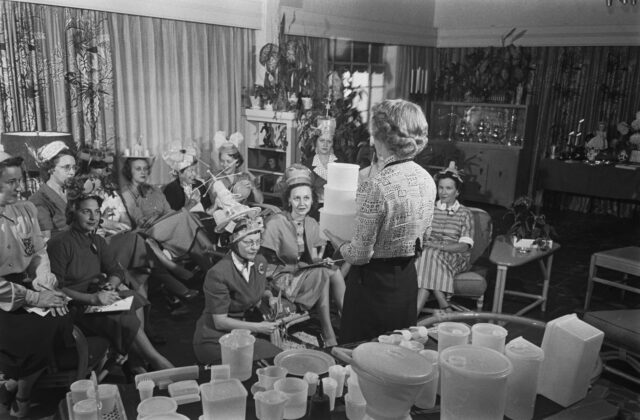
Not my mother, but the Tupperware and the fridge look about right. Ain’t AI fun!
It takes guts to admit to a phobia. I have more than one, but this one will do for now. I can’t stand to touch plastic ware, mainly Tupperware or any brand that resembles that sturdy piece of American culture from the 1950s.
My mother, rest her sainted soul and bless her heart, was a Tupperware lady. During those years, she hosted numerous parties in our and her friends’ homes.
It wasn’t until years later I learned the truth about these parties. They were a front for gossip and cocktails. In her old age, she admitted it was a sham, and the girls used it as a front to get away from us kids and husbands for a few hours and get sloshed on Manhattans and Gin and Tonics. It was the perfect set-up. She made a small amount of money, had some good hi-balls, and caught up on the neighborhood gossip. They were the forerunner to ” girls night out,” which started in the 90s. I sometimes wandered into the room hoping to find a little finger sandwich or a Vienna sausage on a toothpick. Instead, I found a pack of “big-haired” gals holding a cocktail glass in one hand and a cigarette in the other. My mother was a world champion smoker and would have a ciggie in hand and one perched in her ashtray. Mothers back then were tough gals.
Our kitchen was stuffed to the point of bursting with the plastic-ware. It filled every drawer and cabinet and was neatly stacked to the ceiling on top of the ice-box. We ate on paper plates and drank from aluminum glasses. There was no room for real dishes or glassware; It was all Tupperware everywhere. The ice box was neatly arranged, with meals sealed in Tupperware. We didn’t call them “leftovers” in our home; they were called “future pre-prepared dinners.” Some of those dinners were on-call for a year or more. That’s the beauty of Tupperware: if properly sealed per the manufacturer’s instructions, the food will last for years.
Now, the explanation of the phobia. It’s complex and involves many layers of childhood anxiety. My therapist said it started with an incident when I was five years old. I don’t remember what I did, but it was severe enough for a butt-whooping from my mother. While trying to escape, she grabbed one arm, a classic move that only mothers use, and wielded the nearest object she could find, which was an 8×10 Tupperware slimline cake storage container. I had no idea plastic ware could hurt so damn much. The impression of the insignia on the bottom of the container lingered on my butt for days. Of course, I showed it to all my buddies, and they were pretty impressed and worried because their mothers owned the same Tupperware containers.
After that incident, I couldn’t bring myself to touch plastic ware in any form. That brought more punishment because when helping with the dishes, I would retreat from the kitchen sink when a dirty piece of Tupperware was to be washed. There was nothing that could make me touch that vile object. That plastic dish scared me as much as the monster under my bed. My father realized that his only son was becoming a child neurotic and stepped in to help my mother with the dishes, thus allowing me to enjoy a somewhat normal childhood.
Not much has changed in 65 years; I can’t touch the stuff. My wife, Momo, loves her some Tupperware. She has a beautiful assortment of colored containers that, when soiled, she puts in the dishwasher. That is another layer of my anxiety. I cannot take them from the rack. I use a set of tongues to grab the cursed piece and then lay it on the counter for her to put away. I don’t care to know where she hides this stuff as long as I don’t come into contact with it.
My therapist is a cheeky fellow. He told me that being spanked with a Tupperware dish and all the problems it caused me could have been worse. My mother could have grabbed a PYREX dish.
Keeping with the spirit of Christmas, I am posting a few tales of personal Holiday experiences growing up in the 1950s in Fort Worth, Texas.
The hundreds of hours I wasted thinking about Santa Claus, where he lived, and whether he was happy. Did Mrs. Claus make him hot cocoa and cookies? Does his reindeer live in a lovely barn? How do they fly? Is Rudolph the leader of the pack? Did he get my letters? Was I on the nice or naughty list? Is his spying Elves watching me? These were questions that required an answer. My parents were no help, they would smile and pat my little flat top haircut head.
Santa consumed my life from 4 years old until I turned 9. I was a true believer, a young pilgrim to the point of becoming a child Santa Evangelist. Anyone said something terrible about Santa; it was put up your dukes time or a come to Santa prayer meeting. My younger sister was also a firm believer, but then, she was brainwashed by me, and I was programmed by my parents, grandparents, and the rest of the family.
On Thanksgiving Day, the trickery commenced around our household. First, my mother, the master of deceit, would warn us about the naughty list and what would happen if we were on it. Then it was, ” The Elves are watching you through the windows to see if you’re good.” That’s the one that got to me the most. I had a plan to catch them.
After lights out, I slinked out of bed under the cover of my darkened room. Crawling on my belly like a soldier, I made my way to the nearest window. Back against the wall, I slid up and moved the blinds in a flash, hoping to catch the little guys. Failing to catch one spying on me didn’t deter my mission: I knew they were there and faster on the draw. Santa and his gang were tricky ones.
The annual Christmas visit to Leonard Brothers Department Store in downtown Fort Worth was the ultimate Santa experience. Toyland was akin to holiday Nirvana for us kids. A rocket ship monorail glided around the basement ceiling, kids packed in like sardines on a rocket train to nowhere. Parents rush to purchase presents while the kids are busy, hiding them under their coats or in bags and lying to their innocent children with straight faces.
Santa held his court in the middle of Toyland. His throne was 10 ft. off the ground, with stairs leading up and down. A majestic sight if there ever was one. Sitting in a velvet chair fit for a king while his Elfin helpers lifted the crumb crunchers on and off his lap, it was pure excellence. A line of snot-nosed kids snaked around the room, waiting for their chance to place their order, up the stairs, on the lap for 15 seconds, then off the lap, and down the stairs. The visit was over before you knew what had happened. It was the same routine for years, and I loved it. I could spit out my order in under 10 seconds. Santa and his helpers were impressed.
I asked Santa for a bicycle when I was 9 years old. A red and white machine with side mirrors, streamers, a headlight, and white-side-wall balloon tires. I also asked for a new BB Gun, a larger Cub Scout knife, and a Fanner 50 cap pistol with green stick-um caps. My sister asked him for a doll that was larger than she was and a dollhouse.
Christmas Eve arrived, bedtime rolled around, and we hit the sack. Hot Ovaltine and cookies put me out like a light. Then, sometime after midnight or later, I had to pee. I didn’t want to get up, but the Ovaltine was causing me some discomfort. Half asleep, shuffling down the hallway, I looked into the living room as I passed the doorway. With a Schlitz beer in his hand, my father sat by the tree, assembling a red bike like the one I expected from Santa. My mother was working on a cardboard dollhouse, and the giant doll my sister wanted was standing under the tree, looking creepy.
I convinced myself that Santa must have run out of time and had recruited my parents to complete his work. The reality of the sight escaped me.
My father looked up and saw me standing there; our eyes met, and he smiled like a raccoon caught in a trash can. The jig was up. The big lie was exposed, and my childhood imploded right there in the hallway. Daddy was Santa, and Mom was Mrs. Claus. I peed and made my way back to bed, not comprehending what I had witnessed.
I awakened at daybreak, our usual Christmas morning routine. I was thankful to be awake and away from the nightmare that had gripped me most of the night. I was relieved that it was all caused by the Ovaltine. The gifts were under the tree, and life was good. I loved the bike and the BB Gun, but my sister feared the enormous lifelike doll.
After breakfast, I was lying under the Christmas tree, building an army fort with my plastic soldiers. That’s when I found a Schlitz beer bottle, assembly instructions for a bike, and a few tools.
Tex Styles grilling in the backyard of his Fort Worth, Texas home
After sixteen-year-old Tex Styles is inducted into “The Sons Of The Alamo Lodge,” and gets his big write-up in the Fort Worth Press and a shout-out on the Bobbi Wygant Television show. His status as a “wonder kid” champion griller is increased by ten-fold. So, naturally, everybody wants a piece of Tex, or at least a plate full of his Brisket and sausage.
His face is on the cover of Bonn Appetite magazine and Sports Illustrated, thanks to Dan Jenkins. The Michelin Travel Guide lists him as the top meat griller in America and gives him a five-star rating. Julia Childs is fuming mad.
Queen Elizabeth and Prince Philip are Texas BBQ fans from way back. So, they send Tex an invite to prepare a meat feast at Buckingham Palace; the boy lives in high cotton and cold beer and has not yet graduated high school.
Upon his graduation from Pascal High School in 1968, the Army drafts Tex and sends him to Viet Nam for a visit. His captain happens to be a Fort Worth boy who knows Tex’s hometown celebrity status, which, in turn, gets Tex a gig as the top generals’ chef. He won’t hold a rifle or fire a shot for his two-years tour. Instead, a smoker grill large enough for thirty steaks and ten briskets is his weapon. A color photograph of his boyhood grill instead of the usual Playboy fold-out hangs next to his cot. The general tells his men that he “loves the smell of smoking brisket in the morning.” Tex is an immediate rock star.
Tex used his time in Vietnam wisely by learning exotic cooking techniques from the locals.
For example, a shriveled up old Mama-San educated him on using “Vietnamese Death Peppers,” the hottest pepper in the world. If a man ate one whole, death would occur within twenty minutes, or so the Mama-San said. Tex nibbled a small end piece and was on fire for two days, unable to leave the barracks bathroom, so he figured she wasn’t bullshitting him.
A month of experimentation’s with the “Death Pepper” resulted in an edible and survivable pepper sauce. Tex called it “Davy Crockett’s Ass Canon,” since he is a “Son Of The Alamo” and all that.
He found a local business in Saigon to bottle the product, and a local artist produced an excellent illustrated label for the bottle. It pictures Davy Crockett with his buckskin pants around his ankles, torching Mexican soldiers with a massive fiery flame shooting from his buttocks. In addition, the label said it’s a marinade, a pepper sauce, a medicinal elixir, and a hemorrhoid eradicator. All of this is true, so it’s bound to be a huge hit.
In June 1972, Miss Piddle Sonjair was a nineteen-year-old winner of the “Miss Chigger Bayou Louisiana” contest. Although she is not the prettiest girl entered, she is the only one with a full set of straight white teeth, no baby bump, and doesn’t have a snot-nose kid hanging off her hip, making her the popular winner via unanimous decision.
Piddle holding her Chigger Bayou trophy and a plate of Tex’s brisket
As the newly crowned “Miss Chigger Bayou,” Piddle Sonjair makes her appearance at the “Shreveport Annual Crayfish, Sausage and Meat Smoking Festival,” where she meets handsome Tex Styles as she awards him the winner’s trophy.
She is bug-eyed- shaky-legged enamored with his triple-crusty-peppered Angus brisket and his ten-alarm jalapeno wild boar sausage smothered in his secret chipmunk sauce.
Marriage follows a few months later, then two sons and two daughters round out the Styles family. So naturally, all the kids take to grilling and smoking, just like dear old Dad.
Tex, Piddle, and the children travel the country in their two custom tour bus’s, pulling a 30-foot smoker and grill for the next twenty years. They smoke, grill, and serve the best meats in the south, winning competitions and elevating Tex to legendary status in the grilling world.
His Fort Worth boyhood home, listed in the state historic register, is a traffic-jamming tourist attraction. His first Weber grill is cast in bronze and displayed at Will Rogers Auditorium during the “Fat Stock Show.” Men worldwide come and pay homage to “the masters,” sacred covenant. It’s a moving sight to see grown-assed men weep while kneeling and touching the small grill. It’s one of the top tourist attractions in the south.
Tex is now seventy-two and retired from competitive cooking. The only folks that get a Styles brisket and fixin’s are his select clientele of fifty-plus years and Father Frank, the priest at Our Lady of Perpetual Repentance church of which Tex and Piddle are members in good standing. He has more money than King Faruk, a large home on Lake Granbury, and a cabin in Ruidoso, New Mexico, so he’s in the cooking game for fun.
Ten days before Christmas, Tex gets a call from his old pal Willie “the Red Headed Stranger,” Nelson.
Willie, his family, his band, their families, and numerous relatives and hangers-on have planned a “Santa Claus Pick’in and Grinn’in Christmas” shin-dig at Willies Dripping Springs ranch. Willie has a hankering for a Tex Styles holiday meat feast with all of Miss Piddle’s fancy fixins’.
Tex and Willie exchange the usual howd’ys, and then Willie drops his order.
Expecting around two-hundred-seventy-five people and assorted animals at the shin-dig, Willie needs enough food to satisfy a herd with possible pot munchies and other self-induced disorders.
Willie’s list is a booger bear, and Tex isn’t sure if he and Piddle can fulfill it in time, so he calls in his two sons and a couple of grandkids for backup.
Willie needs 38 each of Tex’s 30-pound “Goodnight Irene Ranch Briskets,” 45 each of West Texas spoon-fed bacon wrapped-beer can pork butts, 35 pounds of San Saba wild pig sausage, and 59 educated and certified free-range smoked chickens, with documentation attached.
All of the sides and fixin’s, are Piddles forte’, and will consist of 175 pounds of “Jacksboro Highway Red Skinned Tater Salad”, 175 pounds of “O.B. Jauns Canobi-Oil Mexican Macaroni Salad”, 120 pounds of high octane Shiner Bock Ranch Style beans, 235 pounds of Piddles special “Nanner Pudding,” 50 gallons of Tex’s secret sweet n’ spicy Chipmunk sauce, and one bottle of ” Davy Crocketts Ass Cannon” hot sauce.
Finally, to wash’er down, 135 gallons of Tex’s unique Dr. Pepper CBD oil-infused sweet tea and 5 commercial coffee urns of Dunkin Donuts Breakfast Blend coffee. The order is too big to ship, so Tex’s fifth grandson and granddaughter will deliver it to the ranch in the Styles family food truck. Money is not a worry for Willie, so he doesn’t discuss cost, which rounds out to be about $18,000 without taxes and tips.
Tex fires up his 30-foot trailer-mounted smoker and three custom-made “Styles Grills.” The next morning. Grandson number 3 unloads a pickup bed full of Mesquite, Peach, and Oak firewood purchased from the “Little Bobs” wood co-op in Eastwood, Texas. Tex won’t use wood or charcoal that doesn’t come from West of Fort Worth; if he suspects it may have come from Dallas or anywhere East of there, he throws it out. He is a Fort Worth boy to a fault.
At midnight, Tex pulls a tester brisket and carts it into the kitchen for a “slice and chew,” checking for tenderness, aroma, and flavor.
When he pulls back the foil wrap, he gasps and stumbles a few steps backward. Piddle hears this and bolts to the kitchen, where she finds a “white as a ghost” Tex sitting in a chair. Thinking he is having “the big one,” she dials 911, but Tex stops the call, assuring her he is alright.
He asks Piddle to join him next to the Brisket, telling her to describe what she sees. After a few seconds, she lets out a hound-dog yelp and crosses herself.
There, on the kitchen counter, resting in a tin-foil boat of succulent juices, sits a 20-pound brisket perfectly shaped like the Virgin Mary holding her baby Jesus. The contour of the torso, the flowing robe, her angelic face, and the little baby in her arms look as if a great master had carved that hunk of beef. Piddle gets all weepy-eyed and announces that this is a “Christmas Miracle Brisket.” Tex takes a picture with his phone and sends it to Father Frank, telling him to get over here now; we may have a miracle on our hands.
An hour later, Father Frank and two Nuns from the rectory view the miracle meat in the kitchen.
Father Frank is skeptical; these things usually happen in Latin America and tend to be the face of Jesus on a tortilla or a piece of burnt toast, not a 20-pound hunk of beef brisket.
The two Nuns intensely study the Brisket for a good thirty minutes. Then, finally, sister Mary and Sister Madgealyn, renowned experts in miracles of all things holy, inform Father Frank that this is the real deal and he should contact the Vatican, stat. So Father Frank dials the Popes’ secure red phone hotline. The Holy Father answers.
The conversation is in Latin and lasts for a few minutes. Then, finally, a bit shook, the good Father hangs up and tells Tex that the Vatican’s special investigation team will arrive tomorrow afternoon and to please hire armed guards to protect the miracle meat. Tex agrees.
Father Frank asks Tex if he might take a tiny slice of the useless burned fat home for religious reasons. Tex cuts a sliver from the back of the meat and wraps it in foil. The nuns, Father Frank, and the miracle sliver depart.
The following day is Sunday, and Tex and Piddle are too busy cooking to attend services. Then, around 1 PM, Father Frank calls Tex and tells him that “we have got a problem.”
Seems that the good Father couldn’t resist a tiny taste of the burned miracle fat before bedtime; he said it was the most Heavenly thing he had ever put into his mouth.
When Father Frank stared into the bathroom mirror this morning, he thought he had died and gone to Heaven. But he was still here, and, instead of a 70-year-old white-haired man in the mirror, a younger version of himself with thick jet black hair and perfect white teeth stared back. His hemorrhoids are gone, his gout is healed, his vision is excellent, his knee’s and hips don’t hurt, he took a dump like a big dog, his skin is as smooth as a baby’s bald head, and he has a woody so hard a cat couldn’t scratch it. This miracle brisket is the real deal for sure. But, Tex senses there is more to the Father’s explanation. So, he presses him for the rest.
Father Frank comes clean and begins to weep like a teenage girl having her period, telling Tex that the experience is a flat-out-miracle, and he was compelled by the all-mighty to share it with his congregation during mass this morning. So, he told them the whole beautiful story. Tex murmured, sum-bitch, and hung up the phone.
Before Tex can get really good and pissed at the good Father, his buddy down the street, Mooch, calls and tells Tex to check his front lawn. “It ain’t good little buddy,” was all Mooch said. News travels like wildfire in a small town, especially if it involves religion.
A hundred or more people sit, lay, stand or take up space in wheelchairs, hospital gurneys, and walkers on the front lawn. The overflow takes up his neighbors front yard.
The block is a traffic jam, and two news trucks from Fort Worth are parked in his driveway, antenna raised and going live. Last night, the two Nuns accompanying Father Frank are now standing on Tex’s front porch, signing autographs and giving fake communion using Goldfish crackers and Sunny Delite grape drink instead of sacraments. The healing circus just hit town.
Two police officers show up. They demand to see Tex’s permit for a gathering of over fifty people and organizing an outside church service. Tex explains there is no church service, but the two nuns giving fake communion show otherwise. The cops write Tex a few tickets and leave.
As soon as the cops depart, the Vatican Special Forces arrive.
Five burly boys in black Georgio Armani suits wearing mirrored aviator sunglasses and sporty Italian Fedoras force themselves into the house. So, naturally, they want the miracle meat. Two black limos with fender flags are parked in front of Tex’s house. The news folks go apocalyptic. Father Frank is curbside giving a live interview to Vatican Television News. It has officially hit the fan.
The main burly boy produces a document printed on expensive Vatican parchment saying that “All Miracles involving God, Jesus, The Virgin Mary, or any relative or likeness thereof on an article of food is the sole property of the Pope and the Catholic Church LLC.” It’s signed by the Pope and has a small picture of him glued next to his signature.
Tex claims bullshit and tells the Pope’s boys to hit the road. Piddle stands in the kitchen doorway, 9mm in hand. Her look says, “don’t mess with a Coon-Ass gal this Brisket ain’t leaving Granbury, Texas.”
The Vatican boys, muttering select Italian curse words, leave in a huff. Tex knows what he is meant to do with the Miracle Brisket.
Willie Nelson sees the news coverage down in Austin and calls Tex on his cell phone. ” I sure could use some of that Miracle Brisket when you deliver my order. The old lumbago and prostate cancer has been acting up and it hurts so bad I can hardly roll a joint or pack my pipe. I’ll be glad to donate a couple of hundred grand to any charity you choose.” Tex says he will send a piece if there is any left. Willie’s word is as good as gold.
Father Frank rushes into the house, arms waving, screaming like a fainting goat. ” What in God’s name have you done you backwoods cow cooking toothless hillbilly? I’m ruined!”
It seems the good Father made a sleazy back door deal with the His Popeness for a secret trip to the Vatican and a fancy appointment to some committee if he delivered the Miracle Brisket to Rome. So, Tex tells the good Father, in a non to gentle way, that the meat is staying in Granbury and will do whatever good it can here at home.
Father Frank yells, ” you double dog crossing sum-bitch,” grabs the two nuns, and they are history. Tex tells them, “don’t let the door hit you in the butt.” He had a feeling that Father Frank was never as holy as he pretended to be, and the nuns were a little flakey.
Tex goes to the kitchen, lays the meat on a cutting board, and slices the Miracle Brisket into tiny slivers, wrapping each morsel in a square of tin foil. He and Piddle then distribute the bites to every person in their front yard that is ill or has an apparent medical condition. He also gives a nibble to his fifteen-year-old dog, McMurtry.
Tex then sends his two sons, his two daughters, grandsons, and granddaughters along with himself and Piddle to every nursing home, mission, physician’s office, memory care facility, hospice, veterinary clinic, and hospital in town with pieces of the Miracle Brisket.
Having made the painful choice to journey back to Texas, Johnny found himself in a heart-wrenching struggle, surrendering the opportunities that lay before him—holdings that promised riches within a decade. With a heavy heart and resolute spirit, he cast aside dreams of wealth, fully aware that the path behind him had irrevocably vanished, leaving only the words of “what have been.”
The lots on the edge of downtown Honolulu vanished in a few days to a dodgy speculator, who offered a fire sale price. The used car lot was sold to a former commanding officer with a firm handshake and a promise that money would follow when the last existing vehicles found new homes. Now, he was left with nothing but the relic of a pawn shop fiddle, a token of better days. He returned the instrument to the old Korean man, who was less than friendly, still smarting from the failed romance between his granddaughter and Johnny. He offered a few dollars, which was silently rebuked. Confident that his father had cared for his prized violin, it would be waiting for the bow’s stroke across the strings.
Johnny made his rounds to bid farewell. The Royal Hawaiian staff had treated him kindly despite his being a Haole. The folks at the Pearl City News and the companions of his musical venture each received a heartfelt goodbye.
On his last night in paradise, Johnny dined alone. Over the years, The Brass Monkey Tavern and its delicious seafood had comforted him. Pika, the native Hawaiian bartender, produced a special bottle from the top shelf. Tonight, there would be no cheap hooch for his valued Haole friend.
The bitterness of his embattled relationship with his mother touched every part of his soul. He knew full well that forgiveness, if it ever came, would be a long, winding road marred by the shadows of contrived intent. Knowing that his father was faltering added to his haste in his departure.
The troop ship to California was packed with weary yet hopeful servicemen returning from their duties. A loud hum of excitement hung thick in the air. For many, it was a moment to rekindle the flame of old lives or to carve out new paths. Yet Johnny was lost to his sadness and felt no thrill. His thoughts drifted to Blind Jelly Roll, Sister Aimee, and Le Petite Fromage, now back in Chigger Bayou. Their presence in his life had brought him great joy. He felt obliged to give them one final visit, knowing it would be the last in his lifetime.
Blind Jelly Roll, aware that his days were numbered, was grateful for the visit. His humor was intact, and he asked Johnny if he would like to ride in his new sedan, touting that his driving skills had improved since their last visit. Pancho Villa, the tiny demon dog, had only taken a soft nip on Johnny’s hand, but his lack of front teeth made the nip more of a gumming affair. Sister Aimee, angelic as ever, had transformed into a maternal figure for Jelly and promised Johnny that the old bluesman would find a nurturing and loving home until his final hour. Even that cantankerous dog would be cared for. Johnny saw something in her eyes; the looks she cast on the old man were more than motherly; he detected an inner fire that fueled her commitment. Farewells were exchanged. There were strong hugs, a few tears, and some laughs. The final, out-the-door goodbye was punctuated by promises to write.
That evening, Johnny boarded the Super Chief bound for Chicago, with a stop in Fort Worth. The journey would take three days and arrive in the morning light. He kept his arrival a secret from his family, anticipating the thrill of surprise. He sat cradling a cup of coffee on a wooden bench in the train station. He had gotten it from the diner. The lady behind the counter, dressed in a waitress uniform, reminded him of his sister. He missed Norma and was troubled by her not writing in almost two years. He knew something was wrong and would make it all right today. The night stretched long. He had come to find peace in books. He thought of Thomas Wolfe’s words, “You can’t go home again.” But could he? Would he be met by a marble angel on the porch or find only a locked door at the end of his journey?
I was in Walmart a few days ago. The Christmas season is the best time to observe humanity at its finest and lowest and street-rat-crazy humans.
All the usual suspects were there. People dressed in bathrobes, onesie pajamas, and rabbit-eared bedroom slippers. One lady squeezed herself into an Elf costume four or five sizes too small. Her husband looked like Edger Alan Poe; all that was missing was the stuffed Raven on his shoulder. Another old lady had her grocery basket full of Mountain Dew and Pork Rinds, which is considered a food group in Appalachia and now in Granbury, Texas. Two little girls absconded bicycles from the toy department and were speeding down the isles terrorizing shoppers: their mother watched with an adoring smile as her little angels wreaked havoc: they likely received a small trophy when they got home. A crazed woman was ripping into the poor Pharmacist because he wouldn’t fill her prescription for Oxycodone; she clearly needed her medication; pulling her hair out in fistfuls didn’t help her cause.
One family, mom, pop, and the three kids pushed baskets with a flat-screen television for each member. What is the fascination with large televisions? Are we the only society that is addicted to electronics? The kids looked undernourished but had to have that TV instead of healthy food.
A lady and her young daughter, maybe five, passed by. They were both on their cell phones. Mama was engrossed in a personal conversation that should have been private, and the little girl was jabbering into her pink Barbie smartphone. I assumed the kid on the other end was about the same age since I couldn’t understand her words. Five-year-olds appear to have a unique language used to communicate with other children. When did giving a child barely out of diapers a smartphone become acceptable? As the song says, ” Only In America.”
Exiting the store, I looked for the Salvation Army and their red kettle. None to be found. The greeter lady said they should be showing up any day. I have childhood memories of my mother dropping change into that kettle as the kindly lady stood ringing her bell. In some years, it was a quarter; in better years, it might have been a dollar. She always had a change in her coin purse to help the less fortunate. I’ve continued that tradition every year of my adult life, stuffing a few dollars into that slot and hearing a “Merry Christmas and God bless you.” That’s when I knew it was Christmas time.





 Notes From The Cactus Patch