The Weight of Goodbye: Johnny’s Regretful Return Home


Chapter 17

Having made the painful choice to journey back to Texas, Johnny found himself in a heart-wrenching struggle, surrendering the opportunities that lay before him—holdings that promised riches within a decade. With a heavy heart and resolute spirit, he cast aside dreams of wealth, fully aware that the path behind him had irrevocably vanished, leaving only the words of “what have been.”

The lots on the edge of downtown Honolulu vanished in a few days to a dodgy speculator, who offered a fire sale price. The used car lot was sold to a former commanding officer with a firm handshake and a promise that money would follow when the last existing vehicles found new homes. Now, he was left with nothing but the relic of a pawn shop fiddle, a token of better days. He returned the instrument to the old Korean man, who was less than friendly, still smarting from the failed romance between his granddaughter and Johnny. He offered a few dollars, which was silently rebuked. Confident that his father had cared for his prized violin, it would be waiting for the bow’s stroke across the strings.

Johnny made his rounds to bid farewell. The Royal Hawaiian staff had treated him kindly despite his being a Haole. The folks at the Pearl City News and the companions of his musical venture each received a heartfelt goodbye.

On his last night in paradise, Johnny dined alone. Over the years, The Brass Monkey Tavern and its delicious seafood had comforted him. Pika, the native Hawaiian bartender, produced a special bottle from the top shelf. Tonight, there would be no cheap hooch for his valued Haole friend.

The bitterness of his embattled relationship with his mother touched every part of his soul. He knew full well that forgiveness, if it ever came, would be a long, winding road marred by the shadows of contrived intent. Knowing that his father was faltering added to his haste in his departure.

The troop ship to California was packed with weary yet hopeful servicemen returning from their duties. A loud hum of excitement hung thick in the air. For many, it was a moment to rekindle the flame of old lives or to carve out new paths. Yet Johnny was lost to his sadness and felt no thrill. His thoughts drifted to Blind Jelly Roll, Sister Aimee, and Le Petite Fromage, now back in Chigger Bayou. Their presence in his life had brought him great joy. He felt obliged to give them one final visit, knowing it would be the last in his lifetime.

Blind Jelly Roll, aware that his days were numbered, was grateful for the visit. His humor was intact, and he asked Johnny if he would like to ride in his new sedan, touting that his driving skills had improved since their last visit. Pancho Villa, the tiny demon dog, had only taken a soft nip on Johnny’s hand, but his lack of front teeth made the nip more of a gumming affair. Sister Aimee, angelic as ever, had transformed into a maternal figure for Jelly and promised Johnny that the old bluesman would find a nurturing and loving home until his final hour. Even that cantankerous dog would be cared for. Johnny saw something in her eyes; the looks she cast on the old man were more than motherly; he detected an inner fire that fueled her commitment. Farewells were exchanged. There were strong hugs, a few tears, and some laughs. The final, out-the-door goodbye was punctuated by promises to write.

That evening, Johnny boarded the Super Chief bound for Chicago, with a stop in Fort Worth. The journey would take three days and arrive in the morning light. He kept his arrival a secret from his family, anticipating the thrill of surprise. He sat cradling a cup of coffee on a wooden bench in the train station. He had gotten it from the diner. The lady behind the counter, dressed in a waitress uniform, reminded him of his sister. He missed Norma and was troubled by her not writing in almost two years. He knew something was wrong and would make it all right today. The night stretched long. He had come to find peace in books. He thought of Thomas Wolfe’s words, “You can’t go home again.” But could he? Would he be met by a marble angel on the porch or find only a locked door at the end of his journey?

Chapter 14: From Homesickness to Harmony


After two months in Hawaii, homesickness crept in. Johnny missed his music and his string band, Blind Faith. His prized fiddle stayed behind, locked away in the hall closet. His father assured him that it would be well cared for.

Norma, his sister, wrote each week; her letters were either sharp with bitterness, primarily toward their mother, or filled with hilarity about life at home. His dog, Lady, lingered in his thoughts, her absence a weight; she is old and might not be alive when he returns.

Once again, in the clutch of her elixirs and perhaps something more potent, his mother continued her assault by missives. Johnny read a few, sensing something wrong. She sounded unsteady, lost. Her words were jagged, and he promised himself no more. He would not carry the burden of the guilt she heaped upon him. Her pen was poison.

A music store sold him a fiddle for ten dollars. The owner was an old Korean man who made a few adjustments, adding new strings and setting the bridge and sound post just right. It did not sound as sweet as his own, but now he had a fiddle, giving him a spring in his step. He needed musicians. His commanding officer, walking by the barrack, heard Johnny practicing. Whenever he had spare time, he sat on a wooden crate under the shade of a Koa tree behind the barracks, entertaining the birds perched in the tree. The officer from the South Texas town of Corpus Christi offered to connect him with musicians he knew. True to his word, two sailors came to Johnny’s Quonset Hut the next day. One was a guitar player named Jerry Elliot, a fellow Texan, and the other was Buzz Burnam, who played the doghouse bass fiddle. Buzz, a Western Swing musician from Albuquerque, knew a few other musicians who might be interested in jamming. They set a practice day and time to meet under the Koa tree. Johnny’s homesickness eased a bit.

A letter from Le’Petite Fromage gave Johnny another lift. She and her husband, Montrose, the trumpet player from Sister Aimee’s orchestra, had a baby child named Savon, an old Cajun family name. They planned to stay in Chigger Bayou, and she would sing in her father’s band if and when he returned from California. Her mother, Big Mamu, said life was better without him underfoot. She had told Johnny many times that girls in the Bayou are expected to be married with a child on each hip by the age of eighteen. Tradition got the best of her. Blind Faith was finished. It was a good run while it lasted.

Sunday was a day for rest, even amid the chaos of war. The sailors moved through the day with light duty on the Sabbath, their shoulders eased, and their spirits lifted after a good dose of religion found in the island’s many churches. After lunch, the two musicians arrived, bringing two more as promised, one bearing a saxophone, the other a snare drum with one cymbal. They played, and the music flowed—Western swing, big band, island tunes. It went on for hours. They were asked to play at the Officers Club in the Royal Hawaiian Hotel a few days later. The pay was meager, but they were musicians, and they knew the worth of their work was in the joy it brought, not the currency it earned.

A letter came from Sister Aimee McPherson. It told Johnny about Blind Jelly Roll. He had been hit by a car. The new seeing-eye dog, following barking directions from the nearly blind Pancho Villa, led them across a busy street. They walked straight into the path of a vehicle. Everyone survived, but Blind Jelly Roll broke his left arm. His hand was crushed under the tires. It seemed unlikely he would ever play the blues again. She would keep him on as the music director and spiritual advisor. She loved that old black man and his ill-tempered Chihuahua deeply.

Sometimes, good luck strikes like lightning hitting the same ground. Johnny felt it. His C.O. asked him to help with the weekly base paper. This led him to work at the Pearl City News when off duty. He became the leading writer. Two sailors he knew were on staff, too. The pay was little, but he saved every cent until he had a decent stack of bills. He rented a lot in downtown. Then, he bought two used cars from an officer. They sat there for sale. The drugstore next door took names for those who inquired, and Johnny made appointments to sell. Two cars turned to three, then five, then ten. Two young Hawaiian boys washed them twice a week. Johnny sat beneath a small canopy that served as his office. He sold cars, saved money, bought more, and eventually acquired the lot and four more on that block. In a year, he owned a few small buildings and all remaining vacant lots—almost an entire city block in east downtown Honolulu. After his Navy discharge, he rented a room in a house owned by the old Korean man who owned the music store. He was taken aback when he met the man’s young granddaughter, who was the same age as him. They both sported arrows in their backs, shot by the mythical fairy, Cupid. Returning to Los Angeles was now out of the question.

The Journey to Bakersfield: A Lively Tale of Struggle and Triumph, Chapter 9


My grandfather, John Henry, possessed a mastery of storytelling that filled the room with warmth. When the rain beat against the windowpanes, or the ice or snow kept me inside, I’d perch myself on the floor near his rocking chair, mesmerized by the tales of his youth in rural Texas, his days as a soldier in the US Army, and the harrowing battles in France. With each word, he painted vivid scenes of the struggle and resilience of his family during the tumultuous depression years in 1930s California. Pausing only to adjust his fiddle, John Henry would then draw the bow across the strings, filling the room with a lively jig that seemed to echo the resilience and spirit of those days and family members long ago passed on. When my grandfather passed, my father, as any good son would do, took the helm, recounting those years in California and beyond. A few drinks of good scotch whiskey for us both lit up his memory and released his vivid imagination. The more scotch we consumed, the more colorful his recounts, so parts of this story may be a bit grandiose.

Bringing Blind Jelly Roll Jackson and Le Petite Fromage into the string band’s musical circle infused the fellows with newfound assurance. John Henry found himself utterly taken aback by their musical prowess.

Johnny and the string band continued to improve with each passing week. After six months of playing front porch shows, birthday parties, a few illegal chicken fights, and one funeral, W6XAI Bakersfield, the most influential radio station in California, came calling. The station approached the band with an offer to perform a thirty-minute live show. Le Petite’s Daddy, Baby Boy Fromage, used his questionable connections to secure the band’s spot on the show, as his own band, The Chigger Bayou Boys, were regulars on the hillbilly program hosted by Colonel Bromide A. Seltzer. The esteemed Colonel was famous for featuring the latest talents on his popular daily show, always staying on the lookout for fresh and promising acts he could sign to a strangeling management contract that left him flush with cash and the talent with a pittance. Blind Faith fitted his bill.

Baby Boy Fromage arranged for transportation to and from Bakersfield. The radio station had agreed to pay the boys $75. 00 for the show, which included four commercials for Father Flannigan’s Holy Healing Tonic, Sister Aimee’s Blessed Miricle Face Cream, and Puffy Cloud Lard. In today’s world, that kind of money might buy you a mediocre supper at an Olive Garden, but in the Depression years, it was a small fortune. Of course, Baby Boy would require a chunk for providing the transportation and a meager finder’s fee for getting the band on the show. All said and done, Blind Faith would make $40.00 cash to split six ways. Le Petite had warned the boy that her father’s deals can sometimes border on nefarious, so don’t cry like a freshly born titty-baby if the whole thing flushes down the toilet.

Around noon on Saturday, the stagecoach to Bakersfield arrived at the Strawn residence. Le Petite’s daddy had promised luxury transportation for the haul to Bakersfield. Baby Boy’s idea of a luxury transport was a converted Tiajuna Taxi, complete with no less than a hundred bullet holes along each side of the vehicle. Two church pews nailed to the wooden floor served as seating, and the big stain on the floor was likely blood. The driver was a Mexican chap who didn’t speak English and drove with a bottle of Tequila planted in his lap. His GPS was a ratty map with the route colored in red crayon. Le Petite was furious with her daddy and planned to smack his big head with a *cajun blamofatchy.

Arriving at the station, the band was led into a large room where the broadcast would take place. A small stage covered with short nap rugs and a half dozen microphones placed where each musician would stand. Another band, The Light Crust Doughboys, from Fort Worth, Texas, was packing up, having completed their live show for their sponsor, Light Crust Flour. They were in Hollywood to be in a Western movie with Gene Autry, and this was their last commitment before heading back to Texas. Johnny spotted their fiddle player, made a bee-line over, and introduced himself. The man, Bob Wills, a fellow Texan, wanted to hear youngsters play, so he stuck around for the live show, which was due to start in twenty minutes. The radio technicians placed each member in front of a mic, giving Le Petite her own microphone for singing. The band played 16 bars of music so the man in the sound booth could adjust the volume. Bob Wills sat in a corner, smoking a cigarette and drinking what appeared to be a pint bottle of hooch hidden in a brown paper sack.

The two announcers, a heavy-set fellow wearing a black cowboy hat and his companion, a boney, skittish little gal, also wearing a matching cowgirl hat and white boots, took their positions in front of a microphone next to a nervous Le Petite. The man told the band that when that light on the wall turns from red to green, that means we are live, and you start your theme song while we announce you and our sponsors. Jelly said he couldn’t see the light, but Pancho Villa would give him the queue. The announcer asked Johnny if that man was blind? Johnny said, “Yep, blind as a bat but he’s a pretty good driver and got us here in one piece.”

The boys had no theme song, so Jelly told them to play Red River Valley: You can’t mess that one up. The man at the mic counted down, the light turned green, and the boys let loose on their new theme song. All the time, the two announcers were jabbering about their sponsors.

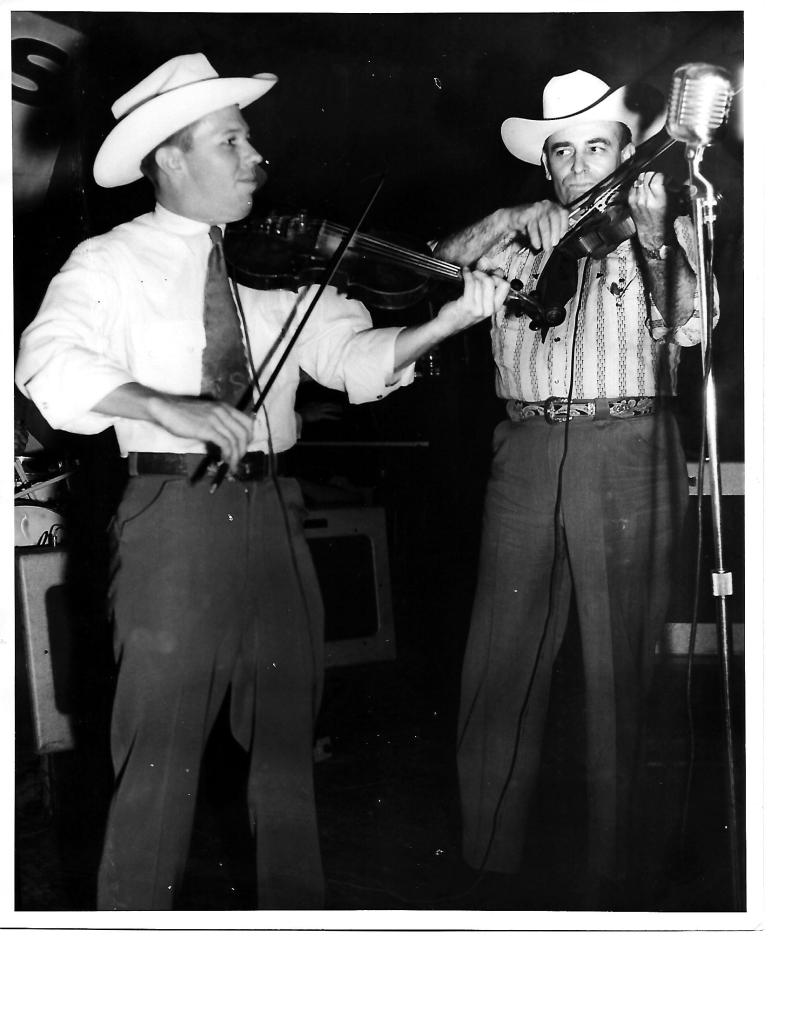
The announcers stepped back from the microphones and gave the boys a thumbs-up to start their show. Le Petite counted off a cajun song about a “Big Mamou” and went into “Will The Circle Be Unbroken” and then “Cold Beer and Calomine Lotion.” The band played every tune they knew, finishing up with Johnny playing a fiddle tune called “Lone Star Rag,” which caused Bob Wills, with a big grin on his face, to rise from his chair and clap along. When the show ended, Bob gave Johnny a few pointers, telling him he had a bright future in country music and to get in touch when and if he returned to Fort Worth. Fifteen years later, back home in Texas and playing country music for a living, Johnny got in touch with Bob Wills, who became his mentor and close friend, gifting Johnny with one of his fiddles, which he is playing in this photo. I have that fiddle as well as my grandfather’s fiddle.

My father, Johnny Strawn playing twin fiddles with Bob Wills. Forth Worth, around 1952.

  • * Cajun Blamofatchy is a piece of wood use

California Ho!-Blind Jelly Roll Jackson Brings Home The Le’ Petite Fromage – Chapter 8


Young Johnny and the rest of the string band joined the Strawn family for Sunday church attendance. John Henry warned the boys that they were about to witness a religious spectacle, so hang on to your britches. He also told the boys that If Jelly Roll was invited to join their group, all four of them would be standing before him, even though he is blind, for revering one’s elders was of the utmost importance.

Bertha and the boys walked with John Henry to the orchestra dressing room, where they found Jelly Roll and Pancho Villa seated on a red velvet settee, likely the same furniture that Sister Aimee used in the soul-saving of Jelly Roll, who now embraced his savior with religious zeal. Each of the boys introduced themselves, shook hands with Jelly, and gave a guarded pat to Pancho Villa; the banjo player was the only one to get a vicious bite from the foul-tempered canine. After a brief, casual conversation, young Johnny inquired if Jelly Roll would entertain the notion of joining the string band. Jelly Roll pondered the request for a few minutes, then gave them a yes, but a young female singer from the choir he had recently befriended would come with the package. The boys agreed, and a deal was struck.

Jelly Roll produced a tidbit of dried bacon from a pocket and gave it to Pancho Villa; he then directed the pooch to hurry down the hallway and fetch Miss Fromage. Pancho returned with a smallish girl in tow. Jelly Roll introduced the boys to *Miss Le Petite Fromage from Chigger Bayou, Louisiana. Her daddy is Baby Boy Fromage, the famous Cajun singer, so her vocal abilities come from good stock. Miss Le Petite was a diminutive gal, measuring less than five feet, yet possessing the curves and form of a fully grown woman, except for her hands and feet, which were the size of a small child’s: she had little baby feets and hands. When she spoke, her heavy cajun-accented voice was as smooth as honey on a warm biscuit. Jelly Roll and Miss Fromage agreed to rehearse with the boys on Saturday at John Henry’s home. The group left with the boys feeling like something big was about to happen.

On Saturday, John Henry gathered up Blind Jelly Roll and Miss Fromage and delivered them to his humble home. The boys perched themselves on the front porch. They were as nervous as a cat in a dog show, and who wouldn’t be: this was their first foray into professional music. John Henry kindly assisted Jelly Roll and Pancho Villa to a seat while Miss Fromage opted to stay standing.

After assisting the boys in tuning up, Jelly asked, “Are you all familiar with Mama Mabel Carter’s tune, Will The Circle Be Unbroken?”

The lads nodded knowingly. He then tapped his foot, “In the key of G, one ana two ana three ana four-ahh.”

After a lively eight-bar introduction with Jelly Roll bending his guitar strings into a torturous sound and Johnny joining him with his fiddle, Le Petite took a deep breath, stood up on her tiny toes, and belted out the song with such gusto that her boisterous vocals nearly blew the boards off the porch floor. By the song’s end, neighbors had gathered in the front yard, their feet tapping and hands clapping in rhythm to the spirited tune.

Turning to the band, Le Petite declared, “The next ditty is from my dear ole Daddy, Baby Boy. It’s a G-C-D progression with A minor thrown in for color. It’s called Party On The Bayou: Cold Beer And Calamine Lotion.” Step it up, boys; it’s a rapide quick-un”

The band played for two hours, covering Cajun music, Dallas blues, and some Bakersfield Okie-inspired country. It was clear that Jelly Roll and Le Petite were professionals and were teaching these lads a thing or two. The rehearsal was a rousing success. But now, if they were to play for money, they needed a good name for the band. Johnny threw a couple out, as did the banjo picker, but nothing stuck on the wall.

Le Petite said, ” Monsieur Jelly Roll, being a blind fellow, and now a born again unto sweet Baby Jesus with the strong, unshakable faith, why not call this outfit **”Blind Faith?” They liked it, and Le Petite announced, “So let it be written, so let it be done.”

  • *Le Petite Fromage is a type of French cheese popular in the bayou country of Louisiana.
  • **Blind Faith was a 1960s supergroup consisting of Steve Winwood, Eric Clapton, Ginger Baker, and Ric Grech. My father couldn’t remember the name of his string band, so Jelly Roll, being blind and embracing his newly found faith, seemed to fit.

California Dreamin’ Chapter 6


New friends, a fresh vocation, and a fine abode for an extended stay. The Strawns couldn’t reckon their good fortune. Were they in the midst of a reverie, or was it a heavenly intervention from on high? My grandmother continued casting glances over her shoulder, half-expecting to glimpse the Guardian Angel who was running this show. Sister Aimee and her mammoth church would require some acclimatization, at least on John Henry’s part.

After the church service, which was more of a Hollywood show than a religious sanctuary, John Henry ambled backstage in search of Blind Jelly Roll Jackson. He rapped on a door marked “orchestra,” but receiving no response, he turned the unlocked knob and proceeded inside. There sat Jelly Roll on a red velvet setee while Sister Aimee fervently laid her hands on his cotton-top head, offering a vigorous prayer of salvation. Pancho Villa stood behind her, firmly attached, growling like a small lion and tugging hard at the bottom of her satin robe. Upon catching sight of John Henry, Sister Aimee hollered,

“Clear out, sinner! Can’t you see I’m rescuing this wretched man’s soul?” John Henry promptly shut the door and made his way back to his family, wanting no part in the strange affairs of that place. This church wasn’t through with him quite yet.

Two weeks into his new job, John Henry felt comfortable enough to open the case of his fiddle. During his time in Texas, he had earned the reputation of a “campfire fiddler,” skilled enough to keep up with any string band in Fort Worth. Nevertheless, this was not the path he aimed to follow. For nearly two years, Young Johnny had shown a deep interest in mastering the art of playing the instrument. The time had come to pass on this skill to the eager young man.

A visit to a local pawn shop produced a fifth-hand fiddle. It wasn’t much of an instrument, but for $5.00, case and bow included, it was good enough for the boy. Johnnie, when given the instrument, almost keeled over from joy. He took the fiddle to his back porch bedroom and began to torment every dog and cat in the neighborhood with his playing, which was more screeching than music.

Miss Angel Halo, a retired high school music teacher, resided a few houses away. She recognized that sound, having heard the screech of strings from her students for most of twenty years. Her Basset Hound, Baby Dog, cowered beneath the back porch while her feline companion, Miss Greta Garbo, made a hasty exit to escape the noise. Miss Halo made her way to the offending house and exchanged pleasantries with the Strawns. Over a cup of coffee, some neighborhood gossip, and a large slice of warm bundt cake, she offered her aid in schooling young Johnnie in the ways of musical notation and the art of the violin; she was a cello player herself. If the boy would mow her grass twice a week, and pull any pesky weeds in her flower beds, she would instruct him in learning the instrument.; no charge. The pact was sealed, and harmony was restored to the neighborhood.

Six weeks into his son’s tutoring, John Henry, not having heard the boy play, was curious if he had learned to play the fiddle. At his teacher’s insistence, Johnnie’s practice sessions were daytime only, and he was confined to the garage, door down, so as not to upset the neighbors.

Saturday evening found John Henry on the front porch, nursing a cold beer and coaxing a few tunes from his beloved fiddle. He asked Johnnie to fetch his instrument and join him, and in a swift instant, the boy returned, fiddle in hand, eager to display his skills to his father. To John Henry’s amazement, as he played an Irish jig, his son effortlessly intertwined harmonious notes with his own, giving the old man a partnership in the form of twin fiddles. A father’s pride has no bounds, and he played on, ignoring the tears on his cheek. In time, that instrument and the dreams of a child would take young Johnnie to the pinnacle of country music.

More to come in Chapter 7

https://notesfromthecactuspatch.com/2024/07/28/california-and-the-magical-elixers-chapter-7/

Would You Paint Over A Rembrandt?


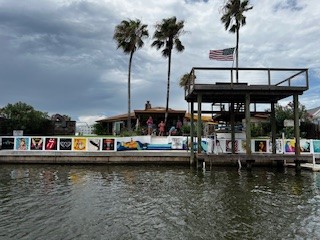
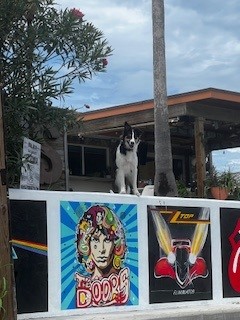
Recently, the saltwater faction of the Strawn clan—my son Wes, his wife Yolli, and grandsons Jett, hired a friend, local artist Jenn Seymour, to paint a mural on their backyard canal bulkhead in North Padre Island, Texas. My oldest grandson, Johnathon, now resides in Corpus, and my granddaughter, Madalyn, was on hand to bolster everyone’s spirits. It’s not their first venture into suburban art; another famous local Corpus Christi mural artist and surfer, John Olvey, painted a large surf mural on their home’s streetside view before he passed away in 2022. Now, the POA, HOA, or whatever this group of whiners calls themselves these days, served my son a letter of violation and demanded the mural be painted over, claiming it is an advertising sign, which is prohibited per their bylaws. The word ‘serve’ is a stretch; they actually taped it to his nice mid-century modern front door, “too yellar” to actually hand it to them in person. I don’t believe this coterie of malcontents thought this one out. Now, it’s taken on its own life form and is spreading like “Pod People.”

The artwork in question is paintings of the covers of the most classic albums in rock music history: Led Zepplin, Jimi Hendrix, ZZ Top, The Beatles, Bob Marley, The Rolling Stones, Willie Nelson, Selena, Nirvana, and a few others. We picked the albums from his extensive collection, and the artist did her magic aided by acrylic paint, Petoli incense, Red Bull, and 1960s good vibrations. Folks from all over the island, Corpus, and far-away lands have made a pilgrimage by boat, foot, and car to view the masterpieces. Wes and Yolli, being gracious hosts, offer a cold bottle of Texas water and a bite of food and lead them through their home to the backyard bulkhead and dock for a better view of the art. Piper, their border collie, happily greets everyone.

The wheels of justice turned quickly when the downtrodden art connoisseurs were wronged. Within a few days, the local paper, The Island Moon, published a rousing piece praising the artwork and exposing the troglodytic POA. One local television station, KRIS, dispatched a top-notch reporter to shoot film and interview Wes, his kin, the artist Jen Seymour, and Piper, the Border Collie. Momo and I spectated the whole shindig from the covered patio and were mightily entertained by the publicity of the whole affair.

This is the last surface in the compound suitable for decoration. So what now? Maybe three large Mariachis playing frogs on the roof? It could happen…it’s the island.

Ob-La-De-Ob-La-Da Life Goes’ On Brah…La-La-How The Life Goes’ On


Yes, Dear Hearts, as the Beatles say, life does go on. As of today, I’m five years cancer-free. I’m expecting a face time phone call from Sir Paul and Ringo anytime now.

It’s 1968, And We Are In A Recording Studio


By request, I am again publishing this post, including my 1968 recording of the band I was part of, The A.T.N.T.; formally, we were the Orphans but changed our name at the suggestion of Mark Lee Productions, our manager. Enjoy.

The year was 1968, and the rock band I played in, The A.T.N.T., recorded a 45 at Summit Sounds in Dallas, Texas. The band had been called The Orphans, but a copywriting dispute resulted in a name change. Our then-manager, Mark Lee Productions, wasn’t keen on the idea because we had been under his management and promotion for a year.

The A side is “Cobblestone Street,” written and sung by myself and our drummer Barry Corbett. The B side is ” No One Told Me About Her,” written and sung by our lead singer and bass player, Danny Goode. The two producers, Marvin Montgomery and Artie Glenn, suggested we add horns to get a Chicago Transit Authority sound. Before the brass was added, Cobblestone Street was loud and raw with loud guitars and organs. After adding the horns, we returned to the studio and tweaked the cuts. I purposely untuned my Gibson 335 a bit to give the guitar break a bit of an out-of-tune carnival sound. Marvin, who went by the name of Smokey, was a member of the Light Crust Doughboys since the 1930s and played with Bob Wills. He produced Paul and Paula and Delbert McClinton. Artie Glenn wrote the famous Elvis hit “Crying In The Chapel” and many others; he was also a Light Crust Doughboy western swing musician. These two men were top-shelf record producers, so we listened when they suggested.

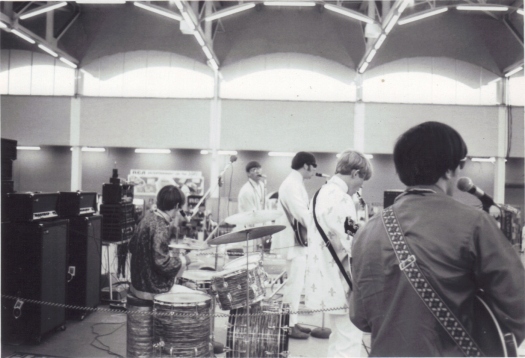
The A.T.N.T. at Flower Fair 1968

Our band members in the above picture are: foreground right John P. Strawn ( me ), then Jarry Davis on rhythm guitar, Barry Corbett on drums, Danny Goode on bass, and Marshall Sartin on keyboards. Barry and Marshall have passed on, but Danny, Jarry, myself, and our wives met for lunch a few weeks back in Fort Worth. It’s obvious why we all have severe hearing loss from the large amplifiers turned up to 11.

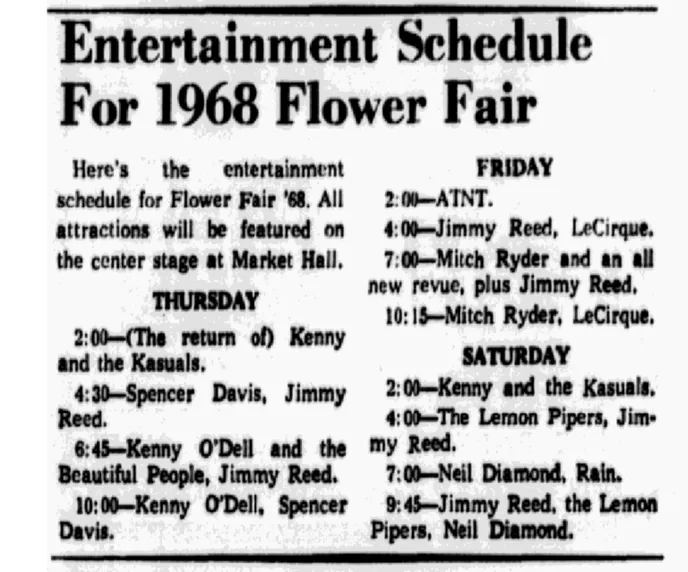
We introduced the songs at Flower Fair 1968 but without the horns. The Doors were supposed to play the event, but last-minute scheduling got sideways, and they couldn’t make it. This was the Spencer Davis Group without Steve Wynwood in the band. LeCirque ( The Smell Of Incense Fills The Air ) was formally known as The Southwest F.O.B. with members England Dan and John Ford Coley, who would later go on to fame as a duo, both local Texas boys. Kenny and the Kasuals were also a local group managed by Mark Lee.

The record received good airplay, but we never made much money. Distribution was the key, although the local radio personalities gave it positive chatter. Hope you enjoy the tunes.

“Getting Zapped…Brown Shoes Don’t Make It” And A “Beach Party On The Ganges”


It would be a shame if I didn’t include some local 1960s rock musical history by spotlighting our drummer, Barry Corbett, otherwise known in our tight little musical circle as ” Li’l Spector.” The moniker came about because the boy, at age 15 years old, was a musical genius in the same vein as Brian Wilson, Leonard Bernstein, and Phil Spector: thus his earned nickname. We would never know why he chose the drums as his primary instrument: the guy played an assortment, including Bongo drums, kazoo, paper and comb, Dog House bass, violin, Hurdy Gurdy, guitar, keyboards, Vibes, Trumpet, Piccolo, Harmonica, Juice-Harp, Spoons, Autoharp, Dulcimer, French Horn, Tabla, finger cymbals, gasoline-powered Lawnmower, and Sitar. I’ve probably left a few out; it’s been a while since I thought about this. Barry’s original drums were worn out, so his father purchased him a set of Slingerlands. The finish was all swirling and psychedelic, and if we wore those cheesy 3D glasses from 7-Eleven, we could see the Summer of Love a full year before it happened.

In 1966, our repertoire consisted of The Beatles, The Rolling Stones, Hollies, Paul Revere And The Raiders, The Turtles, and The Byrds. We also played a handful of Beach Boy songs. Our voices were still high, so the Brian Wilson falsetto wasn’t a problem.

The 1966 Orphans in our Paul Revere boots

Unknown to Jarry and I, Barry secretly listened to weird underground music: “Frank Zappa And The Mothers of Invention.” These guys were so whacked out that the radio refused to play them, but Barry would. He adored Zappa and wouldn’t wear brown shoes in brotherhood to the song ” Brown Shoes Don’t Make It.” He was also a newbie-semi-devout disciple of East Indian music, mainly Ravi Shankar and his droning Sitar, thanks to George Harrison and the album Rubber Soul.

We knew Barry had purchased a Sitar from “Pier One,” a Dallas specialty store loved by the Hippies. The store hawked strange goods from India and the Middle East. He called one day and asked that Jarry and myself drop by to hear him play his sitar.

We were surprised when he could coax the part to “Norwegian Wood” out of the goofy instrument, so we agreed to learn the song and let him play it during our next gig at the Richardson Recreation Center the coming Saturday evening. He failed to mention that he had two additional musicians accompany him. He was a tinkerer, so he removed the electric pickups from his Gibson Melody Maker guitar and installed them on the sitar, creating the first electric East Indian instrument. Two Electrovoice condenser microphones were used to amplify his additional musicians.

Our gear was set up, and sound checked an hour before the dance, and in strolls Barry, dressed in a Nehru suit: his girlfriend and a guy about Barry’s age in tow. His followers, wearing a white Sari and a Dhoti, trolled behind him: they carried a small bongo-like drum called a Tabla and two tiny Zildjian cymbals on cute little stands. The guy was carrying an instrument that looked like a cross between a fiddle, a guitar, and a Dulcimer. All three had bright red Bindi dots on their foreheads. Barry was lugging his sitar, drum kit, and a Vox AC30 amplifier. After he set up his drums, he ran a sound check on the electric sitar and stuck the other mic inside the Tabla drum, one next to the little cymbals and the frankeninstrument. They sounded pretty good for a Rube Goldberg rigged setup. The three of us were duly impressed but leary of what might happen. Chaos followed Barry like an afternoon shadow.

The band played the first set to about 300 sweaty teenagers. The building’s air conditioning couldn’t keep up: it was a typical July in Texas.

Barry and the two musicians rolled out a Persian rug, which was likely stolen from his mother’s dining room, and positioned it in front of his drums. The girl lighted incense sticks held in large brass holders. Barry lugs his sitar from behind the stage, plugs it into the Vox amp, and sits in the traditional Shankar crossed-legged position. He is ready to rock. We break into Norwegian Wood, and the three-piece Hindi band sounds darn good but a bit loud. The teenagers move in close and surround the trio. Who are these weirdo-freaks? We finished the tune and received polite applause. A better reception than we had hoped for, but then…

For their second tune, Barry announces they will play Ravi Shankers’ biggest hit: “Beach Party On The Ganges,” a snappy little number sounding like Brian Wilson, and the boys meet Ghandi and crew for a cookout on a crocodile-infested beach. The sitar starts to feedback, and the Tabla drummer and Frankenguitar lose their tempo, not that there was one ever established, and Barry, now in a musical trance, is all over the sitar. The crowd of surrounding teens is transfixed, awed by his Zen Zone musicianship. The two other musicians, lost and toasted, have stopped playing. Lil Spector drives onward in his moment of musical adulation.

The Sitar feedback was incredible, so Barry, still locked in his “Ravi sitting position,” leaned back to reduce the volume on his amp. He leans too far, loses his balance, and falls backward, causing the head of his Sitar to catch a mic stand and break off the long body of the instrument. No one knew that Sitar strings were wound to a deathly tension. When the Sitar broke, the strings popped, winding around Barry’s head into his hair and then into his two other musicians’ long hair. It was a disaster. All three were incapacitated on the rug, unable to move. The crowd hooped and hollard, thinking it was part of the show. The poor Sitar wound up in the dumpster, and his musical disciples left the fold, throwing their red-dot makeup tin at Barry as they stormed out of the Rec Center. At his request, we dropped Norwegian Wood from our setlist.

So You Want To Be A Rock N Roll Star? 1966-67 – Part 2


“So you want to be a rock and roll star?
Then listen now to what I say
Just get an electric guitar
Then take some time and learn how to play”…The Byrds 1967

After the family moved from Fort Worth to Wichita Falls for six painful months and then to Plano, Texas, I met a classmate and fellow guitar player who was also bitten by the “rock-a-rolla” bug. He knew another guy on his block who played guitar and owned a Fender Bassman amp, which automatically made him a band member, and he knew a neighbor across the street who was a drummer with a snare and one cymbal. He also knew a kid with another cheap Japanese guitar that would part with it for $10.00 bucks. I snatched it, bought his Sears amp for another $15.00, and was back in “the biz.” Hours of practice produced twenty songs, which we could repeat at least once or twice if they were shuffled around and changed singers and keys. Our first gig was at the Harrington Park Swimming Pool, Plano, Texas, early summer of 1965.

The Dolphins: left to right: Jarry Boy Davis, Warren Whitworth, Ron Miller, Jay-Roe-Nelson, Phil Strawn

Guitar tuners were not invented yet, so we used a pitch pipe and got as close as possible to A440, and apparently not close enough; we sounded like hammered Racoon crap on grandma’s china plate. It was a humiliating experience. In my playing frenzy, I broke my B string and had to play with five strings, and then our amplifiers went south because the outside temperature was over 100 degrees, and we were in the direct sun. Then, the drummer’s head on his snare split, his cymbal fell over and cracked, and Jerry Nelson, another guitar flanger, tripped on an extension cord and fell flat, damaging his Silvertone guitar. Our third guitar player, Warren, came into contact with water splashed from the pool onto the concrete while touching the strings of his electrified, ungrounded guitar, resulting in a bad electrical shock. Hair frizzed out, smoking from his ears, and burns on his fingers; he finished the gig, not knowing who or where he was. The grand debut ended with sympathetic applause, and the pool manager refused to pay us, which, per our contract, was free burgers and shakes. Warren, our previously electrocuted guitar player, got into a fight with our drummer, and the two rolled around in the gravel parking lot for a while with no clear victor. We thought Warren was a trooper, considering the amount of electricity that had almost fried him an hour before. Bad music tends to piss folks off. The final curtain was when my pal Jarry discovered his Mustang had a flat tire, so we had to call our parents to rescue us. Welcome to the rock n’ roll music business.

From 1966 into 1967, the band continued with better gear, a new drummer and bass player, and a different name. We were now known as “The Orphans.” A strange pick since we were all middle-class guys with full sets of parents, but Barry Corbett, our drummer, thought it sounded tough and a bit rebellious. Barry may have been the biggest rebel of the four members, listening to Frank Zappa and Spike Jones and teaching himself to play the Sitar. George Harrison’s influence led him into the realm of Indian music, which he fully embraced to the point of obsession. He developed a strange Peter Sellers-type accent, wore the red dot on his forehead, and had two high school girls follow him around town wearing white robes, playing with small cymbals attached to their fingers. He was also a rudderless musical genius and would soon lead us into the semi-big time and the really big show.

Alice Davis, Jarry’s mother, was now our official manager and did a wonderful job of it. She knew people and had connections and was not afraid to use them or to press a business contact into hiring her band. We were booked around Dallas and Fort Worth most Friday and Saturday nights. We made some good cash for high school kids but spent all we made on new equipment and clothing. Band members were in constant rotation. Teenage musicians proved to be an unreliable commodity.

Our keyboard and bass player left us for high school football, again, leaving three of us. Calls went out, Alice worked the phones and contacts, and we auditioned two musicians from McKinney, Texas. Danny Goode, a bass player/singer and former member of the Excels, and Marshall Sartin, church organist, classically trained pianist, and blues guitar player. We played a few songs as a five-member band and almost passed out. It was as if the ghost of Phil Spector had brought us into that practice room at this appointed time in the universe, which was strange because Spector was still alive and kicking in Los Angeles.

The Orphans. Left to right front: Jarry Davis, Danny Goode. Left to right rear: Barry “Lil Spector” Corbett, Phil Strawn, Marshal Sartin

Miss Alice was religiously overcome with musical emotion and experienced a spell of the rock n’ roll vapors that led to seating herself with a double Jack Daniels and branch water. Barry, our drummer and musical genius, had an epiphany and went to work on arranging our music and vocal parts, showing Marshall how to play them on his Farfisa Organ, which was another strange thing; Jarry and I didn’t know Barry could play the piano, or as we soon found out; the guitar, the trumpet, the sax, or the vibes. We dubbed him “Lil Spector” in honor of the famous Wall of Sound producer.

After the Miss Janelle Bobbie Gentry-infused tenure that ended in a puff of hair spray and perfume, the band took a vote: no females allowed. Marshall was still recovering from a severe case of the Love Fever Hubba Hubba’s, and we needed him in good condition for our upcoming gigs.

Miss Alice grew weary of working the phones, dealing with clubs and booking gigs, her realty business was suffering and needed her attention. She arranged for us to be managed by an upstart agency called Mark Lee Productions of Dallas, Texas. Mark was a go-getter and had more connections than Bell Telephone. His one and only main band, Kenny And The Kasuals, had just released a great 45 that was climbing the charts, so we were excited about working with him. We signed on the dotted line of a ten-page contract that not one of us read. Why bother? We were young and full of piss and vinegar: point us in the direction of the stage and plug us in!

Within twenty-four hours, The Orphans were booked into some of the hottest venues in the DFW: The Studio Club, LuAnns, The Pirates Nook, Phantasmagoria, and Teen A-Go-Go and The Box in Fort Worth. Mark Lee was turning down gigs because he had only two bands. We wouldn’t have a Friday and Saturday night free for two years, and even less free time in the summer when the bookings took up most of each week.

We were booked to play a Christmas party for Parkland Hospital at the famous Adolphus Hotel in downtown Dallas. Pulling up to the front in our 57 Caddie Hearse caused a stir. The bellman politely told us the bodies were picked up at the rear. We got the joke and proceeded to the loading docks. The party turned out to be for the doctors, nurses, and administration folks. In the next ballroom, Braniff Airlines was having their Christmas party, but with no band. It didn’t take long before the airline partiers spilled over into the hospital party, and that’s when it got crazy.

These people, supposedly responsible adults, were dancing on the tables, had a conga line going on the bartop, and we had our own go-go dancers on either side of the stage. Three of us were under the age of 18, but that didn’t stop the inebriated partiers from pumping us full of hooch in the form of cute little airline bottles. By the last set, we had gone from charming and talented to stupid drunk and were glad the gig ended. We couldn’t locate our keyboardist, Marshall, so we loaded up his gear and headed out. He showed up a few days later with some dumb-assed story he couldn’t talk about: the Hubba-Hubba’s got him again.

More to come in Part 3