Momo acompanied me to my primary doc today for the results of my physical a few weeks back: it’s best she drives, but I’ll explain all that later on.
I like my doc; he’s a young fellow who dresses nice, wears stylish shoes, and wears colorful socks, sort of like a younger version of myself. He immediately started in on the blood work results, which were amazing since I’m on the cusp of 77 years old. I had a few age-related glitches, and he wasn’t worried just yet. I asked him, “When is yet a problem?” He said he would let me know later. I told him my heart doctor said I had a real good chance of a major malfunction, but couldn’t tell me when that might happen. He said not to worry, it would be quick and painless. I also said I needed to lose 25 pounds, and could he put me on that Wegovy pill or the Ozempic shot all the movie folks are killing themselves with? He sidestepped that question. I said, “Jeeze, doc, I don’t want to look like Demi Moore or Oprah, I just need to lose a few pounds.” He said just stop eating and work out. ” That’s all fine, but I can’t work out; I’m disabled from a bad back surgery, and my body won’t cooperate, and Momo just bought a yummy French Vanilla Pound Cake with some Blue Bell Ice Cream: get the picture?
The young nurse was a bit too perky when she handed me the little notebook for the cognitive test. She said the instructions are a bit tricky. She was right, they were Ayatollah gibberish. I did the best I could, but failed with flying colors. All those numbers, words, little pictures of monkeys and fish and ice cream cones. Old folks don’t give one shit about any of that crap, so I was a miserable failure. I told him I re-learned to play the mandolin in six weeks and will be taking on the fiddle next week, so my brain can’t be that blocked up. He gave me a cute little Dr. Marcus Welby laugh and said he wants more blood and another cognitive test to see if I should be in some sort of home, or at home with Momo pulling me around in a wagon with a drool sponge taped to my chin. I asked him if I was smart enough to be president, and he said, “No, we’ve already been down that road.” As of yet, I haven’t left the truck keys in the freezer, burned down the shed, or dug up a natural gas line with my spade, so there is still hope. Old folks remember what they want to and screw the rest of it.
I called them the Old Scotchmen; my mother had a few different names, none of which were complimentary.
In 1968, my father, John Strawn, and his friend Dexter Prince were known characters on the island of Port Aransas, Texas, which was an honor, considering the long list of other local characters that added lore and color to the quaint fishing village. Lawnmower Ted, Shorty Fowler, Spanny Gibbs, Carlos Moore, Captain Rick Corn, and the notorious but lovable Jack Cobb were a few, and the list changed weekly depending on their antics.
My parents had purchased a house on East Street in the winter of 1968 and planned to spend holidays and summers on the island. Our main home was in Plano, Texas, where my father was a custom home builder and developer. Saltwater and the island were part of my childhood, shaped by the journeys to Port A, which satisfied my father’s and grandfather’s love of saltwater fishing, which began when the family lived in Los Angeles during the 1930s. Dexter and his family had been coming to the island just as long and preferred to live in one of Gibbs’ Cottages, his home away from home. Dexter and my father were avid fishermen, competent tellers of tall tales, and aficionados of fine Scotch Whiskey. My father’s AquaSport fishing boat allowed them to fish until they were spent, and then manufacture believable lies about their catch to anyone who would listen, which was usually the patrons of Shorty’s Place, their favorite post-angling hangout.
Most evenings, when both were on the island, Dexter would swing by the house around ten-thirty. My father, already into his routine of watching The Tonight Show would be dressed in his pajamas and working on a nice tumbler of scotch. He would change into shorts and a T-shirt, and the two characters would take their drink and drive around the island in my folks’ turquoise dune buggy, making big plans and yapping. That was back when Port A was small and the police knew everyone in town, so they left the old Scotchmen alone. The strict DUI laws were years away.
One evening, Dexter dropped by around eleven or so, and the two jumped in the dune buggy and took off for their ride. About halfway through the exploring, they realized they needed more scotch, so Dexter recommended a stop at Shorty’s Place. My father balked because he didn’t change, and was wearing his red silk pajamas and barefoot. Dexter said it would be fine, the place would be empty on a Tuesday night. It wasn’t: it was full of locals and tourists. They strolled in and took a seat at the bar. Shorty, ever her sweet self, told my father he could sleep on the cot in the storeroom since he was dressed for bed. They ordered a nice glass of Chivas Regal scotch. A few other patrons made some smart-assed remarks, making my father turn as red as his attire. Even the local gal who wore nothing but a white satin slip on most nights complimented him on the cute red pajamas. After that, John always made sure to bring a bottle of Scotch for the ride around.
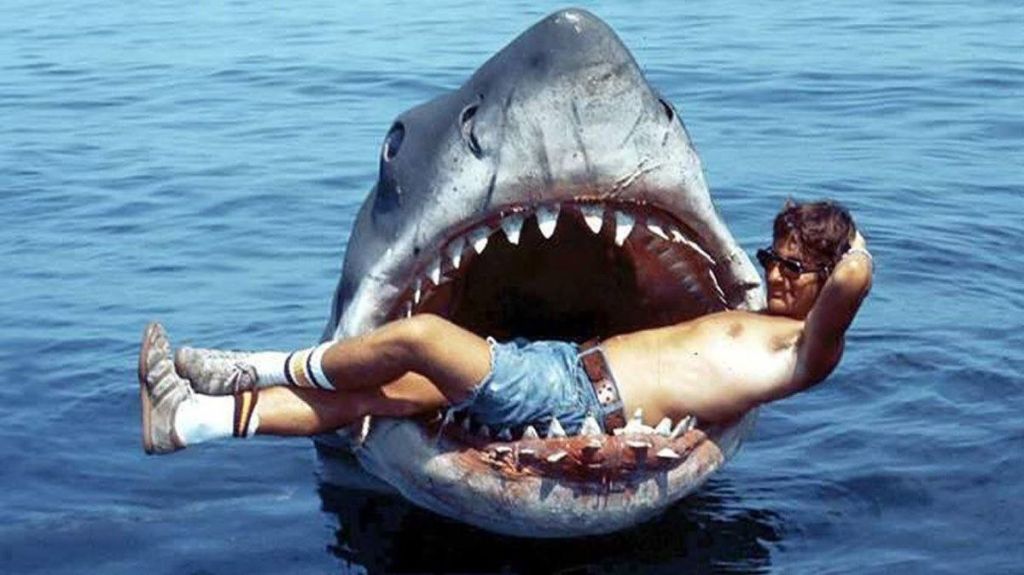
In honor of one of the greatest scary movies ever made, I’m posting a picture of my late, late cousin, Chumley, who worked as a shark wrangler and trainer on the iconic 1975 movie, Jaws. He was always hamming it up with the cast and crew and thought he had trained the white shark to join in the fun. This picture was taken a few seconds after he informed Quint and the Chief that they would need a bigger boat and more weaponry. Sadly, the only item recovered was a sneaker, which was sent to his widow.
The makeshift sunblock my father had fashioned from a tarp and four cane fishing poles wasn’t beautiful, but it worked fine. Sitting under the contraption was my little sister, mother, and grandmother. I was eight years old. He and my grandfather were not far away, holding their fishing rods after casting into the rough surf. Whatever they caught would be our supper that evening. I wasn’t invited to fish with them; I was too young, and the surf too dangerous. Besides, my small Zebco rod was only strong enough to catch a passing perch.
The visit was our annual summer fishing trip to Port Aransas, Texas, a small fishing village on the northern tip of Mustang Island. I don’t remember my first visit, but my mother said I was barely one year old. After that, the Gulf of Mexico, the beach, and that island became part of my DNA
I’m an old man now, but I can recall every street, building, and sand dune of that small village. Over the decades, it became a tourist mecca for the wealthy, destroying the innocent and unpretentious charm of the town. Gone are the clapboard rental cottages with crushed seashell paving and fish-cleaning shacks. Instead, rows of stores selling tee shirts made in China sit between the ostentatious condominiums, restaurants, and hotels. I prefer to remember it as it was in the 1950s when families came to fish, and the children explored the untamed beaches and sand dunes.
Born in 1891, my grandfather was an old man by the time I was eight years old. Tall and lanky, with white hair and skin like saddle leather. He was a proud veteran of World War 1 and as tough as the longhorn steers he herded as a boy. He lost part of his left butt cheek from shrapnel and was gassed twice while fighting in France. Nevertheless, he harbored no ill feelings toward the Germans, even though he killed and wounded many of them.
On the contrary, he disliked the French because they refused to show proper gratitude for the doughboys saving their butts from the Krauts. As a result, he wouldn’t allow French wine in his home. He preferred Kentucky bourbon with a splash of branch water or an ice-cold Pearl beer. He left his hard-drinking days in Fort Worth’s Hell’s Half Acre decades ago. He told a few stories about the infamous place, but he was careful to scrub them clean for us youngsters.
His one great joy in life was saltwater fishing with my father, playing his fiddle, and telling stories to whoever would listen. The recounting of his early childhood and life in Texas captivated my sister, cousins, and me for as long as the old man could keep talking. He told about being in France but never about the horrors of the war. He lived a colorful childhood and, for a while, was a true Texas cowboy. Half of it may have been ripping yarns, but he could tell some good ones. My mother said I inherited his talent for recounting and spinning yarns. If that’s true, I’m proud to have it.
He could have been in a Norman Rockwell painting while standing in the surf, a white t-shirt, a duck-billed cap, and khaki pants rolled to his knees. I was in awe of the old man, but I was too young to know how to tell him. My grandmother said he was crazy for wearing his gold watch while fishing.
The timepiece was a gift of gratitude from his employer when he worked in California during the Depression years. A simple gold-plated 1930s-style Bulova. It was an inexpensive watch, but he treated it like the king’s crown, having it cleaned yearly and the crystal replaced if scratched. He called that watch his good luck charm and wore it when fishing for good juju. It was a risk that the salt water might ruin it, but he took it. He caught five speckled sand trout and half a dozen Golden Croaker that day, so the charm worked. Add the three specs my father snagged, joined with the cornbread and pinto beans my mother and grandmother cooked, and we dined like the Rockefeller’s that night.
The next few days were a repeat of the same thing. I rode my blow-up air mattress in the shore break and caught myself a whopper of a sunburn on my back. The jellyfish sting added to my discomfort. I was miserable and well-toasted, but I kept going, determined to enjoy every second of beach time. We returned to Fort Worth as a spent and happy bunch. The family would give it another go the following year.
Two years passed. One day, my father told me my grandfather was sick and would be in the veteran hospital in Dallas for a while. He mentioned cancer. I was young and didn’t understand this disease, so I looked it up in our encyclopedia and then understood its seriousness. One week, he seemed fine, sitting in his rocking chair playing his fiddle and telling stories, and the next week, he was in a hospital fighting for his life. His doctor said being gassed in the war was the cause of his cancer. It was not treatable and would be fatal.
Near a month later, he was not the same man when he came home. His face was gaunt; his body, which was always lean and wiry, was now skin and bone. The treatments the doctors ordered had ravaged him as much as the disease. My grandmother’s facial expressions told it all. There was no need to explain; I knew he would soon be gone. My father was stoic, if only for his mother’s benefit. His father, my grandfather, was fading away before our eyes, and we couldn’t do a thing to change the outcome.
A week after returning home, Grandfather found his strength, walked to their living room, and sat in his rocking chair. He asked me for his fiddle, which I fetched. He played half of one tune and handed it back to me. I cased it and returned it to the bedroom closet; he was too weak for a second tune. His voice was raspy and weak when he spoke, but he had something to say, so I took my position on my low stool, as I often did when he recounted his tales. I noticed his gold watch was loose and had moved close to his elbow. His attachment to the timepiece would not allow removal. It was a part of him. He spoke a few words, but continuing was a painful effort. My grandmother helped him to his bed. He removed his watch, placed it on the nightstand, and lay down. He was asleep within minutes. From that day on, he would sleep most of the time, waking only to be helped to the bathroom or to sip a few spoonfuls of hot soup. I would visit after school, sitting next to him while he slept, cleaning his watch with a soft cloth, winding it, and ensuring the time was correct. I felt he knew I was caring for this treasured talisman.
I came home from school on a Friday, and my grandfather was gone. I could see the imprint in the bed where he had laid, and his medication bottles and watch were missing from the nightstand. Mother said he took a turn for the worse, and my father took him back to the veteran’s hospital.
The following day, my father came home and told us my grandfather had passed away during the night. I noticed he was wearing his gold watch. I thought if the timepiece was such a lucky charm, as I had been told all these years, why had it not saved my grandfather?
Life continued on Jennings Street; for me, some of it was good, and a little of it was not. Father wore grandfather’s watch in remembrance and respect. He waited for the magic to come. He gave me his worn-out Timex, which was too big for my wrist, but I wore it proudly.
The magic of the watch began to work for my father. He acquired two four-unit apartment houses near downtown, fixed them up a bit, rented them out, and sold them. We then moved to Wichita Falls, where he started building new homes. A year later, we moved to Plano, Texas, where he continued to build houses. It appeared the good luck of the watch was working overtime. I became a believer in this talisman. The hard days in Fort Worth were well behind us now. The future held promise for our family.
On a day in 1968, riding with my father to lock his homes for the night, we had a long overdue father-to-son talk. I rarely saw him because of his work, so I welcomed the time. Had I thought about college? What was going on in my life? I played in a popular rock band, so that was a point we touched on. He didn’t want me to become a professional musician as he had been. I assured him this phase would end soon. He and my mother were worried I would be drafted and sent to Vietnam. We talked for two hours. He remarked that as long as he wore his father’s watch, everything he touched turned gold. My father was successful, so how could I doubt his beliefs?
In the summer of 1969, the band on the old watch broke while we were fishing for Kingfish in the gulf off Port Aransas. While gaffing a Kingfish, my father bumped his wrist against the side of our boat. The watch fell into the water, and in a flash, it was gone. He said that if he had to lose it, this was a fitting end, lost to the water his father loved so much.
I wrote this recount a few years back and figured it might need a little sunlight shined on it.
We’ve been on North Padre Island for the past few days, visiting my son and his family. I’ll be 72 on the 17th and figured I owe myself a bucket list item: surfing one more time.
Wes, my son, also a surfer, was accommodating and borrowed a new, all-foam board that he thought I could handle. My grandson has a much shorter board because he is 8. The beach at Padre Island was the most crowded mess I have ever witnessed. Granted, the last time I was on a Texas beach on Labor day was in the mid-90s, and that was at Port Aransas. This was beyond stupid. Thousands of people parking their cars near the water, getting stuck in the sand, hogging any sliver of a spot to reach the water. After searching for an hour, Wes found a small opening and managed to squeeze his truck into the slot.
Beach chairs are unloaded, cooler and surfboards ready, so my grandson and I grab our boards and wade into the surf. As it turns out, the surf today was terrible. Slushy with no good form. We struggled to find a decent wave.
I paddled through the shore break past the first sand bar and tried to sit on my board. Nope, that wasn’t happening. I needed a real fiberglass and foam board. I took off on a wave and couldn’t stand up: nope, that neither. The head injury from two years ago is most likely the culprit. No balance and no equilibrium, and less good sense. Being 72 didn’t help my quest. I was a good surfer in the 60s and 70s, and I figured it was something that couldn’t be forgotten. Wrong on my part. The defeat was at hand, and I took it willingly.
Humility hung on me like my wet tee-shirt. I slow walked it back to the beach. I laid the board down and told my wife, Momo, that I could scratch this one off the bucket list. Sometimes your memories are bigger than your brain.
I came into this world in 1949, a mere flicker of life amidst the portal to the West, Fort Worth. The good nuns who ran the hospital, those stern guardians of order, chose an unconventional method to usher me into my first cries, with a 12-inch wooden ruler upon my fragile backside rather than the customary spank from a soft hand. From that day forward, I held a quiet disdain for nuns, a sentiment my mother echoed with an understanding heart. I emerged into stark confusion—bright lights glaring above, towering figures in black robes scuttling about. A tiny stranger in a bewildering land devoid of any plan, I only wanted to know what the hell just happened and where I was.
I was a happy kid, or so I’m told. My routine was breakfast, playing until lunch, eating a baloney sandwich, washing it down with Kool-Aid, playing some more, eating fresh-baked cookies from Mrs. Mister’s kitchen, watching afternoon cartoons, taking a bath after supper, and going lights out—pretty mundane stuff.
My family rallied behind Roosevelt in the 1930s, their hearts giddy with hope for a better tomorrow. They believed with every fiber of their being that Franklin Delano Roosevelt pulled this nation from the dark abyss of despair during the Great Depression, and perhaps he did in many ways. Pushing the buttons that led the country into World War Two with the Nazis and giving the checkered flag to spank the Japs. The Works Progress Administration sprang forth from his dream, and thousands of men and women found temporary refuge in constructing parks and carving streets in Fort Worth; each brick laid a testament to earning a paycheck. My father had a lovely singing voice, so he filled our home with a constant tempest of musical disdain aimed at Dwight Eisenhower from the first light of dawn until the sun sank low and I was fast under my covers. Eisenhower was a gentle figure, a soft old soul cradling a golf club like a weary king holding his lost crown tightly. Later in life, when I took to the sport, I learned he was a 3 handicapped and was a certified bad-ass who commanded our troops on D-Day.
I was too young to grasp the significance then, but amidst the familiar shouts and wailing, I began carving my political identity. To belong to this raucous, somewhat heathen brood, I learned to hurl adult insults at Eisenhower and shake my tiny fist in solidarity with my kin. It is a truth held dear — a family that goes full bore batshit crazy together stays together. We were a close-knit brood, vowing to all enter the mental hospital together if need be to prop up the sickest of the clan. My father was the first. Politics and his alcoholic mother got the better of his mind, and he was tied down and shocked like Ready Killowwat. He came out of the procedure a Republican, which caused his extended family to shrink back in disgust and horror. The doctors had taken a witty lunatic Democrat and turned him into a pipe-smoking, tweed-jacketed professor of Ryan Street. His demeanor hadn’t changed much, but the burn marks on his temples never faded. I viewed him as a now sophisticated Frankenfather.
Thanks to my electrically converted Pop, I eventually forgot about old Dwight. I learned to read and write and took to my Big Cheif Tablet, hoping to make a mark, or at least a permanent stain, on this planet. Politics went by the wayside, and I lost interest in gnashing, wailing, and blaming fault. I was becoming a writer thanks to my favorite aunt, Norma, who diligently taught me to read and write before entering first grade. I was a bored child prone to fidgeting while daydreaming about Mark Twain and Micky Spillane while sitting at my tiny desk. I had no interest in the little people around me, uneducated booger eating feral children with no purpose.
When John Kennedy was elected president in 1961, I began reading Life Magazine, my mother’s favorite slick-paged rag. He was a nice-looking fellow with an elegant wife. My mother and her friends went limp, noodle-wobbly-legged when discussing Mr. and Mrs. Camalot. I didn’t get it until the Cuban missile crisis came about. He was willing to risk the population of America just to give Castro and Krushev a butt-whooping and the middle finger; “here Jackie, Hold my 80-year-old Scotch and soda and watch this shit”. JFK had some big ones, as attested by Marylin Monroe. All of us school kids knew we were about to be ashes to ashes and dust to dust. Teachers stepped up the nuclear drills, and we spent the better part of each school day hiding under our desks. Why? If the bomb incinerated our school building, then our tiny desk wasn’t going to protect us. That’s when I realized teachers were as stupid as the rest of us Neanderthal knuckle-dragging children.
When the lovely gentleman with the perfect hair took a headshot in downtown Dallas, Texas, I was like most of my kin and friends. We all felt terrible and mourned for a few days, but then it was “back to the basics of life;” Luckenbach, Texas, didn’t exist then, so we made do with Fort Worth.
My cousins and I were heavily into Brother Dave Gardner, the preacher turned comic. His albums were a bulging bag of witty, logical, and borderline racist comedy. America hadn’t learned quite yet to be so easily offended. Brother Dave’s favorite targets were Lyndon Baines Johnson and James Lewis, a fictional black character from the Deep South. LBJ was perhaps the most excellent Politicasterd crook in history, and by damn, he just had to be from the great state of Texas. We agreed; the lumbering goon from the hill country was as slimy as they come.
Around 1965, I began to form my own political beliefs. I was neither a lib nor a conservative, But a white flag on a long stick, wafting in the breeze. Heavily into surfing and playing rock music on my cheap Japanese guitar, I began to listen to the Beatles. I was told that some songs held mysterious political messages. When Sargent Pepper‘s Lonely Hearts Club Band debuted, My bandmates and I recorded the album on a Reel Reel tape machine and played it backward. After that, I was sure the four lads from Liverpool had been sent by Beelzebub to corrupt our nation’s youth. That’s around the same time our drummer, Little Spector, bought into the Hindu religion and found solace in Ravi Shankar and his melodious Sitar. It seemed I was the only one in the band with enough political knowledge to hold a riveting conversation with an adult.
The 1960s found me non-committal to a political party. The long hair and playing in a band were my disguise. Most of my friends and bandmates were in the bag for the liberal side of life; I was a relic, an uncommitted poof in the wind, although I dug Robert Kennedy and was just getting into his mantra when he followed his older brother to the Spirit In the Sky. Now, there was no choice, but “Little Richard” Nixon and his “Five O’clock World” beard shadow and sweaty upper lip creeped me out.
In 1976, I took a direct hit to the head from the mast while sailing my Hobie Cat 16-foot catamaran sailboat in the Gulf of Mexico off the island of Port Aransas. I was sailing by myself, which is not recommended, and was jibing downwind, which is also a no-no, when the mast caught the wind and reversed position, knocking me off the boat. I was wearing a diaper rig attached to the main mast, and that saved my life. What I do remember after the initial shock from that experience was that, like my father and his electrical conversion, I was now a Republican and have been ever since. I wonder if there is voting in Heaven?
Sleep is a sneaky little thing, often playing hide and seek; some nights, with the right concoction of pain medications, I drift off like a mighty oak, a tree that has finally decided to take a break from standing tall. Just the other night, however, the meds turned their backs on me, and there I was, half awake and befuddled, reaching for my trusty hot Ovaltine to lend a healing hand. With my vision askew from wearing the wrong pair of spectacles, I grabbed my Bible, thinking I’d find some solace in holy verses, only to stumble upon the most thrilling tales of storms, hurricanes, and the odd musings about planting under the October moons, eventually realizing that I’d accidentally opened the pages of the Farmers Almanac instead.
Many of my readers have been transfixed or shocked by the epic tale of the Strawn family, who, in a fit of brave lunacy, decided to traipse from Fort Worth, Texas, to Los Angeles, California, all during that notorious dust bowl of the 1930s. Now, as I wipe the dust from my fingers and finish this latest chapter, I find myself staring into the abyss of forgetfulness. Is my memory playing tricks—after all, reaching 75 isn’t exactly the golden age of recall—or did my father and aunt, long since departed, keep the family secrets tucked away like old socks full of silver coins? You see, I was but a wee lad, soaking up the stories like a dry sponge around the family campfire, spinning yarns until I waded into my twenties. I do recall reading the best of my grandmother’s missives to her siblings, which was the catalyst that started this literary campfire. So, onward, I go, armed with a mighty pen and a healthy dose of ancestral curiosity, ready to dig deeper into the sands of time! If I can locate my shovel.
Last week, Mrs. Momo and I set forth on a meandering journey to the sun-drenched sands of Padre Island, where we sought respite among the company of my son Wes, his wife Yolli, and my spirited grandson Jett, along with my oldest grandson, Johnathan, who had deftly forged a new life in Corpus after escaping the relentless grip of a desolate land rife with crime, situated just east of Fort Worth. Even after the passage of years, the name Dallas invokes within me the primal instinct to spit into the dirt or a sidewalk, a ritual harkening back to the deep-rooted traditions of Amon Carter’s Texas. My grandfather, a quintessential Texan in every sense, would erupt at the mere mention of that city, a sentiment that courses through the veins of my remaining kin. The few ventures I undertook into that sprawling metropolis during my youth were begrudgingly limited to solemn funerals or the obligatory excursions with my father, who charmed the patrons as part of the house band at The Big D Jamboree. But let us return to The Island, as the locals fondly refer to it. Our ambition was to embark on a fishing expedition in my son’s Gulf Coast fishing boat, cradled comfortably in the canal behind his home; yet, as fate would have it, life had scripted a different tale. The weather was hellishly hot, and now, knowing my limitations for physical abuse, the trip will happen another time. We did, however, find the opportunity to journey to Port Aransas, where we reveled in a banquet of seafood and marveled at the garish, towering temples—those three and four-story houses, not erected for the warmth of home but serving as mere rental coffins—sprouting up like unwanted weeds in a fishing village that had cradled myself and my sons childhood, now stripped of its charm and morphed into a pale imitation of Myrtle Beach. I remember driving every road in Port A during the late sixties with my surfboard secured atop my Korean War-era jeep, Captain America. That faithful jeep has since vanished, much like my surfboards, yet Wes has preserved a fine collection of vintage longboards. I will be embarking on these new wonder pharmaceutical supplements I catch glimpses of in commercials; perhaps I’ll summon the energy to paddle out and catch a wave, allowing me to once again sit atop the world. I can already hear the Beach Boys playing my tune.
My son, Wes, lives on Padre Island on the Texas coast. He took this picture of the solar eclipse on Saturday. I couldn’t see it that well from this part of Texas, but as you see, it was perfect viewing at the beach. Gotta love George Harrison.
There she is, folks, standing with her girlie friends, cheering on her soon-to-be next breakup song inspiration: Travis Kelce, who doesn’t have a clue what he’s latched onto, but now that he has spent serious time with her, he’s fresh meat for the lithe blonde succubus. Who is it I’m taunting? Why it’s that semi-country music, man-hating gal, Saint Taylor Swift. I read on some sort of reliable website that there were ten- thousand of her “Swifty” lemmings praying and lighting religious candles outside the stadium in hopes of a miracle-induced glimpse of the Swift One as she and her entourage of movie brats left the venue. She brought in better ratings than the game, so you can bet that Jerry Jones is calling her for an appearance at his Dallas Plowboys game next week. If there are any more Taylor Swift sightings in the news, I may go into hibernation for the winter.
Chick Filet Is Costing Me A Butt-Load Of Money
Yesterday, while watching the tube, I enjoyed a chicken lettuce wrap from Chickie Filet. I bit down on the supposedly soft morsel and felt a piece of my proper back molar break off. After a visit with my dentist today, I will pay around two grand for a crown made from some new wonder material called Kryptontonium that will be good for at least a century. I asked my dentist why he couldn’t use the cheap stuff since my parking meter is about up. He said I’d have sound molars if I needed to eat in Heaven. He’s about half right.
Craftsman vs. Aftermarket Hardware
When I had my major back surgery over a year ago, my surgeon said he used only Craftsman tools and materials. I was comforted knowing that a brand that has been around for a hundred-plus years would be used on my spine. Screws, plates, cages, and other mysterious materials take to support my spine at L4 and L5. Good ole’ American-made stainless materials. Right? I hope my surgeon didn’t cheap out and use aftermarket materials, but how would I know? A few weeks ago, while attempting to catch a plane, I tripped on DFW’s uneven sidewalks and went down hard. I’m talking bone-jarring, falling like a tree hard. That, and another fall at the Houston airport and then a bone-jarring fishing trip in the Gulf, did my carcass in. Now my hardware has shifted, sprung a screw, or some other failure, and I am looking forward to another cut-and-paste spine surgery. I’m beginning to feel like Dr. Frankenstein’s creation. It’s only Monday, so I’ve got the rest of this week to see what else can go to hell.
I haven’t flown on a commercial airline in five years or so, and I don’t miss it for one minute. I recently flew to Corpus Christi to visit my son and his family for five days while my wife, MoMo, flew to Colorado Springs for the same reasons. United Airlines, ” Fly The Friendly Sky’s of United,” yes, those friendly folks had the best fare, so bang, I’m in. What could go wrong with a brief layover in Houston, then a commuter jet to Corpus? Plenty can and did go south.
My wife dropped me off at Terminal C at DFW Airport. Once inside, I discovered I was in the wrong terminal; United changed it at the last minute. I called MoMo to haul me to the new and improved Terminal E. Coming out of the old terminal, I tripped on an uneven sidewalk, went down hard on my left knee, and sprawled out like a Squirrel lying in the shade, my laptop case went flying, little roller suitcase goes too, sunglasses ejected from my face. I’m lying on a filthy sidewalk, bleeding, cursing, and feeling like an old fool. I look up, and this foreign guy is yapping on a cell phone, staring at me with a stupid grin; he gives me a little wave, and I wave back with my one-finger wave. He keeps smiling, not understanding the traditional American one-finger salute. No one is there to help me, so I belly crawl to a trash bin, haul my injured carcass up, collect my stuff, and wait for MoMo to collect me. Blood and other major fluids are running down my leg, my back hurts, both legs hurt, and I somehow banged my head. My once-clean flying clothes are covered in dirt and grime from the disgusting sidewalks. I’m pretty sure every known disease to man is lurking on their surface, and now I’m covered with the deadly germs.
MoMo collects me at the curb, patches me up the best she can with handi-wipes and one bandaid, and drops me off at terminal E.
A sympathetic young lady, a United employee, helps me check in and sends me on my way to security. I wait in line for a while, arrive at the roller belt, remove shoes, wallet, laptop, coins, glasses, and walking cane. I pass through the radar detector, and it goes off. I tell the officer I have metal in my back. He gave me the wand treatment and had me collect my belongings. As I reach for my walking cane, an agent grabs it and says,
” Not so fast, buddy-boy, we don’t like canes here at the TSA. There could be explosives, Cartel money, or Fentenayl in that hollow stick.” Holy crap, I hadn’t thought about any of those things, it’s an old man walking stick. “We’re going to let Cujo, our security dog, have a sniff of this cane.”
The agent walks over to a humongous dog crate and opens the door. A tiny Chihuahua wearing a camo vest trots out. The agent bends down, gives him a dog treat, and holds the cane for inspection. Cujo sniffs it from top to bottom, steps back, barks once, and trots back into his carriers. The agent handed me my cane and said, ” Cujo says you’re good to go, but remember, we don’t like canes.” I get it.
Seated on the plane, a less-than-perky flight attendant stops by,
” Sir, I can put that cane in the overhead for you.”
“No thanks, I need it to get up and out of this tiny-assed, kid-sized seat.” She wasn’t amused, and by this time, neither was I.
“Sir, here at United, we don’t like canes. There could be explosives, drugs, or a laser weapon in the handle that you could use to kill the attendants and then laser through the cockpit door and take over the plane.” Her tone is snarky at best.
I give her my cane and am thinking about a cold beer to calm my nerves.
An attendant speaks over the intercom, ” We hope you enjoy the 59-minute flight to Houston. Since the flight is under one hour, no beverage service will be available.” You could hear the “tough-shit Sherlock” tone in her voice. Son-of-a-bitch, one minute shy of an hour, and they don’t serve beverages. I’m parched and dying here. The guy next to me is sucking on a Big Gulp and eating a sub sandwich full of onions and garlic.
The plane jumps into the sky. The ride is a bit bouncy, but I’ve had worse. I noticed the lady across the aisle had a huge, gnarly red pimple on her cheek and was messing with it. This is not the place to work on her facial outbreaks. One good squeeze and that pimple juice could land on me; I’m within squirting range. She gets up, heads to the bathroom, and comes back with a bandaid on her face.
Once in Houston, I asked a gate attendant how to get to my connecting flight.
She points down the terminal and says,
” Well, you go about three miles that way, turn left, go another mile or so, then take the SkyTrain to Terminal A, gate 2. These are big terminals, so it will take you at least an hour or so to get there.” She’s damn dead serious. I find a skycap with one of those nice rolling riding invalid chairs, and she takes me to the SkyTrain entrance; I tip her five bucks. Then she says,
“The elevator is broken, so you’ll need to take the escalator up to the SkyTrain, then to Terminal A.” Take the escalator, no kidding?
The “Up” escalator is on the left. You have to make your way through the passengers coming down the “Down” escalator, and they are moving fast; everyone is late and about to miss their flight, so it’s every person for themselves; herd mentality takes over. I see a break in the stampede and dart through. I’m not fast enough; a Wildabeast in a pink tracksuit sideswipes me, and I go flying and land on my back; she keeps running with the herd. Lying prone on the carpet, the passengers are leaping over me like Axis Deer escaping from a pride of Lions. I feel someone grab me under my arms and drag me back. I look up into the eyes of a teenage girl. She helped me up and collected my cane and laptop case.
” Are you sure you are alright, Sir?” I say yes and thank her for saving my life. ” Oh, it was nothing, Sir; I have a Grandpa, and you remind me of him.”
I make it to Terminal A and find a skycap to give me a wheelchair ride to the gate, which is another two miles away. I notice a Marine Corps ring on his finger and a Masonic Lodge medallion around his neck. I am impressed.
” I say, ” You served in the Marine Corps and are a Mason, dang young man, I am impressed.”
“Thank you, Sir; yes, Marines for eight years, and a Mason, now for three years. Married my high school sweetie, and we have two kids; life is good.” He drops me at my gate; I tip him generously and shake his hand in thanks.
Sitting at the small airport bar, I drink my $ 14.00 beer and munch on a $12.00 dry Tuna sandwich. I want to rant about the prices, but it’s a useless cause, so I reflect on meeting two generous young folks today and think if there are more of them out there, then maybe I won’t feel so afraid about handing off the baton to their generation. The flight to Corpus was good, and the visit was great. We went deep-sea fishing in my beloved Gulf, and I spent some quality time with my son, daughter-in-law, and grandson. Sometimes, life can be good.







 Notes From The Cactus Patch