I realize my thoughts might carry as much weight as a thimble in a swimming pool, but at 75, I’ve witnessed more ups and downs than a cheap roller coaster. Lately, though, it feels like our dear old blue planet has taken a wrong turn and is spinning like a top on a greased floor, sending everything straight into a comical disaster!
Momo whisked me away to a swanky birthday supper at a place called 1890—how fancy! We had previously visited there, of course, but on that occasion, our wallets had us seated in the bar, indulging in a drink and a wedge salad that could barely fill a mouse’s stomach. This time, however, we plopped ourselves into the big boy chairs adorned with linen tablecloths and sparkling silverware that made us feel like we were pretending to be someone important. Our waiter—his name was a puzzler, something foreign that I couldn’t grasp, yet I distinctly recall his well-groomed beard and a whiff of patchouli oil wafting about him. It took me back to our youthful days as hippies in the 70s when that scent was all the rage with the hairy-legged hippie chicks. Momo went for a steak that could challenge a cow in size while I, with an empty wallet echoing my woes, settled for saltines slathered in butter and Tabasco—gourmet, I assure you! As we departed, stomachs full and wallet depleted, we spotted a black Greyhound-style bus parked at the courthouse. We mused that perhaps a country band was visiting our quaint township for a hearty meal. But lo and behold, when the door flung open, cats erupted like confetti, scattering everywhere—hundreds, I’d wager, taking over the square as if they owned the place. Nuns, dressed in their required uniform, handed out squeaky toys, kitty litter, and catnip to placate the new arrivals. Curious, I asked the driver what on earth was happening. With a grin, he informed me that the SPCA was orchestrating a rescue mission, whisking away all the cats and some distressed dogs from Springfield, Ohio, to Texas. It was, he said, a noble endeavor backed by a contingent of single cat ladies and a handful of purified nuns forever wed to their feline friends.
Football players are often regarded as the dimmest bulbs in the grand carnival of manly athletics, a parade of brawn where a surplus of testosterone is the secret sauce for getting through the heavy lifting of life. Picture, if you will, poor Travis Kelce, relegated to the bench like a discarded plaything, wearing the kind of woeful hang-dog expression that could bring tears to a Confederate statue. Ah, but even Neanderthals have their emotions, and it seems the Swift One is tucked away in her plush hotel suite, likely crafting a breakup ballad that might just capture the essence of their fleeting romance, a tale as old as time and yet as fresh as a morning breeze. Young love is a fleeting aura that departs on the fickle winds of gastronomical flatulence. He should have taken the strenuous advice of friends and whisked her off to a tar paper shack in deep Appalachia and kept her barefoot and pregnant with annoying little swifties playing small plastic Ukelales.
Tonight, I discovered that my pitching arm doesn’t work anymore. Listening to the debate, I couldn’t tell who deserved my ire. Trump could have done better, and Harris surely had the questions, possibly weeks in advance, so it wasn’t really a debate but a corrugated yuk-yuk party. I started scanning my den for objects to hurl at my flat screen. My Dallas Cowboys honorary brick would go through the set and possibly the wall, so that was out. Maybe a vinyl record album, but then I like them too much. A music CD, nope, I like them too. Maybe a sandal, nope, might ruin the footwear. So I threw an old Texas Highways magazine, and it bounced off: no power in my throwing arm anymore. Trump did bring up the Haitians eating people’s pets, which got a yuk from the moderators, but folks, that is true. I read that one Ohio grandmother watched a hungry Haitian eat her little Yorkie while she still held the leash. Haitians have a new dish, Kitty Tacos, which we’ve likely eaten before if you lived in Texas. I can’t take any more politics, so this will be my last post about the subject. Chapter 10 on Wagons Ho to California is about in the can, so stay tuned for that. May the force be with you…well, maybe not; Luke Skywalker likes Harris. Why did he have to go and ruin my Star Wars memories?
My grandmother hailed from a sizable brood: four sisters and a solitary brother. Their formative years were spent in the sun-drenched fields of south Texas, toiling on the family produce farm. The patriarch, Grandfather Duncan, regarded his children as mere hired hands and didn’t pay them a dime. Every child born saved him from hiring a lazy field hand to pick his watermelons and oranges.
Upon the completion of their high school years, one by one, the siblings, usually in the dead of night and with assistance from the others, embarked on a journey, whether by bus, train, hitchhiking, or on foot, seeking their own version of freedom from the farm. Miraculously, within a few years, they and their new spouses found themselves settling in Fort Worth, Texas, mere blocks apart.
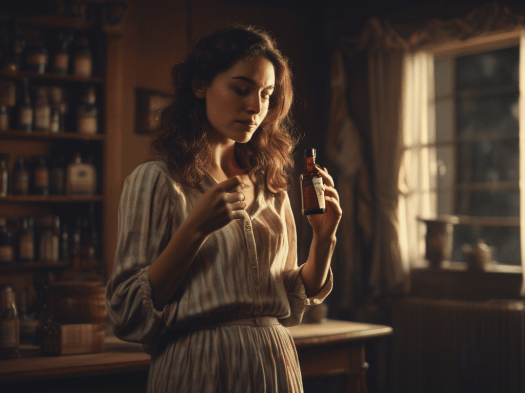
The transition from Texas to California proved to be arduous. My grandfather, possessing the toughness of weathered leather and an insensitivity to female emotions, saw the move as a blessing and a chance for a new beginning. However, for Bertha, it felt more like a forced abduction. John Henry appeared oblivious to her distress, or perhaps he believed it would pass in due time. Yet her sorrow lingered until she stumbled upon a seeming panacea: alcohol, fashioned into the magical healing elixirs hawked on the radio and in the newspapers. From anemia to tremors, from insomnia to weight loss, from night sweats to antisocial behavior, there existed a bottled pharmaceutical remedy for every affliction, no doctor’s visit required. Countless bottles of happy juice lined the shelves of the local drugstore, catering to the myriad conditions that afflicted my grandmother, a certified hypochondriac.
When not self-diagnosing herself that she harbored every disease known to man and convinced that her death was mere hours away, Bertha was quite the letter writer. Every day, seated at her kitchen table, her fountain pen full of blue ink, she’d churn out missives to her sisters in Texas. Fueled by her newfound self-assurance courtesy of those magic elixirs, she didn’t see any harm in embellishing the truth a bit about her new life out in California: alone in a strange land, who could blame her? It’s not as if her family would ever drop by for a visit. As time went by, her letters became creative works of fiction, painting the picture of a grand Beverly Hills home in place of her modest stucco house and a swanky Duesenberg convertible instead of their old Ford. According to Bertha, even the legendary Clark Gable was a neighbor, and Sister Aimee McPherson, the radio firebrand preacher gal, became a dear friend, and the two of them often enjoyed lunch at Musso and Franks Grill, mingling with the movie stars. Bertha was dead set on landing an audition with MGM or writing a grandiose screenplay, all thanks to that magical elixir of hers. Not thinking of how she would explain her fabricated world when they returned to Texas, she continued, and the more she wrote, the more she believed her own stories.
When Johnny turned thirteen, he approached his father with a request to pursue a professional career in music. John Henry, harboring doubts about the practicality of such a proposal, pondered the unlikelihood of anyone hiring a boy for such a venture, much less paying him with real money. Nonetheless, three of Johnny’s older schoolmates had extended an invitation to join their string band, which often performed at birthday parties and school events for a small fee, which was usually a coke and a plate of food. Their need for a fiddle player in the Bakersfield-style hillbilly tunes they favored aligned perfectly with Johnny’s musical talents. That evening, seated on the front porch after supper, Johnny revealed his decision to his father — he had embarked on a professional journey with his newfound band. Despite his initial surprise, John Henry offered his warm congratulations to the young boy venturing into this new vocation.
Their first official rehearsal was an epic disaster. The guitar player knew four, maybe five chords on his out-of-tune instrument, the bass player, using a beat-up dog house bass fiddle, couldn’t get the beast anywhere near in-tune, and the tenor banjo picker was worse than the other two. After massacering a dozen or so tunes, Johnny floated an option. He knows of a genuine black blues singer who burns up a guitar when he plays. The other three were wagging their tails like a hungry dog and voted to bring this fellow into the fold. Now, Johnny had to convince Blind Jelly Roll Jackson to play with a bunch of borderline musicians.
Church on Sunday was a rousing spectacle. Sister Aimee, after singing a handful of beautiful songs and just enough preaching to make sure the offering plates were full, called for souls that needed saving to approach the altar and receive Jesus. This was part of every service; a few folks would come down to be blessed and saved. With the orchestra playing, the choir singing, and a contingent of Hollywood-style dancers on stage, a hundred folks rushed the front in need of salvation. Sister Aimee, not knowing how to handle a worked-up mob that scared her out of her witts, retreated stage right and hid in her dressing room. Her assistant preacher and a few ushers administered to the flock while Sister Aimee gulped a handful of Carter’s nerve pills, washing them down with “Father Flannigan’s Holy Healing Tonic,” which was around 80% alcohol and claimed to be brewed from the holy waters of the River Jordan.
New friends, a fresh vocation, and a fine abode for an extended stay. The Strawns couldn’t reckon their good fortune. Were they in the midst of a reverie, or was it a heavenly intervention from on high? My grandmother continued casting glances over her shoulder, half-expecting to glimpse the Guardian Angel who was running this show. Sister Aimee and her mammoth church would require some acclimatization, at least on John Henry’s part.
After the church service, which was more of a Hollywood show than a religious sanctuary, John Henry ambled backstage in search of Blind Jelly Roll Jackson. He rapped on a door marked “orchestra,” but receiving no response, he turned the unlocked knob and proceeded inside. There sat Jelly Roll on a red velvet setee while Sister Aimee fervently laid her hands on his cotton-top head, offering a vigorous prayer of salvation. Pancho Villa stood behind her, firmly attached, growling like a small lion and tugging hard at the bottom of her satin robe. Upon catching sight of John Henry, Sister Aimee hollered,
“Clear out, sinner! Can’t you see I’m rescuing this wretched man’s soul?” John Henry promptly shut the door and made his way back to his family, wanting no part in the strange affairs of that place. This church wasn’t through with him quite yet.
Two weeks into his new job, John Henry felt comfortable enough to open the case of his fiddle. During his time in Texas, he had earned the reputation of a “campfire fiddler,” skilled enough to keep up with any string band in Fort Worth. Nevertheless, this was not the path he aimed to follow. For nearly two years, Young Johnny had shown a deep interest in mastering the art of playing the instrument. The time had come to pass on this skill to the eager young man.
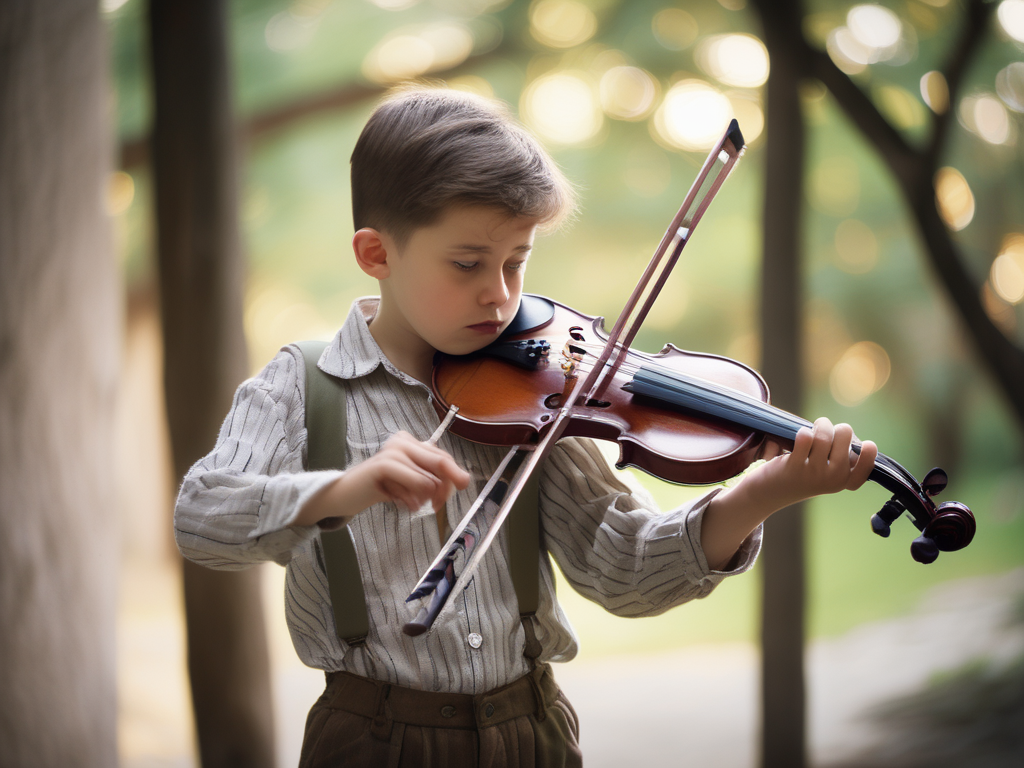
A visit to a local pawn shop produced a fifth-hand fiddle. It wasn’t much of an instrument, but for $5.00, case and bow included, it was good enough for the boy. Johnnie, when given the instrument, almost keeled over from joy. He took the fiddle to his back porch bedroom and began to torment every dog and cat in the neighborhood with his playing, which was more screeching than music.
Miss Angel Halo, a retired high school music teacher, resided a few houses away. She recognized that sound, having heard the screech of strings from her students for most of twenty years. Her Basset Hound, Baby Dog, cowered beneath the back porch while her feline companion, Miss Greta Garbo, made a hasty exit to escape the noise. Miss Halo made her way to the offending house and exchanged pleasantries with the Strawns. Over a cup of coffee, some neighborhood gossip, and a large slice of warm bundt cake, she offered her aid in schooling young Johnnie in the ways of musical notation and the art of the violin; she was a cello player herself. If the boy would mow her grass twice a week, and pull any pesky weeds in her flower beds, she would instruct him in learning the instrument.; no charge. The pact was sealed, and harmony was restored to the neighborhood.
Six weeks into his son’s tutoring, John Henry, not having heard the boy play, was curious if he had learned to play the fiddle. At his teacher’s insistence, Johnnie’s practice sessions were daytime only, and he was confined to the garage, door down, so as not to upset the neighbors.
Saturday evening found John Henry on the front porch, nursing a cold beer and coaxing a few tunes from his beloved fiddle. He asked Johnnie to fetch his instrument and join him, and in a swift instant, the boy returned, fiddle in hand, eager to display his skills to his father. To John Henry’s amazement, as he played an Irish jig, his son effortlessly intertwined harmonious notes with his own, giving the old man a partnership in the form of twin fiddles. A father’s pride has no bounds, and he played on, ignoring the tears on his cheek. In time, that instrument and the dreams of a child would take young Johnnie to the pinnacle of country music.
Moving day from the migrant camp fell on a Saturday. There wasn’t much to transport apart from the car and the personal belongings they had brought from Texas. Knowing that John Henry had very little, the landlord had left behind some furniture: a kitchen table, an icebox, two beds, and a well-worn couch. The screened-in back porch extended across the entire width of the house. In one corner, a roll-away bed and a standing lamp stood, and it was there that Johnny made his claim to the porch as his bedroom. Meanwhile, Lady ventured out to explore the expansive backyard, complete with an Eucalyptus tree that was home to a resident squirrel.
My grandmother Bertha had come across newspaper stories about the firebrand woman preacher, ‘Sister Aimee, ‘ holding court at her downtown church. She aimed to grace the Sunday service, eager to unravel the mysteries that had stirred up such a commotion among the camp folks. Ever the agreeable sort, John Henry consented to accompany her and young Johnny, perhaps harboring a hope to cross paths with Blind Jelly Roll Jackson and Pancho Villa.
The faithful congregations formed a line that stretched down the block, twisted around, and continued for another block. It seemed this preacher lady possessed a special magnetism to draw such a crowd. As they reached the doors, they discovered the church was once a theater with a plush red carpet and a winding stairway leading to the balcony. Climbing the stairs, they found seats near the balcony’s edge. With an eagerness to feel the Holy Ghost passing through her, Bertha was in stark contrast to John Henry, who simply yearned for a cup of black coffee and a nap.
The house lights dimmed, and the red velvet stage curtains slowly drew back to reveal an orchestra and a singing choir, all adorned in purple velvet robes. The orchestra boasted horns, a piano, violins, and a drummer, and right up front sat Blind Jelly Roll holding a shiny black guitar. His seeing-eye dog, Pancho Villa, was seated on a chair next to him, wearing a small matching robe. In a moment of confusion, Johnny, unaware of his surroundings, called out Pancho’s name, causing the dog to excitedly tumble off the chair. Jelly, recognizing the voice, offered a warm smile and a friendly wave as he reseated Pancho.
A slender woman with short blonde hair stepped into the center of the stage, enveloped by the spotlight’s glow. She was draped in a white silk robe, and a sizable golden cross hung at her breast, casting a mesmerizing reflection across the congregation. In that divine light, she took on an ethereal quality, almost angelic, as if transported from the pages of a biblical tale.
The singer, whom everyone now recognized as ‘Sister Aimee,’ suddenly turned into a musical whirlwind, belting out a heartfelt religious hymn that could make even the angels jealous. How did this powerful voice project from such a small woman? The orchestra performed as if they were on a mission from above, and the choir sounded so otherworldly that even the congregation wondered if they were in the presence of celestial beings. As tears flowed freely and some brave souls rose to join her in song, Bertha found herself on the verge of a melodramatic meltdown; young Johnny was bored and on the verge of sleeping, while poor John Henry remained steadfast in his pursuit of a good nap. It seemed like the lengthy two hours ahead were shaping into a divine comedy of sorts.
After two more songs just as rousing as the first one, Sister Aimee spoke.
” Dear Hearts, recently, a lost soul came to our church. He had wandered in the wilderness for years. Blind since birth and led by his small seeing-eye dog, he came to me seeking repentance and personal guidance. He is now walking the straight and holy path of our Lord. A formidable blues guitarist and singer, he has agreed to share one of his songs of atonement. Please welcome Blind Jelly Roll Jackson.” The crowd applauded.
A stagehand stationed a large silver microphone before Jelly. The spotlight shone on his hair, white as an East Texas cotton field. He tugged and twisted his guitar through eighteen bars of mournful blues without a moment’s pause. The audience was spellbound, the majority never having encountered a blind black bluesman. Leaning towards the mic, he growled deeply as he sang,
” I gots me a woman, haw-haw-haw-haw, she don’t mean a thang, squeezes my lemon picks my peaches from my trees, gonna go see that gal and get my hambone greased, haw-haw-haw-haw.”
Sister Aimee lunged for the microphone, but a stagehand beat her to it. He grabbed the microphone and carried it away. Jelly Roll was still singing and playing when the stage curtain closed. Blind Jelly Roll Jackson’s official California debut was history.
Don’t touch that dial or turn that computer off; there is more to come in Chapter 6
Divine lightning has been known to strike twice, but only if it is directed by a Guardian Angel.
With a job in his pocket, the few loose coins that jingled in his khakis sounded like a hundred dollars.
John Henry made it a point to stop by, to offer up his thanks to Sargent and Sunny for their helping hand. Their kindness was the kind that stuck with a man, went deeper than any he’d known before.
Sargent asked John Henry to join him for a stroll down the sidewalk, just the two of ’em. They walked and smoked on their Lucky Strikes, talking about this new job that was waiting for John Henry like an open road.
They trudged along the sidewalk, the setting sun beating down on their gray fedoras, until they came to a halt in front of a small, weathered, stucco bungalow. A faded ‘For Rent’ sign hung crookedly from the porch railing, creaking lazily in the faint breeze. An older woman, around Sargent’s age, sat in a creaking swing, sipping listlessly at a glass of iced tea; she gave them a slight wave as friends do. The only sounds were the rhythmic groan of the swing chains and the growing buzz of cicadas, their evening song a mournful hum that seemed to vibrate through the very air itself as dusk drew near.
Sargent took one last drag on his cigarette, the ember flaring orange in the dusk. With a practiced motion, born of countless battlefields, he field-stripped the butt and sent it swirling into the breeze. Beside him, John Henry echoed the gesture, the ritual of it a comforting reminder of days past and the unbreakable bonds of soldiers forged in blood and fire.
Sargent spoke up.
“I’ve already gotten the okay from the owners; they’re fixin’ to move up to San Francisco for a spell, maybe a long one, five or six years they say. The house is yours for the taking if you’re so inclined. I put in a good word for you, figured my vouchin’ would mean something to them. Hope our bond of friendship will be the thing that seals this deal tighter than a jug of moonshine on a hot summer day.”
John Henry let out a hearty laugh, the easy kind that comes from deep in the belly, at the mention of moonshine.
“I ain’t touched the white lightning in near 10 years, Sargent,” he said, a twinkle in his eye. “But I’ll take the house, and you can bet your Justin boots our friendship is stronger than any gold or jug of ‘shine you can find.”
That evening, after John Henry shook on the deal for the house, he stopped at a butcher shop around the corner from Sergeant’s house. He counted out what little change he had left, just enough for three thick pork chops, a couple of fat red potatoes, and a sweet onion. Tonight, he’d throw the chops on the campfire, watch ’em sizzle till they were good and done, and bake the spuds in the coals. Bertha and Johnny, they’d eat like King Farouk. And Lady, she’d get her a big chunk, too, because this was a night for celebration if there ever was one. One thing he had learned in life is to take your blessings as they come and give thanks because they may never come again.
Being in the right place at the right time can lead to life-changing events. A bit of prayer added to the mix produces wonderful things.
From what I was told, my grandfather was willing to lend a helping hand to anyone who needed one. He was kind to a fault and was often taken advantage of by family members and close friends. I can’t use them in this chapter because their families are still alive, they know where I live, and everyone is so touchy. I was ten when my grandfather passed on. He made sure I learned numerous lessons from his mistakes. Being the great poohbah recounter in the family, he left me with enough oral history to fill a book. I remember most of it from his stories and yarns, of which he could spin some tall ones. No one thought to write anything down, so for now, I’ve been blessed with a good memory, but only for a while.
John Henry helps the man carry the heavy piece of furniture into the house and places it in a small bedroom that appears to be that of a girl. Pink ruffles and stuffed animals is a sure sign.
With the furniture all squared away, the two men stood on the front porch, taking a break to enjoy a smoke. John Henry offered one of his Lucky Strikes to the other fellow, and they both lit up with a flick of the Zippo John Henry still carried from the war. The man introduced himself as Sargent James, said that was his real name, and he never rose higher than corporal in the Army. That got a good laugh out of them both. He told John Henry about his wife, Sunny, and their daughter Cloudy, away at school in Sacramento on some kind of scholarship, studying’ to be a doctor no less.
After lunch, the two men traded stories and discovered they served in France at about the same time, 1917-1918, in the big war against the Germans.
Veterans become fast, tight friends; the probability of dying from a bullet or an exploding shell bonds them in a way only they understand. It’s a brotherhood for life, formed on the battlefield.
They had both been wounded in battle; John Henry having but half a left buttock, compliments of shrapnel and had been gassed twice while fighting in the muddy trenches. His new friend was shot in the leg and the arm but recovered enough to continue fighting until some shrapnel sent him to a hospital in England and then home for good. Both showed their scars like kids on a school playground trying to outdo the other.
John Henry is no saint; he will own up to killing men in battle, some with his rifle, a few with a bayonet, one with a large rock to the head, and one stabbed through the heart with his side knife. He regrets them all, especially the young German boy, no more than a teenager he stabbed during hand-to-hand fighting before the soldier got the better of him with his sidearm. His face is the one in his worst dreams. The boy’s face looks as if he knows he is a dead man, as he is within seconds. It took years for the brutality to catch up to him, and now, late at night, when the ticking clock is the only sound in the house, his demons come for him.
Both men dance around the worst battle stories but share memories of their friends, living and dead. It’s easier that way. John Henry’s half-a-buttock won the competition. The prize was a large slice of apple pie with melted cheese topping. He feels comfortable enough to ask his host if he might know of any work a man could find. Sargent mulls the question a few moments, then says,
“I’ve got a cousin that works at the docks building shipping crates, I’ll give him a call and see if he can get you an interview. Swing by here in the morning around seven and I’ll have you an answer. I can’t promise anything, but he has the ear of the owner. ”
Good on his word, Sargent had John Henry an answer, and it was the one he had hoped for, an interview for a job. He thanked Sargent and gladly took the biscuit sandwich that Sunny insisted he eat before his interview.
Six-thirty finds John Henry standing on the sidewalk in front of the business, 808 Shipping Row. The docks are half-block away, and the noise of men and equipment moving heavy crates onto ships carries in the cool morning breeze.
Two doors are marked “Entry,” so he takes the one on the left. Down a short hallway into a large office, he finds a man sitting at a desk drinking coffee and writing in a journal. The man invites him to sit and have a cup. John Henry thinks this must be the shop foreman or the interview man. After drinking coffee for a few minutes, the man asked him about family, church, drinking, accountability, and his time in the service. After a thirty-minute visit, with a few laughs, the fellow stands, shakes John Henry’s hand, and tells him to start tomorrow morning at seven am sharp, and by the way, he is the company’s owner. Augustus Petrillo, and welcome aboard.
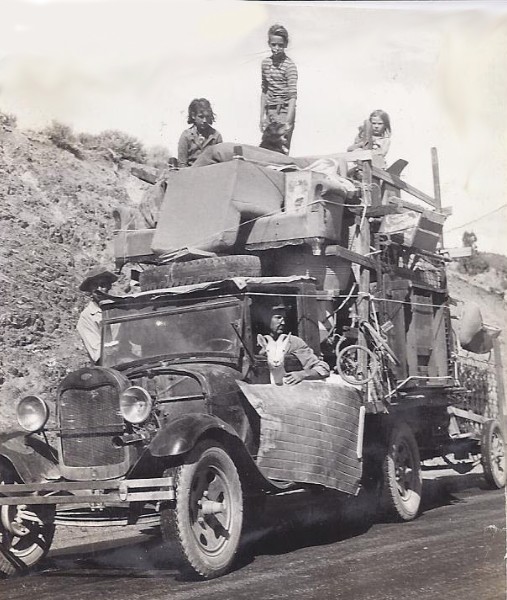
My grandparents, my father, and my aunt migrated from Texas to California in 1934 because there were no jobs available in Fort Worth or Dallas. When reaching the desert town of Needles, CA, they were immediately labeled “Okie’s” by the border guards. My grandfather, a man of few but choice words, mostly curse ones, did his best to convince the guards that he was a Texan and had visited Oklahoma once for a funeral, which made the situation worse because the guards then labeled them Texas Okie’s, which was a double insult, and to boot, they weren’t welcome in the land of pleasant weather and movie stars. Grandfather turned himself into a poor man’s Will Rogers, with plenty of aw-shucks, dirt-kicking, and head-scratching, which made the guards laugh, so the family was admitted. He forgot to mention the three pistols, the sawed-off shotgun, and his pet Rattlesnake, stashed in a burlap bag under the front seat of his Ford.
It was quite a weekend for us average Americans. A former and possibly future president was almost assassinated by a twenty-year-old anti-social nut-job, the recipient of school bullying. Take note of anyone who was ever bullied, pushed, or spoken to in a demeaning manner in your high school days. Shooting people is not the panacea.
The present commander-in-chief hesitated for two hours before delivering a statement. When it finally came, it was a brief, confused jumble, possibly crafted by (not a medical professional) Jill Biden. It urged for a reduction in the aggressive language and insinuated that this was the result of America’s conservative faction. Now that’s damn sure taking it down a notch or two, Mr. President..keep it up.
You know those individuals on the right side? They are the regular, hardworking, blue-collar folks driving the pickup trucks they use in their trade. They build our homes and buildings, repair our plumbing and electrical, check out our purchases at the grocery store, pave our roads, support their kid’s little league and soccer teams, and tithe what they can to their church. These folks are struggling to afford basic necessities under Biden’s economic H-bomb. I highly doubt they have time for violence. Just getting by consumes all their energy and money. The welder with a family of five now has to saddle the debt of some woke child’s college loan for a worthless degree in Social Media Posting or perhaps Taylor Swift Music Theory. The parents want the dependent swindler out of their home; they require the kid’s room for their podcast studio. And let us not forget the ten million illegals that have invaded our country; they are living in luxury hotels and receiving hefty benefits for being criminals. All the Democrats ask is that they vote for their candidate when they are allowed to cast a ballot. Ask the homeless mother with a few children, living in a cramped shelter, or perhaps on the streets or in her minivan how she feels about the invasion of foreign grifters draining our social services when she can’t get a damn dime, a meal, or a room at Motel 6.
I’m an old fella turning 75 come September, and I ain’t liking it at all. Every joint aches, and the fear of major organs giving out is as real as can be. Momo, my missus, is a few years behind me and is dealing with many of the same issues.
We both grew up in the 1950s and were teenagers in the 1960s. I remember I was in seventh grade when Kennedy got shot in Dallas. The teacher wheeled in a portable black and white Zenith TV, and the class watched those news fellas with their sleeves rolled up, cradling a black dial phone to their ear, a cigarette in each hand, and a stiff drink of bourbon just out of camera sight, doin’ their job. They broke the news to the world that our president, John Kennedy, was deceased from a shot to the head. Our little 1950s happy-happy world was shattered. The innocence was gone in a blink, and Dallas, Texas, would always be known as the city that killed Kennedy.
In 1968, as a high school junior, I discovered the power of the written word might actually be used to facilitate change. This era sparked within each of us the belief that we could possess the strength to change the world. We all felt we had something significant to say. During this period, I began to approach my writing with a newfound sense of earnestness. I channeled my thoughts and ideas into not only opinions for my school newspaper but also into the creation of short stories, a pursuit that became my primary focus. I would never be a Steinbeck or Twain, but I could give it one hell of a try.
When Nixon ascended to power, politics ensnared my attention. Lyndon Johnson and his Great Society pipe dream left the country in turmoil, bitterly split by his failed policies and the Vietnam War. It’s no coincidence that Joe Biden idolized Johnson and patterned himself after the arrogant bully from Texas. The familial supper table transformed into a platform for deliberating the condition of our nation. My folks remained unwavering Roosevelt democrats while I vacillated like a reed in the wind, embracing liberalism one day and conservatism the next. My loyalty belonged to no single ideology. Politicians appeared nefarious and tainted; the entirety of the government left a bitter taste in my mouth. I was not a Hippie or a Yippie, or a Yuppie, or a Guppie. Then Martin Luther King was assassinated. The good work he had done vanished within hours of his death. The lines between black and white grew wider, and violence was in the wind.
Shortly thereafter, Bobby Kennedy, the Democratic candidate for the presidency, met his tragic end in the kitchen of the hotel mere minutes after delivering a triumphant speech. The perpetrator of this heinous act, an Arab kitchen worker wielding a 22-caliber pistol, answered to the name of Sirhan Sirhan.
The Black Lives Matter movement, Antifa, and the Palestinian protest movement are powerful forces of tension in today’s society. Their intemperate assaults on our cities and citizens are vividly portrayed on our 4K television screens. Yet, when measured against the tumultuous events of the sixties, these groups appear to be more petulant young college students than Marxist terrorists.
During that era, we witnessed the emergence of formidable terrorist entities like the Symbionese Liberation Army, The Weathermen (the Weather Underground), The Students For Democratic Society (SDS), The Black Panthers, and the Ku Klux Klan, in addition to numerous other fringe groups originating on college campuses across the nation. Tossing Molotov Cocktails didn’t require a degree. These folks bombed buildings and wielded guns against Police and citizens. Patty Hearst, once the beautiful and cherished debutant darling of the Hearst publishing empire, underwent a remarkable transformation following her abduction, attributing her radical shift to the influence of the SLA’s brainwashing techniques. No, Patty, you got off on the whole terrorist ideology. Today, she is a wealthy matron with more money than she could ever spend. It leaves me pondering whether she still possesses that automatic rifle and beret from her revolutionary days.
Daddy’s little girl
The upcoming Democratic Convention is scheduled to be held in Chicago, reminiscent of its 1968 counterpart. During that time, a multitude of protesters, guided by the aforementioned organizations, flocked to the city, turning its streets into a battleground as they engaged in confrontations with Mayor Daley’s police, igniting buildings and police cars. The majority of the demonstrators aligned themselves with the Democratic party, displaying discord within their own ranks. It seems that this forthcoming convention is on track to mirror the tumultuous events of 1968.
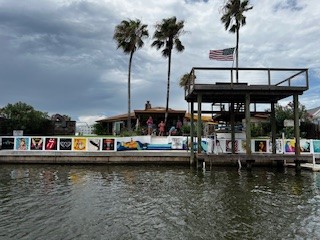
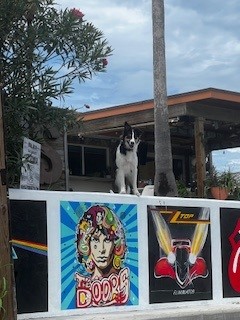
Recently, the saltwater faction of the Strawn clan—my son Wes, his wife Yolli, and grandsons Jett, hired a friend, local artist Jenn Seymour, to paint a mural on their backyard canal bulkhead in North Padre Island, Texas. My oldest grandson, Johnathon, now resides in Corpus, and my granddaughter, Madalyn, was on hand to bolster everyone’s spirits. It’s not their first venture into suburban art; another famous local Corpus Christi mural artist and surfer, John Olvey, painted a large surf mural on their home’s streetside view before he passed away in 2022. Now, the POA, HOA, or whatever this group of whiners calls themselves these days, served my son a letter of violation and demanded the mural be painted over, claiming it is an advertising sign, which is prohibited per their bylaws. The word ‘serve’ is a stretch; they actually taped it to his nice mid-century modern front door, “too yellar” to actually hand it to them in person. I don’t believe this coterie of malcontents thought this one out. Now, it’s taken on its own life form and is spreading like “Pod People.”
The artwork in question is paintings of the covers of the most classic albums in rock music history: Led Zepplin, Jimi Hendrix, ZZ Top, The Beatles, Bob Marley, The Rolling Stones, Willie Nelson, Selena, Nirvana, and a few others. We picked the albums from his extensive collection, and the artist did her magic aided by acrylic paint, Petoli incense, Red Bull, and 1960s good vibrations. Folks from all over the island, Corpus, and far-away lands have made a pilgrimage by boat, foot, and car to view the masterpieces. Wes and Yolli, being gracious hosts, offer a cold bottle of Texas water and a bite of food and lead them through their home to the backyard bulkhead and dock for a better view of the art. Piper, their border collie, happily greets everyone.
The wheels of justice turned quickly when the downtrodden art connoisseurs were wronged. Within a few days, the local paper, The Island Moon, published a rousing piece praising the artwork and exposing the troglodytic POA. One local television station, KRIS, dispatched a top-notch reporter to shoot film and interview Wes, his kin, the artist Jen Seymour, and Piper, the Border Collie. Momo and I spectated the whole shindig from the covered patio and were mightily entertained by the publicity of the whole affair.
This is the last surface in the compound suitable for decoration. So what now? Maybe three large Mariachis playing frogs on the roof? It could happen…it’s the island.







 Notes From The Cactus Patch