The Journey to Fort Worth: A Story of Hope and Sacrifice


The continuing story of Jesus Got A Mainline
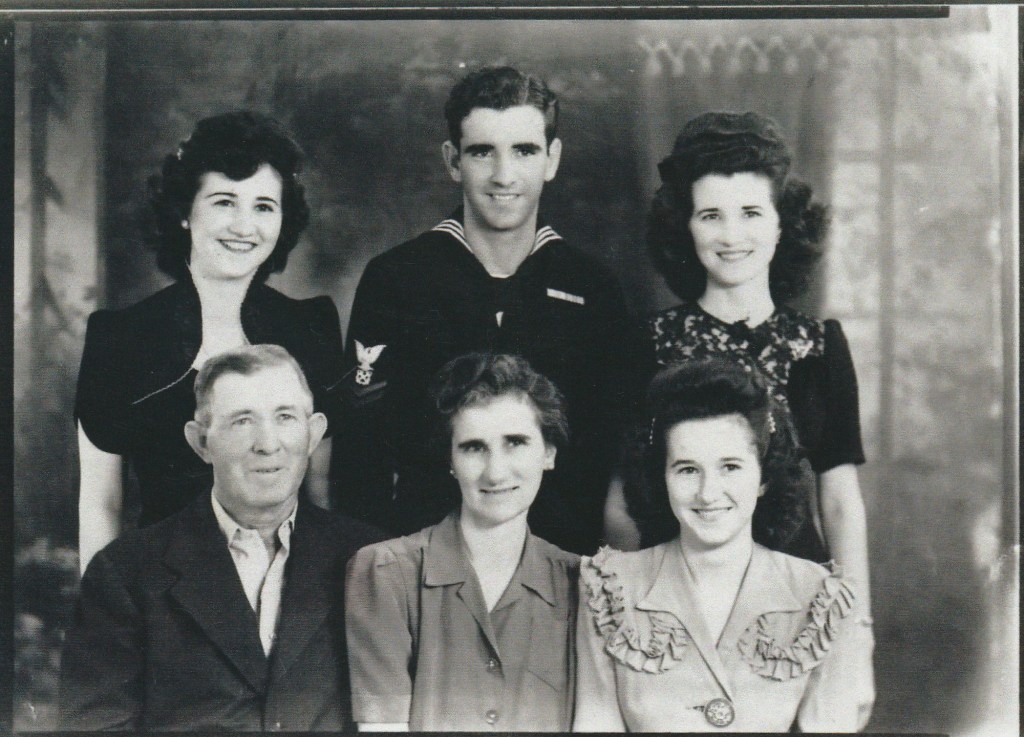
the Manley Family: Front from left, Jasper, Marcy, Lavelle. Standing, from left, Mozelle, Jay, and Catharine

Leaving home to forge a new life can be an exhilarating journey or a regretful mistake, depending on the circumstances of the departure. My mother, Mozelle, saw it as a journey that must be made; there would be no regret or sadness. The days of laboring in the fields and chopping cotton were behind her now. She would never again grip the wooden handle of a hoe.

Her mother’s parting tears left a permanent stain on the shoulder of her best dress. Her father’s apathy and refusal to hold her pierced her heart.

The bus ride to Fort Worth stretched into the night, giving her time to reflect and to shed her tears in the dark.

Sharing an apartment with her sister, Lavelle, she found work at Consolidated Aircraft Corporation, where she built B-24 bombers as part of the war effort. She was now the girl on the famous poster, with her sleeve rolled up and a polka dot headscarf. Her life was all work with little time for a social life.

In a letter from home, her father demanded that she and her sister send him a percentage of their paychecks, as their departure from the farm had forced him to hire labor and change crops that yielded less money. They complied, albeit unwillingly, for the sake of their mother. They learned that the Preacher and his family had come one last time, and with no cotton to pick, returned to San Angelo, where he passed a few months later. His sons carried on the church. She never forgot Preacher and his mainline to Jesus.

Her brother, Jay, wrote frequently to his sisters from his ship in the Pacific theater. He was a gunner on a destroyer and participated in the invasion of Iwo Jima. He was one of my two uncles who were the best liars and spinners of yarns and tall tales, and he passed that treasure on to me.

The front porch of the family farm house was his stage, and I would sit for hours absorbing his tales, some true, some as tall as the oak tree growing in the front yard. Give the man a few Pearl Beers and he could orate as well as Will Rogers. I felt he missed his calling to be a writer or a stage personality. In later years, the stories had darker undertones, and he became a world-class alcoholic who, after two stays in a state hospital, beat the demon and lived a sober life until his passing in a car accident in 1968, a head-on collision caused by, of all things, a drunk driver. She believed the war affected him deeply and led to his drinking problem. Today, we call it PTSD. My mother loved him dearly, and she was the force that convinced and aided him to seek help. His death affected her deeply, and I believe she grieved him for the rest of her life.

As a young girl, my mother wrote poetry and was quite good; she won an award in grade school. Her handwriting was exquisite. She and a fountain pen became one, and a sheet of lined school paper became her canvas.

Reading the great poets of her time and writing her own poems was her idea of a proper education, and she dreamed of one day publishing her own book. There were hundreds of pages of poems, squirreled away in a drawer, for someday. The poems were lost, and so was the day with them.

After the war ended, she and her sister worked on drawing maps. There was more time for a social life, and the two enjoyed dancing, so that led them to nightclubs at Crystal Springs on Lake Worth, Belknap Street, and Jacksboro Highway. She wasn’t looking for a boyfriend or a husband, but was swept off her feet by a good-looking, dynamic young fiddle player in one of the bands. The attraction was immediate and intense, and both of their backs were chock-full of Cupid’s arrows. That nice young man, a native of Fort Worth, a veteran, and recently relocated from Hawaii, would become my father.
Dreams of Europe: A Haunting War Reflection


Last night, I dreamed of Europe, teetering on the brink of war, reminiscent of those haunting days of the 1940s. It was not a nightmare but rather a sepia-toned memory, grainy like an old newsreel flickering in a rundown theater, the air thick with the scent of buttered popcorn and sticky sodas clinging to the soles of my worn Tom McCann wingtips. Beside me, my wife, Momo, sat elegantly in her gabardine dress, her silk scarf accentuating her perfect neck. A picture of quiet strength amidst the storm brewing outside. Somehow, as if a magical spell, we knew of war, maybe because our fathers had participated, not reluctantly like some, but dutiful, knowing their presence would make a difference in the outcome.

We found ourselves seated amid a crowd, the air thick with the scent of Old Spice, a memory of times past. Momo leaned forward; her senses caught Chanel No. 5 drifting languidly alongside us while cigarette smoke curled upwards, smothering the flickering images that danced on the screen. An army advanced in unyielding formation, each soldier a cog in an unfeeling machine ready to unleash mayhem upon a peaceful country. A lone figure stood poised for inspection; within his eyes, a cold emptiness lingered, reminiscent of a predator—those soulless eyes of a waiting shark. At first, I thought he might be Hitler, a returned demon from the depths of Hell. I was wrong. A Russian, short in stature, long on evil, intent on destruction. The shark now has legs and walks among us. I awakened, sweating and gasping. Momo sleeping peacefully, unaware of the dream we shared. We left without seeing the movie.

Johnny’s Journey: From War to Healing in Hawaii


Chapter 16: Johnny Didn’t Come Marching Home

Foreword: Usually by another writer or friend. Excuse the breaking of tradition. These chapters reveal my struggle with the truths of my family. As a child and later as an adult, I saw the darkness of alcoholism and how it grips every soul within a household. I wished for families like those in a Norman Rockwell painting, gathered at the table with Grandfather carving the turkey, but life shattered that image. AA was just beginning to rise, and the word “enabler” had not yet marked the shadow of alcoholism. Bleeding in a public arena is not pretty.

The island of Hawaii held its charm, still untouched by the war. A year after the conflict with Japan, a few tourists arrived by boat, drawn to its beaches and emerald water. The men and women in uniform returned home, demobilized from the military. Johnny chose differently. He stayed, nurturing the holdings he had acquired over two years. Luck had favored him; he owned land in downtown Honolulu, not the best area, but one that would grow over the years and be worth hundreds of times what he paid. California held no interest, Texas even less. He would again be under the veil of his mother’s demands and secrets. The more time away he had, the more he saw that the extended family of her sisters and cousins was more toxic than nurturing. The arrangement with the old Korean had soured; there would be no marriage to his granddaughter, a relief to Johnny. He would take his chances to either flourish or fail in Hawaii.

Near the end of his first year after leaving the Navy, once again, the missives from home arrived almost daily. They were often the same—repetitive and sharp. Nothing had changed; Sister Aimee’s cures were lost like smoke in the wind. His father did not write, making Johnny feel like he was not there or had no strength to fight. The family had returned to Fort Worth. He now knew that something dire had transpired.

A letter from his sister Norma came with bad news. His beloved dog, Lady, had passed peacefully in her sleep at the age of eighteen. John Henry was not doing well; a depression had set upon him soon after they returned to Texas from California. His leaving a prestigious job and salary and returning to the furniture shop, working for a pittance of his former wage, caused him great stress. He would go days without speaking to anyone, lost in his sadness, reluctantly accepting the fact that he was now an older man and he had left his best life out west. PTSD was not yet diagnosed, but his behavior had all the signs of the illness. Killing another human, even in the ugliness of war, will take a piece of a man, leaving him un-whole and susceptible to the whispers of the Demons that await. John Henry had many to fight.

Johnny’s mother had become a mean, spiteful woman full of hatred for anyone other than her precious sisters in arms; they were all swimming in alcohol for the better part of each day. The reality of life was a concept they didn’t grasp; the party came first, and to hell with the rest of it.

Norma was planning to leave and join her brother in Hawaii but was reluctant to leave their father in his fragile state. Guilt washed over Johnny for not being there for his dog, Lady; she had been his faithful companion for his entire life. He was ashamed that he was more broken up over her death than the tribulations of his parents; they were adults who occupied their own prison. They could deal with it themselves. He wanted nothing to do with any part of their perils. Still, the missives came daily, now more frantic and cruel than ever. He was teetering, trying to stay positive and not give in to the dark web woven by his mother’s disease. It was impossible to fight. In anguish, he gave into her cruelty, hating himself for his weakness. Arriving in Hawaii, a boy, then becoming his own man, now again, a boy dragged across the Pacific Ocean by a three thousand-mile umbilical cord.

Chapter 13 Wagons Ho, The War Becomes Real


The winds of war swept smoke over the Pacific and the Atlantic, shrouding America in the grim scent of burning flesh and shattered towns. No American could turn away from the truth that lay ahead.

With his basic training done, my father, Johnny, boarded a troop ship headed for Pearl Harbor, Hawaii. The voyage lasted a week, maybe more. He met many young men like him, all seventeen, their fathers signing the papers for them to join the Navy. They were bonded by youth, their love for their country, and the call of duty that carried them forward.

In Los Angeles, my grandmother Bertha accepted, somewhat, that her only boy was going to war. She kept busy writing letters to him before he made it to the islands. Her frantic behavior brought back the elixirs. Sister Aimee’s healing failed, yet no one in the family dared to take her back for a tune-up.

After arriving in Hawaii and settling into his barracks, the post carrier handed him two dozen letters, all from Mama. He did not need to read them; he understood their essence: “come home, I need you, I might die soon.” It was all self-inflated nonsense, and for the first time, he recognized it and turned away. From then on, he would burn or tear the letters into shreds, neither reading nor answering a single one. The umbilical cord had been severed.

The islands of Hawaii were beautiful, like a dream each young man held close. The mountains rose with dignity, green forests swayed softly, and the beaches called out their enticing embrace. It was difficult to accept that an island paradise could be in such turmoil. Yet, reality ousted the vision. Johnny stood on the fantail of a destroyer, the sea raging with anger, trapped between the allure of paradise and the blood-soaked chaos of war, all within a day’s sail. He reconsidered his reluctance to write and penned a few letters: one to his mother, sister, and father, in case he didn’t return to safe harbor.

Hollywood portrayed war in a way that seemed clean and tidy. The soldiers and sailors donned uniforms that were always crisp, and wounds were mere shadows, with no blood to mar the screen. But for Johnny, the truth of war came crashing down on the third day out at sea. His ship, along with four others, escorted an aircraft carrier that was suddenly attacked by Japanese planes. They struck the carrier twice, and Johnny’s destroyer was caught in the crossfire, taking a torpedo hit that crippled its forward compartments. Though the ship still moved, it was ordered to return to Pearl for repairs. Fear didn’t manifest itself until he was awakened in his bunk, shaking and praying that he had made the right choice. At that moment, he realized that death was a real option.