Summer Adventures of a 1950s Boyhood


It was the summer of my seventh year, 1957.

It was too hot to play pick-up baseball games unless my buddies and I got to the Forest Park Ball Diamonds before 8 am, and the city pool was closed because of the Polio scare; my mother kept a picture of an iron lung taped to the icebox to remind me what would happen if I disobeyed her orders. Boredom set upon us, we had too much free time on our grimy little hands, so the six of us that comprised our neighborhood coterie did what any gang of young boys would do; we went feral. It was two full months of constant butt-whoopings, loss of cartoon time, and other parental vs child warfare. My buddies and I agreed it was our best summer so far.

Mr. and Mrs. Mister, our next-door neighbors and mentors, attempted to reel us in, which worked for a short while. Mrs. Mister, a wonderful mom substitute who resembled the movie starlet Jane Mansfield, would let us sit under their backyard Mimosa tree. At the same time, she served chocolate chip cookies and Grape Kool-Aid to control our restless young spirits. Fred and Ginger, her twin white Poodles, would join us and beg for cookies. Mr. Mister, when his wife wasn’t looking, would let us have a sip or two of his ice-cold Pearl beer. We were bad assed and nation-wide.

This was the summer we declared war on our school tormenters, the older boys across the tracks known as “the hard guys.” And thanks to Mr. Mister and his military and engineering experience, we successfully implemented a detailed plan and defeated our nemesis. Sidewalk biscuits with implanted cherry bombs and a small Roman Catapult designed by Mr. Mister played a role in the defeat. Instead of feeling remorse for injuring our schoolmates, the battle made us insufferable and meaner, fueling our summer of feral behavior.

Our parents and Mrs. Mister were shocked and bewildered. Fifty or so butt-whoopings with everything from a belt, switch, and a Tupperware pan, didn’t phase me or my gang. The three girls in our neighborhood, our classmates, were all tomboys, and they said we were now “too mean” for them to associate with. Cheryl, our center fielder, the only girl we would allow to play on our team, called us “mean little shits.” Those are pretty sophisticated words from a seven-year-old gal, although we knew some of the good ones we heard from our fathers.

Skipper, or resident math wiz and duly elected gang leader, had the “Hubba-hubba’s” for Cheryl and gave her his tiny Mattel Derringer cap pistol as a sign of affection. He found it on his front porch one morning with a note from her mother that read, ” stay away from my daughter, you mean little shit.” Now we know where her scoffing comments came from. He was crushed, of course, but he was young and felt much better after he blew up Mr. Rogers’s mailbox with a cherry bomb. Firecrackers and high-powered fireworks secretly supplied by Mr. Mister played a big role in our feralivious behavior. The two neighborhood garages that caught fire were blamed on us, and Georgie, with his love of matches and lighter fluid, may have had something to do with those fires, but he wouldn’t admit to it.

My parents started taking Miltowns, an early pill similar to Xanex, and most other parents began drinking more than normal. Mr. Mister was called in to negotiate a truce, but secretly, he was on our side. He felt boys should have the right to cut loose and show their young oats, even though we didn’t have raging hormones, underarms, or pubic hair, which we anxiously awaited.

Our parents had enough of our feral behavior, and one Saturday evening, there was a hot dog party in our backyard. All my gang was there, as were their parents. Ice cream and a cake were served along with burnt wieners, and the Misters were there with Fred and Ginger. It was a downright ambush, the predecessor to the popular “intervention.” Our parents let us know that the next stop for us was “The Dope Farm,” an institution where malcontents and little hoodlums were sent to do time. We knew the stories about the place. It was out of a horror movie, and Father Flannigan wouldn’t be there to save us. It was time to clean up or be locked up doing hard labor and eating maggot-infested gruel. No more baseball, cartoons, or Mrs. Mister’s cookies and Kool-Aid. We huddled, agreed amongst ourselves, and promised our parents we would walk the righteous path of the good child. We did for the most part, but we hid our stash of cherry bombs for the next summer.

The Boys and Girls of Summer


On the third day of summer vacation, the euphoria of no school for three months had lost its sparkle. Our gang of sweaty-smelly boys spent most of the day sitting under our neighbor, the Mister’s Mimosa tree, drinking grape Kool-Aid and eating home-baked oatmeal cookies baked by our mom-mentor, Mrs. Mister. Saturday couldn’t get here fast enough; that was the first day of official practice for our second-year little league team, “The Jets.”

This year, as a group, by a special vote in Skipper’s garage, we decided to let Cheryl and Ann play on the team, putting Freckeled Face Bean and Georgey on the bench for a few innings. Mr. and Mrs. Mister were in agreement; the girls were better at catching fly balls. In 1957, teams didn’t award participation trophies; it was all about winning the game. Cheryl played some last season, and we put Ann through the try-out wringer at recess. and she passed every test, so we will be the first and only team in the Fort Worth Little League system to have two girls on a boy’s team. We “broke on through to the other side” and didn’t know what we had done. I believe our assistant coach, Mrs. Mister, was secretly proud, being a former Air Force officer and ball player herself.

Saturday arrived, and our practice time on the diamonds was at noon, right when it was cooking like a griddle at a balmy 98 degrees. Mr. Mister worked with our two pitchers, and Mrs. Mister took the rest of us heathens to the field, hitting flys and grounders and yelling at us when we messed up. Ann and Cheryl caught every fly ball, and me, at shortstop, only missed two grounders and tosses to first. It was going to be a good season. Georgy and Bean sat on the bench, sulking. I guess I would, too, if I lost my spot to a girl. We were kids, but back then, even boys were a bit manly men, only smaller.

After practice, Mr. Mister told us that the coach from the Trimble Tech area team had been spying on us, hiding behind the concession stand and taking notes. It was a known fact that any team from that area of Fort Worth would be known as ” the hard guys.” We figured he was scouting out whose legs to break if they caught any of us out of our neighborhood and alone.

Our first game was a week later, and damn if it wasn’t the “hard guys” team. We watched from our dugout as they warmed up, fearing the worst. The pitcher had a five-o’clock shadow and arms so long that he left knuckle furrows in the infield dirt. Most of their team was a head taller than us and had to be old enough to drive. These guys can’t be Little League? Many had likely spent time at the Dope Farm or jail; they had all the markings of experienced delinquents. Their coach was a walking mugshot. We were doomed and knew it.

Bottom of the seventh, and we were down by two runs. Skipper was throwing his hardest and slipping in some calculated peppered pitches Mr. Mister had taught him. The “hard guys” weren’t even swinging hard, and all their balls went to the fence line and a few over it.

Our coach, Mr. Mister, suspected something for some reason and asked the umpire to examine their bats. The umpire was equally suspicious, so he grabbed a few of their bats, pulled a pen knife from his pocket, dug out a wad of wood filler, and emptied four large ball bearings into his hand. The little mobsters were using fixed bats. He then checked their cleats and found all of them to have been filed to a sharp edge. He confiscated their bats and shoes, making them play in sneakers or barefoot. He gave them a beat-up Rawlings bat to use. They were caught, and the crowd of parents booed them into the next county. After that, they couldn’t buy a ball past second base, and we scored three runs and beat them. Strike one up for the good guys. Mrs. Mister informed us that their team had been dissolved a few days later, and the players were suspended. Their coach was likely on his way back to Sing-Sing.

The rest of our season was memorable. Our two girls got a write-up in the paper, along with a cute picture. Skipper got bonked in the forehead and missed four games, and Freckled Face Bean caught a case of Polio and was out for the season but expected to make a full recovery. We missed the championship by two games, but hey, it was a great season.

The Misters gave the team a backyard cookout a few days before school started. Parents, siblings, dogs, and the whole shebang crowded into their backyard. At the end of the party, with fireflies drifting around us in the summer evening, our team gathered in a circle for a moment of recollection. We had been so wrapped up in months of baseball no one noticed that we all had changed. The school fat was gone, replaced with dark suntans and sinewy arms and legs. Baseball was our game, America’s game. At that brief moment, as we stood in the dark, silent, we were the boys and girls of summer.

Baseball, Balloon Tires and Cap Pistols


I first met Billy Roy on a Monday morning in September of 1957 when Mrs. Edwards, our third-grade teacher, introduced him to our class. He stood next to her, arms crossed with a sour-ball look on his face.

I knew this kid was trouble. He hadn’t done a thing to anyone yet, but he had that weaselly look about him; beady eyes, no chin, partially bucked front teeth, and a bad haircut giving him the appearance of a hillbilly.

Our teacher says he is from Hamburg, Germany, and his father is an officer out at Carswell Air Force Base. Billy Roy, she says, is a German and an American citizen but doesn’t speak good English quite yet. So then, what is he, an all-American boy or a Nazi transplant? We, kids, knew all about those guys, watching World War II movies on channel 11 and playing war with our BB guns. We always whopped the Nazis and the Jap’s. We also took care of the Mexican army when we defended the Alamo.

As luck would have it, Billy Roy now lives in my neighborhood, three houses down from my best buddy, Skipper, so after school, the gang calls an emergency meeting to figure out how to deal with this infiltrator.

It’s decided to give the “new kid” a chance to prove his salt; he would be allowed to hang with us until deemed worthy or fell flat on his face.

Our parents got word of our secret plan and told us, “We had better be nice to Billy Roy, or we would wind up at the “Dope Farm.” Someone ratted us out; most likely, it was Georgie; he’s afraid of everything and can’t keep a secret. He is also a known titty-baby.

“The Dope Farm” is a juvenile detention institution that our parents use as a threat when we act up. It keeps us in line. The stories about the place give us nightmares; it’s Sing-Sing for children. One of my older cousins spent some time there, and later when he was supposedly rehabilitated, he robbed a Piggly Wiggly dressed as a woman.

Saturday came our day to ride our bikes to Forest Park diamonds for pick-up baseball games. Our group of eight departed from Skipper’s house at 8:30 am. Billy Roy is standing on the sidewalk as we approach his house.

Skipper stops and asks Billy Roy if he has a bike and a glove; in broken English, he states he has neither of those items.

Georgie, the titty-baby, then says in a snarky tone, “if you don’t have a bike and don’t play baseball, you can’t be part of our gang.” The word’s spoken, the gauntlet laid. It looks as if Billy Roy might be out. Everyone gives him “the look” as they ride by. I feel a little bad for the kid.

Billy Roy keeps to himself during the next school week, eating his sack lunch alone and staying inside during recess. We can care less. He can’t tote his salt.

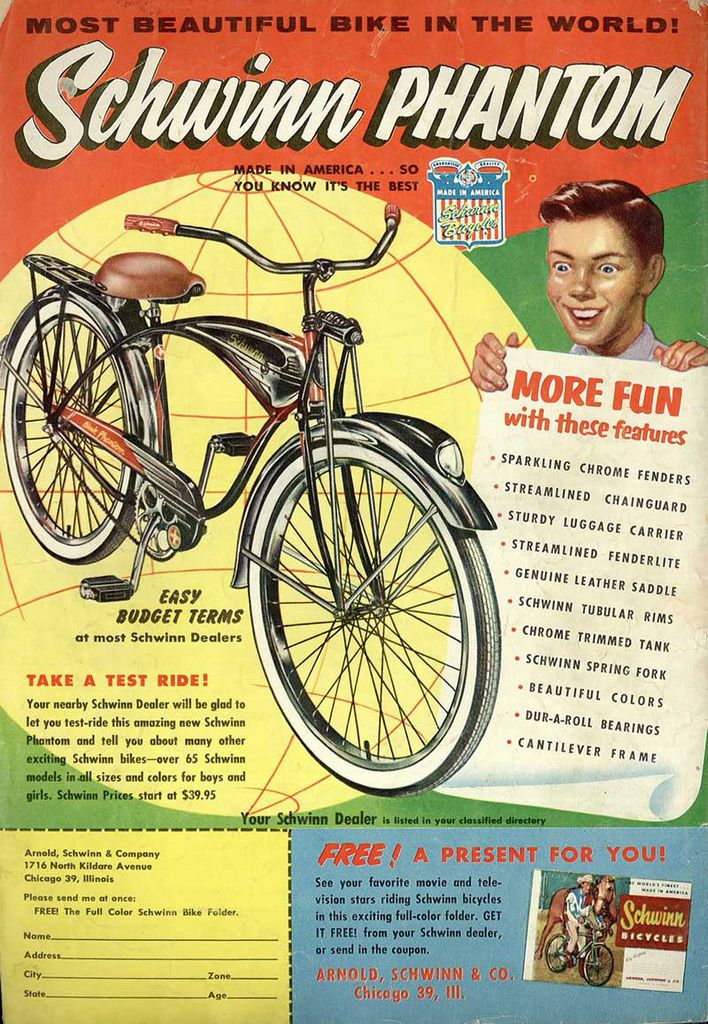
Saturday morning, 8:30 am, the same scenario. We leave Skippers’ house on bikes, heading for the ball diamonds. As we approach Billy Roys’s house, he comes flying out of his garage on a brand-spanking-new Schwinn Hornet bike. A chrome headlight and taillight adorn the bright red and white bike—the sun’s reflection off the chrome fenders that cover the white sidewall balloon tires is blinding. Hanging on the handlebars is a new double-stitched  “Plug Redman” Rawlings baseball glove, and sitting on his little head is a genuine New York Yankees ball cap.

Skipper skids to a stop, and the rest of our bunch almost wrecks our bikes, trying to miss him. What is going on here?

The gang is in awe and more than a tad envious. This kid’s been here two weeks, doesn’t play baseball, can’t speak English, is likely a German spy, and here he is riding the Cadillac of bikes and now sports new ball equipment. Some snot-nose in our neighborhood is as rich as King Faruk, and it isn’t us.

Skipper, the wise leader of our bunch, surveys the scene, then tells Billy Roy that he can come along with us to the baseball diamonds since he now has the required items. So he rides at the end of our pack and struggles to control his expensive bike. He crashes a few times but catches up. Unfortunately for our intern, things don’t go well at the ballpark.

After educating Billy Roy on holding and swinging a bat, he’s bonked square in the forehead with a 40-mile-per-hour hardball. He’s out like a corpse.

The umpire, some kid’s father, drags him over to the bleachers and pours a cup of cold water on his head. Billy Roy wakes up, staggers for a minute, and acts like nothing happened. We are impressed; he’s tougher than we thought.

Around the fourth inning, Billy Roy tells us that he is going home. He’s a bit dizzy and wobbly after his bonk and can’t participate in the rest of the game. We get it. He departs, driving his fancy bike from curb to curb like a blind drunk.

After the game, which we won, we gathered our stuff left in the dugout.

Stevie says he can’t find his Cub Scout knife. Freckled Face Bean can’t find his Roy Rogers watch, and Skippers’ decoder ring is missing. My almost new pack of Juicy Fruit is also gone. Good Lord! There’s a thief amongst us. Georgie, the titty-baby, is the likely culprit; but he says he can’t find his dental retainer, so he’s cleared. That makes Billy “the Nazi” Roy, the perpetrator. There is an ass-whoopin’ brewing. With retribution in our hearts, we haul ass to Billy’s house.

Mrs. Roy answers their door. We demand to see Billy, so she brings him to face us. He stands behind the screen door for protection. But, of course, he denies it all until Skipper tells him to step onto the porch so he can whoop him. Billy steps onto the porch, but before Skipper can get a lick in, Billy pulls a switchblade knife from his pocket. He pops the blade and waves it at Skipper. Yikes! Not only is the little Nazi a thief, but he’s also a West Side Story hoodlum. We leave the porch and the guilty Billy Roy to his young life of crime.

After the incident, Billy Roy, to us kids, is a fart in the wind.

Having ruined his reputation in our neighborhood, he starts hanging with some older hoodlum boys from across the railroad tracks; we call them “The Hard Guys.” We are sure they will wind up at “The Dope Farm” sooner or later, and now young Billy will join them.

Billy Roy has been missing from school for almost a week, a few days before Christmas vacation. We figure he has the bird flu or polio.

The next day, a rumor around the neighborhood, and now our school, is that Billy Roy and two of the “Hard Guys” were pinched for holding up our small neighborhood grocery store with a Mattel Fanner 50 cap pistol.

We all agreed that the bonk from the baseball injured his kid’s brain and turned him into a criminal. Last we heard, Billy and the two “hard guys” were off to the “Dope Farm.”

The Summer I Became A Feral Child


It was the summer of my seventh year, 1957.

It was too hot to play pick-up baseball games unless my buddies and I got to the Forest Park Ball Diamonds before 8 am, and the city pool was closed because of the Polio scare; my mother kept a picture of an iron lung taped to the icebox to remind me what would happen if I disobeyed her orders. Boredom set upon us, we had too much free time on our grimy little hands, so the six of us that comprised our neighborhood coterie did what any gang of young boys would do; we went feral. It was two full months of constant butt-whoopings, loss of cartoon time, and other parental vs child warfare. My buddies and I agreed it was our best summer so far.

Mr. and Mrs. Mister, our next-door neighbors and mentors, attempted to reel us in, which worked for a short while. Mrs. Mister, a wonderful mom substitute who resembled the movie starlet Jane Mansfield, would let us sit under their backyard Mimosa tree. At the same time, she served chocolate chip cookies and Grape Kool-Aid to control our restless young spirits. Fred and Ginger, her twin white Poodles, would join us and beg for cookies. Mr. Mister, when his wife wasn’t looking, would let us have a sip or two of his ice-cold Pearl beer. We were bad assed and nation-wide.

This was the summer we declared war on our school tormenters, the older boys across the tracks known as “the hard guys.” And thanks to Mr. Mister and his military and engineering experience, we successfully implemented a detailed plan and defeated our nemesis. Sidewalk biscuits with implanted cherry bombs and a small Roman Catapult designed by Mr. Mister played a role in the defeat. Instead of feeling remorse for injuring our schoolmates, the battle made us insufferable and meaner, fueling our summer of feral behavior.

Our parents and Mrs. Mister were shocked and bewildered. Fifty or so butt-whoopings with everything from a belt, switch, and a Tupperware pan, didn’t phase me or my gang. The three girls in our neighborhood, our classmates, were all tomboys, and they said we were now “too mean” for them to associate with. Cheryl, our center fielder, the only girl we would allow to play on our team, called us “mean little shits.” Those are pretty sophisticated words from a seven-year-old gal, although we knew some of the good ones we heard from our fathers.

Skipper, or resident math wiz and duly elected gang leader, had the “Hubba-hubba’s” for Cheryl and gave her his tiny Mattel Derringer cap pistol as a sign of affection. He found it on his front porch one morning with a note from her mother that read, ” stay away from my daughter, you mean little shit.” Now we know where her scoffing comments came from. He was crushed, of course, but he was young and felt much better after he blew up Mr. Rogers’s mailbox with a cherry bomb. Firecrackers and high-powered fireworks secretly supplied by Mr. Mister played a big role in our feralivious behavior. The two neighborhood garages that caught fire were blamed on us, and Georgie, with his love of matches and lighter fluid, may have had something to do with those fires, but he wouldn’t admit to it.

My parents started taking Miltowns, an early pill similar to Xanex, and most other parents began drinking more than normal. Mr. Mister was called in to negotiate a truce, but secretly, he was on our side. He felt boys should have the right to cut loose and show their young oats, even though we didn’t have raging hormones, underarms, or pubic hair, which we anxiously awaited.

Our parents had enough of our feral behavior, and one Saturday evening, there was a hot dog party in our backyard. All my gang was there, as were their parents. Ice cream and a cake were served along with burnt wieners, and the Misters were there with Fred and Ginger. It was a downright ambush, the predecessor to the popular “intervention.” Our parents let us know that the next stop for us was “The Dope Farm,” an institution where malcontents and little hoodlums were sent to do time. We knew the stories about the place. It was out of a horror movie, and Father Flannigan wouldn’t be there to save us. It was time to clean up or be locked up doing hard labor and eating maggot-infested gruel. No more baseball, cartoons, or Mrs. Mister’s cookies and Kool-Aid. We huddled, agreed amongst ourselves, and promised our parents we would walk the righteous path of the good child. We did for the most part, but we hid our stash of cherry bombs for the next summer.