A Performance to Remember.. Cookie Becomes A Beatnik


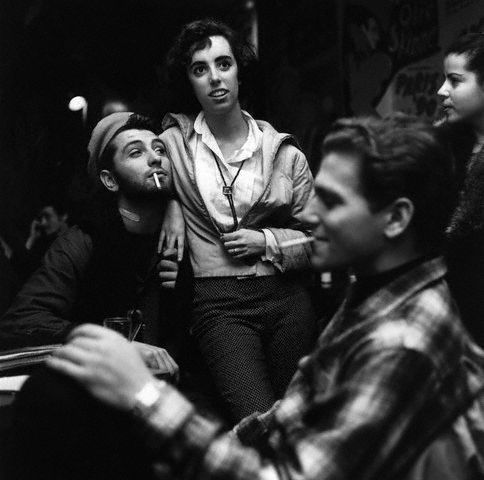
In the fall of 1958, the first Beatnik-style coffee house opened its doors in Fort Worth, Texas. Calling itself “The Cellar.”

Fort Worth did not welcome its presence or the inhabitants it attracted. Conservative city fathers asked, “Where did these people come from? Have they always been here?” It was a cowtown of shit-kicking cowboys, Cadillac-driving oil men, and country club debutants wearing Justin boots. My cousin Carmalita, who preferred the name Cookie, was a perfect fit for the coffee house and secured a job as a waitress at the new establishment.

Being seven- years younger than Cookie, the other cousins and I had limited interaction during her teenage years. Still, I know from the family stories and the “almost out of earshot whispers” that she was a real hellion of a girl. Her mother, a rosary-clutching Catholic, believed her daughter to be mentally disturbed and demon-possessed. She was neither, just a rebellious girl born twenty years too early who refused to fit into the conservative society of the 1950s.

Immersing herself in books by Kerouac and Ginsberg that glorified the new lifestyle of the “beat generation.” Cookie began dressing in the style of “the Beats.” She envisioned herself traveling west with Dean Moriarty and Sal Paradise as they motored their way to New Mexico in search of God and the meaning of life fueled by Marijuana sticks and two-dollar-a-bottle liquor. Jack Kerouac was her hero.

Waist-length black hair and a resemblance to a young Ava Gardner didn’t endear her to the Sandra Dee-loving girls’ club at school. She was labeled an outcast. She dropped out of Paschal High School at sixteen to live in sin with her next-to-worthless greaser-hoodlum boyfriend, a motorcycle-riding teenage hubcap-stealing thief from the north side of town. This decision resulted in her instant banishment from the family.

Polled by a phone-in family vote, she was christened the “little trollop.” Her name was not to be spoken at gatherings, and her mother requested all photographs containing images of Cookie be returned to her for proper disposal by fire in the backyard BBQ pit. Her father was brokenhearted by her rejection. Unable to watch her sweet sixteen birthday present, a Ford Fairlane convertible, sit abandoned in his driveway, he sold it. The rebellious type was not tolerated well in the 1950s, especially in Texas and our extended family.

“The Cellar” grew in popularity, and crowds of unwashed self-appointed poets and deep thinkers found their way to the dark, smokey den.

Cookie grew tired of the bland poetry readings from ancient books and tried her hand at writing. Her heart was full of self-induced resentment, and it didn’t take long for her to dish on everyone and everything she felt had “done her wrong.” Her parents were number one on her list. She asked the club owner to let her perform a personal poem about her life, and he agreed.

Saturday evening is reserved for the serious night-dwelling “hip beats.” They convene and hold literary court to anyone who will listen. Mixed groups gather around small tables, arguing about poetry, politics, religion and the meaning of life. Old Crow adds the extra kick to the strong coffee. An occasional strange cigarette might be passed around.

Sensing the time is right, Cookie takes the stage, cradling a cardboard box under her left arm and a large pair of sewing shears in her right hand. She sets the box on the floor next to a tall stool. Tears stream from her eyes, forming dark streams of watery mascara onto her peach-pale cheeks. A thin tinsel string of snot drips from her left nostril, resting on her upper lip, and glitters in the spotlight, bathing her face in an ethereal glow. She sniffs and gags a few times, composes herself, and begins her poem.

She retrieves her favorite childhood doll baby from the box and lays it on the stool top. She grabs a large meat cleaver from the box and beheads the poor toy. A gasp erupts from the crowd. Earlier, for maximum effect, she filled the doll’s plastic head with Heinz Ketchup and potted ham to simulate blood and brains. The ketchup-splattered patrons recoil in horror when the doll’s head is guillotined and bounces onto their table by the stage.

Next, she pulls a beautiful 8×10 glossy photo of her parents from the box and cuts it to shreds with the sewing shears. She pulls a Girl Scout uniform from the box and rips it to pieces, throwing the all-American remnants of the uniform into the audience.

Cookie leans into the microphone, takes a long drag from a Pall Mall, and in a low growl, says, ” I never liked dolls or toys, but you made me treat the little fakes like real people. I fed them imaginary food, bathed them in imaginary water, changed their tiny poopless diapers, and dressed them in stupid clothes, and for that, I hate you and cut my hair.” With that statement, she grabs a chunk of her beautiful lady Godiva’s length hair and removes a six-inch portion with the sewing shears.

She continues, ” I didn’t want to be a Bluebird, but no, I had to be like the other girls on our street, you know, I don’t like the color blue, and for that, I hate you, and I cut my hair.” Then, whack, another large section falls to the stage. ” you hate my boyfriend because he is a bad boy, and he is all that, but I love him and want to spend my life on the back of his ratty-ass motorcycle holding a nursing baby in each arm as we travel west to find the meaning of life.” She then whacks the left side of her hair to within inches of her scalp.

The audience is on the verge of bolting for the door, fearing her next move may sever an artery and expire in front of them. A voice from the back of the room yells, “This chick is crazy, man.”

Cookie ends her act and exits the stage, leaving a pile of black hair mixed with ketchup and photo paper. The crowd of poets and hip cats give her a lukewarm reception. This performance was too unhinged for the normally unshakable.

That performance at the Cellar that night was the debut of what would become known as “Performance Art.”

Cookie got her wish. Less than a year later, with a baby in her arms, she and her boyfriend made their way to California, and that’s another story.
The Legacy of Junior: Cowboy to Coffeehouse Icon


Junior Gives Fort Worth The Blues

An old friend of mine passed a few months ago. We had been apart for years, yet he held a distinct place in my thoughts. I sometimes borrowed fragments of his vivid life for my short stories, which pleased him. His name was simply Junior. He believed a last name was of no consequence and cared little for family ties.

In 1957, he opened a coffee house in the heart of downtown Fort Worth, Texas. Although they will tell you that “The Cellar” was the first, the “Hip Hereford” came first by a full year.

Junior was born to be a cowboy. His father, grandfather, great-grandfather, and all the uncles and cousins wore the same boots and lived by the code of the West. There were more cowboys in his bloodline than in a John Wayne film. It should have been his fate. But then, his favorite horse, Little Bill, kicked him hard in the head. After that, he turned his back on the rugged ideals of the West. He became the owner of a coffee house club, a renaissance man, a poet, and a man who lived life like a Stetson-wearing beatnik. He said a life spent on a sweaty saddle, inhaling the stench of cattle farts, was not the life he dreamed of.

The opening night for the coffee house was Halloween 1957. Junior hires two street winos to help run the door and do odd jobs. They were reluctant to give him their birth names, so he christened them Wino 1 and Wino 2. They were good to go as long as Junior paid them and kept the booze flowing. The following is an excerpt from the unfinished story.

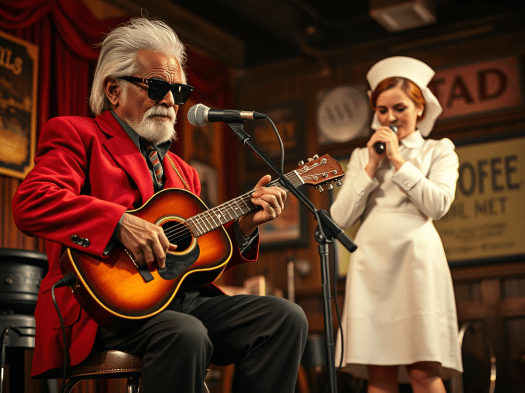
Around 7:15, Wino 2 informs Junior that the first performer has arrived and takes the stage for the introduction. He steps to the mic and, in that pleasant voice, says, “Ladies and gents, please welcome to the stage, Mr. Blind Jelly-roll Jackson and his nurse Carpathia.”

An ancient black man with hair as white as South Texas cotton, holding a guitar as old as himself, is helped to the stage by a prim female nurse dressed in a starched white uniform. The old man wears a red smoking jacket, a silver ascot, and black trousers. Dark sunglasses and a white cane complete his ensemble. The old fellow is as blind as Ray Charles.

The nurse gently seats the old gentleman in a chair provided by Wino 1 and lowers the large silver microphone to a height between his face and his guitar. She then stands to the side of the stage, just out of the spotlight. Blind Jelly Roll starts strumming his guitar like he’s hammering a ten-penny nail. Thick, viscous down strokes with note-bending riffs in between. His frail body rocks with every note he coaxes out of his tortured instrument. He leans into the mic and sings,

“We’s gonna have us a mess o’ greens tonight…haw..haw..haw…haw…gonna wash her down with some cold Schlitz beer..haw..haw..haw..gonna visit ma woman out on Jacksboro way…gonna get my hambone greased”. This was Texas blues at its best.

On cue, his nurse steps into the spotlight, extracts a shiny Marine Band harmonica from her pocket, and cuts loose on a sixteen-bar mouth-harp romp. Her ruby-red lips attack that “hornica” like a ten-year-old eating a Fat Stock Show Corndog. The crowd loves it. They dig it. When Blind Jelly Roll finishes his song, Wino 2 passes a small basket through the group for tips. Jelly Roll and his nurse take their kitty and depart. He’s due back at the old folk’s home before midnight.

In Remembrance: Fort Worth Days


Captain Salt and the Lonely Beatnik Band

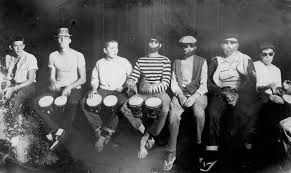
Pictured above is my late cousin’s band, Captain Salt And The Lonely Beatnik Band. They had a steady gig as the house band for the Hip Herford Coffee House in Fort Worth, Texas, in 1957. Junior Parker, my cousin, is the hip dude in the striped shirt. No one could play a stringed instrument, so everyone had a set of bongos. When a guest, such as Brother Dave Gardner, was on stage, the boys would provide a soft, cool beat, adding an aura of hipness to the poet’s reading. The band released a greatest hits album in 1958 that was a local hit within a four-block area. A young visitor from England, on vacation with his aunt, visited the coffee house, heard the band, and dug their stuff. It’s rumored he went back to England and formed his own band called the “Quarrymen,” and years later paid homage to the boys with a groundbreaking album, Sargent Peppers Lonely Hearts Club Band. I guess you can say my cousin had “X-Ray Eyes and knew his groceries. ” Hit me, man, I’m ice cold.

born to be wild

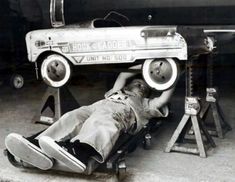
I wasn’t satisfied with my ordinary peddle car; I craved excitement and wind in my flat-top haircut: Speed was my need. My neighbor, Mr. Mister, our local mentor, and mad scientist, helped me install a Briggs & Stratton 5 HP lawn mower motor in my Western Auto peddle car. We tested my machine on the runway at Carswell Air Force Base, and it reached a speed of 70 MPH. I was a speed demon… ready for Thunder Road, figure 8 stock car races, quarter-mile drags, cruising Berry Street, racing teenagers between traffic lights, which is what I did one Saturday night when my parents thought I was asleep and wound up in a jail cell after the fuzz arrested me and confiscated my hot rod.

Delinquent women on motorcycles

“The Shangri-La’s” motorcycle gang, Fort Worth, Texas, 1957. My late cousin, Marlene Brando, right front, on the bad-ass Harley, was the Leader Of The Pack.

“Sargent Yorks Lovely Beatnick Bongo Band”


The Bongo Band at The Hip Hereford. Sargent ( Sal ) York in Stripped shirt

In 1957 there was a coffee house and Beatnik hangout in downtown Fort Worth, Texas called “The Hip Hereford,” named in honor of the owner’s prized champion bull.

Sargent ( Salvatore )Tulane York was related to the legendary war hero, Sargent York, on his fathers’ side of the family, thus his naming after his famous cousin.

Growing up on a vast cattle ranch outside of Weatherford Texas, Salvatore wanted one thing; to be a singing cowboy, like Gene Autry, Roy Rogers, and maybe Tex Ritter.

All-day, every day, from the time he could sit a saddle, Salvatore sat on his shetland pony, “Giblet,” playing a plastic ukulele while singing “Home On The Range” and “Oh Susana.” This behavior went on for years, and his parents finally gave up on the little savant, letting him ride the range singing his two-song songbook to the cattle and the critters. At times, his parents forgot to call him in for supper, or when it rained, and little Salvatore would make camp with the doggies, showing up a few days later as if nothing strange had happened.

When Salvatore turned 17, he began going by his family name of Sargent. It made him feel dignified and a little important. He and a few boys from school formed a little guitar and fiddle band and began playing around Parker County. Chicken fights, church fundraisers, and intermission at the Cowtown Drive Inn were about the only gigs they could get. They knew four songs and were hard to listen to. They called themselves ” The Parker Valley Ranch Boys.” They met Buddy Holley once and asked for his advice. He told them to stay the hell away from him and his Crickets and to get a real job.

The band didn’t work out, so Sargent decided he would try being a Beatnik. It didn’t take talent or an education, both of which he had none of, so he figured he could make it work.

He opened the first Beatnik-type coffee house in Fort Worth near the Majestic Theater. He gave the guitar and fiddle band one more shot but it didn’t fit the atmosphere. He had another idea that would work. Why even have music! Just have a few guys playing bongo drums while people speak or recite poetry. How cool is that? No messy music or instruments, just the gentle beat of the soothing bongo to accentuate the moment.

The picture above is the first incarnation of “Sargent Yorks Lovely Beatnik Bongo Band,” onstage at The Hip Hereford. Sargent York, the band leader, is the dude in the middle wearing the striped shirt.

Word got out about how cool and hip the place was, and soon every performer around wanted to be seen there. Elvis Presley was at Fort Hood serving his time in the Army, so he would come up on Saturday nights and sing a few tunes. Jack Ruby ( yes, that one ) would bring Candy Barr, the famous stripper to do her show, and Lyndon B.Johnson and Lady Bird would stop by to shake a few hands and recite the latest bill he was introducing in the senate. Lady Bird would give gardening advice. Brother Dave Gardner, the famous comedian made a few appearances, as did Lenny Bruce, Joan Rivers, Phylis Diller, Jonny Carson, Alvin, and The Chipmunks, Soupy Sales, and Rabbi Schmolie and his singing dog, Moses.

The place rocked on for another year, then when interest waned, Sargent closed the doors and went to Greenwich Village to become a folk singer.

The rumor that floated around for years, even into the mid-60s, was that some English musician was vacationing in Texas and caught a few acts at the Hip Hereford. He dug the name of the house bongo band and later passed it along to some of his blokes over on Abbey Road. Who knows, it could have happened?