

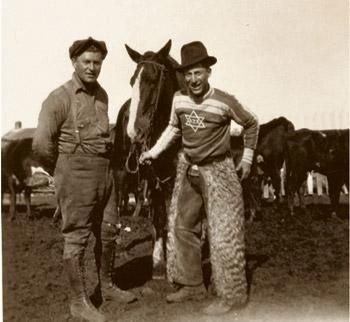
My grandfather on the left and his friend Hymie Rothstein with his horse, Miss Golda.
Hymie Rothstein departed the “old country”—New York City—in 1910, driven by a fierce longing to carve out a life as a cattle rancher. Armed with a tidy sum of money, a gift from his father, he purchased 500 acres of ranch land between Weatherford and Mineral Wells, filling the vast plains of Texas with 500 head of Hereford cattle. In a nod to his roots, he named the ranch “The Flying Menorah,” a tribute to his mother’s enduring spirit.
His mother’s cousin in New York, a man of ambition and impeccable taste, owned a fine restaurant in Manhatten. He made an agreement with Hymie to provide kosher meat for his clientele that desired it. Hymie, not one for shouldering piety, found himself adrift in the ways of raising kosher cattle. He took his best shot, his only shot.
He instructed his hands to don traditional Yarmulkes and grow their beards long as if the mere outward appearance would somehow sanctify the herd. On Fridays, just before the onset of the Sabbath, he would wheel a wagon through the pastures, a local Rabbi perched in the back, chanting blessings over the cattle and the land itself. Hymie, in his complacency, assumed some transformative power in these rituals. However, the Rabbi was paid twenty-five dollars for his solemnity and kept his thoughts on the insufficiency of such blessings close to his vest. A buck is a buck.
It was then that Hymie, seeking to nurture and grow his herd, purchased a massive Hereford bull from a neighboring ranch. The rancher who sold the bull warned Hymie that the bovine suffered from a restless spirit and could not be contained by mere wire fences. The bull’s wildness seemed almost elemental; he broke through barbed wire as if it didn’t exist, suggesting desperation and freedom to roam. Hymie named the bovine “Little Moses.”
As December descended into winter, a blue Texas norther swept across the prarie, enveloping it in a foot of snow. It was two days before Hymie’s ranch hands could reach the cattle, and when they finally did, they found the herd had vanished into the vastness, leaving only a gaping break in the fence. “Little Moses,” with his insatiable desire to roam, had led the others away into the boundless prairie.
Worry filled the air as the cowboys scoured the land for trails, only to lose their way in the rugged hills. Frantic, Hymie called upon the local sheriff, JD Ramses, to put out an alert for the missing cattle—a flyer caricaturing a group of smiling cows decorated every telephone pole and storefront in town. The sheriff alerted law enforcement in the surrounding counties. The poster added a comic touch in desperate times. Reports trickled in from West Texas of a large number of cattle seen crossing Route 66 a week ago.
Hymie and his men doggedly pursued the herd, picking up cow tracks outside of Lubbock. Thirty-nine days had passed, and the exhausted cowboys were ready to return home. On the fortieth day, they stumbled upon their herd resting against the edge of Palo Duro Canyon. All seemed accounted for, save for their leader, “Little Moses.”
As twilight descended, one of the men caught sight of a ghost emerging from the canyon, a snow-white bull, trembling, stumbling, yet proud. “Little Moses” had returned, his dark coat transformed into a glaring white, his eyes a startling blue that shifted like lightning in a storm. The bull had witnessed a Biblical apparition, possibly a burning tumbleweed or a flame-engulfed Mesquite tree.
The beast settled near the campfire, surrounded by his loyal herd, which gathered to pay homage as if sensing the moment’s gravity. Hymie offered him bread and a few sips of kosher wine as a final kindness. “Little Moses” then lay down next to the campfire. Accepting the warmth and the final moment, he drew his last breath, exhaling a vapor cloud that floated upward into the chilled night.
The sky boomed with thunder, a sudden crack of lightning that could have startled any common cattle, yet no one moved. Instead, they stood, rapt in attention, staring upward as a celestial sound of trumpets pierced the night. From somewhere above, two heavenly Holstein Angel Cows, graced with beautiful white wings, descended, each adorned with a golden trumpet in their right hoove.
The angelic cows flanked “Little Moses,” and, in a transcendent moment, the trio ascended into the heavens, a journey not just for the bull but for every living soul that had wandered alongside him. The Cowboys were left gobsmacked.
The group of men, in stunned silence, sat by the campfire, finding solace in their whiskey, rolled cigarettes, and hardtack. Dialogue sputtered and finally ended: no one could explain the miraculous ascending of Little Moses. Hymie, being the most religious of the bunch, said, “If God takes us sinful cowboys to Heaven, why not a cow? “
As dawn painted the sky anew, the cowboys awoke to find a snow-white bull calf standing proud among the cows—fiery blue eyes that sparked with the promise of a bovineious legacy. This new leader, born from the mystique of the canyon, would guide the way back to the Flying Menorah, a symbol of continuity in a world that had brushed against the divine.

 Notes From The Cactus Patch