We All Screamed For The Ice Cream Man


Summer afternoons with temps in the upper 90s. There is no air conditioning in your house, and you have a bad case of chiggers you picked up from the vacant lot down the street. Your front tooth is loose, and two toes on your left foot may be broken from being run over by your uncles’ station wagon. Life for kids in the 1950s was hard. But, the one thing that made it all worthwhile was the Ice Cream Man.

You could hear the cheesy music from two blocks away; plenty of time to make it home for some change. It didn’t matter if there was an entire half-gallon of Blue Bunny in the freezer, the Ice Cream Man was coming, and he had what we needed, the good stuff; Popsicles, Dreamsicles, Chocolate Cows, Rockets, Push Up Sherbert, Fudge Bars, and Eskimo Pies.

I thought selling ice cream from a white truck while dressed in a uniform was my career path. So I told my father that’s going to be me in a few years. But, yessir-ree-bob, it didn’t get any better than Mr. Good Humor pushing frozen sweets to kids. Of course, my father was concerned about my plans, but I was 7 years old and likely to change professional aspirations within a few hours. I also thought the Milk Man was a great gig. Half the kids on our block resembled him.

My pal Skipper and I once crawled into the back of the Vandorvorts Milk truck and rode for two blocks before being caught. We drank as much chocolate milk as we could hold before being discovered. It was freezing cold inside, but we did our best. It was worth the butt-busting.

There is nothing quite as funny as a bunch of kids with Popsicles stuck to their tongues running and screaming bloody murder. I always thought that ice cream man had a mean streak.

“Sargent Yorks Lovely Beatnick Bongo Band”


The Bongo Band at The Hip Hereford. Sargent ( Sal ) York in Stripped shirt

In 1957 there was a coffee house and Beatnik hangout in downtown Fort Worth, Texas called “The Hip Hereford,” named in honor of the owner’s prized champion bull.

Sargent ( Salvatore )Tulane York was related to the legendary war hero, Sargent York, on his fathers’ side of the family, thus his naming after his famous cousin.

Growing up on a vast cattle ranch outside of Weatherford Texas, Salvatore wanted one thing; to be a singing cowboy, like Gene Autry, Roy Rogers, and maybe Tex Ritter.

All-day, every day, from the time he could sit a saddle, Salvatore sat on his shetland pony, “Giblet,” playing a plastic ukulele while singing “Home On The Range” and “Oh Susana.” This behavior went on for years, and his parents finally gave up on the little savant, letting him ride the range singing his two-song songbook to the cattle and the critters. At times, his parents forgot to call him in for supper, or when it rained, and little Salvatore would make camp with the doggies, showing up a few days later as if nothing strange had happened.

When Salvatore turned 17, he began going by his family name of Sargent. It made him feel dignified and a little important. He and a few boys from school formed a little guitar and fiddle band and began playing around Parker County. Chicken fights, church fundraisers, and intermission at the Cowtown Drive Inn were about the only gigs they could get. They knew four songs and were hard to listen to. They called themselves ” The Parker Valley Ranch Boys.” They met Buddy Holley once and asked for his advice. He told them to stay the hell away from him and his Crickets and to get a real job.

The band didn’t work out, so Sargent decided he would try being a Beatnik. It didn’t take talent or an education, both of which he had none of, so he figured he could make it work.

He opened the first Beatnik-type coffee house in Fort Worth near the Majestic Theater. He gave the guitar and fiddle band one more shot but it didn’t fit the atmosphere. He had another idea that would work. Why even have music! Just have a few guys playing bongo drums while people speak or recite poetry. How cool is that? No messy music or instruments, just the gentle beat of the soothing bongo to accentuate the moment.

The picture above is the first incarnation of “Sargent Yorks Lovely Beatnik Bongo Band,” onstage at The Hip Hereford. Sargent York, the band leader, is the dude in the middle wearing the striped shirt.

Word got out about how cool and hip the place was, and soon every performer around wanted to be seen there. Elvis Presley was at Fort Hood serving his time in the Army, so he would come up on Saturday nights and sing a few tunes. Jack Ruby ( yes, that one ) would bring Candy Barr, the famous stripper to do her show, and Lyndon B.Johnson and Lady Bird would stop by to shake a few hands and recite the latest bill he was introducing in the senate. Lady Bird would give gardening advice. Brother Dave Gardner, the famous comedian made a few appearances, as did Lenny Bruce, Joan Rivers, Phylis Diller, Jonny Carson, Alvin, and The Chipmunks, Soupy Sales, and Rabbi Schmolie and his singing dog, Moses.

The place rocked on for another year, then when interest waned, Sargent closed the doors and went to Greenwich Village to become a folk singer.

The rumor that floated around for years, even into the mid-60s, was that some English musician was vacationing in Texas and caught a few acts at the Hip Hereford. He dug the name of the house bongo band and later passed it along to some of his blokes over on Abbey Road. Who knows, it could have happened?

Sharing A Piece Of Juicy Fruit With Tex Ritter


Tex Ritter, photo courtesy of Roy Rogers

“Do not forsake me, oh my Darlin,” on this our wedding day,” who didn’t know the first verse of that song from the radio? A massive hit from the 1952 movie “High Noon,” performed by everybody’s favorite singing cowboy, Tex Ritter.

In 1957, I was eight years old, and on some Saturday nights, I got to tag along with my father to the “Cowtown Hoedown,” a popular live country music show performed at the Majestic Theater in downtown Fort Worth, Texas. My father was the fiddle player in the house stage band, so I was somewhat musical royalty, at least for a kid.

Most of the major and minor country stars played Fort Worth and Dallas as much as they did Nashville, and I was fortunate to have seen many of them at this show. One, in particular, made a lasting impression on my young self.

I was sitting on a stool backstage before the show, talking to a few kids; who, like me, got to attend the show with their fathers.

My father came over and asked me to follow him. We walked behind the back curtain and stopped at a stage-level dressing room. There in the doorway stood a big fellow in a sequined cowboy suit and a 30 gallon Stetson. I knew who he was; that is Tex Ritter, the movie star and cowboy singer. My father introduced me, and I shook hands with Tex. I was floored, shocked, and couldn’t speak for a few minutes. What kid gets to meet a singing cowboy movie star in Fort Worth, Texas? I guess that would be me.

Tex asked my name and then told me he had a son the same age as me. We talked baseball and cowboy movies for a bit, then he handed me a one-dollar bill and asked if I would go to the concession stand and buy him a package of Juicy Fruit chewing gum. So I took the buck and took off down the service hallway to the front of the theater. I knew all the shortcuts and hidey holes from my vast exploration of the old theater during the shows.

I knew nothing of the brands and flavors, not being a gum chewer, but the words Juicy Fruit made my mouth water. Not having much money, what change I did get from selling pop bottles went to Bubble Gum Baseball Cards, not fancy chewing gums.

I purchased the pack of gum for five cents. Then, gripping the change tightly in my sweating little hand, I skedaddled back to Tex’s dressing room. He was signing autographs but stopped and thanked me for the favor. He then gave me two quarters for my services and disappeared into his dressing room for a moment. He handed me an autographed 8×10 photograph of him playing the guitar and singing to the doggies when he returned. I was in country and western music heaven. He also gave me a piece of Juicy Fruit, which I popped into my mouth and began chewing, just like Tex.

Juicy Fruit became my favorite gum, and now, whenever I see a pack or smell that distinct aroma as someone is unwrapping a piece, I remember the night I shared a chew with Tex Ritter.

“The Light Crust Doughboys Are On The Air”


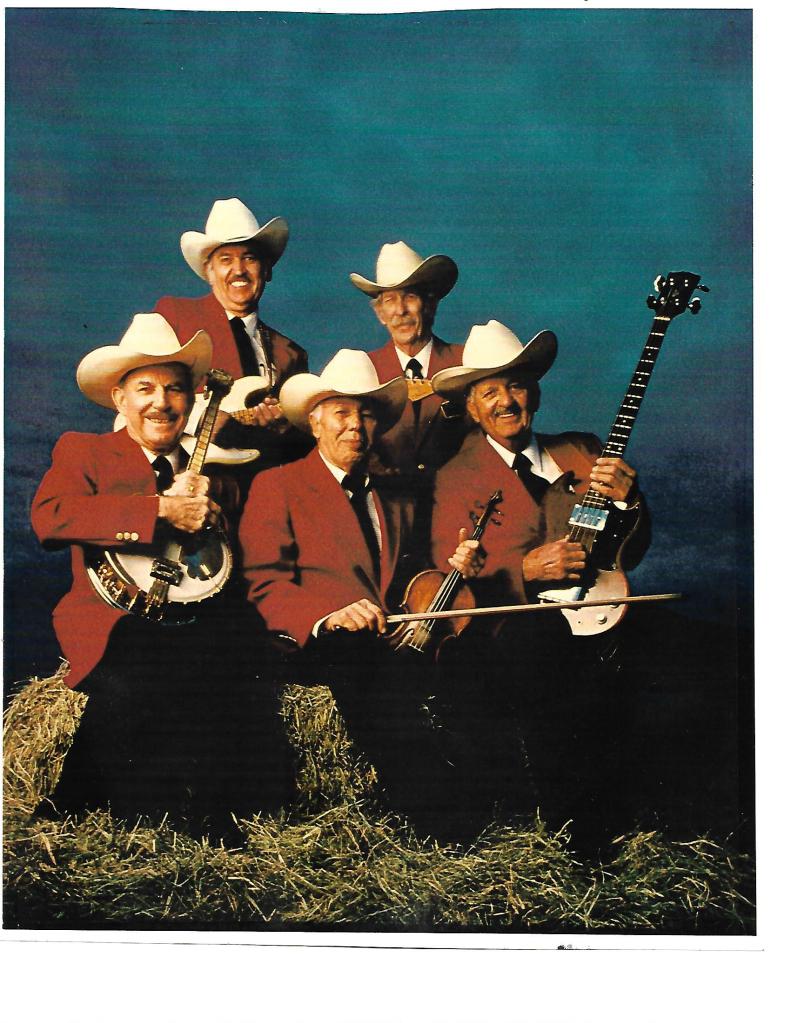
I am posting a picture of the legendary Texas western swing band, The Light Crust Doughboys, in memory of National Country Music Day. Top L to R; Jerry Elliot and Bill Simmons, bottom L to R; Smokey Montgomery, Johnny Strawn ( my father), and Jim Boyd.

As a small child growing up in Fort Worth, Texas, these men were part of my life until I helped carry some of them to their final rest. Texas, country music, and I are better because of them.

“Hair Today, Gone Tomorrow”


We Texans can be braggarts, pompous asses, and supercilious zealots about our state, history, and traditions. To us, “everything is bigger” in Texas. I won’t deny it because it’s true.

We are divinely blessed with the big sky country, enormous cattle ranches larger than most states, the vast rolling prairies, Big Tex and the State Fair, The Fort Worth Fat Stock Show, the Big Bend National Park, big rodeos, colossal oil and gas fields, big cattle with massive horns, tall longneck beers, fat fluffy biscuits, and my favorite, “big hair.” I happen to have first-hand knowledge of the big hair phenomenon. It happened in our household.

In 1956, an artistically inclined Fort Worth beautician who happened to be my uncle figured out he could take a woman’s healthy, shining long hair and transform it into a towering monument of femininity. Teasing, ratting, poking, backcombing, and then mold the mass into a two-foot mountain of tortured follicles. To keep the sculpture in place required a minimum of one or more 16-ounce cans of flammable cancer-causing lacquer-based hair spray that was known to explode when in the vicinity of an open flame. Who knew a hair-do could be so dangerous.

It was a winning combo for the beauty shops. Women had to visit their beauticians to achieve their “big hair” style, and the shop sold the spray to hold the sculpture in place. It was a gold mine, and within six months, every beautician in Fort Worth had doubled their business and was driving a Frank Kent Cadillac. The good times were rolling, and Texas women would never be the same.

My hair-fixin uncle entered a hairstyle show in Dallas and needed a model. My mother, ever the good sister, volunteered for the job, and off the two went. But, of course, Dallas was the forbidden zone for us Fort Worth-ians, so it was a shock to the family when my mother consented to go.

As children, we had to repeat an oath, pledging never, under any circumstance, to visit Dallas, except for funerals and weddings. Then, we were told not to spend our money there, to keep it in Cowtown. Amon Carter watched over his sheep, and the Leonard Brothers needed our support.

As a cold Saturday in late December, turned to nighttime, and then late evening. My father grew increasingly worried about his wife’s whereabouts.
“How long does it take to fix some damn hair?” He said for the hundredth time. The weatherman on Channel 5 had forecast a big sleet storm that could hit at any time.

Dinner was a sack of White Castle burgers. My sister went to bed early, and I, supporting my father, sat up watching “The Mummy” on Nightmare Theater. My father was outside in the cold, pacing on the front porch, chain-smoking unfiltered Lucky Strikes and cursing Dallas.

Around 10 PM, my father joined me in front of the television as the mummy was killing his final victim with a choke-hold; the front door opened, and there stood my mother with a furry gargoyle perched on her head.

The lighting from our Christmas tree cast an eerie glow on her form. Tiny glass ornaments in her hair reflected the red and blue lights, making her an angelic Christmas version of “The Bride of Frankenstein.”

She staggers to the sofa, plopped down, and fell over sideways. My father gently lifted her to a sitting position and placed a cushion behind her back. I noticed a small pile of broken hair where her head had landed. She began to weep. There was no consoling her; the more we tried, the louder she wailed.

Uncle said a jealous competitor had switched his hair spray with a can of spray glue so the hair-do would be permanent. The good news is that they won the hair show and received a big trophy and a check.

The following day, mom left the house early. When she returned, her hair was as short as a man’s.

I was sad to see the hair-do go. I thought the tiny ornaments in her hair looked pretty cool. After all, it was Christmas time.

I Was A 3-D Child


I saw my first 3-D movie in 1956. The House of Wax had been out for a few years, but this was close to Halloween, so the theater brought it back for an encore. My cousin Jock, Billy Roy, Georgie, my pal who was scared of everything and also our neighborhood firebug, and I rode our balloon-tire bicycles to the 7th Street Theater in Fort Worth. A ticket was 25 cents, and a Coke and popcorn were another 10 cents. We were set. The cheesy cardboard 3-D glasses were free.

I saw my first 3-D movie in 1956. The House of Wax had been out for a few years, but this was close to Halloween, so the theater brought it back for an encore. My cousin Jock, Billy Roy, Georgie, my pal who was scared of everything and also our neighborhood firebug, and I rode our balloon-tire bicycles to the 7th Street Theater in Fort Worth. A ticket was 25 cents, and a Coke and popcorn were another 10 cents. We were set. The cheesy cardboard 3-D glasses were free.

After two cartoons, a message on the screen said “put on your 3-D glasses now!” Man, we were ready. The music was scary, the credits and opening scenes were even scarier. Vincent Price looked about as evil as the devil, and the wax figures looked real, ready to jump through the screen. None of us would admit it, but we were scared to death.

Things started flying around the screen, then into the audience and over our heads. Floating orbs, spears and flying ghost. Old Vincent threw a fiery orb at the front row, and kids ran down the isle screaming, hitting the seats and falling, blind, still wearing their 3-D glasses. It was pandemonium. The manager stopped the film and brought up the house lights. That was it. How did the theater expect a bunch of little kids to react to such a weird movie?

We rode our bicycles home still wearing our 3-D glasses and looking oh so cool.

I wore those glasses for three days, and the world looked darn good in blue and red.