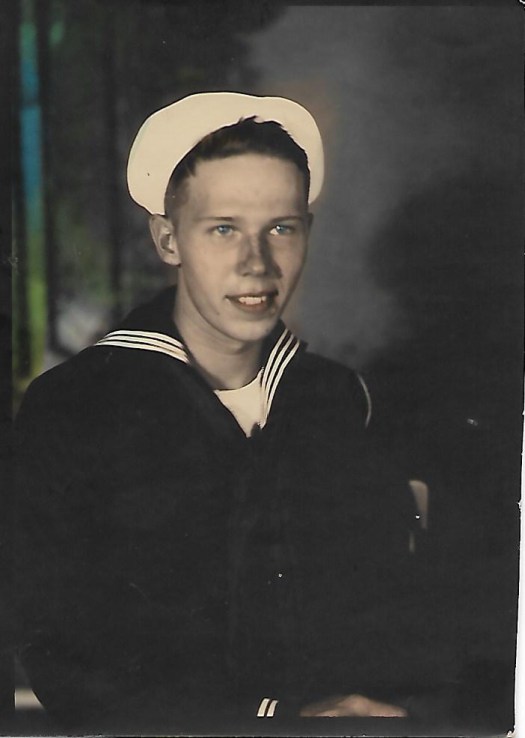
The Young Man In A Blue Uniform


Chapter 15

My father, Harold Johnny Strawn, Pearl Harbor 1942. When war comes and our country is set upon, young men and women will sacrifice themselves to stop evil.

Chapter 13 Wagons Ho, The War Becomes Real


The winds of war swept smoke over the Pacific and the Atlantic, shrouding America in the grim scent of burning flesh and shattered towns. No American could turn away from the truth that lay ahead.

With his basic training done, my father, Johnny, boarded a troop ship headed for Pearl Harbor, Hawaii. The voyage lasted a week, maybe more. He met many young men like him, all seventeen, their fathers signing the papers for them to join the Navy. They were bonded by youth, their love for their country, and the call of duty that carried them forward.

In Los Angeles, my grandmother Bertha accepted, somewhat, that her only boy was going to war. She kept busy writing letters to him before he made it to the islands. Her frantic behavior brought back the elixirs. Sister Aimee’s healing failed, yet no one in the family dared to take her back for a tune-up.

After arriving in Hawaii and settling into his barracks, the post carrier handed him two dozen letters, all from Mama. He did not need to read them; he understood their essence: “come home, I need you, I might die soon.” It was all self-inflated nonsense, and for the first time, he recognized it and turned away. From then on, he would burn or tear the letters into shreds, neither reading nor answering a single one. The umbilical cord had been severed.

The islands of Hawaii were beautiful, like a dream each young man held close. The mountains rose with dignity, green forests swayed softly, and the beaches called out their enticing embrace. It was difficult to accept that an island paradise could be in such turmoil. Yet, reality ousted the vision. Johnny stood on the fantail of a destroyer, the sea raging with anger, trapped between the allure of paradise and the blood-soaked chaos of war, all within a day’s sail. He reconsidered his reluctance to write and penned a few letters: one to his mother, sister, and father, in case he didn’t return to safe harbor.

Hollywood portrayed war in a way that seemed clean and tidy. The soldiers and sailors donned uniforms that were always crisp, and wounds were mere shadows, with no blood to mar the screen. But for Johnny, the truth of war came crashing down on the third day out at sea. His ship, along with four others, escorted an aircraft carrier that was suddenly attacked by Japanese planes. They struck the carrier twice, and Johnny’s destroyer was caught in the crossfire, taking a torpedo hit that crippled its forward compartments. Though the ship still moved, it was ordered to return to Pearl for repairs. Fear didn’t manifest itself until he was awakened in his bunk, shaking and praying that he had made the right choice. At that moment, he realized that death was a real option.

Chapter 12, Wagons Ho From Texas To California, War Comes To America


My grandfather, John Henry Strawn, was a man who walked through the shadow of World War I, kill or be killed, and he did that to stay alive. This left his life marked indelibly by the echoes of battle and the night terrors of remembrance.

Like a capricious storyteller, as most newspapers were in those years, in the bustling heart of Los Angeles, the “Daily News” spilled forth tales of a world war that often danced precariously between the lines of truth and embellishment. John Henry read the papers, listened to the radio, and sensed the winds of conflict stirring anew: England, under the dogged leadership of Churchill, had already been forced to take up arms against Germany, and the very fabric of Europe was being torn apart by Hitler’s relentless march. The veterans he worked with and once fought beside in the first war, their spirits worn yet resolute, whispered with a shared conviction that Japan, lurking in the periphery, was quietly readying itself for an insidious alliance with the Nazis, as if the world were a stage set for a dark, unfolding tragedy.

Though a year too young to answer the call of duty, my father carried the heavy knowledge that at eighteen, the war might come knocking at his door.

With weary eyes and a resolve hardened by fate, Churchill was bartering and begging Roosevelt for machines of war, trying to keep the demons of Hitler from roaming freely on Europe’s fields and invading his island nation. With the earnestness and bravo of youth, Young Johnny approached his father, asking him to sign the papers letting him enter the fray at seventeen. No man who had walked the grim aisles of battle wanted his only son to face the specter of death on foreign soil, yet in a moment of bittersweet surrender, he found himself issuing that reluctant blessing, driven by a love that could not deny the call of his son’s heart. Convincing his wife, Bertha, would be a battle he dreaded and would likely lose.

Japan unleashed its first thunderbolt, and as the morning awoke over Pearl Harbor, Hawaii, our once-proud Navel fleet lay shattered on the waters of war, a haunting reflection of the chaos unleashed on that fateful December 7th, 1941. The weight of long-forgotten battles seemed to press upon the shoulders of the divine Emperor Hirohito as if the specters of ancient warlords propelled him towards an unseen abyss, a dark and uncertain fate simmering beyond the horizon. The gates of Hell swallowed Japan, and the gatekeeper kept them imprisoned until their foolish folly was completed.

Three members of the string band Blind Faith had fancied themselves sailors and enlisted in the Navy, much to the dismay of Johnny, Blind Jelly Roll, Pancho Villa, and Le’ Petite Fromage, who found themselves in possession of a hefty bag of bookings badly in need of some good ol’ resolution. To add a sprinkle of chaos to the mix, Pancho Villa, the loyal seeing eye dog of Blind Jelly Roll, had now joined the ranks of the visually impaired, having lost sight in his last good eye. Sister Aimee, ever the resourceful soul, splurged on a certified German Shepherd to take over the seeing-eye duties, much like the replacement engine in a clunky old jalopy. Pancho Villa, undeterred and full of moxie, took to his new post on a small platform fixed to the back of this new pooch’s harness, barking orders like a captain adrift at sea, blissfully unaware of his own shortcomings. More than once, they came perilously close to being flattened by a passing car, prompting Jelly to stuff Pancho into a papoose on his shoulder, urging the little rascal to button it. It was becoming painfully apparent that the music of the Blind Faith string band was about to fade into the pages of history, as every good tale must come to an end; their final curtain had been drawn, and boy, did it drop with a thud!

Le Petite Fromage, bless her heart, found herself smitten with the charming trumpet player of the church orchestra, a situation that surely raised the eyebrows of the good girls in the choir. Sister Aimee tied the knot between the two in their rather cramped dressing room as a way of keeping things discreet—or perhaps just to save on wedding costs. Off they scampered on an Eastbound train to Chigger Bayou, Louisiana, the very next day, with visions of a well-timed little one dancing in their heads like so many sugar plum fairies. Meanwhile, good ol’ John Henry, ever the dutiful father, marched with his son Johnny to the enlistment office, signing his life away in exchange for a rather dashing Navy uniform, all at the tender age of seventeen. As for Bertha, bless her soul, she took to her bed like a shipwrecked sailor, wailing and concocting her questionable brews that promised to calm her nerves but likely only added to her woes. There she lay, utterly convinced that her son was on an express boat to Pearl Harbor and straight into the chaos of World War II. The dutiful son had left one duty to embrace another.