Dylan In One Paragraph: Going Electric And Country


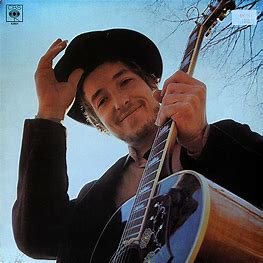
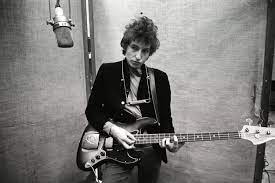
Bob was a restless cat. His hair was longer and wilder now. Minnesota was a dream or at best, a faded picture on a postcard from home. The Martin guitar didn’t do it for him anymore, nor did Pete, Woodie, or Joan. He hooked up with some Canadian boys with electric guitars and organs and traded the acoustic for a Fender Strat and a Super Reverb Amplifier. He was hip…he was in the scene…current and cool. He was tired of writing songs about nothing that seemed like something after a few bottles of wine and some grass. All these young hippie kids thought he was the Messiah of music..the second coming, he tried walking on water and almost drowned, all for believing the hype. He was done. Joan B. was clingy, handsy, folksy, and too natural for his taste. She didn’t shave her armpits or legs and he was sick of her traditional whiney folk music. He had been to Monterey and played grab-ass with Janis. New York can go to hell. He was going to Nashville and pick with them cats that played cool as country water. Chet Atkins invited him to dinner. Johnny Cash invited him into the fold. He was sold on country cooking and Gibson guitars. Nashville Skyline was his opus. Cash led him to the promised land. He found Baby Jesus in a snow globe at the Bluebird Cafe. He put the Menorah in his pantry and laid out the “Good Book” on his coffee table, next to the crystal ashtray and his roll-your-own cigarettes. Bob was a Christian now, his Jewish days behind him for a while, but he would revisit them often. Joanie wanted a rematch..said she would be less competitive and write even crappier songs, Bob said no way, he couldn’t take another round of her. He thought about buying another motorcycle, but just for a minute. Naw…I don’t need another broken neck and leg. He purchased a machine gun in case the Black Panthers came to Woodstock, he would be ready. He wrote ten thousand songs and won the Pulitzer Prize. He kept the money. His son, Jacob is too hip and hangs out with girls from Laurel Canyon that have no talent for anything except spending his money and wailing. Bob tells him to get a haircut and a real job, he is now his own father back in Minnesota. Bob sells his song catalog for a Billion dollars to a group of Japanese. He’s flush with cash. He calls Paul and Ringo and tells them to stick it, he’s richer than they are now. Paul writes a song about it. Ringo sends him some Kale cupcakes. He revisits the Village. All the old hangouts are now fast food joints and iPhone shops. He walks the street, but no one recognizes him..he’s good with that. His cell phone rings, it’s Joan B., and she wants to meet for a salad and mineral water lunch. He wants a burger, he tells her he loves meat, and she gags and pukes on her Samsung phone. Bob laughs and walks into McDonalds for a Big Mac. The girl behind the counter asks him if he’s that guy on that “Survivor.” TV show. He says “No, I am a survivor.”

Ask A Texan: Wife Tries to Sing Like Willie Nelson


Pretty Good Advice For Folks That Don’t Live In Texas, But Wishing They Did

The Texan

Mr. ET ( Ernest Tom ) Home from Roswell New Mexico sent this Texan a long letter written on a McDonald’s takeout food bag. His wife is attempting to become a country singer and has gone to extremes, and he’s hoping I can help.

ET Home: Mr. Texan, about a month ago, the wife, Willowmina, decided she was going to become a country songstress. Well, that’s all fine and dandy, but the poor gal, bless her heart, sounds like Phyllis Diller when she sings. Both cats have left home and the neighbors are knocking on our door, a lot. She see’s old Willy Nelson on the View and he’s bragging about how he gave Beyonce some of his strongest weed and it turned her into a country singer. Well, that’s all it took. Next day, we drive to Ruidoso and visit the Miss Dolly’s Weed Emporium and Desert Shop. The wife asked the young lady manager what is the best and strongest stuff she has from old Willy. She leads us into a back room, then into a closet and down some secret stairs into another little room. She hands her a small box and says this is the best stuff on planet earth: Willy’s “Hide And Watch” secret stuff. I hear it can be a life changer, and not always in a good way. Well, we take the stuff and go back to Alien city.

She’s been puffing away on that stuff for a while now, and I hear her singing in the shower, and will admit, she is getting better. Then about a week ago, she put her long gray hair in braids, put a bandanna on her head and starts playing songs on our granddaughters Taylor Swift plastic Ukulele. She’s starting to look like old Willy, face stubble and all, and I think I must be losing my marbles. So’s, I calls the daughter, Little Tator, and she drives down from Raton Pass, walks in the house looks at her mother and says, “You ain’t crazy Daddy, that’s Willy Nelson in a Pioneer Woman house robe and Pokemon slippers.” Looking for an answer here.

The Texan: Well, Mr. ET I was at a loss on this one so I called a friend of mine, Dr. Scaramouche at the Fred Mercury Hospital For The Deranged in Queens, NY. He says this derangement is new and becoming more common thanks to entertainers like Taylor Swift and the Kardashian clan. Folks think that by eating, drinking, ingesting things, or dressing like their idols, they can glam off their talent and become a version of them. Willy was right, Beyonce is about as country as Martha Stewart. I would start out by taking away the weed. If that doesn’t change things, you might consider buying a used tour bus and going “On The Road Again.” I hear it can be a lot of fun. Keep in touch, and I am sending her a box of Little Debbie snack cakes.

Chapter 14: From Homesickness to Harmony


After two months in Hawaii, homesickness crept in. Johnny missed his music and his string band, Blind Faith. His prized fiddle stayed behind, locked away in the hall closet. His father assured him that it would be well cared for.

Norma, his sister, wrote each week; her letters were either sharp with bitterness, primarily toward their mother, or filled with hilarity about life at home. His dog, Lady, lingered in his thoughts, her absence a weight; she is old and might not be alive when he returns.

Once again, in the clutch of her elixirs and perhaps something more potent, his mother continued her assault by missives. Johnny read a few, sensing something wrong. She sounded unsteady, lost. Her words were jagged, and he promised himself no more. He would not carry the burden of the guilt she heaped upon him. Her pen was poison.

A music store sold him a fiddle for ten dollars. The owner was an old Korean man who made a few adjustments, adding new strings and setting the bridge and sound post just right. It did not sound as sweet as his own, but now he had a fiddle, giving him a spring in his step. He needed musicians. His commanding officer, walking by the barrack, heard Johnny practicing. Whenever he had spare time, he sat on a wooden crate under the shade of a Koa tree behind the barracks, entertaining the birds perched in the tree. The officer from the South Texas town of Corpus Christi offered to connect him with musicians he knew. True to his word, two sailors came to Johnny’s Quonset Hut the next day. One was a guitar player named Jerry Elliot, a fellow Texan, and the other was Buzz Burnam, who played the doghouse bass fiddle. Buzz, a Western Swing musician from Albuquerque, knew a few other musicians who might be interested in jamming. They set a practice day and time to meet under the Koa tree. Johnny’s homesickness eased a bit.

A letter from Le’Petite Fromage gave Johnny another lift. She and her husband, Montrose, the trumpet player from Sister Aimee’s orchestra, had a baby child named Savon, an old Cajun family name. They planned to stay in Chigger Bayou, and she would sing in her father’s band if and when he returned from California. Her mother, Big Mamu, said life was better without him underfoot. She had told Johnny many times that girls in the Bayou are expected to be married with a child on each hip by the age of eighteen. Tradition got the best of her. Blind Faith was finished. It was a good run while it lasted.

Sunday was a day for rest, even amid the chaos of war. The sailors moved through the day with light duty on the Sabbath, their shoulders eased, and their spirits lifted after a good dose of religion found in the island’s many churches. After lunch, the two musicians arrived, bringing two more as promised, one bearing a saxophone, the other a snare drum with one cymbal. They played, and the music flowed—Western swing, big band, island tunes. It went on for hours. They were asked to play at the Officers Club in the Royal Hawaiian Hotel a few days later. The pay was meager, but they were musicians, and they knew the worth of their work was in the joy it brought, not the currency it earned.

A letter came from Sister Aimee McPherson. It told Johnny about Blind Jelly Roll. He had been hit by a car. The new seeing-eye dog, following barking directions from the nearly blind Pancho Villa, led them across a busy street. They walked straight into the path of a vehicle. Everyone survived, but Blind Jelly Roll broke his left arm. His hand was crushed under the tires. It seemed unlikely he would ever play the blues again. She would keep him on as the music director and spiritual advisor. She loved that old black man and his ill-tempered Chihuahua deeply.

Sometimes, good luck strikes like lightning hitting the same ground. Johnny felt it. His C.O. asked him to help with the weekly base paper. This led him to work at the Pearl City News when off duty. He became the leading writer. Two sailors he knew were on staff, too. The pay was little, but he saved every cent until he had a decent stack of bills. He rented a lot in downtown. Then, he bought two used cars from an officer. They sat there for sale. The drugstore next door took names for those who inquired, and Johnny made appointments to sell. Two cars turned to three, then five, then ten. Two young Hawaiian boys washed them twice a week. Johnny sat beneath a small canopy that served as his office. He sold cars, saved money, bought more, and eventually acquired the lot and four more on that block. In a year, he owned a few small buildings and all remaining vacant lots—almost an entire city block in east downtown Honolulu. After his Navy discharge, he rented a room in a house owned by the old Korean man who owned the music store. He was taken aback when he met the man’s young granddaughter, who was the same age as him. They both sported arrows in their backs, shot by the mythical fairy, Cupid. Returning to Los Angeles was now out of the question.

In Remembance: Kids With Weapons Of Mass Destruction


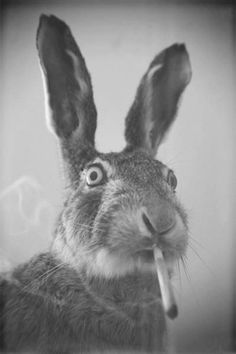
Toys in the 1950s, you gotta love them. The one pictured above, the machine gun that shoots wooden bullets, is a weapon I could never get my paws on. I did manage a Fanner 50 western pistol and a Colt snub-nose version that shot plastic bullets, but nothing like a machine gun. That would have been the ultimate weapon for our neighborhood battles against each other and “the hard guys” across the railroad tracks. All of these potentially lethal weapons were advertised in comic books. Did any responsible adult ever check these ads before the book was printed? Hard wooden bullets mowing down kids; talk about shooting an eye out or death. These weren’t ads dreamed up by New York Mad Men, but ones from back alley shops that made money off the gullibility of children, me included. My buddy Georgie ordered a so-called real hand grenade from the back page of a Richie Rich comic. A month later, he got a real steel WW2 surplus hand grenade in the mail. It wasn’t live with explosives, but damn, it gave his parents a shock. His father had thrown more than a few of them when he fought at Guadalcanal.

I ordered the Super Man X-Ray glasses from my Super Man comic book. The first pair I ordered for $1.49 called “Magic X-Ray Glasses,” got me into trouble. I told two girls from my neighborhood baseball team that I could see their bones and guts, even though I couldn’t see a thing. They ended up giving me a beating with their Hula Hoops! Who knew a Hula Hoop could hurt so much? I had the word WHAMMO imprinted on my back for a week. My mother dispensed the fake glasses to the garbage can in the alley and saved me from further assaults. Most everything bad that got me in trouble wound up in those alley garbage cans.

Faster Than A Speeding….

Yep, I had to have one, so for Christmas, mom coughed it up. It was a cheesy-looking costume, not much better than cheap pajamas. My Aunt Norma, a seamstress extraordinaire, added tufts of foam and cotton padding to give the appearance of super muscles. She made gold material covers for my PF Flyers and made a new cape. I was hot stuff. Naturally, all my buddies assumed this suit would enable me to leap tall buildings in a single bound, fly faster than a speeding bullet, and all that super stuff. I actually believed I could, so I climbed to the second-story roof of our house, stood on the roof line, cape blowing in the wind, and stared at my buddies thirty feet down in the backyard, awaiting my takeoff. Down the roof, I ran and launched off the edge into the spring air. I landed on top of two of my friends, which saved me from injury. Mother, who saw the whole performance immediately busted my butt with a Tupperware container while dragging me into the house. The suit was in the alley garbage can the next morning. I never flew again.