The Weight of Goodbye: Johnny’s Regretful Return Home


Chapter 17

Having made the painful choice to journey back to Texas, Johnny found himself in a heart-wrenching struggle, surrendering the opportunities that lay before him—holdings that promised riches within a decade. With a heavy heart and resolute spirit, he cast aside dreams of wealth, fully aware that the path behind him had irrevocably vanished, leaving only the words of “what have been.”

The lots on the edge of downtown Honolulu vanished in a few days to a dodgy speculator, who offered a fire sale price. The used car lot was sold to a former commanding officer with a firm handshake and a promise that money would follow when the last existing vehicles found new homes. Now, he was left with nothing but the relic of a pawn shop fiddle, a token of better days. He returned the instrument to the old Korean man, who was less than friendly, still smarting from the failed romance between his granddaughter and Johnny. He offered a few dollars, which was silently rebuked. Confident that his father had cared for his prized violin, it would be waiting for the bow’s stroke across the strings.

Johnny made his rounds to bid farewell. The Royal Hawaiian staff had treated him kindly despite his being a Haole. The folks at the Pearl City News and the companions of his musical venture each received a heartfelt goodbye.

On his last night in paradise, Johnny dined alone. Over the years, The Brass Monkey Tavern and its delicious seafood had comforted him. Pika, the native Hawaiian bartender, produced a special bottle from the top shelf. Tonight, there would be no cheap hooch for his valued Haole friend.

The bitterness of his embattled relationship with his mother touched every part of his soul. He knew full well that forgiveness, if it ever came, would be a long, winding road marred by the shadows of contrived intent. Knowing that his father was faltering added to his haste in his departure.

The troop ship to California was packed with weary yet hopeful servicemen returning from their duties. A loud hum of excitement hung thick in the air. For many, it was a moment to rekindle the flame of old lives or to carve out new paths. Yet Johnny was lost to his sadness and felt no thrill. His thoughts drifted to Blind Jelly Roll, Sister Aimee, and Le Petite Fromage, now back in Chigger Bayou. Their presence in his life had brought him great joy. He felt obliged to give them one final visit, knowing it would be the last in his lifetime.

Blind Jelly Roll, aware that his days were numbered, was grateful for the visit. His humor was intact, and he asked Johnny if he would like to ride in his new sedan, touting that his driving skills had improved since their last visit. Pancho Villa, the tiny demon dog, had only taken a soft nip on Johnny’s hand, but his lack of front teeth made the nip more of a gumming affair. Sister Aimee, angelic as ever, had transformed into a maternal figure for Jelly and promised Johnny that the old bluesman would find a nurturing and loving home until his final hour. Even that cantankerous dog would be cared for. Johnny saw something in her eyes; the looks she cast on the old man were more than motherly; he detected an inner fire that fueled her commitment. Farewells were exchanged. There were strong hugs, a few tears, and some laughs. The final, out-the-door goodbye was punctuated by promises to write.

That evening, Johnny boarded the Super Chief bound for Chicago, with a stop in Fort Worth. The journey would take three days and arrive in the morning light. He kept his arrival a secret from his family, anticipating the thrill of surprise. He sat cradling a cup of coffee on a wooden bench in the train station. He had gotten it from the diner. The lady behind the counter, dressed in a waitress uniform, reminded him of his sister. He missed Norma and was troubled by her not writing in almost two years. He knew something was wrong and would make it all right today. The night stretched long. He had come to find peace in books. He thought of Thomas Wolfe’s words, “You can’t go home again.” But could he? Would he be met by a marble angel on the porch or find only a locked door at the end of his journey?
Dreams of Europe: A Haunting War Reflection


Last night, I dreamed of Europe, teetering on the brink of war, reminiscent of those haunting days of the 1940s. It was not a nightmare but rather a sepia-toned memory, grainy like an old newsreel flickering in a rundown theater, the air thick with the scent of buttered popcorn and sticky sodas clinging to the soles of my worn Tom McCann wingtips. Beside me, my wife, Momo, sat elegantly in her gabardine dress, her silk scarf accentuating her perfect neck. A picture of quiet strength amidst the storm brewing outside. Somehow, as if a magical spell, we knew of war, maybe because our fathers had participated, not reluctantly like some, but dutiful, knowing their presence would make a difference in the outcome.

We found ourselves seated amid a crowd, the air thick with the scent of Old Spice, a memory of times past. Momo leaned forward; her senses caught Chanel No. 5 drifting languidly alongside us while cigarette smoke curled upwards, smothering the flickering images that danced on the screen. An army advanced in unyielding formation, each soldier a cog in an unfeeling machine ready to unleash mayhem upon a peaceful country. A lone figure stood poised for inspection; within his eyes, a cold emptiness lingered, reminiscent of a predator—those soulless eyes of a waiting shark. At first, I thought he might be Hitler, a returned demon from the depths of Hell. I was wrong. A Russian, short in stature, long on evil, intent on destruction. The shark now has legs and walks among us. I awakened, sweating and gasping. Momo sleeping peacefully, unaware of the dream we shared. We left without seeing the movie.

Johnny’s Journey: From War to Healing in Hawaii


Chapter 16: Johnny Didn’t Come Marching Home

Foreword: Usually by another writer or friend. Excuse the breaking of tradition. These chapters reveal my struggle with the truths of my family. As a child and later as an adult, I saw the darkness of alcoholism and how it grips every soul within a household. I wished for families like those in a Norman Rockwell painting, gathered at the table with Grandfather carving the turkey, but life shattered that image. AA was just beginning to rise, and the word “enabler” had not yet marked the shadow of alcoholism. Bleeding in a public arena is not pretty.

The island of Hawaii held its charm, still untouched by the war. A year after the conflict with Japan, a few tourists arrived by boat, drawn to its beaches and emerald water. The men and women in uniform returned home, demobilized from the military. Johnny chose differently. He stayed, nurturing the holdings he had acquired over two years. Luck had favored him; he owned land in downtown Honolulu, not the best area, but one that would grow over the years and be worth hundreds of times what he paid. California held no interest, Texas even less. He would again be under the veil of his mother’s demands and secrets. The more time away he had, the more he saw that the extended family of her sisters and cousins was more toxic than nurturing. The arrangement with the old Korean had soured; there would be no marriage to his granddaughter, a relief to Johnny. He would take his chances to either flourish or fail in Hawaii.

Near the end of his first year after leaving the Navy, once again, the missives from home arrived almost daily. They were often the same—repetitive and sharp. Nothing had changed; Sister Aimee’s cures were lost like smoke in the wind. His father did not write, making Johnny feel like he was not there or had no strength to fight. The family had returned to Fort Worth. He now knew that something dire had transpired.

A letter from his sister Norma came with bad news. His beloved dog, Lady, had passed peacefully in her sleep at the age of eighteen. John Henry was not doing well; a depression had set upon him soon after they returned to Texas from California. His leaving a prestigious job and salary and returning to the furniture shop, working for a pittance of his former wage, caused him great stress. He would go days without speaking to anyone, lost in his sadness, reluctantly accepting the fact that he was now an older man and he had left his best life out west. PTSD was not yet diagnosed, but his behavior had all the signs of the illness. Killing another human, even in the ugliness of war, will take a piece of a man, leaving him un-whole and susceptible to the whispers of the Demons that await. John Henry had many to fight.

Johnny’s mother had become a mean, spiteful woman full of hatred for anyone other than her precious sisters in arms; they were all swimming in alcohol for the better part of each day. The reality of life was a concept they didn’t grasp; the party came first, and to hell with the rest of it.

Norma was planning to leave and join her brother in Hawaii but was reluctant to leave their father in his fragile state. Guilt washed over Johnny for not being there for his dog, Lady; she had been his faithful companion for his entire life. He was ashamed that he was more broken up over her death than the tribulations of his parents; they were adults who occupied their own prison. They could deal with it themselves. He wanted nothing to do with any part of their perils. Still, the missives came daily, now more frantic and cruel than ever. He was teetering, trying to stay positive and not give in to the dark web woven by his mother’s disease. It was impossible to fight. In anguish, he gave into her cruelty, hating himself for his weakness. Arriving in Hawaii, a boy, then becoming his own man, now again, a boy dragged across the Pacific Ocean by a three thousand-mile umbilical cord.

The Young Man In A Blue Uniform


Chapter 15

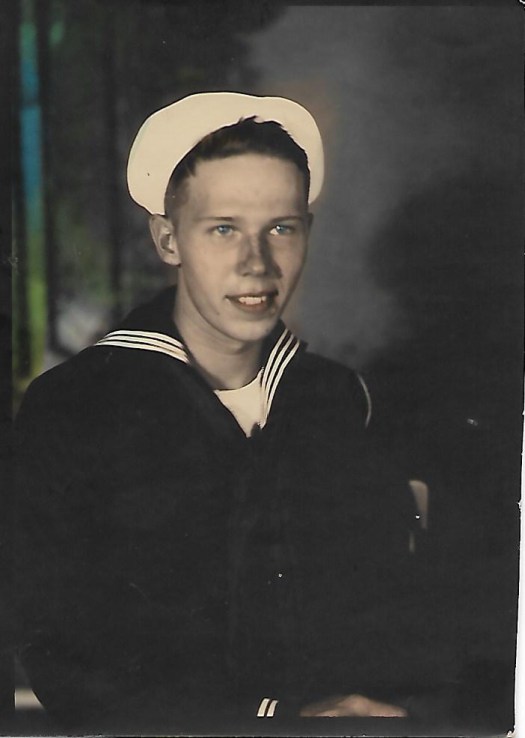
My father, Harold Johnny Strawn, Pearl Harbor 1942. When war comes and our country is set upon, young men and women will sacrifice themselves to stop evil.

Chapter 14: From Homesickness to Harmony


After two months in Hawaii, homesickness crept in. Johnny missed his music and his string band, Blind Faith. His prized fiddle stayed behind, locked away in the hall closet. His father assured him that it would be well cared for.

Norma, his sister, wrote each week; her letters were either sharp with bitterness, primarily toward their mother, or filled with hilarity about life at home. His dog, Lady, lingered in his thoughts, her absence a weight; she is old and might not be alive when he returns.

Once again, in the clutch of her elixirs and perhaps something more potent, his mother continued her assault by missives. Johnny read a few, sensing something wrong. She sounded unsteady, lost. Her words were jagged, and he promised himself no more. He would not carry the burden of the guilt she heaped upon him. Her pen was poison.

A music store sold him a fiddle for ten dollars. The owner was an old Korean man who made a few adjustments, adding new strings and setting the bridge and sound post just right. It did not sound as sweet as his own, but now he had a fiddle, giving him a spring in his step. He needed musicians. His commanding officer, walking by the barrack, heard Johnny practicing. Whenever he had spare time, he sat on a wooden crate under the shade of a Koa tree behind the barracks, entertaining the birds perched in the tree. The officer from the South Texas town of Corpus Christi offered to connect him with musicians he knew. True to his word, two sailors came to Johnny’s Quonset Hut the next day. One was a guitar player named Jerry Elliot, a fellow Texan, and the other was Buzz Burnam, who played the doghouse bass fiddle. Buzz, a Western Swing musician from Albuquerque, knew a few other musicians who might be interested in jamming. They set a practice day and time to meet under the Koa tree. Johnny’s homesickness eased a bit.

A letter from Le’Petite Fromage gave Johnny another lift. She and her husband, Montrose, the trumpet player from Sister Aimee’s orchestra, had a baby child named Savon, an old Cajun family name. They planned to stay in Chigger Bayou, and she would sing in her father’s band if and when he returned from California. Her mother, Big Mamu, said life was better without him underfoot. She had told Johnny many times that girls in the Bayou are expected to be married with a child on each hip by the age of eighteen. Tradition got the best of her. Blind Faith was finished. It was a good run while it lasted.

Sunday was a day for rest, even amid the chaos of war. The sailors moved through the day with light duty on the Sabbath, their shoulders eased, and their spirits lifted after a good dose of religion found in the island’s many churches. After lunch, the two musicians arrived, bringing two more as promised, one bearing a saxophone, the other a snare drum with one cymbal. They played, and the music flowed—Western swing, big band, island tunes. It went on for hours. They were asked to play at the Officers Club in the Royal Hawaiian Hotel a few days later. The pay was meager, but they were musicians, and they knew the worth of their work was in the joy it brought, not the currency it earned.

A letter came from Sister Aimee McPherson. It told Johnny about Blind Jelly Roll. He had been hit by a car. The new seeing-eye dog, following barking directions from the nearly blind Pancho Villa, led them across a busy street. They walked straight into the path of a vehicle. Everyone survived, but Blind Jelly Roll broke his left arm. His hand was crushed under the tires. It seemed unlikely he would ever play the blues again. She would keep him on as the music director and spiritual advisor. She loved that old black man and his ill-tempered Chihuahua deeply.

Sometimes, good luck strikes like lightning hitting the same ground. Johnny felt it. His C.O. asked him to help with the weekly base paper. This led him to work at the Pearl City News when off duty. He became the leading writer. Two sailors he knew were on staff, too. The pay was little, but he saved every cent until he had a decent stack of bills. He rented a lot in downtown. Then, he bought two used cars from an officer. They sat there for sale. The drugstore next door took names for those who inquired, and Johnny made appointments to sell. Two cars turned to three, then five, then ten. Two young Hawaiian boys washed them twice a week. Johnny sat beneath a small canopy that served as his office. He sold cars, saved money, bought more, and eventually acquired the lot and four more on that block. In a year, he owned a few small buildings and all remaining vacant lots—almost an entire city block in east downtown Honolulu. After his Navy discharge, he rented a room in a house owned by the old Korean man who owned the music store. He was taken aback when he met the man’s young granddaughter, who was the same age as him. They both sported arrows in their backs, shot by the mythical fairy, Cupid. Returning to Los Angeles was now out of the question.

Chapter 13 Wagons Ho, The War Becomes Real


The winds of war swept smoke over the Pacific and the Atlantic, shrouding America in the grim scent of burning flesh and shattered towns. No American could turn away from the truth that lay ahead.

With his basic training done, my father, Johnny, boarded a troop ship headed for Pearl Harbor, Hawaii. The voyage lasted a week, maybe more. He met many young men like him, all seventeen, their fathers signing the papers for them to join the Navy. They were bonded by youth, their love for their country, and the call of duty that carried them forward.

In Los Angeles, my grandmother Bertha accepted, somewhat, that her only boy was going to war. She kept busy writing letters to him before he made it to the islands. Her frantic behavior brought back the elixirs. Sister Aimee’s healing failed, yet no one in the family dared to take her back for a tune-up.

After arriving in Hawaii and settling into his barracks, the post carrier handed him two dozen letters, all from Mama. He did not need to read them; he understood their essence: “come home, I need you, I might die soon.” It was all self-inflated nonsense, and for the first time, he recognized it and turned away. From then on, he would burn or tear the letters into shreds, neither reading nor answering a single one. The umbilical cord had been severed.

The islands of Hawaii were beautiful, like a dream each young man held close. The mountains rose with dignity, green forests swayed softly, and the beaches called out their enticing embrace. It was difficult to accept that an island paradise could be in such turmoil. Yet, reality ousted the vision. Johnny stood on the fantail of a destroyer, the sea raging with anger, trapped between the allure of paradise and the blood-soaked chaos of war, all within a day’s sail. He reconsidered his reluctance to write and penned a few letters: one to his mother, sister, and father, in case he didn’t return to safe harbor.

Hollywood portrayed war in a way that seemed clean and tidy. The soldiers and sailors donned uniforms that were always crisp, and wounds were mere shadows, with no blood to mar the screen. But for Johnny, the truth of war came crashing down on the third day out at sea. His ship, along with four others, escorted an aircraft carrier that was suddenly attacked by Japanese planes. They struck the carrier twice, and Johnny’s destroyer was caught in the crossfire, taking a torpedo hit that crippled its forward compartments. Though the ship still moved, it was ordered to return to Pearl for repairs. Fear didn’t manifest itself until he was awakened in his bunk, shaking and praying that he had made the right choice. At that moment, he realized that death was a real option.