Ask A Texan: Finding Joe Bee’s Father


Pretty Stable Advice For Folks That Don’t Live In Texas And Can’t Get Here

The Texan

This Texan received a letter from Miss Sparkle, a business owner in Chattooga, Georgia. She runs the Papa Gus River Rafting and Fish Camp, which was made famous in the movie Deliverance.

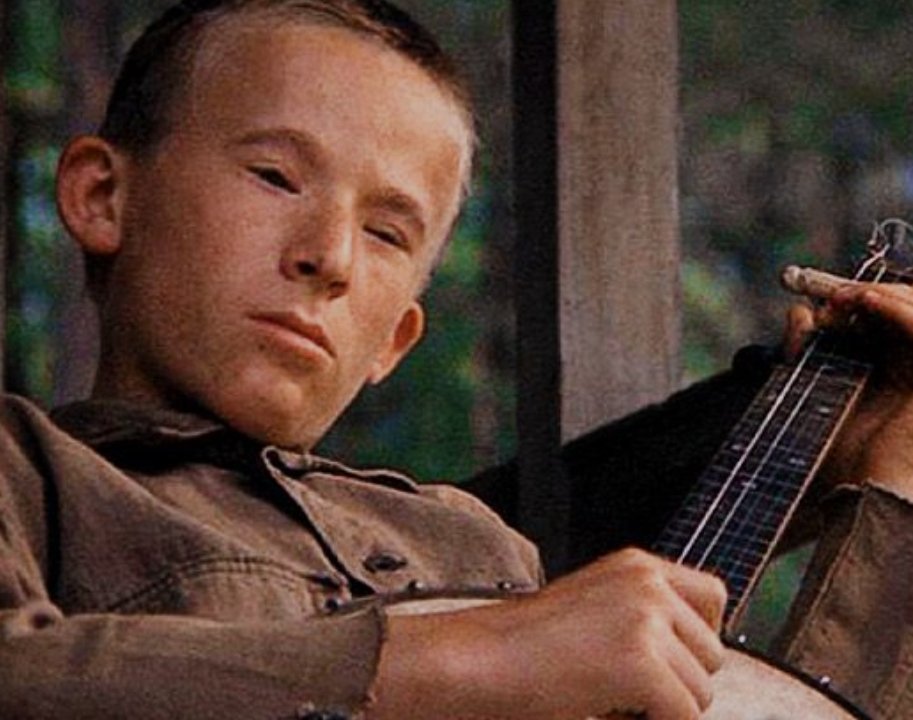
My little boy, Joe Bee before he grew up into a man

Mr. Texan: I can’t get no help around here from nobody: it’s just a bunch toothless hillbillies sitting around drinking moonshine, so maybe you can shine a light on my predicament. I enclosed an old picture of my boy, he’s real shy and won’t let me take a picture now that he’s older.

Back in 1972, a group of Hollywood boys filmed a movie here on the river. It was all fun, and my family got to be in the movie. I enjoyed many an evening drinking shine with some of the actors and got to know one of them really well. Bless his heart, he’s passed on now, but I’ll always remember his funny laugh and how good he was with that bow and arrows. Now, in 1984, a bunch of rich big-shots from Washington, DC came down to ride the Chattooga like in that famous movie that was filmed here. They were nice men and treated me with respect, even though I was just a river rat. Daddy hadn’t been gone long, and I was really sad, so it was nice to have some company at the camp. One night, the bunch of us were sitting around the campfire drinking daddy’s famous shine, and this one fellow they called Joe B started sniffing my hair. I didn’t mind cause I had just washed it with lye soap, and it smelled pretty good. He was a nice man, in a creepy sort of way. Too much shine always gets you in trouble, and I’ve had plenty of it since then. Well, about a year later, the old stork shows up with this bundle of joy. I call him Joe Bee. He ain’t no kid no more and doesn’t want to do anything but sit in his porch swing all day long playing the same song on his damn-ole’ banjo. I’ll tell ya, it’s driving us all to drink more than we normally do, and that’s a bunch. We tried hiding it, but he always finds the darn thing. Little Joe Bee just wants to know who his daddy is. My two other boys, the twins, Smokey and Bandit, their daddy never comes to see them either, but that’s cause he’s dead as a shot squirrel. I’ll give him a pat on the back; at least he gave them each a black Pontiac Trans Am for their sixteenth birthday. At least Joe Bee’s daddy could send him a monster truck or something. He just wants to meet his daddy and have something with big wheels to drive.

The Texan: Miss Sparkle, I’m sorry to hear of your problem and Joe Bee’s fatherless miserable life. Like you, I couldn’t stand to hear a banjo picking all day long. At least you have some good moonshine to knock the edge off. Looks like your boy’s Pop might be found in Washington, DC, and shouldn’t be too hard to track down; the family resemblance to a former big-shot should help find his daddy. We folks down here in Texas believe that every boy deserves a big truck to drive. Keep in touch, and tell your son I’m sending him a DVD of the Smokey And The Bandit movie along with a month’s supply of Ben and Jerry’s Ice Cream.

Ask A Texan 4.29.25


Decent advice for folks who might not live in Texas but wish they did.

The Texan

A fella sent me a note on a Tractor Supply postcard. It seems Mr. Leroy Buford of Chigger Bayou, Louisiana, has suffered the wrath of a vengeful wife.

Leroy: Mr. Texan, my wife, Lavernfullella, got mad at me for gambling away my paycheck on the Dallas Cowboys game. I’ll admit it was my fault; who in their right mind would bet on those boys to win. The case of Bud Light had something to do with it. Anyhow, I came home, and our house was gone. She had hooked up her pickup to the trailer and pulled that sumbitch out of the Chigger Bayou Trailer Park. I don’t have a home and am living in the old lady next door’s tool shed. Can you give me some advice on how to fix this mess?

The Texan: First off, Mr. Leroy, never bet or watch those washed-up Americas team again. That Hillbilly with a gold card ruined a great Texas franchise. Secondly, why didn’t you remove the tires from your home? You’d be sleeping warm and cuddly right now. This scenario reminds the Texan of his friend, the great white hunter, Bwana of San Saba. He had a nice Airstream on his hunting lease in the Texas rough country. He was sleeping good one night, dreaming of killing a Bambi. Some Cartel boys liked the looks of his fancy trailer, so they hooked up to it and pulled it away. He was sleeping soundly and didn’t know he was being hijacked. He woke up the next morning in a parking lot in Juarez, Mexico. He looked for a policeman, but he only found two little boys wanting him to come to meet their sister for twenty dollars. Lesson learned, take the tires off your home and hide them somewhere. Hope you find your Hacienda. Keep in touch.

2025 The Year Of Reading Dangerously


The current image has no alternative text. The file name is: image.png

I’m an old-school reader. An Amazon tablet sits in my desk drawer, but it has gone untouched for four years. Electronic devices don’t allow me the same experience as holding a book made from cardboard and ink printed on recycled paper. Technology is fine for some but for the written word.

It starts with the jacket. Most are now in color, printed on shiny paper, with the author’s name as large as the title, a nice photo or drawing, and a few lines of publisher praise to capture your attention and make you feel that the $30 or more you paid wasn’t in vain. It’s a dance of sorts, but our money has been collected, so it’s best to continue the waltz.

Then comes the preface or the dedication to loved ones, friends, or contributors. Some are short, sweet, and curt and fail to credit the deserved; others ramble on until I lose interest.

Truman Capote snubbing Harper Lee’s dedicated research with “In Cold Blood” comes to mind. A few excluded words of thanks ruined a lifelong friendship. He wasn’t the first, but his pettiness was unforgivable.

I notice the typeset and spacing information, the font, the Library of Congress notes, the printing dates, and then the first paragraph, which sets the tone for the next few hundred pages or more.

Ernest Hemingway said a book should begin with ‘one true sentence.’ He knew it was a waste of the author’s and their readers’ time if it didn’t. His advice has taught me well.

My wife, Momo, a Registered Nurse, retired last August. Soon after, she underwent major back surgery, and during her recuperation, she re-discovered her love of reading. Now, instead of watching television until late hours, we both retire early, prop ourselves up on our bed pillows, and read our books late into the night.

I recently revisited ” In Cold Blood,” Capote’s masterpiece that so affected his life that he never fully recovered to write another novel. I enjoyed it more this time than I did thirty years ago. It was a butt-whooping to the end. Every chapter contained a piece of his soul.

Anthony Doerr’s two newest novels are commanding reads. My wife and I have read both, and she is on the verge of starting his third. I am reading Amor Towels and find his storytelling to be in the style of Steinbeck and Hemingway. I was once a James Elroy fan, but his last two books were an effort from start to completion. He is on my rest list for now.

Besides ” Fun With Dick and Jane,” the first real books I read were Mark Twain’s ” The Adventures of Tom Sawyer” and then his follow-up “The Adventures Of Huckleberry Finn.”

I come from a family of non-readers, so my love for books comes from somewhere, possibly my elementary school librarian or my father’s sister, Norma. She was a voracious reader who leaned toward romance schlock, Cormack McCarthy, and Micky Spillane noir. I am thankful to both for their influence and guidance. It was Aunt Norma who introduced me to Thomas Wolf. I returned the favor with Joseph Heller and Kurt Vonnegut.

My wife and I are relieved that the year 2024 is behind us. It won’t be missed. No tears from this household, only two middle fingers pointed skyward. Our ages allow us to forget what we wish to and remember the best. I believe 2025 will be our year of reading dangerously. We may, holding hands and a frosty cocktail, step out onto that literary ledge and take the leap, attempt to leave our comfort zone, and take a chance or three. Time is of the essence, my eyesight is on the fritz, I have a blister on my thumb, and the books keep coming.

Finding My Voice Through Tall Tales and Truths


Over the years, I’ve spotlighted the storytelling skills of my two late Uncles, Jay and Bill. They remain in good standing and are the best liars and yarn spinners I have met. Each could have been as popular as Will Rogers, but they chose the farmhouse porch as their stage, shunning the spotlight and life as a celebrity.

Around the age of nine, I was convinced that the spirit of Mark Twain had somehow entered my body, and my destiny was one he had lived. My teacher, an older woman of little patience, was convinced that I was dropped on my head during infancy, which led to my outlandish literary behavior. She couldn’t see that I was destined to be a writer of some importance. Mathematics was a mystery I loathed, but I perked up when the curriculum came around to History and English. To me, everything became a story and originated from my grandparents’ farm, my extended street-rat crazy family, or neighborhood antics, and included made-up tales of ridiculous origins. Mrs. Badger, ever the suffering teacher, labeled me an insufferable pathological liar and called my mother in for the dreaded parental meeting, which included my school’s principal, who sat with a wicked wooden paddle in his lap, poised to administer punishment. Mother handled it well until we reached home. There was no butt whooping, but she did corner me in the kitchen, put her face nose to nose with mine and in a seething saliva spewing accusation said,

“You are one of them..my loathsome, worthless brothers have ruined you: I forbid you to associate with them, ever again.” She was right, they had, and I wore that tawdry badge proudly. All those nights sitting on the farmhouse front porch listening to their beer-infused tall tales, yarns, and lies formed me. I was spoiled, but happy goods. My family lacked the foresight needed to distinguish a liar from written fiction. My Aunt Norma, a tarnished angel, is the gal who taught me to read, write, and imagine. She understood my affliction.

The Art of Writing: Going Old School with Typewriters


Old Ernest is tapping away on another good book.

For my birthday a while back, my wise and thoughtful wife, Momo, gifted me a classic 1970 Underwood 310 manual typewriter. It is a wonderful present I would never have purchased, although I have yearned for one for a while now.

For some time, possibly five years or so, I have been whining and casually threatening to go “old school” with my writing and get away from this demon laptop. It’s too easy to keep on tapping and spit out a page or two of gibberish that has more words than needed and makes no sense. It’s not about speed and what your program does; it’s about the content. A typewriter makes you think before striking that key. The delete button does not exist.

Hemingway would tap for hours on end, and then if he wasn’t pleased with his effort, it went into the waste basket. Using a typewriter to transpose your thoughts to paper is a commitment, and not an easy one.

There was a typewriter in our household when I was a child. It was a large black beast of an Underwood, all pure American heavy metal, requiring a grown man and a hefty child to lift it. I would peck on it for hours and eventually come up with something legible. I never once saw my parents use it, so its presence in our home was a mystery. I heard from my older cousin, Cookie, that it was my grandmother’s when she lived in California, and she spent all of her waking hours tapping away letters and movie script ideas. It caused a good bit of drama and injury within the family, so it was banished to our household for safekeeping. My father wasn’t pleased when he would find me chicken pecking away.

My love of the machine started at an early age, and came into full blossom as a teenager in the 1960s, when I started to write stories. I took typing in high school to sharpen my skills and learn the keyboard. I studied two years of journalism, and learned to love the written word. My teacher was my mentor. She pushed me to excel. It all paid off well. When computers came about in the late 90s, I was a good typist and had no problem adapting.

I will keep you posted on how this “old school” project turns out. I typed a page on my Underwood, and my fingers are throbbing.

The Green Legacy of Mr. Greenjeans


If you were a kid in the 1950s, then you knew who Captain Kangaroo and his sidekick Mr. Greenjeans were. Their television show was broadcast five days a week in glorious black and white and viewed by millions of kids on tiny television screens. ” Don’t sit too close to that TV, you’ll go blind.” That was the stern warning from every mother, and here we are today, all wearing glasses or blind. How did you expect us to see the Captain and Greenjeans on an 8-inch screen?

The burning question we all had was, did Mr. Greenjeans wear “green jeans?” We were kids, with no color sets, it made us crazy. Was this man green?

A few months ago, I took a shortcut through a Fort Worth neighborhood to avoid road construction and noticed a weirdly dressed man using a hand pump sprayer to paint his yard a deep shade of Kelly green. I stopped and watched him walk from the curb to the house. Long, even strokes coat the brown grass to imitate spring’s favorite color. It was then I noticed his house was green, the cars in the driveway were green, his clothes and skin were green, and a small dog sitting on the porch was also green. What the hell? The man saw me staring and motioned me over.

I parked my car and walked up to the fellow, feeling a bit foolish for interrupting the work of a stranger. I introduced myself and complimented him on his handy work. He thanked me, extended his hand to shake, and said, “names Levi, Levi Greenjeans, nice to meet you.”

” That’s an unusual name, sir. The only time I’ve heard that last name was on Captain Kangaroo, and that was seventy years ago,” I said.

The green fellow laughed and said, ” That’s the family name. Mr. Greenjeans was my pop. My sister and I grew up in a green world, so this is pretty natural for us. Dad’s been fertilizer for a good many years now, so it’s up to me to carry on the family brand.” I agreed; he looked pretty good for an old green guy.

I didn’t want to pry or be too forward, but I asked, ” Sir, what might the family brand be?”

“Call me Levi,” he said. ” You know that song ” The Jolly Green Giant? I wrote it and collect mucho royalties. That Tom Jones song about the green-green grass of home wrote that one, too. The Green Giant food brand, that’s mine; also, copyright infringement made them pay up. Home Depot has a Green Jeans color named after Dad. I get change from that, and I get a shiny penny from YouTube for the Captain Kangaroo videos.” This dude has turned green into green cash.

I am impressed and honored to be in the presence of one of the famous Greenjeans family, but now is the chance to get the answers to my childhood questions. I am afraid of coming off like a six-year-old Duffus, but I asked, ” did your dad wear green jeans and did he have a green face, and was the captain a nice man, and why did he have a big mustache, and did your dad really have a farm? There, I spat it out, and I am an idiot.

Levi chuckled and said, “Dad wore green jeans, and his face was green from stage makeup. The captain, bless his dead heart, was not too friendly. He wore a mustache because, on the first live show, a little kid threw a Coke bottle at him and split his lip; the stash hid the scar, and that’s why he disliked kids. He carried a small cattle prod under his sleeve, and if the kids got too close, he would shock them. Pretty funny stuff to see them jump. And the final answer is yes, Dad had a farm and grew veggies and raised prize-winning Llamas. Recently, my sister Denim planted forty acres of butt-kicking pot that we will sell in our “Mr. Greenjeans Apothecary Co-op in Denver.”

I thanked Levi for his kindness and started to leave when he stopped me. Extracting a green Sharpie from his pocket, he signed his name on the front of my white Eddie Bauer Polo shirt. “Hang on to that shirt, brother. It’ll be worth some cash one day.”

Writing Gibberish For The Masses..Blood On The Keyboard And God Slaps Me Up The Side Of My Head…


After fighting sleepless nights for years, I thought I had moved on from the condition. Nope. The wide-eyed wonder hours are back. I consume enough pain meds to take out the Hulk. So many, it’s a marvel that I’m still alive. I have these problems because of back surgery. It left me with an Elvis leg that twitches and gyrates without music. My right foot refuses to walk normally. My gait resembles Frankenstein after a few stiff cocktails. Now, I read an intriguing article about waking up at 3:00 AM, something I know about.

A biblical professional, not a Pastor or a Priest but a cleric psycho-babbler, has discovered something interesting. Folks waking at that hour are more susceptible to communing with God, and are at the height of creativity. Their brains are clicking on all cylinders instead of one or two. I agree with this discovery, even if it might be new-wave chatter or, in my case, a holy intervention.

Three AM arrives. My eyes pop open, no more sleep for me. I turn off the CPAP and make my way into the den. I heat up A2 milk for my hot Ovaltine. I grab my laptop and begin to write. Sometimes, I’m unsure of my story, so I tap away, paying no attention to where the words go. My brain is on fire, swirling with emotion. I can’t write fast enough. It must be..it will be divine intervention. God issues a stern smack up the side of my old head, showing me what to write. Sometimes it’s good, often it’s gibberish, not fit to read. His hand is guiding mine, so I soldier on, spewing out my brain, bleeding on the keyboard. We all have our bloody moments.

This is one of those times.

Dreams of Europe: A Haunting War Reflection


Last night, I dreamed of Europe, teetering on the brink of war, reminiscent of those haunting days of the 1940s. It was not a nightmare but rather a sepia-toned memory, grainy like an old newsreel flickering in a rundown theater, the air thick with the scent of buttered popcorn and sticky sodas clinging to the soles of my worn Tom McCann wingtips. Beside me, my wife, Momo, sat elegantly in her gabardine dress, her silk scarf accentuating her perfect neck. A picture of quiet strength amidst the storm brewing outside. Somehow, as if a magical spell, we knew of war, maybe because our fathers had participated, not reluctantly like some, but dutiful, knowing their presence would make a difference in the outcome.

We found ourselves seated amid a crowd, the air thick with the scent of Old Spice, a memory of times past. Momo leaned forward; her senses caught Chanel No. 5 drifting languidly alongside us while cigarette smoke curled upwards, smothering the flickering images that danced on the screen. An army advanced in unyielding formation, each soldier a cog in an unfeeling machine ready to unleash mayhem upon a peaceful country. A lone figure stood poised for inspection; within his eyes, a cold emptiness lingered, reminiscent of a predator—those soulless eyes of a waiting shark. At first, I thought he might be Hitler, a returned demon from the depths of Hell. I was wrong. A Russian, short in stature, long on evil, intent on destruction. The shark now has legs and walks among us. I awakened, sweating and gasping. Momo sleeping peacefully, unaware of the dream we shared. We left without seeing the movie.

Aspirations, Expectations And Exasperation


75th Birthday Dinner with Momo

I’ve recently sprouted a beard, and much to my surprise, not a single dark hair dares to intrude upon my snowy facial wilderness: the scruffy testament to my frothy mirth matches the proud hue atop my head, a delicate white crown. As a son of Cherokee lineage, I stood astonished, finding myself transforming into an old man with pearly locks in my forties. This change, I suspect, is the handiwork of my father’s Scotch-Irish heritage—a rowdy clan of kilted revelers who seemed to navigate life with laughter and a touch of mischief. They must have commandeered a ship, setting sail for New York, then onto Pennsylvania, where the merry-making reached promising heights. My grandfather would neither confirm nor deny the wild tales of our kin. This speaks volumes about my love for Irish Whiskey, while the Cherokee blood in my veins draws me to large, sharp knives. Hand a drink to an Indian, and trouble isn’t far behind. History whispers of how Little Bighorn ended for Custer. Loose chatter suggests that Sitting Bull and Howling Wolf snagged a wagon load of drink the night before the fray, bestowing upon the braves a reckless spirit. Had they chosen an early night with a hearty breakfast of Buffalo tacos, perhaps the bloody disaster would have been averted.

As a boy of nine, I dreamt of writing like Twain. In my innocence, I thought I was his spirit reborn, dropped into a different time: September of 1949, the last year of the baby boomer generation. With a Big Chief Tablet and a number 2 pencil, I set out to capture the simple chaos of childhood mischief. There were four of us, bold and reckless, stealing cigarettes, hurling water balloons at police cars, and fighting with the tough kids across the tracks. The local papers laughed at my tales as if a child’s imagination could not hold weight. My aunt, wise and educated, introduced me to Spillane and Steinbeck. Spillane turned me into a wise-ass, insufferable child, resulting in numerous mouth cleansings with Lifeboy soap. Steinbeck felt right—my family had lived a life like Tom Joad’s, migrating to California during hard times of the Dust Bowl and the 1930s. I had stories in me, maybe even a book. A therapist dismissed it as a childish fantasy, saying it would fade. Yet here I am, much older, still tethered to that innocence. Now, I’m in my Hemingway phase, my looks echoing the rugged man who lived wild in Cuba, writing furiously while embracing the chaos of life.

There is more sand in the bottom of my hourglass than in the top. I feel the end approaching. I do not wish to know the day or hour. I can only pray it is a good one, resulting in a trip to Heaven, which is better than the alternative. I am not the writer Twain, Steinbeck, or Hemingway was. They had talent, and they had time from youth to hone their craft and find their voices. Yet, I will still give it a try.

Chapter 10. Wagons Ho To California: Grandmother Is Healed By Sister Aimee McPherson, And Carman Miranda Stops By


Sister Aimee McPherson

As the months stretched into years, the Strawn family flourished financially, finding their footing in California’s golden land. The prospect of permanence hung in the air, and the pull of Texas grew less each year. Johnny’s elder sister, Norma, had begged to remain with one of her aunts to complete her schooling, but destiny had other plans. Completing her education in Fort Worth, she succumbed to the barrage of pleading letters from her mother, who was convinced that her death was only weeks or hours away, but she would try to hold on until her daughter made it to California. Knowing Bertha’s love for drama, her aunts consoled Norma and thought it best that she travel to California and could return if needed. With a small amount of currency in her purse, she embarked on a westward journey with a family bound for Los Angeles, paying for a seat in their car.

After two years of absence from the fold, Norma returned to find her family ensnared in a web of not-so-well-hidden disillusionment. The initial euphoria of their reunion faded, exposing the harsh light of reality. Her father, now a manager, toiled away long hours with little time left for living, while Johnny when not in school, devoted all his time to the members of his string band, Blind Faith. Her mother’s dependence on medicinal elixirs was the worst of it.

Bertha, a dedicated aficionado of her restorative elixirs, consumed multiple weekly bottles. She has a friendly rapport with the local pharmacist, who considers her his best customer and gives her a discount. She would often be found at the kitchen table for most of the day, dosing her tonics and composing lengthy, nonsensical letters to her sisters. By this time, her siblings had come to understand that the words emanated from the pen of a medicinal lunatic. Norma and Johnny acknowledged the necessity of professional intervention for their mother, and, with assistance from Le Petite Fromage and Blind Jelly Roll, they formulated a plan for Bertha to undergo a holistic religious cure under the guidance of Sister Aimee McPherson.

On that Sunday, a vibrant sermon accompanied by half a dozen show tunes with a dazzling chorus line stirred the congregation as Sister Aimee made her return to the pulpit for three thunderous ovations. Following the service, Le Petite Fromage and Johnny, the fiddler, as he is now called, escorted Bertha to the orchestra dressing room, believing her holiness sought to personally meet her and perhaps bestow a signed copy of her latest literary work, “You Can’t Take It With You When You Go So Give It To Me.” Embracing Bertha warmly, Sister Aimee presented her with a signed book before guiding her to a crimson velvet settee that had previously served as Blind Jelly’s salvation vehicle. With hands upon Bertha’s head, she prayed for deliverance from the grip of elixirs and zealous missives to her siblings. Understanding she had been played by her blood kin, Bertha, teeth-gnashing and fist-squeezed white, surrendered and embraced the moment. The healing transpired in a mere ten minutes as Sister Aimee proudly proclaimed the departure of the demons, assuring that all would be splendid by supper time. As she departed the dressing room, a divine fragrance lingered in the air. Blind Jelly Roll spoke up, ” I smells me some Channel No. 1. ” Leave it to a blind bluesman with the senses of nine cats to figure it out.

With the spoke mended in the family wheel, taut and ready for the road, John Henry indulged the family, comprising of Le Petite and Blind Jelly Roll, to a Sunday supper at a restaurant. Their choice fell upon Treasure Island, a pseudo-swanky seafood establishment under the ownership of the actor Wallace Beery. The best restaurants were on the Sunset Boulevard, known as the Strip. The entrance was the front hull of a sailing schooner, complete with a mast and sail. Johnny noticed the address above the door: 77 Sunset Strip: that address would come up again a bit later. Bertha and Le Petite were giddy, anticipating the prospect of encountering Hollywood movie stars savoring fish and chips washed down with a dirty Martini.

While awaiting their meal, James Cagney and his raucous family were seated a few tables away. Clark Gable and Carman Miranda snuggled in a cozy booth, where they indulged in sips of Martini and beer. Le Petite and Bertha were in a state of apoplexy. Carman Miranda made her way to the lady’s room, passing their table. Pancho Villa sat upon Blind Jelly’s lap, nibbling on a saltine. As the movie star strolled by, she took notice of Pancho and remarked on the adorable little doggie. When she reached out to pet Pancho, she received a vicious bite that tore off the long middle fingernail from her left hand’s digit. Stunned by the sudden attack, she yelled, “Get that little demon dog out of here!” Pancho and Blind Jelly concluded their meal in the comfort of Strawn’s car.

If you missed Chapter 9, click the link below for more amusement.