Life In California, Chapter 5


Moving day from the migrant camp fell on a Saturday. There wasn’t much to transport apart from the car and the personal belongings they had brought from Texas. Knowing that John Henry had very little, the landlord had left behind some furniture: a kitchen table, an icebox, two beds, and a well-worn couch. The screened-in back porch extended across the entire width of the house. In one corner, a roll-away bed and a standing lamp stood, and it was there that Johnny made his claim to the porch as his bedroom. Meanwhile, Lady ventured out to explore the expansive backyard, complete with an Eucalyptus tree that was home to a resident squirrel.

My grandmother Bertha had come across newspaper stories about the firebrand woman preacher, ‘Sister Aimee, ‘ holding court at her downtown church. She aimed to grace the Sunday service, eager to unravel the mysteries that had stirred up such a commotion among the camp folks. Ever the agreeable sort, John Henry consented to accompany her and young Johnny, perhaps harboring a hope to cross paths with Blind Jelly Roll Jackson and Pancho Villa.

The faithful congregations formed a line that stretched down the block, twisted around, and continued for another block. It seemed this preacher lady possessed a special magnetism to draw such a crowd. As they reached the doors, they discovered the church was once a theater with a plush red carpet and a winding stairway leading to the balcony. Climbing the stairs, they found seats near the balcony’s edge. With an eagerness to feel the Holy Ghost passing through her, Bertha was in stark contrast to John Henry, who simply yearned for a cup of black coffee and a nap.

The house lights dimmed, and the red velvet stage curtains slowly drew back to reveal an orchestra and a singing choir, all adorned in purple velvet robes. The orchestra boasted horns, a piano, violins, and a drummer, and right up front sat Blind Jelly Roll holding a shiny black guitar. His seeing-eye dog, Pancho Villa, was seated on a chair next to him, wearing a small matching robe. In a moment of confusion, Johnny, unaware of his surroundings, called out Pancho’s name, causing the dog to excitedly tumble off the chair. Jelly, recognizing the voice, offered a warm smile and a friendly wave as he reseated Pancho.

A slender woman with short blonde hair stepped into the center of the stage, enveloped by the spotlight’s glow. She was draped in a white silk robe, and a sizable golden cross hung at her breast, casting a mesmerizing reflection across the congregation. In that divine light, she took on an ethereal quality, almost angelic, as if transported from the pages of a biblical tale.

The singer, whom everyone now recognized as ‘Sister Aimee,’ suddenly turned into a musical whirlwind, belting out a heartfelt religious hymn that could make even the angels jealous. How did this powerful voice project from such a small woman? The orchestra performed as if they were on a mission from above, and the choir sounded so otherworldly that even the congregation wondered if they were in the presence of celestial beings. As tears flowed freely and some brave souls rose to join her in song, Bertha found herself on the verge of a melodramatic meltdown; young Johnny was bored and on the verge of sleeping, while poor John Henry remained steadfast in his pursuit of a good nap. It seemed like the lengthy two hours ahead were shaping into a divine comedy of sorts.

After two more songs just as rousing as the first one, Sister Aimee spoke.

” Dear Hearts, recently, a lost soul came to our church. He had wandered in the wilderness for years. Blind since birth and led by his small seeing-eye dog, he came to me seeking repentance and personal guidance. He is now walking the straight and holy path of our Lord. A formidable blues guitarist and singer, he has agreed to share one of his songs of atonement. Please welcome Blind Jelly Roll Jackson.” The crowd applauded.

A stagehand stationed a large silver microphone before Jelly. The spotlight shone on his hair, white as an East Texas cotton field. He tugged and twisted his guitar through eighteen bars of mournful blues without a moment’s pause. The audience was spellbound, the majority never having encountered a blind black bluesman. Leaning towards the mic, he growled deeply as he sang,

” I gots me a woman, haw-haw-haw-haw, she don’t mean a thang, squeezes my lemon picks my peaches from my trees, gonna go see that gal and get my hambone greased, haw-haw-haw-haw.”

Sister Aimee lunged for the microphone, but a stagehand beat her to it. He grabbed the microphone and carried it away. Jelly Roll was still singing and playing when the stage curtain closed. Blind Jelly Roll Jackson’s official California debut was history.

Don’t touch that dial or turn that computer off; there is more to come in Chapter 6

California Dreamin’ Chapter 6

Chapter 4, Wagons-Ho, Leaving Texas Far Behind


Divine lightning has been known to strike twice, but only if it is directed by a Guardian Angel.

With a job in his pocket, the few loose coins that jingled in his khakis sounded like a hundred dollars.

John Henry made it a point to stop by, to offer up his thanks to Sargent and Sunny for their helping hand. Their kindness was the kind that stuck with a man, went deeper than any he’d known before.

Sargent asked John Henry to join him for a stroll down the sidewalk, just the two of ’em. They walked and smoked on their Lucky Strikes, talking about this new job that was waiting for John Henry like an open road.

They trudged along the sidewalk, the setting sun beating down on their gray fedoras, until they came to a halt in front of a small, weathered, stucco bungalow. A faded ‘For Rent’ sign hung crookedly from the porch railing, creaking lazily in the faint breeze. An older woman, around Sargent’s age, sat in a creaking swing, sipping listlessly at a glass of iced tea; she gave them a slight wave as friends do. The only sounds were the rhythmic groan of the swing chains and the growing buzz of cicadas, their evening song a mournful hum that seemed to vibrate through the very air itself as dusk drew near.

Sargent took one last drag on his cigarette, the ember flaring orange in the dusk. With a practiced motion, born of countless battlefields, he field-stripped the butt and sent it swirling into the breeze. Beside him, John Henry echoed the gesture, the ritual of it a comforting reminder of days past and the unbreakable bonds of soldiers forged in blood and fire.

Sargent spoke up.

“I’ve already gotten the okay from the owners; they’re fixin’ to move up to San Francisco for a spell, maybe a long one, five or six years they say. The house is yours for the taking if you’re so inclined. I put in a good word for you, figured my vouchin’ would mean something to them. Hope our bond of friendship will be the thing that seals this deal tighter than a jug of moonshine on a hot summer day.”

John Henry let out a hearty laugh, the easy kind that comes from deep in the belly, at the mention of moonshine.

“I ain’t touched the white lightning in near 10 years, Sargent,” he said, a twinkle in his eye. “But I’ll take the house, and you can bet your Justin boots our friendship is stronger than any gold or jug of ‘shine you can find.”

That evening, after John Henry shook on the deal for the house, he stopped at a butcher shop around the corner from Sergeant’s house. He counted out what little change he had left, just enough for three thick pork chops, a couple of fat red potatoes, and a sweet onion. Tonight, he’d throw the chops on the campfire, watch ’em sizzle till they were good and done, and bake the spuds in the coals. Bertha and Johnny, they’d eat like King Farouk. And Lady, she’d get her a big chunk, too, because this was a night for celebration if there ever was one. One thing he had learned in life is to take your blessings as they come and give thanks because they may never come again.

Click the link below for Chapter 5.

https://notesfromthecactuspatch.com/2024/07/06/life-in-california-chapter-5/

Chapter 3- Wagons Ho, and Settling In California


Being in the right place at the right time can lead to life-changing events. A bit of prayer added to the mix produces wonderful things.

From what I was told, my grandfather was willing to lend a helping hand to anyone who needed one. He was kind to a fault and was often taken advantage of by family members and close friends. I can’t use them in this chapter because their families are still alive, they know where I live, and everyone is so touchy. I was ten when my grandfather passed on. He made sure I learned numerous lessons from his mistakes. Being the great poohbah recounter in the family, he left me with enough oral history to fill a book. I remember most of it from his stories and yarns, of which he could spin some tall ones. No one thought to write anything down, so for now, I’ve been blessed with a good memory, but only for a while.

John Henry helps the man carry the heavy piece of furniture into the house and places it in a small bedroom that appears to be that of a girl. Pink ruffles and stuffed animals is a sure sign.

With the furniture all squared away, the two men stood on the front porch, taking a break to enjoy a smoke. John Henry offered one of his Lucky Strikes to the other fellow, and they both lit up with a flick of the Zippo John Henry still carried from the war. The man introduced himself as Sargent James, said that was his real name, and he never rose higher than corporal in the Army. That got a good laugh out of them both. He told John Henry about his wife, Sunny, and their daughter Cloudy, away at school in Sacramento on some kind of scholarship, studying’ to be a doctor no less.

  After lunch, the two men traded stories and discovered they served in France at about the same time, 1917-1918, in the big war against the Germans.

Veterans become fast, tight friends; the probability of dying from a bullet or an exploding shell bonds them in a way only they understand. It’s a brotherhood for life, formed on the battlefield.

     They had both been wounded in battle; John Henry having but half a left buttock, compliments of shrapnel and had been gassed twice while fighting in the muddy trenches. His new friend was shot in the leg and the arm but recovered enough to continue fighting until some shrapnel sent him to a hospital in England and then home for good. Both showed their scars like kids on a school playground trying to outdo the other.

     John Henry is no saint; he will own up to killing men in battle, some with his rifle, a few with a bayonet, one with a large rock to the head, and one stabbed through the heart with his side knife. He regrets them all, especially the young German boy, no more than a teenager he stabbed during hand-to-hand fighting before the soldier got the better of him with his sidearm. His face is the one in his worst dreams. The boy’s face looks as if he knows he is a dead man, as he is within seconds. It took years for the brutality to catch up to him, and now, late at night, when the ticking clock is the only sound in the house, his demons come for him.  

      Both men dance around the worst battle stories but share memories of their friends, living and dead. It’s easier that way. John Henry’s half-a-buttock won the competition. The prize was a large slice of apple pie with melted cheese topping.   He feels comfortable enough to ask his host if he might know of any work a man could find. Sargent mulls the question a few moments, then says,

“I’ve got a cousin that works at the docks building shipping crates, I’ll give him a call and see if he can get you an interview. Swing by here in the morning around seven and I’ll have you an answer. I can’t promise anything, but he has the ear of the owner. ”

Good on his word, Sargent had John Henry an answer, and it was the one he had hoped for, an interview for a job. He thanked Sargent and gladly took the biscuit sandwich that Sunny insisted he eat before his interview.

Six-thirty finds John Henry standing on the sidewalk in front of the business, 808 Shipping Row. The docks are half-block away, and the noise of men and equipment moving heavy crates onto ships carries in the cool morning breeze.

Two doors are marked “Entry,” so he takes the one on the left. Down a short hallway into a large office, he finds a man sitting at a desk drinking coffee and writing in a journal. The man invites him to sit and have a cup. John Henry thinks this must be the shop foreman or the interview man. After drinking coffee for a few minutes, the man asked him about family, church, drinking, accountability, and his time in the service. After a thirty-minute visit, with a few laughs, the fellow stands, shakes John Henry’s hand, and tells him to start tomorrow morning at seven am sharp, and by the way, he is the company’s owner. Augustus Petrillo, and welcome aboard.

More to come in Chapter 4.

Chapter 4, Wagons-Ho, Leaving Texas Far Behind

Wagons Ho to California ! Chapter 2. The Arrival


Ten or so miles past the Needles California border station, my grandfather, John Henry Strawn, encountered a stooped, raggedy-dressed black man and a small dog walking along the side of the road. The man’s attire resembled that of a poorly dressed scarecrow. Without hesitation, he slowed the Ford, performed a swift turnaround, and approached the traveler. After stopping the car, he offered the old fellow a ride. Without hesitation, the traveler gratefully accepted, ensuring that his dog was settled in first, followed by his knapsack, a guitar case, and then himself.

A few miles down the road, the man broke the silence, introducing himself as *Blind Jelly Roll Jackson from the Deep Ellum Dallas, Texas, and his seeing-eye dog, a Chihuahua named Pancho Villa, who is blinded in one eye. The result of a dog fight with a Coyote, so he wears tiny sunshades because the bright sunlight hurts his good eyeball. Jelly says he is a blues man and is headed to Los Angeles to stay with a cousin and find work in a juke joint, and he, by accident, shot a fella in Dallas four times over a pay dispute. He said it was all Pancho’s fault because the dog said the man had a knife, so what else is a body to do. He pulled a leather Bolla from his knapsack, took a jolt, poured a little liquid into his palm, and let Pancho Villa lick it up. John Henry was sure it was whiskey, and after the dog drank it, he fell over and started snoring. Jelly’s chin found his chest, and he slept the sleep of the weary.

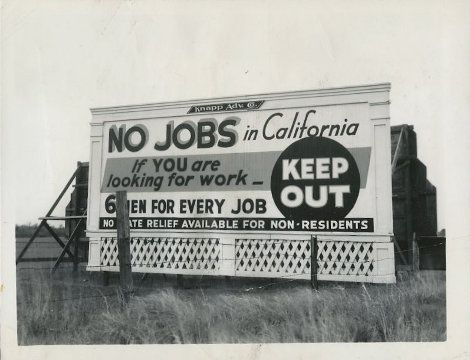
On the eastern outskirts of Los Angeles, they saw the first billboard, “No Jobs in California, Keep Out.” John Henry paid no attention to the sign; he was certain he could find a job on the docks in Long Beach. He was an artisan, not an Okie fruit picker. The next sign was for a migrant campground, $.25 per day, running water, showers, and clean grounds; John Henry took the turn off Route 66, drove a few miles, took two more turns, and found himself at a tidy campground guard shack. Unlike the border boys, the guard wore a clean, crisp uniform and was pleasant. The three-day fee was paid with small change from the small stash in grandmother’s purse. Their assigned camping slot was shaded by a tall Eucalyptus tree. This would do until a job was found. Jelly and Pancho Villa wandered down the main lane, stopping to let the children pet and scratch Pancho, who nipped a few fingers and chased the local feral cat.

Travel to the eastern outskirts of Los Angeles, past the city limit sign. This is where a well-manufactured fantasy meets reality. Families living in tents or shanties of plywood and canvas. The city fathers, embarrassed to call them shanty towns, label them “migrant campgrounds.” Men walk the roadways for miles into the city looking for day labor or something better. These are hardworking, proud people who have been dealt a hand of misfortune. Los Angeles is becoming a city of “haves and have-nots.”

The Los Angeles of 1934 is a city unlike any other in the country.  The motion picture industry paints it as larger than life.  Hollywood, where dreams are made and shattered, is the engine that powers this city.  Oil and shipping will defend their role, but Hollywood fuels the beast.

At first glance, commerce appears untouched by the depression.  Polished cars parade on Santa Monica Boulevard.  People fill the sidewalks as if on holiday, smiles on their faces, knowing they are fortunate to live in this unique land of opportunity.  The manufactured facade so completely obscures the reality that, in fact, California suffers, but not quite as much as the rest of the country.  It’s hidden so well that thousands of hopeful migrants genuinely believe this is the “Promised Land.”
   
At dawn, John Henry, with Blind Jellyroll, drove into Los Angeles to search for work. He and a few thousand others had the same idea. A long line of men and women walked in unison as if Moses were leading the Jews from Egypt along the dusty highway.      
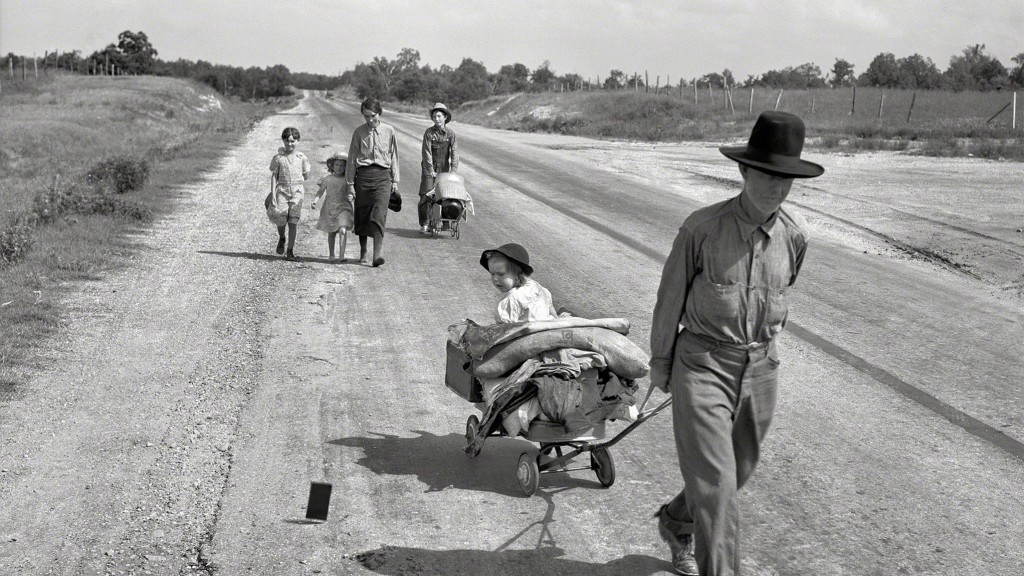
Men wearing patched overalls, sewn-up khaki pants, and shirts as white as a wash tub could get them. A few wore a dirty Fedora or a worn sweat-stained Stetson. Some real Okies wore frayed straw hats and cracked work boots. Their clothes hadn’t seen a wash tub of water in months. It was an army made of misery. The cloud of roadside dust told the folks in town they were coming—”NO WORK HERE” signs went up in every window along their route.

John Henry drops Jellyroll and Pancho Villa at the downtown mission run by Sister Aimee McPherson, the celebrated firebrand radio preacher. Jelly’s cousin works for the preacher and has assured him that the good sister has a place for him. John Henry wonders how a blind man and a one-eyed dog made it from Texas to here. Perseverance and Moxy, some folks have it, but most don’t.

  Lost and asking directions to Long Beach every mile or so, John Henry made a wrong turn and found himself on a residential street. Tidy bungalows with mowed green yards and colorful landscaping lifted his spirits. Back in Fort Worth, you only saw streets like this where the rich folks lived. He could tell by the cars in the driveways and houses that needed paint that these folks were plain working people, getting by better than most.  

 Half a block up, he sees an older man and woman losing the battle to unload a large chifforobe from the back of a pickup truck that should have been in a scrap yard. The rear end of the old truck sat on the concrete, and both leaf springs shot to hell. They are struggling and on the verge of dropping the piece of furniture when John Henry stops and, without asking, jumps in and grabs the end the woman is about to lose. The man thanked him for his help as they carried the furniture into their house. The home smelled like the fragrant gardenias growing around the front porch.

More in Chapter 3. * Note; My father couldn’t remember the name of the fellow or his dog, so I used the name of a character from an earlier story. A dog named Pancho could be nothing else but a Chihuahua.

Open the link below for Chapter 3

Chapter 3- Wagons Ho, and Settling In California

Being in the right place at the right time can lead to life-changing events. A bit of prayer added to the mix produces wonderful things.

From what I was told, my grandfather was willing to lend a helping hand to anyone who needed one. He was kind to a fault and was often taken advantage of by family members and close friends. I can’t use them in this chapter because their families are still alive, they know where I live, and everyone is so touchy. I was ten when my grandfather passed on. He made sure I learned numerous lessons from his mistakes. Being the great poohbah recounter in the family, he left me with enough oral history to fill a book. I remember most of it from his stories and yarns, of which he could spin some tall ones. No one thought to write anything down, so for now, I’ve been blessed with a good memory, but only for a while.

John Henry helps the man carry the heavy piece of furniture into the house and places it in a small bedroom that appears to be that of a girl. Pink ruffles and stuffed animals is a sure sign.

With the furniture all squared away, the two men stood on the front porch, taking a break to enjoy a smoke. John Henry offered one of his Lucky Strikes to the other fellow, and they both lit up with a flick of the Zippo John Henry still carried from the war. The man introduced himself as Sargent James, said that was his real name, and he never rose higher than corporal in the Army. That got a good laugh out of them both. He told John Henry about his wife, Sunny, and their daughter Cloudy, away at school in Sacramento on some kind of scholarship, studying’ to be a doctor no less.

  After lunch, the two men traded stories and discovered they served in France at about the same time, 1917-1918, in the big war against the Germans.

Veterans become fast, tight friends; the probability of dying from a bullet or an exploding shell bonds them in a way only they understand. It’s a brotherhood for life, formed on the battlefield.

     They had both been wounded in battle; John Henry having but half a left buttock, compliments of shrapnel and had been gassed twice while fighting in the muddy trenches. His new friend was shot in the leg and the arm but recovered enough to continue fighting until some shrapnel sent him to a hospital in England and then home for good. Both showed their scars like kids on a school playground trying to outdo the other.

     John Henry is no saint; he will own up to killing men in battle, some with his rifle, a few with a bayonet, one with a large rock to the head, and one stabbed through the heart with his side knife. He regrets them all, especially the young German boy, no more than a teenager he stabbed during hand-to-hand fighting before the soldier got the better of him with his sidearm. His face is the one in his worst dreams. The boy’s face looks as if he knows he is a dead man, as he is within seconds. It took years for the brutality to catch up to him, and now, late at night, when the ticking clock is the only sound in the house, his demons come for him.  

      Both men dance around the worst battle stories but share memories of their friends, living and dead. It’s easier that way. John Henry’s half-a-buttock won the competition. The prize was a large slice of apple pie with melted cheese topping.   He feels comfortable enough to ask his host if he might know of any work a man could find. Sargent mulls the question a few moments, then says,

“I’ve got a cousin that works at the docks building shipping crates, I’ll give him a call and see if he can get you an interview. Swing by here in the morning around seven and I’ll have you an answer. I can’t promise anything, but he has the ear of the owner. ”

Good on his word, Sargent had John Henry an answer, and it was the one he had hoped for, an interview for a job. He thanked Sargent and gladly took the biscuit sandwich that Sunny insisted he eat before his interview.

Six-thirty finds John Henry standing on the sidewalk in front of the business, 808 Shipping Row. The docks are half-block away, and the noise of men and equipment moving heavy crates onto ships carries in the cool morning breeze.

Two doors are marked “Entry,” so he takes the one on the left. Down a short hallway into a large office, he finds a man sitting at a desk drinking coffee and writing in a journal. The man invites him to sit and have a cup. John Henry thinks this must be the shop foreman or the interview man. After drinking coffee for a few minutes, the man asked him about family, church, drinking, accountability, and his time in the service. After a thirty-minute visit, with a few laughs, the fellow stands, shakes John Henry’s hand, and tells him to start tomorrow morning at seven am sharp, and by the way, he is the company’s owner. Augustus Petrillo, and welcome aboard.

More to come in Chapter 4.

Chapter 4, Wagons-Ho, Leaving Texas Far Behind

July 23, 2024, 3:03 pm 0 boosts 0 favorites

Wagons Ho-To California ! Chapter 1


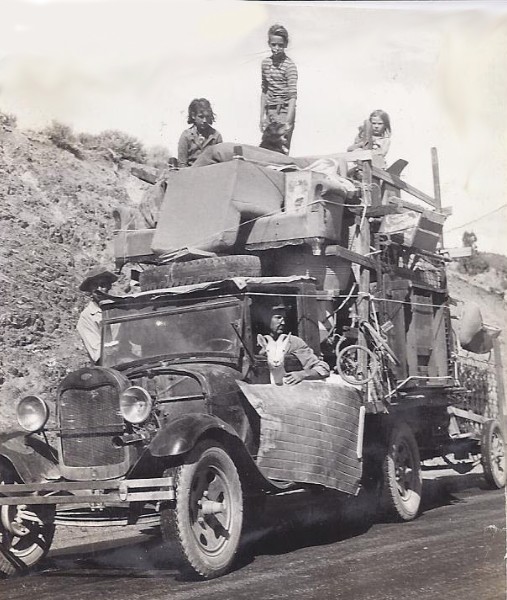
June arrived with a dreaded heat wave forming in the southwestern desert and creeping into Texas. The Mexican province, formally known as the state of California, is experiencing the hottest weather in history, and that adds to the folks getting out of Los Angeles and Sacramento and moving to my state, which has done nothing to stop the influx of unwanted refugees. U haul and Ryder are out of trucks, so folks are building their own trailers or tying furniture to the tops of their cars. Yesterday, I saw a Tesla with luggage and home decor tied to the roof of the poor EV. Of course, the car had California plates, and the occupants were likely looking for a home to buy in my little town. All that was missing was Granny and Eli Mae sitting on the roof.

My grandparents, my father, and my aunt migrated from Texas to California in 1934 because there were no jobs available in Fort Worth or Dallas. When reaching the desert town of Needles, CA, they were immediately labeled “Okie’s” by the border guards. My grandfather, a man of few but choice words, mostly curse ones, did his best to convince the guards that he was a Texan and had visited Oklahoma once for a funeral, which made the situation worse because the guards then labeled them Texas Okie’s, which was a double insult, and to boot, they weren’t welcome in the land of pleasant weather and movie stars. Grandfather turned himself into a poor man’s Will Rogers, with plenty of aw-shucks, dirt-kicking, and head-scratching, which made the guards laugh, so the family was admitted. He forgot to mention the three pistols, the sawed-off shotgun, and his pet Rattle Snake, Bubba, stashed under the front seat of his Ford.

Click the link below for Chapter 2

Chapter 2- Wagons Ho to California !

The Arrival

Ten or so miles past the Needles California border station, my grandfather, John Henry Strawn, encountered a stooped, raggedy-dressed black man and a small dog walking along the side of the road. The man’s attire resembled that of a poorly dressed scarecrow. Without hesitation, he slowed the Ford, performed a swift turnaround, and approached the traveler. After stopping the car, he offered the old fellow a ride. Without hesitation, the traveler gratefully accepted, ensuring that his dog was settled in first, followed by his knapsack, a guitar case, and then himself.

A few miles down the road, the man broke the silence, introducing himself as *Blind Jelly Roll Jackson from the Deep Ellum Dallas, Texas, and his seeing-eye dog, a Chihuahua named Pancho Villa, who is blinded in one eye. The result of a dog fight with a Coyote, so he wears tiny sunshades because the bright sunlight hurts his good eyeball. Jelly says he is a blues man and is headed to Los Angeles to stay with a cousin and find work in a juke joint, and he, by accident, shot a fella in Dallas four times over a pay dispute. He said it was all Pancho’s fault because the dog said the man had a knife, so what else is a body to do. He pulled a leather Bolla from his knapsack, took a jolt, poured a little liquid into his palm, and let Pancho Villa lick it up. John Henry was sure it was whiskey, and after the dog drank it, he fell over and started snoring. Jelly’s chin found his chest, and he slept the sleep of the weary.

On the eastern outskirts of Los Angeles, they saw the first billboard, “No Jobs in California, Keep Out.” John Henry paid no attention to the sign; he was certain he could find a job on the docks in Long Beach. He was an artisan, not an Okie fruit picker. The next sign was for a migrant campground, $.25 per day, running water, showers, and clean grounds; John Henry took the turn off Route 66, drove a few miles, took two more turns, and found himself at a tidy campground guard shack. Unlike the border boys, the guard wore a clean, crisp uniform and was pleasant. The three-day fee was paid with small change from the small stash in grandmother’s purse. Their assigned camping slot was shaded by a tall Eucalyptus tree. This would do until a job was found. Jelly and Pancho Villa wandered down the main lane, stopping to let the children pet and scratch Pancho, who immediately bit a couple of them.

Travel to the eastern outskirts of Los Angeles, past the city limit sign. This is where a well-manufactured fantasy meets reality. Families living in tents or shanties of plywood and canvas. The city fathers, embarrassed to call them shanty towns, label them “migrant campgrounds.” Men walk the roadways for miles into the city looking for day labor or something better. These are hard-working, proud people who have been dealt the cards of misfortune. Los Angeles is becoming a city of “haves and have-nots.”

The Los Angeles of 1934 is a city like no other in this country.  The motion picture industry paints it as larger than life.  Hollywood, where dreams are made and shattered, is the engine that powers this city.  Oil and shipping will defend their role, but Hollywood fuels the beast.

At first glance, commerce appears untouched by the depression.  Polished cars parade on Santa Monica Boulevard.  People fill the sidewalks as if on holiday, smiles on their faces, knowing they are fortunate to live in this unique land of opportunity.  The manufactured facade so completely obscures the reality that, in fact, California suffers, but not quite as much as the rest of the country.  It’s hidden so well that thousands of hopeful migrants genuinely believe this is the “Promised Land.”
   
At dawn, John Henry, with Blind Jellyroll, drove into Los Angeles to search for work. He and a few thousand others had the same idea. A long line of men and women walked in unison as if Moses were leading the Jews from Egypt along the dusty highway.      
Men wearing patched overalls, sewn-up khaki pants, and shirts as white as a wash tub could get them. A few wore a dirty Fedora or a worn sweat-stained Stetson. Some real Okies wore frayed straw hats and cracked work boots. Their clothes hadn’t seen a wash tub of water in months. It was an army made of misery. The cloud of roadside dust told the folks in town they were coming—”NO WORK HERE” signs went up in every window along their route.

John Henry drops Jellyroll and Pancho Villa at the downtown mission run by Sister Aimee McPherson, the celebrated firebrand radio preacher. Jelly’s cousin works for the preacher and has assured him that the good sister has a place for him. John Henry wonders how a blind man and a one-eyed dog made it from Texas to here. Perseverance and Moxy, some folks have it, but most don’t.

  Lost and asking directions to Long Beach every mile or so, John Henry made a wrong turn and found himself on a residential street. Tidy bungalows with mowed green yards and colorful landscaping lifted his spirits. Back in Fort Worth, you only saw streets like this where the rich folks lived. He could tell by the cars in the driveways and houses that needed paint that these folks were plain working people, getting by better than most.  

 Half a block up, he sees an older man and woman losing the battle to unload a large chifforobe from the back of a pickup truck that should have been in a scrap yard. The rear end of the old truck sat on the concrete, and both leaf springs shot to hell. They are struggling and on the verge of dropping the piece of furniture when John Henry stops and, without asking, jumps in and grabs the end the woman is about to lose. The man thanked him for his help as they carried the furniture into their house. The home smelled like the fragrant gardenias growing around the front porch.

More in Chapter 3. * Note; My father couldn’t remember the name of the fellow or his dog, so I used the name of a character from an earlier story. A dog named Pancho could be nothing else but a Chihuahua.

Open the link below for Chapter 3

Chapter 3- Wagons Ho, and Settling In California

July 23, 2024, 2:04 pm 0 boosts 0 favorites

What Say’s It’s Summertime..More Than Political Violence?


1968 Democratic Convention In Chicago

It was quite a weekend for us average Americans. A former and possibly future president was almost assassinated by a twenty-year-old anti-social nut-job, the recipient of school bullying. Take note of anyone who was ever bullied, pushed, or spoken to in a demeaning manner in your high school days. Shooting people is not the panacea.

The present commander-in-chief hesitated for two hours before delivering a statement. When it finally came, it was a brief, confused jumble, possibly crafted by (not a medical professional) Jill Biden. It urged for a reduction in the aggressive language and insinuated that this was the result of America’s conservative faction. Now that’s damn sure taking it down a notch or two, Mr. President..keep it up.

You know those individuals on the right side? They are the regular, hardworking, blue-collar folks driving the pickup trucks they use in their trade. They build our homes and buildings, repair our plumbing and electrical, check out our purchases at the grocery store, pave our roads, support their kid’s little league and soccer teams, and tithe what they can to their church. These folks are struggling to afford basic necessities under Biden’s economic H-bomb. I highly doubt they have time for violence. Just getting by consumes all their energy and money. The welder with a family of five now has to saddle the debt of some woke child’s college loan for a worthless degree in Social Media Posting or perhaps Taylor Swift Music Theory. The parents want the dependent swindler out of their home; they require the kid’s room for their podcast studio. And let us not forget the ten million illegals that have invaded our country; they are living in luxury hotels and receiving hefty benefits for being criminals. All the Democrats ask is that they vote for their candidate when they are allowed to cast a ballot. Ask the homeless mother with a few children, living in a cramped shelter, or perhaps on the streets or in her minivan how she feels about the invasion of foreign grifters draining our social services when she can’t get a damn dime, a meal, or a room at Motel 6.

I’m an old fella turning 75 come September, and I ain’t liking it at all. Every joint aches, and the fear of major organs giving out is as real as can be. Momo, my missus, is a few years behind me and is dealing with many of the same issues.

We both grew up in the 1950s and were teenagers in the 1960s. I remember I was in seventh grade when Kennedy got shot in Dallas. The teacher wheeled in a portable black and white Zenith TV, and the class watched those news fellas with their sleeves rolled up, cradling a black dial phone to their ear, a cigarette in each hand, and a stiff drink of bourbon just out of camera sight, doin’ their job. They broke the news to the world that our president, John Kennedy, was deceased from a shot to the head. Our little 1950s happy-happy world was shattered. The innocence was gone in a blink, and Dallas, Texas, would always be known as the city that killed Kennedy.

In 1968, as a high school junior, I discovered the power of the written word might actually be used to facilitate change. This era sparked within each of us the belief that we could possess the strength to change the world. We all felt we had something significant to say. During this period, I began to approach my writing with a newfound sense of earnestness. I channeled my thoughts and ideas into not only opinions for my school newspaper but also into the creation of short stories, a pursuit that became my primary focus. I would never be a Steinbeck or Twain, but I could give it one hell of a try.

When Nixon ascended to power, politics ensnared my attention. Lyndon Johnson and his Great Society pipe dream left the country in turmoil, bitterly split by his failed policies and the Vietnam War. It’s no coincidence that Joe Biden idolized Johnson and patterned himself after the arrogant bully from Texas. The familial supper table transformed into a platform for deliberating the condition of our nation. My folks remained unwavering Roosevelt democrats while I vacillated like a reed in the wind, embracing liberalism one day and conservatism the next. My loyalty belonged to no single ideology. Politicians appeared nefarious and tainted; the entirety of the government left a bitter taste in my mouth. I was not a Hippie or a Yippie, or a Yuppie, or a Guppie. Then Martin Luther King was assassinated. The good work he had done vanished within hours of his death. The lines between black and white grew wider, and violence was in the wind.

Shortly thereafter, Bobby Kennedy, the Democratic candidate for the presidency, met his tragic end in the kitchen of the hotel mere minutes after delivering a triumphant speech. The perpetrator of this heinous act, an Arab kitchen worker wielding a 22-caliber pistol, answered to the name of Sirhan Sirhan.

The Black Lives Matter movement, Antifa, and the Palestinian protest movement are powerful forces of tension in today’s society. Their intemperate assaults on our cities and citizens are vividly portrayed on our 4K television screens. Yet, when measured against the tumultuous events of the sixties, these groups appear to be more petulant young college students than Marxist terrorists.

During that era, we witnessed the emergence of formidable terrorist entities like the Symbionese Liberation Army, The Weathermen (the Weather Underground), The Students For Democratic Society (SDS), The Black Panthers, and the Ku Klux Klan, in addition to numerous other fringe groups originating on college campuses across the nation. Tossing Molotov Cocktails didn’t require a degree. These folks bombed buildings and wielded guns against Police and citizens. Patty Hearst, once the beautiful and cherished debutant darling of the Hearst publishing empire, underwent a remarkable transformation following her abduction, attributing her radical shift to the influence of the SLA’s brainwashing techniques. No, Patty, you got off on the whole terrorist ideology. Today, she is a wealthy matron with more money than she could ever spend. It leaves me pondering whether she still possesses that automatic rifle and beret from her revolutionary days.

Daddy’s little girl

The upcoming Democratic Convention is scheduled to be held in Chicago, reminiscent of its 1968 counterpart. During that time, a multitude of protesters, guided by the aforementioned organizations, flocked to the city, turning its streets into a battleground as they engaged in confrontations with Mayor Daley’s police, igniting buildings and police cars. The majority of the demonstrators aligned themselves with the Democratic party, displaying discord within their own ranks. It seems that this forthcoming convention is on track to mirror the tumultuous events of 1968.

Would You Paint Over A Rembrandt?


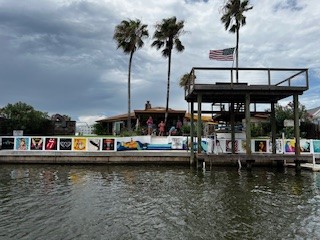
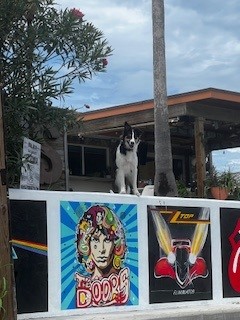
Recently, the saltwater faction of the Strawn clan—my son Wes, his wife Yolli, and grandsons Jett, hired a friend, local artist Jenn Seymour, to paint a mural on their backyard canal bulkhead in North Padre Island, Texas. My oldest grandson, Johnathon, now resides in Corpus, and my granddaughter, Madalyn, was on hand to bolster everyone’s spirits. It’s not their first venture into suburban art; another famous local Corpus Christi mural artist and surfer, John Olvey, painted a large surf mural on their home’s streetside view before he passed away in 2022. Now, the POA, HOA, or whatever this group of whiners calls themselves these days, served my son a letter of violation and demanded the mural be painted over, claiming it is an advertising sign, which is prohibited per their bylaws. The word ‘serve’ is a stretch; they actually taped it to his nice mid-century modern front door, “too yellar” to actually hand it to them in person. I don’t believe this coterie of malcontents thought this one out. Now, it’s taken on its own life form and is spreading like “Pod People.”

The artwork in question is paintings of the covers of the most classic albums in rock music history: Led Zepplin, Jimi Hendrix, ZZ Top, The Beatles, Bob Marley, The Rolling Stones, Willie Nelson, Selena, Nirvana, and a few others. We picked the albums from his extensive collection, and the artist did her magic aided by acrylic paint, Petoli incense, Red Bull, and 1960s good vibrations. Folks from all over the island, Corpus, and far-away lands have made a pilgrimage by boat, foot, and car to view the masterpieces. Wes and Yolli, being gracious hosts, offer a cold bottle of Texas water and a bite of food and lead them through their home to the backyard bulkhead and dock for a better view of the art. Piper, their border collie, happily greets everyone.

The wheels of justice turned quickly when the downtrodden art connoisseurs were wronged. Within a few days, the local paper, The Island Moon, published a rousing piece praising the artwork and exposing the troglodytic POA. One local television station, KRIS, dispatched a top-notch reporter to shoot film and interview Wes, his kin, the artist Jen Seymour, and Piper, the Border Collie. Momo and I spectated the whole shindig from the covered patio and were mightily entertained by the publicity of the whole affair.

This is the last surface in the compound suitable for decoration. So what now? Maybe three large Mariachis playing frogs on the roof? It could happen…it’s the island.

Ob-La-De-Ob-La-Da Life Goes’ On Brah…La-La-How The Life Goes’ On


Yes, Dear Hearts, as the Beatles say, life does go on. As of today, I’m five years cancer-free. I’m expecting a face time phone call from Sir Paul and Ringo anytime now.

Remembering the 4th of July 1957


The whirling of the push mower blades sings a song of torment as I strive to advance the heavy beast forward. I missed cutting the grass by two days: now, it’s akin to whacking my way through a South American jungle. I’m eight years old, and it’s the 4th of July 1957.

Later this afternoon, folks and kin will come over for a backyard cookout and fireworks. A watermelon is chilling in the ice-filled tub, while a supply of Cold Pearl beer and soft drinks occupy another. Both tubs rest in the refreshing shade of our backyard Mimosa tree. My old man’s cherished Leonard Brothers all-steel Master Chef charcoal grill sits on the driveway, brimming with Mesquite briquettes freshly bought from “Little Bills Cookout Ranch” in Eastwood Texas.

Many of the kinfolk invited to the family gathering have long found themselves on my father’s “Naughty List,” but being a kind man, he extends the invitation year after year, including on Christmas Day. They always come, and before long, the reasons for their past banishments come to the fore. Cold beer, followed by a belt of Old Crow whiskey, seems to grant them the audacity to make a truly remarkable spectacle of themselves. They can be quite entertaining, but only for a short while. As a young one, their antics matter little to me. My mind is set on handling dangerous fireworks and causing grandiose explosions.

Folks start moseying in as the sun starts its descent. A few cousins near my age will make the shindig bearable. My tomboy cousin Ginger brings her bow and target arrows, while I tote a bag full of steel-pointed lawn darts. Ginger wastes no time in shooting my cousin Jok in his left buttock. My father yanks out the arrow, and a band-aid does the trick. Kids were made of sterner stuff back then. Only a speeding bullet might have given us pause. We then move on to firecrackers, cherry bombs, and sparklers.

Burgers are served along with “tater salad” and watermelon. Pearl beer gives my father’s uncle Orum the ability to talk like Will Rogers. His home-spun recounts of past family gatherings captivate the adults. Without the lubrication of beer, he is as humorless as a cardboard box.

Cousin Ginger finds her not so well-hidden bow and arrows in our garage and sends an arrow through a bedroom window glass. Her father, Jake administers a well-deserved butt whooping. It’s not often I see a girl get a spanking. Jok and I egg our uncle Jake on. Ginger does the one-arm escape dance, screaming for mercy, as her father delivers the blows.

I obliterate every ant hill in our alley using Black Cat firecrackers before launching a tin can into the stratosphere with a Cherry Bomb. Cousin Jok places a Cherry Bomb on the front tire of his older brother’s new MG convertible to gauge the velocity of the blast. The firework creates an outward dent in the fender, serving as a foreboding omen for Jok’s impending doom; he is well aware of the retribution that awaits him upon his return home.

Darkness comes, and we twirl sparklers in figure-eight shapes. Sticks of metal ablaze at 3,000 degrees. Children clutching a welding torch; what could possibly go wrong? Cousin Jok miscalculating the burn duration of a sparkler, singes his hand, leading him to release the little torch, igniting a yard blanket upon which his mother was seated, prompting her to drop her beer and hot dog. My father douses the blaze with a garden hose. Jok is surely on track to set a new standard for butt whooping’s when he gets home.

Ten o’clock arrives, and I’m lying in bed after my bath. The soft whir of my bedroom fan lulls me into La-La Land. The adults are still in the backyard. I hear their laughter and catch a few words of some dirty jokes.

Drowsiness comes; sleep is but a minute away; then I hear my mother singing God Bless America, and the others join in. It feels good to be a kid on the 4th of July.