Momo and I are creatures of habit, wandering through the peculiar tapestry of our country, mainly the desert southwest and the mountains of far West Texas. Drawn like a moth to a porchlight, time and again to the whimsical embrace of a certain town.
Marfa, Texas, stands as a solitary beacon of floating lights in the mountains amidst the vastness, nestled alongside its mysterious neighbors—Alpine and Fort Davis—forming a curious landlocked Bermuda Triangle of odd happenings in the Chihuahuan high desert. Strange lights, ghostly apparitions floating around town, young hipsters from Austin that migrated to the new Nirvana, only to find out that it costs more than they can afford to live there, and who will buy their third‑rate art and used clothing? The local folks call them “Marfa Surfers.” Either the surf is up or down, and then on to the next beach. The average shelf life for these young gypsies is around three to six months: then it’s back to Austin, where their air of weirdness is commonplace.
Each visit finds us returning to the Hotel Paisano, a historic haunt where the stars of the film “Giant” once breathed in the same desert air, their whispers still echoing through the adobe walls, reminding us of the historical stories that linger in this town.
There exists an ever-growing assembly of characters, primed to share the local tales intertwined with a potpourri of exaggerations, all while maintaining a devilish demeanor as they weave their narratives, and Planet Marfa appears to be their favored stage.
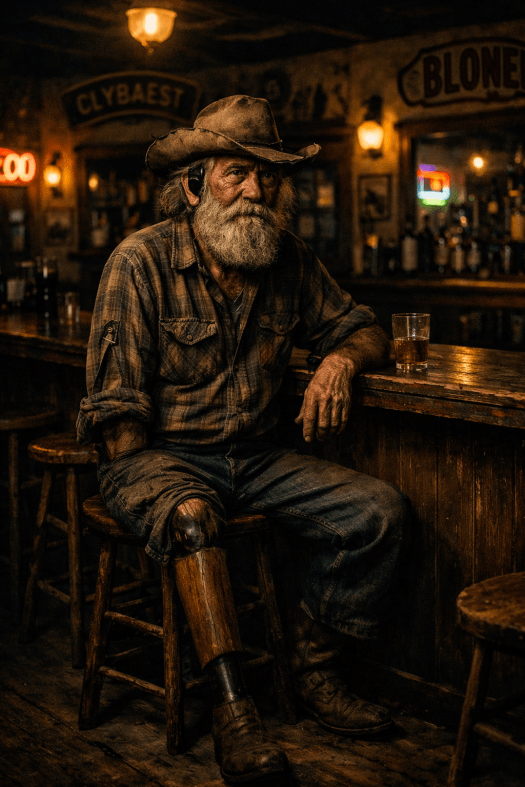
Sagebrush Sonny Toluse was my favorite from our last visit. Sporting a long white beard and a wooden leg, courtesy of a large desert dump of toxic nuclear waste from the 1945 Atom Bomb. The waste was eaten by a group of escaped Chihuahuas from a breeder in Persideo, which turned them into vicious, mutated killer mongrels, which in turn relieved him of his right leg. I believed most of it, but truthfully, he’s full of crap, but it was fun crap. I was hoping to run into him again, ply him with beer, and hear a few more stories.
As luck has it, he was at his usual seat at the end of the bar, looking much worse for wear than two years ago. The dry desert air is supposed to preserve one like an Egyptian mummy, but Sonny may be the exception. He looked as if he had been vacationing in Hell and just arrived home that day. His drinking a case of beer a day is not considered medicinal or practical, and he was smoking two cigarettes at a time with a third sitting in a classic Hotel Paisano glass ashtray, ready to be lit. I didn’t see money on the bar, so the kind young bartender likely lets him drink for free these days.
I saddled up beside him, and he remembered me:
“You’re the fella from Fort Worth who liked my stories,” he says.
“Yep, that’s me,” I reply. Mister gullible, but interested enough to listen and use what he tells me, even though much of it is a tall tale, and I do know something about that genre.
I ask the bartender to bring Sonny two beers, on me. He appears to have had more than a few already, but I can sense he is ready to orate a few of his tales. It’s then that I notice he is wearing a black patch over his left ear, and his left arm is missing: his shirt sleeve is held in place at the shoulder by a safety pin, and there is a large area of his scalp on the left side that is bare of hair. The poor man looks like a wreck, so I ask if he was in a car accident. He drinks his beer in one gulp, lights his third cigarette, and I can sense he is going to explain his ghastly appearance. Momo is sitting under a canopy, enjoying a beer, texting, and taking a few pictures. A light rain has started to fall.
Sonny wastes no time and begins his story.
He speaks in between deep draws of his cigarette and swigs of his fourth beer, ” Back about a year ago, I was driving on the highway over by El Cosmico, you know that bunch of hippies from Austin that live in those tents and trailers. There was this 1960s Fairlane station wagon with the hood up, spewing steam, and a family standing by the side of the highway, so I stopped to help. The man said they were from Minnesota and were looking to set up camp in the desert, but couldn’t afford to rent a space in El Cosmico. They were a ragged-looking bunch, three kids, all wearing boxer shorts and sneakers, long hair with fishing lures woven into it. The wife, who called herself Sassy, was cute, but kind of a smart ass. The guy, Tiberius, was really nice. I told them there’s an old abandoned campground about ten miles out that might fit their need, and it has a little pond the kids can swim in. After I put some water in their radiator, they followed me to the spot, which is way out yonder in the desert. When we got there, they were excited to see a few Yurts that were still livable, so after I got rid of the rattlesnakes, they moved right in. It was getting dark, so they asked me to stay for supper and spend the night. I had a cooler full of beer, and they fixed up some beans and weiners and sat around the campfire swapping stories. That’s when I told them about the toxic killer Chihuahuas that roamed the desert at night, and that’s why I have a wooden leg cause they chewed the other one off. They thought I was full of crap and got a big hoot over my story, which was really a warning: this place ain’t safe at night. They laughed so hard, the wife wet her shorts, and they thought I was telling a tall tale. Around midnight, we all said goodnight and hit the hay.
I ordered him two more beers and a fresh pack of cigarettes, and he continued, ” I was sleeping in my truck, and during the night I had to pee, so I hobbled a few feet away from the truck, because at night, I take my wooden leg off to give my stump a rest. That’s when the little demon Chiuauas jumped me. They had been hiding under the pickup, waiting for me. The little demons got me down, chewed off my left ear and most of my left arm, and took a good part of my scalp and hair, which was sparse already. The family woke up after the attack, piled me in the car, and drove me to the hospital over in Alpine, and the doc saved my life, cut off the rest of my arm, and sewed up what was left of my ear and scalp. I was there for a week or so, and when I returned to Marfa, the family had packed up and gone back to Minnesota. They were too weird for me anyway.” I looked at the bartender, and he gave me a smile and a nod, as if to say, It’s all true.
The year was 1955, and at six years old, by my grandmother’s observation, I was a heathen child, almost feral. Being raised in the big city of Fort Worth on a steady diet of television featuring Popeye, Bugs Bunny, and the Three Stooges, I was living in a religious void. I saw the “good book” as a large decoration on the dining room table and read it at Christmas, Easter, and family funerals. Recently, I had been attending a few services at the Poly First Baptist Church with my parents. Still, the preacher, with his over-animated, stage-stomping Hell-and-Damnation rants, scared me more than The Mummy and Frankenstein combined. I was wishing for a fatal disease to strike so I would be bedridden and couldn’t attend.
I had been visiting the farm for six weeks, from June into July, and it was my first time away from my parents. The farmhouse had no television, only a radio. By the third day of no cartoons, I had the shakes and a low-grade fever. I did bring my Red Ryder BB gun and enough ammo for a summer’s worth of popping some of my grandmother’s five hundred chickens: the BBs bounced off their thick feathers, so none were harmed. Other than throwing dirt clods at Rattle Snakes, it was all the entertainment I could muster. Granny was a wise Cherokee, medical Shaman, and self-proclaimed Texas Biblical scholar, and she felt a week at the Baptist Church Vacation Bible School would fix me up and assure my acceptance into Heaven. I had no idea where Heaven was or when I would be required to visit, so I trusted my Granny would make my reservations.
Miss Ida Belle Mae and her younger sister, Rita Rose Mae, are the self-appointed teachers of our Bible school class of 25 children, ages 6 to 10. Homely as a sack of poultry feed, the two are old maids and prolific spinsters rumored to survive on a tidy income from a single pumping oil well on their farm. It has been a long-standing gambling bet at the Domino Parlor that that gasping little well will give it up. To date, no one has won the wager. When the holidays come around, the two sisters are rumored to donate a substantial sum to the church. To appease the ladies and keep the money flowing, the kind but timid preacher is forced to let them do what they please. Their pleasure this summer will be teaching Bible school. The preacher will regret this decision.
On the first day of Bible School, our class cut, pasted, and signed 270 prayer cards for the sick and unfortunate children in Africa; quite a feat for 25 kids. Most of us were injured and bleeding from paper cuts and glue poisoning from licking the envelopes. My tongue swelled up the size of a buttery biscuit. The kid beside me glued his lips shut, and Miss Ida had to pry them open with a spoon and a douse of grape Kool-Aid.
Miss Ida sent us outside to lounge under the trees and recover from our stint on her assembly line. There is no recovery; it’s 96 degrees and not a rustle of a breeze, but it’s better than forced child labor.
A black Cadillac sedan stops in front of the church, and an older lady escorts a boy of maybe nine or ten into the main building. The kid wears a black suit, white shirt, and red bow tie. We assume he is here for a funeral or a baptism, but don’t care because it’s too hot to move or think. Miss Ida rings the lunch bell. Yummy peanut butter, grape jelly sandwiches, and lukewarm Kool-Aid await—the usual menu for Bible school attendees. After we are seated, Miss Ida brings the suited boy to the front of the class. She is beaming like a schoolgirl attending her first prom In a giddy voice, she addresses us,
” Children, I would like to introduce Master Stewart Sweet. His daddy is the famous tent-preaching evangelist and faith healer from San Angelo, the Right and Honorable Doctor I.M. Sweet. Master Stewart will attend our Bible school and lead the children’s Bible study on Sundays for a few weeks. I can assure you that he is quite capable since he has read the Bible three times, all before he was six years of age, and preaches at his father’s tent revivals.” Miss Ida doesn’t know this kid’s back story, nor do we, but it will soon come to light.
As a class, in childish camaraderie, we are unimpressed and instantly dislike this brat. Will this kid, dressed as a department store dummy, preach to us about sin and saving our little souls? At our young age, the worst thing we could have done is tell a few small lies, steal a cookie, or shoot a chicken with a BB Gun. Hell and Damnation are years away for most of us.
Young Master Stewart steps from behind Miss Ida’s table and slams his ten-pound Bible down on the floor so hard it sounds like a firecracker. A few girls in front are shaken and begin to whimper. The young preacher Stewart raises his hands to the Heavens and launches into a tirade that can only be considered appropriate for adults designated to luncheon with Beelzebub within the hour.
After ten minutes of our first fiery sermon, we are ready to wrap this kid in scotch tape and send him to Africa with the prayer card. Suddenly, he stops and begins to bless our food. He bows his head and, in a reverent whisper, says,
” Dear Lord, these children, wretched little hayseeds that they are, cannot survive on the butter of the Peter Pan and the mush of Welches. They need a substantial amount sustenance so they may be healthy to accept your holy spirit. Starting tomorrow, a glorious feast of grilled sausages wrapped in soft buns, the salad of the potato and the ruby-red fruit of the melon will be their manna from Heaven. Amen.”
Miss Ida is speechless. The little preacher kid has called her food “garbage,” and she has to sit there and take it. The class is now a bit impressed. This kid is good. The sisters, rattled by Young Sweets’ blessing, need time to recover and devise a plan to send this kid back to San Angelo as soon as possible. So they send the class outside to suffer in the heat again.
Miss Rita delivers the ice cream freezer and instructs two larger boys to start churning for the afternoon dessert. Allowing us to have ice cream may be the only kindness these two witches grant us.
Twenty-five minutes into the churning, the ice cream remains a pitiful mush. Now impatient for their treat, the class gathers around the freezer, demanding an explanation. We are kids and know nothing about how these machines work. You add ice, salt, liquid, and chur. That’s all we know.
Young Stewart parts the crowd and approaches the ice cream freezer. He kneels and places both hands on the contraption. In a soft, almost inaudible voice, he says a small prayer and violently shakes the machine a few times. He rises and declares, “There shall be delectable ice cream in five minutes.” He is right. This ice cream might be the best we have tasted in our young lives. Little Master Stewart fixed the ice cream machine. A girl calls it a miracle.
After ice cream, Miss Ida calls the class for Bible study and a story. Her stories are known to last too long, and kids tend to lose interest and fall asleep. Her voice is that of an older man who smokes two packs of Camels daily — raspy and accentuated by the occasional hack.
Bitsy, the smallest and youngest girl in class, is seated at the front table and is in distress. The new kids in the class are unaware that she has an immobilizing speech defect. She stutters, and her vocabulary is limited to a simple yes or no. The little girl is wide-eyed and squirming in her chair. Miss Ida knows her problem, and when Bitsy politely raises her hand to request a bathroom visit, Miss Ida insists that she must stand and ask aloud in front of the class. Of course, Bitsy, immobilized with fear and embarrassment, wets her pants. Miss Ida snickers and calls her a little baby child. We all knew these two sisters were mean, but now we know they are darn right evil.
Master Stewart comes from the rear of the class and stops in front of Bits. He turns and gives the two sisters a “stink-eye” that makes them fall back into their chairs, white with fear. He bends down, takes Bitsy’s head in his tiny hands, and declares,
” Take this affliction from this small child. Purvey upon her the diction of William Shakespeare and the wisdom of Mark Twain. Let her words flow forth like the singing of Doves on the south wind. She will never again stammer or grasp for words and will someday speak to massive gatherings of people who will clamor to hear her message. Amen.”
The class sits in stunned silence. Healing the ice cream machine was a warm-up compared to this. A girl from the back of the room yells, “Thank you, Sweet Baby Jesus.” And there it is: Young Stewart will now be known as Sweet Baby Jesus, or just Sweet Baby for short.
Miss Ida and Miss Rita sit rigidly in their chairs, eyes glazed and staring into nothing. The amount of “stink eye” Stewart, now known as Sweet Baby Jesus, put on them must be compelling. He approaches the two women, lays his small, soft hands on their wrinkled, sweating foreheads, and mumbles a few words. His back is to the class, so we have no idea what is said. The two evil sisters shiver a few times and awaken from their “stink eye” trance. They stand, gather themselves, and tell the class they are going home. Master Stewart will teach for the duration of the Bible school. They depart the church as if in a zombie trance.
Sweet Baby Jesus takes his Bible, sits on the edge of Miss Idas’ desk, smiles, and says, “Now, let’s hear some real Bible stories straight from the source.” It was a beautiful afternoon full of unexpected laughter and acceptance. For once, we kids found that listening to the word of God from another kid made us feel good, sort of like hot oatmeal on Christmas morning.
The following day, the preacher greets us with the news that young Stewart is back in San Angelo and will teach the class for the remainder of Bible school. Of course, we were sad to see our new Sweet Baby Jesus depart our Bible school. Bitsy, in between constant talking, sniffles, and wishes him the best. The class wrote a letter to Sweet Baby, thanking him for his kindness to Bitsy and for putting the evil sisters in their place.
I attended the vacation Bible school for a few more summers, but it wasn’t the same without Sweet Baby, and I attended my last one at eight years old. A few decades later, I read that the Right and Honorable Reverend Stewart Sweet, with assistance from his wife, Bitsy, had established an enormous ministry in Africa and healed everything from Beri-Beri to auto engines. It looks like Sweet Baby Jesus is still doing a great job.
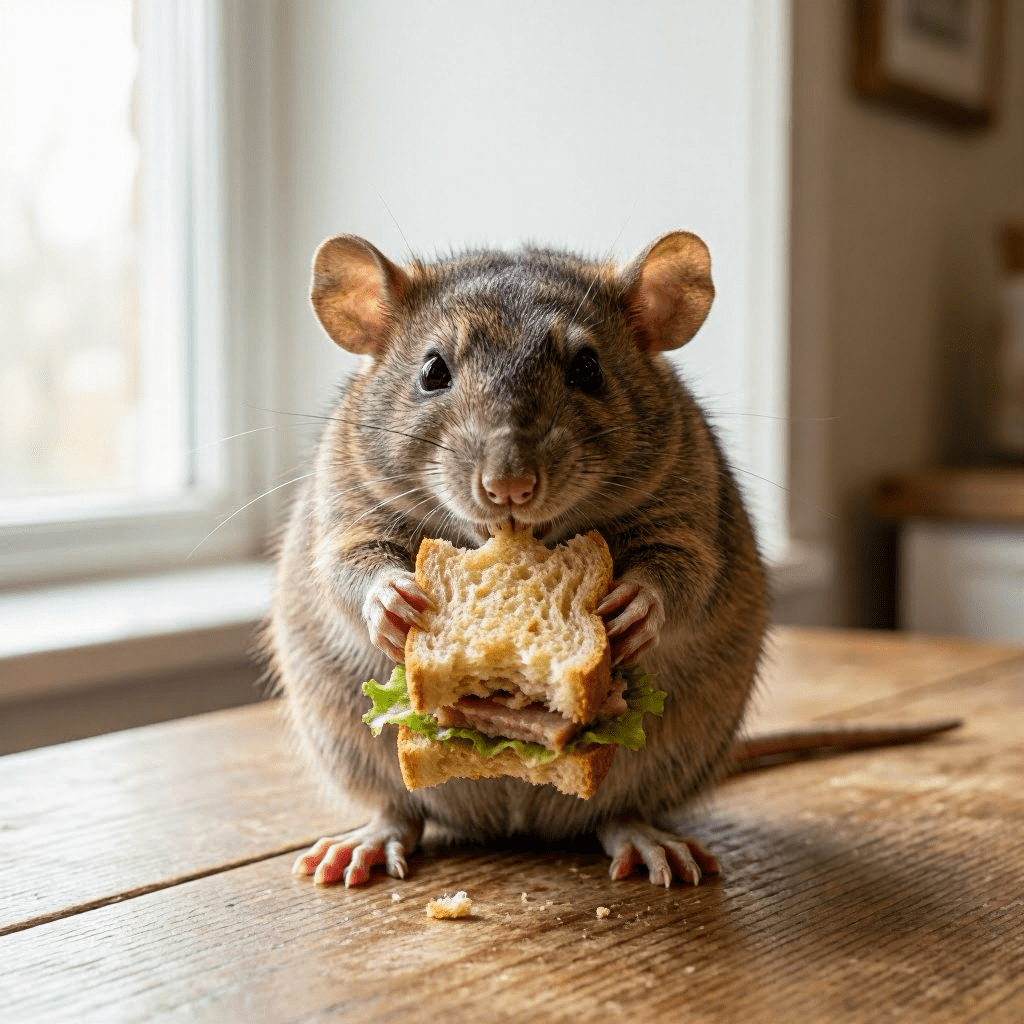
As some of you know, I had, and now, still have a Rodent, Rat, Mouse, or something more vile living within the depths of my wife, Momo’s, favorite thing: her hot tub.
We’ve removed most of the foam from inside, found the tubes the little critter chewed to obtain water, and have a friend who is a plumber who plans to replace the damaged parts in a week or so.
Now the Hantavirus, or the Black Plague, is going around, Good Lord Almighty, another pandemic? Mouse poop is going to wipe out the country?
Those folks on that tour ship must have ingested some in their Ceaser salad while gorging at the buffet. There is a substantial amount of Rat poop inside the hot tub, so there must be more than one, possibly a family with relatives.
I did the inhumane, unthinkable, and poisoned the little Rat with some guaranteed tasty and effective bait. Yesterday, he was lying down, breathing hard, and in a spot I could reach with my wife’s Martha Stewart Cooking Tongs. I figured he was about to go to Ratland, so I would wait out the expiration, but this morning, he or she has vanished. It’s unlikely a Rat Rapture happened, so he is either deeper in the tub or has crawled away to croak in a more natural and serene setting in the woods that surround my home.
My cousin and I used to sit in my grandparents’ barn and shoot the Rats with our Daisy BB Guns, killing a few now and then, but developing a keen eye for shooting fast-moving targets. Now I’m back to square one: find the Rat, dig more foam, put on a Hazmat suit, and finish vacuuming up the foam pieces and the Rat poop. I’m seriously considering having someone haul the tub away, Rat and all, or purchasing a 410 Shotgun and gettin er’ done.
Real Good Advice For Folks That Don’t Have Any Brain Cells left….
The Texan
This Texan received a request for help written on the back of a Walmart bag, the new ones made from paper. Mr. Weemus Weesley of Sore Rabbit Foot, South Dakota, says his wife is abusing Ozempic in the worst way possible.
Mr. Weesley: Mr. Texan, there ain’t nobody in our town that knows nothing about nothing. My wife, Luella, is a bit overweight. Well, some folks say she just has big bones, but she is honestly just a bit overweight, as are most women her age during menopause. Most of the weight is in her buttocks. I had to butter up the door jambs to the bathroom just so she could get in there for a shower. Her Doctor gave her a script for this new weight loss stuff, Ozempic, but she is deathly afraid of needles and passes out after I give her the first jab.
Some influencer on social media said she could inject this stuff into a blueberry and put it up her behind like a suppository. So she tried it. It was working for a while, and she wasn’t eating two gallons of Blue Bunny ice cream a day, but then she stopped losing weight everywhere except in her buttocks and her hands and her feet, and now the rest of her is still a bit heavy, but her ass, feet, and hands are the size of a little kid’s. She’s going through two or three pounds of Blueberries a week, and now I don’t have any to put in my yogurt, and she has this little gimlet ass, hands, and feet about the size of our six-year-old granddaughters, who refuses to come visit because Luella looks like some weird alien from those 1950s scary shows. She’s so freaky looking, I can’t even take her to Walmart at midnight when no one is there except folks in their jammies. Any ideas on this one?
The Texan: Well, Mr. Weesley, I’m almost out of words on this one. I’ve seen the pictures of the Hollywood crowd, and they all look like “The Night of the Living Dead,” staggering around with folks helping them to walk. This might be a good movie for her to watch. I believe it’s on Amazon. Take those Ozempic pens and squish all the juice out, then fill them with liquid Miralax, and change her ice cream to Bluebell. She might still be a bit overweight, but she’ll be regular and happy. This is just a phase these women are going through. Oprah will look like her old, chubby self once she stops the Ozempic. I’m sending you a case of liquid Miralax and some cherry bombs just to cheer you up.
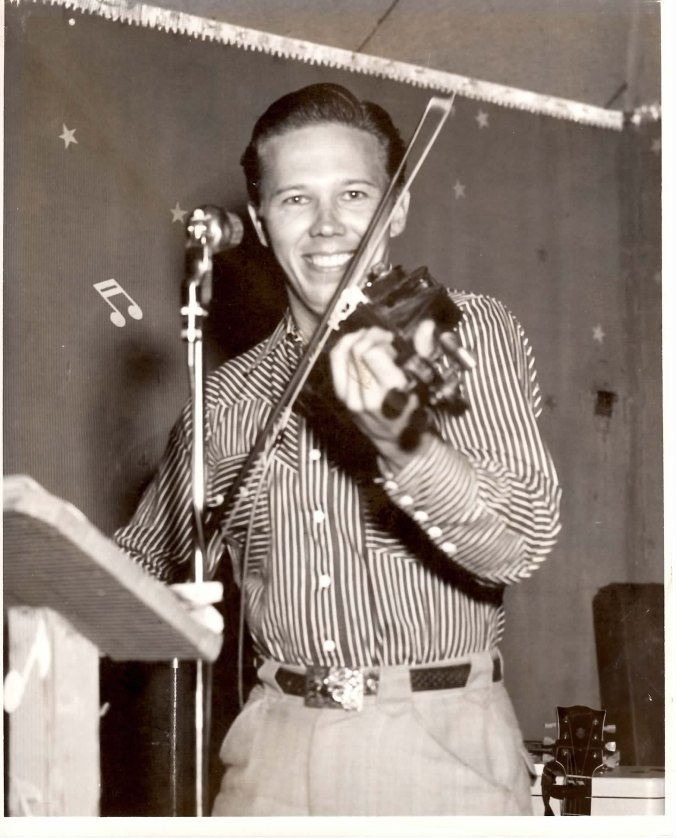
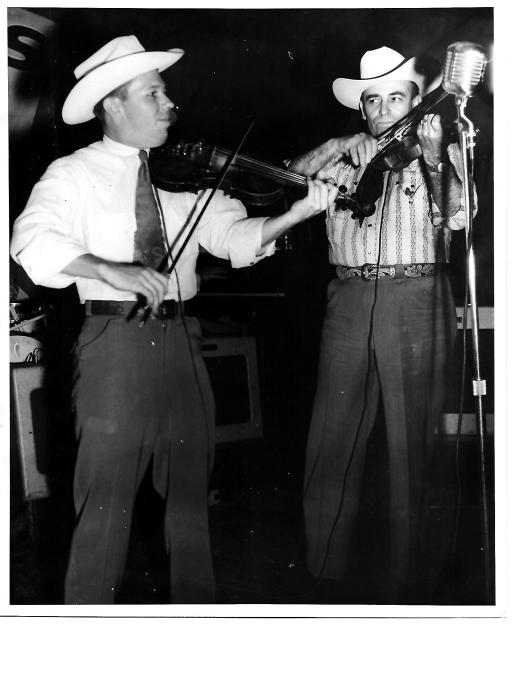
Johnny Strawn on the left and Bob Will on the right. The Sunset Ballroom, early 1950s
I was born into music the way some children are born into weather—something that surrounds them before they have words for it. Long before my hands were big enough to hold a wooden neck or find a note on a steel string, the sound was already there, drifting through the rooms like a ghostly wind. A man doesn’t choose a life like that; he’s shaped by it, the way wind shapes a tree on an open plain. Our home pulsed with music, not a 78 RPM record on a Victrola but real instruments played by men, some would become mentors, lifelong friends, and a few I would help carry to their final rest, my hand supporting their coffin. It seemed they were always there, a few feet away or on the front porch and around the kitchen table, drinking coffee, smoking cigarettes, and playing music. My younger sister and I thought it all to be quite normal, but it was so far from that.
My father carried his fiddle the way working men carry their tools—worn smooth by sweat and nights on the road, tuned by the laughter and sorrow of dance halls from Fort Worth to Nashville, Springfield, Tulsa, and to Abilene and then on to California. He played with the great ones, the ones whose names still hang in the air like smoke: Bob Wills And The Texas Playboys, Willie Nelson and Paul English, Milton Brown, Cliff Bruner, Adolph Hoffner, Bill and Jim Boyd, Smokey Dacus, Jake Ghoul, Artie Glenn, Ray Chaney, Smokey Montgomery, Jerry Elliot, Bill Hudson, Red Foley, Grady Martin, Roger Miller, Ted Daffan, Lefty Frizzell, Hank Garland, and the Light Crust Doughboys. Those bands were more than music; they were a kind of moving tribe, stitching the country together one dusty town at a time. And my father stood among them, bow in hand, drawing out the heartbeat of the West. He wasn’t a big man in stature, but when he drew that bow across those strings, he stood as tall as Iowa corn.
But the story didn’t start with him. It ran back through my grandfather, John Henry Strawn, and further still to my great-grandfather, Marion Strawn—men who bent their backs to the land by day and lifted their spirits with a fiddle by night. In those days, a tune wasn’t entertainment; it was survival. A way to keep the darkness from settling too heavily on a man’s shoulders. My grandfather, in his younger days, was a cowboy, but was always that campfire fiddler with a tune poised on his fingertips, as was his father.
So, of course, I was born into it. The first instrument wasn’t wood or wire but a small blue baby rattler, the kind a child shakes without knowing he’s keeping time with the world. I still have it tucked away in a box, along with those tiny shoes from The Little Texan shop in Fort Worth, 1945—leather soft as memory, soles barely scuffed by the earth. My Aunt Norma told me my feet didn’t touch solid ground until I was three or so. Proof that even then, before you could walk, the rhythm was already in your hands.
Some families pass down land, or money, a name carved into a building cornerstone, or a legacy that follows them through generations. Mine is passed down as a sound—a long, unbroken line of strings vibrating against fine old wood.
And so the question was never how I became a musician. The real wonder is how I could not become anything else.
The Great Depression settled on the land, especially the Midwest, from the Dakotas to the bottom of Texas. Misery was in every mouthful of whatever families could scrape together for a meal.
My grandparents loaded their dilapidated car with whatever scraps of a life could be carried, tucking them into corners already crowded with worry. They pulled away from Fort Worth in the hard years of the early 1930s, when work had vanished like water in a dry creek bed, and the dust from the Panhandle settled over the city in a fine, punishing veil. Folks walked with their shoulders bent, not from age but from the heaviness of days that offered little and took much. In those times, every family felt the pinch of hunger and the quiet shame of wanting more than the land and the cities could give. So they turned their eyes westward, toward a place they’d only heard about in stories — a place where the air was said to be softer, and smelled of blossoms, the work steadier, and opportunity flowed like milk and honey for anyone brave enough to chase it. Like the frivolous dancing girls in the unrealistic movies echoed, “We’re In The Money.” Come to California, and all will be healed, my brother, and happiness will be here again. For many, it was their salvation, for even more, it was their Waterloo.
The journey was a gritty trial; more than once, my grandparents’ aspirations lay shattered within the confines of the bloated car. Harsh words, blame, and unforgiveness forced the old Ford to veer back Eastward, yet practicality prevailed, and the road West stretched ahead once more. Route 66 transformed at times into a mere gravel-and-dirt dog track, its ruts so profound they could swallow a child, never to be seen again. Just beyond the Border Patrol in Needles, California, my grandfather—clad now in the worn label of an “Okie”—picked up an elderly blind bluesman and his tiny Chihuahua, supposedly his seeing eye dog. Still, the dog possessed one good eye, so his loyalty only went so far. They were fleeing from the shadows of Deep Ellum in Dallas, Texas, where the blind bluesman, in a pay dispute, had shot six folks in a bar at the aimining direction of the small dog, all the patrons were wounded, and the wrongdoer escaped unharmed. That chance encounter would shape the souls of all within that car, threading their lives together in an unbreakable bond forged by hardship and hope.
After depositing the old blues singer, Blind Jelly Roll Jackson, at Sister Amiee McPherson’s downtown Los Angeles Mission Church, my grandfather encountered a couple who sensed the need and subtle transformation within him. I have always believed that angels walk among us most days, though they sometimes take a leave of absence for their own reasons. In that moment of serendipity, my grandfather’s guardian angel appeared in the passenger seat beside him, illuminating the path with a chance encounter that offered help and guidance from above. He forged a friendship, secured an unimaginable job, found a modest home to rent, and within weeks, he bestowed upon his family the very gifts of life he had only dared to dream. God is awesome, but he sometimes requires his Angels to carry that extra pat of butter in their rucksack for special times.
Around the age of ten or eleven, my father, Johnny, expressed interest in learning the instrument. My grandfather showed him the basics, then handed him off to a retired high school music teacher on their block, who gave him violin lessons in exchange for mowing, weeding, and odd jobs. A $5 pawn-shop violin was purchased, and tutelage began. Within a few weeks, he could read music, had learned the notes on the fretboard, and could play a few simple tunes. Most nights, grandfather would sit on their front porch and play his father’s old 1812 German-made fiddle while spinning yarns to anyone who would listen. He was a master of Texas Dichos, and with each jig he played, there would be a life’s lesson or a tall tale to accompany the tune. Many nights would find a dozen folks sitting on the front lawn listening to his fiddle and his tall tales. All of it seemed to fit in life’s complex package. Every fiddle carried the tales of heartache and hope: real or imagined.
Around the age of thirteen, my father found himself among a group of schoolboys who, in their youthful exuberance, formed a string band that echoed the sounds of their dreams: they wanted to be country musicians like the ones they listened to on KUZZ, the famous country radio station out of Bakersfield, California. My father wielded the fiddle, the others accompanied with a stand-up bass, a tenor banjo, and a guitar perpetually missing a string, creating an element of embarrassment and laughter.
None of the young lads had the gift of a soothing voice to uplift their spirits, so my grandfather, with the wisdom of a man with a good musical ear, recalled the old black blues man he had once deposited at Sister Aimee’s Mission in downtown L.A.
A few calls were made, a meeting set, and the boys were graced by the presence of Blind Jelly Roll Jackson, accompanied by his loyal Chihuahua, Giblet, whose single keen eye began to see beyond the darkness. Blind Jelly, with the patience and kindness of a seasoned mentor, accepted their earnest offer to perform, insisting that a young Cajun girl from the church choir that he had grown fond of join them, a girl whose voice could lift the very rafters off their hinges. Le’ Petite Fromage, though barely five feet tall, could sing with a strength that belied her tiny stature. As they gathered on the Strawn’s front porch for their first rehearsal, the band realized they needed a name. “Le’ Petite proposed ‘Blind Faith,’ inspired by Blind Jelly’s newfound devotion to Jesus and the church, and his obvious disability.” Sister Aimee, her spirit both stern and forgiving, had an off-kilter sense of humor and deemed the name tinged with a slight touch of blasphemy, yet offered her blessing, recognizing the earnestness in their hearts. The band was born. A new type of country, Texas-style Cajun-infused Jesus music had arrived, without an organ or big hair, an edgy choir, and it hit Los Angeles like a Super Chief express train from Fort Worth.
Word of their talent reached every corner of the church community, a bustling hive of activity every weekend, filled with the laughter of children at birthday parties, the fierce spirit of chicken fights, the tender moments of school dances, and the somber gatherings of a few funerals; on lazy Sunday afternoons, they would often spill out onto the sun-warmed corner outside the church, entertaining any who would stop for a listen.
Le’ Petite’s father, Baby Boy Fromage, a nickname given to him because of his stature, brought his band “The Chigger Bayou Boys,” to Los Angeles, driven by an urgent need to escape the depression drought of paying jobs in Louisiana, Texas, and Oklahoma; he hoped that the burgeoning migration to Bakersfield might present a new opportunity. His unique blend of Cajun country, alligator tunes, skeeter-swatting antics, and the camaraderie of beer drinking seemed to resonate with the Californian spirit, and for a time, it flourished. Meanwhile, Le’ Petite found her own path, joining Sister Aimee’s church choir, which divinely led to a deepening friendship with Blind Jelly Roll. This bond blossomed into the formation of their band, Blind Faith, as if fate itself had conspired to align their destinies just right.
Bob Wills, a spirited and legendary member of The Light Crust Doughboys from Fort Worth, Texas, traversed the country in a bus, on a well-financed quest to promote the finest flour known to man, Light Crust Flour, milled in Fort Worth, Texas. It was Baby Boy Fromage, father of’Le’ Petite, who journeyed with his band from the marshy Chigger Bayou, Louisiana, to Bakersfield, where the heart of California’s country music pulsed with life. He orchestrated a thirty-minute live radio broadcast for this budding ensemble, cleverly pocketing the majority of the earnings. It was during this very broadcast that my young teenage father encountered the legendary Bob Wills, whose band had just wrapped up their own live radio performance. United by their Texas roots, they met and ignited a bond, with Bob assuring my father that, upon his return to Fort Worth, he could count on him to swing open the doors to the world of music. Johnny cherished that promise, as did Bob, both forever marked by the fleeting good grace of opportunity. A life-long mentorship had been formed.
When the Japs bombed Pearl Harbor, every high school boy in the country wanted to enlist to fight them and Hitler. Three of Blind Faith joined up, then Johnny, with my grandfather’s consent, because he was seventeen, enlisted in the Navy. That left Blind Jelly Roll, Giblet, and Le’Peetite, who was sweeter by the day, on a sax player in the church orchestra. In a hurried wedding performed by Sister Amiee, the two returned to Chigger Bayou to start their family of ten children.
In 1954, my father, in a sweating fit of entrepreneurship, purchased a club on Jacksboro Highway, the Sunset Ballroom. Between the fights, the Fort Worth mob, making it their newest hangout, and the payoffs, he soon sold it and went back to playing the circuit.
After serving in the Navy in World War 2 and returning from Hawaii to Fort Worth, drawn by the unrelenting trysts of his alcoholic mother, attempting and failing to be in the nightclub business, Johnny was desperate but hesitant to bother Bob. After marrying my mother, he did contact him. As good as his word, Bob put his size-12 cowboy boot in many doors that led to the beginning of my father’s father’s, one of the best country fiddle players in the nation.
The fiddle he played was the very same his father had procured from a pawnbroker’s in Los Angeles; though it possessed a certain charm, it lacked the warmth and volume of a fine-made instrument. In a generous gesture, Bob often invited Johnny to perform with the Playboys and, in turn, gifted him a fiddle crafted by an esteemed Luthier from Fort Worth, Joseph H. Stamps, in November of 1947. Bob, ever the pragmatist, rarely ventured without two or three backups, ever mindful of the fragility of strings. His hands, though skilled, bore testament to a life of rough play, leaving this instrument with its fair share of scars—gouges and scrapes that contributed an unrefined but slightly brutal beauty to its sound. One gouge near the bridge was never repaired because it may have affected the tone, which, to a fiddle, is its purpose. I have preserved a few sepia-toned photographs of him and Bob weaving harmonies on twin fiddles, and that particular instrument, worn yet noble and soaked in history, remains in my care; I am now, even at the old age of seventy-seven, revisiting its strings, having been sidetracked by the allure of guitar since I was twelve and discovered rock n’ roll music. I was like most boys, wanting to be Elvis Presley or Carl Perkins, and neither of them played a fiddle. Young men make foolish decisions, yet my father let my folly continue.
Eventually, Bob approached my father, inviting him to join the Texas Playboys as his second twin fiddle. Without a moment’s hesitation, he accepted this incredible offer, much like a weary traveler might grasp at the hope of a warm meal or a sidewalk found wad of cash rolled in a rubber band.
My mother, embodying the spirit of countless wives of musicians, shared whispers with the other wives, and the tales spun on the circuit painted Bob and his crew as a band of unfettered ruffians and rapscallions ahead of their time. Yet, reality was far from those fabrications; Bob placed strict boundaries on his band, allowing only a few swigs of hooch on the bus after a show, to ease their restless hearts during long nights of travel. It was mere gossip, yet it fueled a storm within her; she planted her feet firmly, unleashing a tempest of emotion, declaring that if he chose that path, she and I would be far away when he returned. My father, grappling with the weight of his choice, made his decision, and there were tears in both men’s eyes as he told him that he must prioritize family, even though such a venture would have freed us from the clutches of borderline poverty by giving him fame and fortune. Bob chose another young fiddle player from Tyler, Texas, Johnny Gimble, who was eventually inducted into the Country Music Hall of Fame posthumously in 2018. In later years, as adults, Father and I would share a scotch while he told me stories from his life on the road as a musician. I sensed that deep within him, he never quite forgave my mother for forcing an imagined and selfish decision on him. I believe that her having to deal with his addicted mother was the only reason for her reluctance.
Through the late forties and fifties, the old fiddle led the way, weaving melodies through the life of a musician. There were evenings filled with the long hours of playing for a thousand dancers with Ted Daffan’s band at Ted Daffan’s Crystal Springs Ballroom on Lake Worth, the beer joints on Jacksboro and Belknap Highway, and the Big D Jamboree in Dallas. where the laughter of dancing feet accompanied the day’s tunes. Western swing was more popular than Benny Goodman.
The stork left me on the front porch in September of 1949, so time was of the essence for a young man of talent to mark his spot in life’s grass.
Then came a call from an old friend in Nashville, the renowned guitarist Grady Martin, who rang in with an invitation to join Red Foley’s national television show, The Ozark Jubilee, cast in the heart of Springfield, Missouri, on ABC every Saturday night. Those were the transformative years for country music in the mid-1950s. We packed our lives into the car and found ourselves in Springfield in less than twenty-four hours, eager and wide-eyed, ready to embrace the unknown that awaited us. Grady and my father became fast friends, as did their wives. On the days they didn’t rehearse for the weekend show, Grady and he would drive to Nashville and do studio work for the top recording stars of the day. Grady brought my father into the tight fold of the A-Team, the country music version of The Wrecking Crew in L.A. He was not a full-time member yet, but since he and Grady were tight friends and his musicianship carried him, he was accepted. The old fiddle sensed the importance and, as always, pulled through. Grady worked on all of Marty Robbins’ records, as well as Patsy Cline’s, Loretta Lynn’s, Johnny Cash’s, The Browns, Hank Snow, Eddy Arnold’s, and almost every popular artist in Nashville. Chet Atkins ran the show like a drill sergeant, with no tolerance for unprofessionalism. I was a child and met most of these famous musicians and singers, but my memory is worn out. I can’t recall who or when, though I do recall the famous country singer Wanda Jackson cleaning my ears with a napkin and her spit, and standing in the wings of the Grand Ole Opry stage, watching the performers of the day weave their magic.
In no time, the sporadic phone calls and daily letters from my grandmother reached Springfield. She had ensnared my father in this manner throughout his existence; he was her chosen instrument of enablement, and escape was merely a mirage. The dosing of the popular medicines had now changed to hard-core hooch, and her demons were back livelier than ever. His older sister had flown the frazzled nest by marriage early on, but was now a raging hypochondriac who harbored every fatal disease known to humanity. I knew little of the contents of those missives, yet I recall their power, enough to unravel his career through mental grief and dismantle his bond with Grady.
An alcoholic parent can lay waste to a child, wielding either fists or cruel words, leaving scars that echo in the silence. The line of love and hate is often melded into one, and there is no choosing which to cross.
I awoke in the back seat of our worn car, under the gaze of the night sky, the hum of tires on asphalt a constant reminder of our hurried retreat from Springfield, leaving behind Grady, Red Foley, and even the unpaid milkman without a proper farewell. The weight of unspoken words lingered in the air, a testament to the unbearable tension that had twisted my father’s heart. Once again, his spirit was broken by his mother and her addictions. My mother knew this brutal betrayal was the worst yet, and it permanently dissolved the artificial, fragile peace with her mother-in-law into a hatred that would never be repaired.
Upon returning to Texas, the Light Crust Doughboys arrived with a proposition that seemed even more enticing than that of Bob Wills and his esteemed band. They would travel, but only for a few days each week, keeping most of their appearances local in the heart of Texas. My father, with his fiddle and mandolin, joined and played with them until 1994, when the cruel hand of brain cancer compelled him to step away from the music he so loved. Whenever the opportunity arose, I would accompany them, driving the band van, assisting with equipment, and playing bass or my five-string banjo. In the mid-1980s, Smokey Montgomery honored me as a member of the Light Crust Doughboys. He gave my father and me a chance to record a cut of Old Joe Clark on the album, “One Hundred Fifty Years of Texas Music.” This recognition, to this day, still leaves me breathless, profoundly aware of the historical gift bestowed upon me. That old fiddle, now repaired, sits in the warmth of its case, waiting for me to catch some of the magic my father left me.
Momo acompanied me to my primary doc today for the results of my physical a few weeks back: it’s best she drives, but I’ll explain all that later on.
I like my doc; he’s a young fellow who dresses nice, wears stylish shoes, and wears colorful socks, sort of like a younger version of myself. He immediately started in on the blood work results, which were amazing since I’m on the cusp of 77 years old. I had a few age-related glitches, and he wasn’t worried just yet. I asked him, “When is yet a problem?” He said he would let me know later. I told him my heart doctor said I had a real good chance of a major malfunction, but couldn’t tell me when that might happen. He said not to worry, it would be quick and painless. I also said I needed to lose 25 pounds, and could he put me on that Wegovy pill or the Ozempic shot all the movie folks are killing themselves with? He sidestepped that question. I said, “Jeeze, doc, I don’t want to look like Demi Moore or Oprah, I just need to lose a few pounds.” He said just stop eating and work out. ” That’s all fine, but I can’t work out; I’m disabled from a bad back surgery, and my body won’t cooperate, and Momo just bought a yummy French Vanilla Pound Cake with some Blue Bell Ice Cream: get the picture?
The young nurse was a bit too perky when she handed me the little notebook for the cognitive test. She said the instructions are a bit tricky. She was right, they were Ayatollah gibberish. I did the best I could, but failed with flying colors. All those numbers, words, little pictures of monkeys and fish and ice cream cones. Old folks don’t give one shit about any of that crap, so I was a miserable failure. I told him I re-learned to play the mandolin in six weeks and will be taking on the fiddle next week, so my brain can’t be that blocked up. He gave me a cute little Dr. Marcus Welby laugh and said he wants more blood and another cognitive test to see if I should be in some sort of home, or at home with Momo pulling me around in a wagon with a drool sponge taped to my chin. I asked him if I was smart enough to be president, and he said, “No, we’ve already been down that road.” As of yet, I haven’t left the truck keys in the freezer, burned down the shed, or dug up a natural gas line with my spade, so there is still hope. Old folks remember what they want to and screw the rest of it.
My first and last speech at the Sons of the Alamo Lodge No. 2 was a rousing lesson in humility; my own. I will admit my prep work was on the shabby side because my few remaining female cousins have taken my name off their Rolodexes and cell phones. I didn’t see the harm in using them in my stories about our childhoods; they were always shown in a good light to avoid tarnishing their social standing in their hometown. Reams of notes, old photos, and orated stories from my mother and granny were the fodder for my historical ramble.
Daniel Crockett, the great-great-great-and even greater grandson, and the grandiose Grand Poohbah of the lodge, accused me of blasphemy because I insinuated that old Davy and Jim Bowie were drunkards. I reminded him that the book written by Veronica Baird confirmed that not only were they affectionately fond of the home-distilled sauce, they also smoked an Indian peace pipe stuffed with loco weed. Nothing like historical truth to bring the wrath of Texas upon you. I have been informed by a certified FedEx delivered rolled parchment letter, sealed with hot wax from candles found in the old mission, that I am on probation within the lodge for insulting historical heresy. I called my good buddy, Mooch, and laid out the scenario, and he volunteered to cut the tires and sugar the gas tank of the Grand Poohbah’s Suburban in retaliation. I will admit, it does sound like a good plan, and Mooch is just enough of a red-neck to pull it off. Before I pull the trigger on this one, I will consult my Pastor on whether this type of revenge is a Hell-bound offense.
The Rat War is in its final days, just as the Iran war with the entire world is hitting its stride. Foam removal from the hot tub’s interior is complete, and no rodents are present; only the damage caused by their excessive chewing. I haven’t bothered to check for carcasses in the woods because the Copperheads and Rattlesnakes are active, but gauging from the amount of the delicious poison consumed from the Martha Stewart Designer Rat trap, they have likely gone to La-La Land, or wherever pestilence goes after death. Wonder how the Supreme Leader Ayatollah Khomeini feels about demon Rats from Hell running up his robe? Yikes!
Sometimes Questionable And Often Brilliant Advice For Folks That Want To Be A Texan, But Can’t Afford To Get Here
The Texan
This Texan received a dispatch from a Mr. Hardy Wood Guthrie of Okemah, Oklahoma, written on the back of a Walmart sales receipt. It seems his wife, Little White Dove, is dead set on going to Minneapolis to join in all the fun the protestors are having.
Mr. Guthrie: Mr. Texan, please excuse my bad manners for writing on a Walmart receipt. Just so you know, my wife bought all that useless stuff, except for the Chili Pork Rinds, which are my favorite snack, and of course the carton of Marlborough’s and the Natural Light Beer. Little White Dove, my Cherokee Indian wife, has lost her arrows. She’s watching the news and seeing all these protesters up in Minneapolis playing in the snow, throwing snowballs, and making snow angels with the help of those nice ICE boys. Now they’ve taken over Target Stores and are getting all that free stuff plus $200 a day for protesting. She’s real fond of that Pioneer Woman stuff and is hoping to get a new set of cookware and a bathrobe for free. I told her it’s about to get really serious because the Army boys are coming to town, but she got really smartie-pants with me and said, “I’ll do what I want to, this land is your land, this land is my land.” She said not to worry, she has a friend named Alice, and she has a restaurant where she can get anything she wants, over in Edina, where all the rich folks live. She is a big fan of that schmuck Garrison Keillor, Mister Handsy Man that lives over in Lake Wobegon, and is going to look him up and have a Lutefisk sandwich with him. She thinks it’s all a big party, sort of like Woodstock on ice, and won’t listen to me. I’m so frazzled, I’m thinking about writing a protest song about all this mess. Got any advice for me?
Little White Dove
The Texan: Well, Mr. Guthrie, sounds like Little White Dove needs a visit from the medicine man. I have a little experience with protest and such, as I went to the University of Texas in Austin, with all those hippie folks, and most of them are still there, riding around on their handicap scooters and smacking visitors with their walking canes. Back then, they weren’t collecting a paycheck for protesting, rioting, and burning things up; they got hopped up on those funny cigarettes and just did it for the fun of it. Not trying to name drop here, but I also spent some time with old Bob Dylan and his squeeze, Joan B. I think Bob is a poet and didn’t know it. and you can tell Little White Dove to be careful, because after all, the times, they are a-changing. I’m sending her a nice bouquet of big sunflowers to stick in the barrels of those Army boys’ guns, a Garrison Keillor VHS tape of Prairie Home Companion, and you a box of cherry bombs to relieve your anxiety. I’ll be watching the news to see how she does.
A while back, an obnoxious blogger that fancied herself a serious author said that writers are not authors, and real authors are those that have been published and cut their teeth in academia, meaning a teacher or a professor of sorts. The rest of the poor souls plodded on through pages of typos and third-rate editing. I know that Hemingway, Steinbeck, and Capote would likely not agree with her observation.
Being the smart-ass that my mother raised well, I challenged the blogger on her assessment of the current literary scene and its “wink-wink” secret membership.
I knew she was a teacher right away because the following lecture and browbeating reminded me of high school. Much high-handed rhetoric and pontification without explaining anything. Sound familiar?
My measured response was that you must first be a writer to become an author. A writer is anyone that puts to paper a story of fact or fiction. It matters not if anyone ever reads your effort; it’s done and sealed. If your writing makes it to a publishing house or a website, you may call yourself an author, but you are still a writer. Nothing changes but a definition and perhaps a fat check.
My first writing was around ten years old and was on a Big Chief tablet. I was working my way to being the second coming of my beloved Mark Twain.
My uplifting teacher at the time had no problem telling me I would likely become a writer. Of what, I asked? She said maybe a book or a novel or a newspaperman; she thought I had a knack for the genre. She did encourage me to learn typing, which I did on a 1930s-era Underwood that occupied my parent’s dining room table. I was the only kid in our neighborhood that knew typing. My friends were google-eyed envious as if I had broken the enigma code or figured out the Orphan Annie decoder ring. I did gloat a bit, but not too much.
At 76 years old, I consider myself a writer; with over 200 short stories and interviews to my name, they attest to my efforts.
I have, over the years, been published a few times; Interviews about the rock scene in the 60s and early country music, so even though I received little to no money, I could, if I wished to, call myself an author. But it’s all a wordplay around egos. So, until I can come up with something as serious as Thomas Wolfe, Harper Lee, Truman Capote, or my beloved Mark Twain, I will remain a humble writer.
I wrote this in 2019, but thought it appropriate to bring it out again for Halloween.
I’m sad to say, that my wife did not believe me when I announced this would be my last “trick-or-treat” before my coming demise. There are three things left on my bucket list, and this will reduce it by one.
Walking out of the front door in my black jacket, black shirt, black jeans and Texas Rangers baseball cap, the look on her face says that she didn’t believe I would really do it. I reminded her to “hide and watch” as I departed down the sidewalk carrying my Trader Joes paper bag.
A few blocks down, I joined a group of children in search of sweets. It was cold, so most had on heavy jackets that hid their fancy costumes. The kids assumed I was someone’s grandfather and welcomed my presence as a chaperone and comrade. A few of the mothers gave me the stink eye, but being a kindly older fellow went a long way in easing their fears.
A few dozen houses behind us, the group was thinning down to a dedicated few. The hour was late and the school bell rings early, so the younger ones retreated for home to sort their spoils. I noticed that my bag was getting heavy, so I told the group I would do one last stop, then split for home.
Our last stop was a retirement apartment complex. One kid said ” it’s the best because old people miss their grandchildren and really pile on the goodies.” I can identify with that, and I would do the same if I was wielding the candy bowl.
As predicted, the octogenarians loaded our bags to the bursting point. They didn’t mess around with the bite size candy bars, everyone received full size bars, like the ones you see in grocery stores. My bag, one handle ripped, was maxed out.
Unable to carry my booty, I summoned my wife to drive me home. She was excited over the amount of candy I collected because she loves chocolate as much as any six-year-old, and I had enough to last for months.
At home, we turned on “The Bride of Frankenstein” and dumped my bag of goodies onto the den rug. We were, for a moment, children again. A treasure trove of candy lay piled before us. It was the largest haul of my life. I gave my spouse a smug “told you so” smile, as she clapped with glee and sorted out the best chocolate bars for her consumption. It was then things took a weird turn.
From the pile of sweet treasure I pulled a plastic bag of No. 2 Male Catheters. I’m thinking someone at that retirement home must be missing these by now. Digging further, I exhumed a new tube of hemorrhoid cream, two tubes of denture paste, a bottle of stool softener, handwipes, a pair of reading glasses, an adult diaper rolled up and tied with a blue ribbon and three 50% off coupons from Luby’s Cafeteria. I was mortified. My wife laughed so hard she barely made it to the bathroom. Well, at least I gave it a shot.







 Notes From The Cactus Patch