
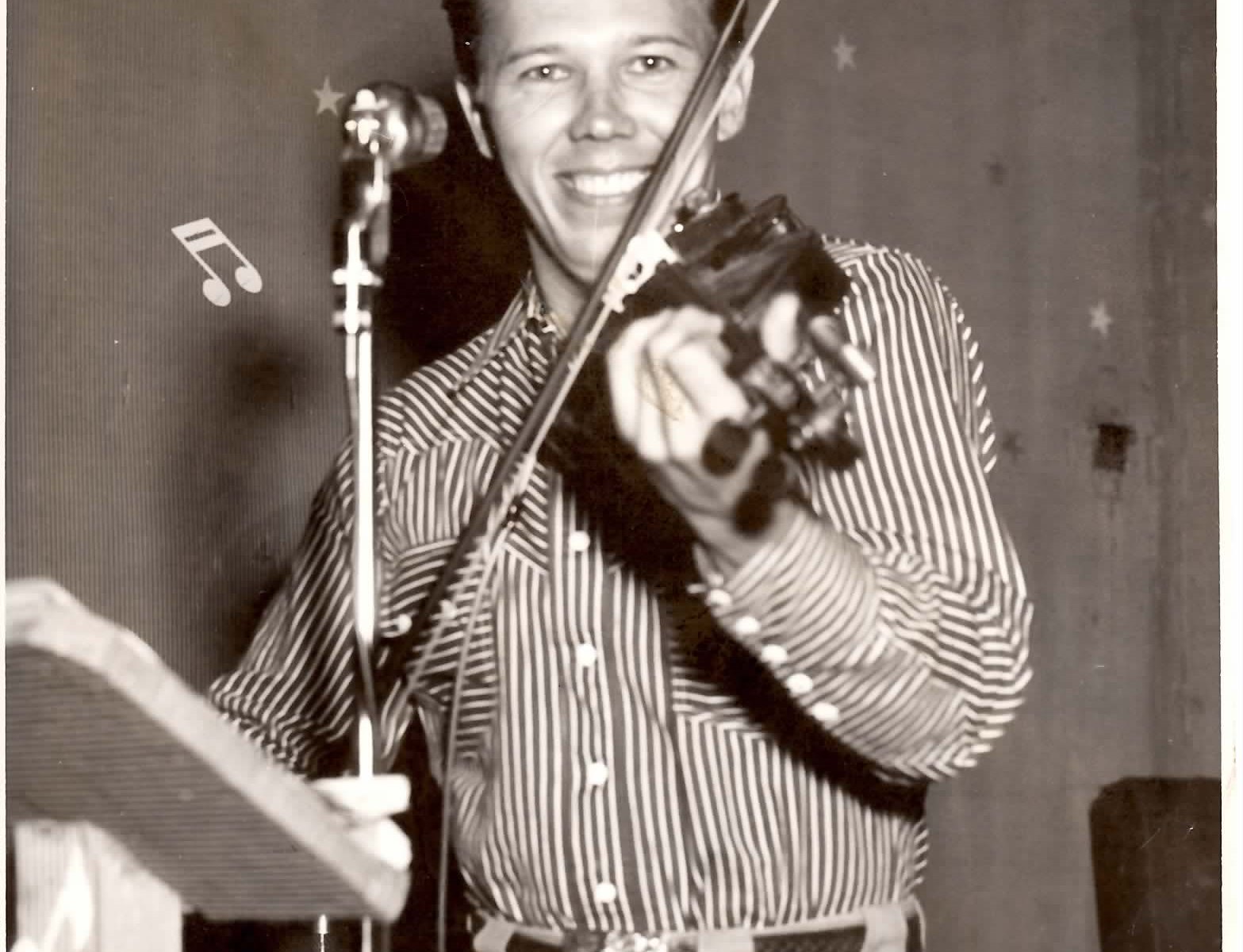
I was born into music the way some children are born into weather—something that surrounds them before they have words for it. Long before my hands were big enough to hold a wooden neck or find a note on a steel string, the sound was already there, drifting through the rooms like a ghostly wind. A man doesn’t choose a life like that; he’s shaped by it, the way wind shapes a tree on an open plain. Our home pulsed with music, not a 78 RPM record on a Victrola but real instruments played by men, some would become mentors, lifelong friends, and a few I would help carry to their final rest, my hand supporting their coffin. It seemed they were always there, a few feet away or on the front porch and around the kitchen table, drinking coffee, smoking cigarettes, and playing music. My younger sister and I thought it all to be quite normal, but it was so far from that.
My father carried his fiddle the way working men carry their tools—worn smooth by sweat and nights on the road, tuned by the laughter and sorrow of dance halls from Fort Worth to Nashville, Springfield, Tulsa, and to Abilene and then on to California. He played with the great ones, the ones whose names still hang in the air like smoke: Bob Wills And The Texas Playboys, Willie Nelson and Paul English, Milton Brown, Cliff Bruner, Adolph Hoffner, Bill and Jim Boyd, Smokey Dacus, Jake Ghoul, Artie Glenn, Ray Chaney, Smokey Montgomery, Jerry Elliot, Bill Hudson, Red Foley, Grady Martin, Roger Miller, Ted Daffan, Lefty Frizzell, Hank Garland, and the Light Crust Doughboys. Those bands were more than music; they were a kind of moving tribe, stitching the country together one dusty town at a time. And my father stood among them, bow in hand, drawing out the heartbeat of the West. He wasn’t a big man in stature, but when he drew that bow across those strings, he stood as tall as Iowa corn.
But the story didn’t start with him. It ran back through my grandfather, John Henry Strawn, and further still to my great-grandfather, Marion Strawn—men who bent their backs to the land by day and lifted their spirits with a fiddle by night. In those days, a tune wasn’t entertainment; it was survival. A way to keep the darkness from settling too heavily on a man’s shoulders. My grandfather, in his younger days, was a cowboy, but was always that campfire fiddler with a tune poised on his fingertips, as was his father.
So, of course, I was born into it. The first instrument wasn’t wood or wire but a small blue baby rattler, the kind a child shakes without knowing he’s keeping time with the world. I still have it tucked away in a box, along with those tiny shoes from The Little Texan shop in Fort Worth, 1945—leather soft as memory, soles barely scuffed by the earth. My Aunt Norma told me my feet didn’t touch solid ground until I was three or so. Proof that even then, before you could walk, the rhythm was already in your hands.
Some families pass down land, or money, a name carved into a building cornerstone, or a legacy that follows them through generations. Mine is passed down as a sound—a long, unbroken line of strings vibrating against fine old wood.
And so the question was never how I became a musician. The real wonder is how I could not become anything else.
The Great Depression settled on the land, especially the Midwest, from the Dakotas to the bottom of Texas. Misery was in every mouthful of whatever families could scrape together for a meal.
My grandparents loaded their dilapidated car with whatever scraps of a life could be carried, tucking them into corners already crowded with worry. They pulled away from Fort Worth in the hard years of the early 1930s, when work had vanished like water in a dry creek bed, and the dust from the Panhandle settled over the city in a fine, punishing veil. Folks walked with their shoulders bent, not from age but from the heaviness of days that offered little and took much. In those times, every family felt the pinch of hunger and the quiet shame of wanting more than the land and the cities could give. So they turned their eyes westward, toward a place they’d only heard about in stories — a place where the air was said to be softer, and smelled of blossoms, the work steadier, and opportunity flowed like milk and honey for anyone brave enough to chase it. Like the frivolous dancing girls in the unrealistic movies echoed, “We’re In The Money.” Come to California, and all will be healed, my brother, and happiness will be here again. For many, it was their salvation, for even more, it was their Waterloo.
The journey was a gritty trial; more than once, my grandparents’ aspirations lay shattered within the confines of the bloated car. Harsh words, blame, and unforgiveness forced the old Ford to veer back Eastward, yet practicality prevailed, and the road West stretched ahead once more. Route 66 transformed at times into a mere gravel-and-dirt dog track, its ruts so profound they could swallow a child, never to be seen again. Just beyond the Border Patrol in Needles, California, my grandfather—clad now in the worn label of an “Okie”—picked up an elderly blind bluesman and his tiny Chihuahua, supposedly his seeing eye dog. Still, the dog possessed one good eye, so his loyalty only went so far. They were fleeing from the shadows of Deep Ellum in Dallas, Texas, where the blind bluesman, in a pay dispute, had shot six folks in a bar at the aimining direction of the small dog, all the patrons were wounded, and the wrongdoer escaped unharmed. That chance encounter would shape the souls of all within that car, threading their lives together in an unbreakable bond forged by hardship and hope.
After depositing the old blues singer, Blind Jelly Roll Jackson, at Sister Amiee McPherson’s downtown Los Angeles Mission Church, my grandfather encountered a couple who sensed the need and subtle transformation within him. I have always believed that angels walk among us most days, though they sometimes take a leave of absence for their own reasons. In that moment of serendipity, my grandfather’s guardian angel appeared in the passenger seat beside him, illuminating the path with a chance encounter that offered help and guidance from above. He forged a friendship, secured an unimaginable job, found a modest home to rent, and within weeks, he bestowed upon his family the very gifts of life he had only dared to dream. God is awesome, but he sometimes requires his Angels to carry that extra pat of butter in their rucksack for special times.
Around the age of ten or eleven, my father, Johnny, expressed interest in learning the instrument. My grandfather showed him the basics, then handed him off to a retired high school music teacher on their block, who gave him violin lessons in exchange for mowing, weeding, and odd jobs. A $5 pawn-shop violin was purchased, and tutelage began. Within a few weeks, he could read music, had learned the notes on the fretboard, and could play a few simple tunes. Most nights, grandfather would sit on their front porch and play his father’s old 1812 German-made fiddle while spinning yarns to anyone who would listen. He was a master of Texas Dichos, and with each jig he played, there would be a life’s lesson or a tall tale to accompany the tune. Many nights would find a dozen folks sitting on the front lawn listening to his fiddle and his tall tales. All of it seemed to fit in life’s complex package. Every fiddle carried the tales of heartache and hope: real or imagined.
Around the age of thirteen, my father found himself among a group of schoolboys who, in their youthful exuberance, formed a string band that echoed the sounds of their dreams: they wanted to be country musicians like the ones they listened to on KUZZ, the famous country radio station out of Bakersfield, California. My father wielded the fiddle, the others accompanied with a stand-up bass, a tenor banjo, and a guitar perpetually missing a string, creating an element of embarrassment and laughter.
None of the young lads had the gift of a soothing voice to uplift their spirits, so my grandfather, with the wisdom of a man with a good musical ear, recalled the old black blues man he had once deposited at Sister Aimee’s Mission in downtown L.A.
A few calls were made, a meeting set, and the boys were graced by the presence of Blind Jelly Roll Jackson, accompanied by his loyal Chihuahua, Giblet, whose single keen eye began to see beyond the darkness. Blind Jelly, with the patience and kindness of a seasoned mentor, accepted their earnest offer to perform, insisting that a young Cajun girl from the church choir that he had grown fond of join them, a girl whose voice could lift the very rafters off their hinges. Le’ Petite Fromage, though barely five feet tall, could sing with a strength that belied her tiny stature. As they gathered on the Strawn’s front porch for their first rehearsal, the band realized they needed a name. “Le’ Petite proposed ‘Blind Faith,’ inspired by Blind Jelly’s newfound devotion to Jesus and the church, and his obvious disability.” Sister Aimee, her spirit both stern and forgiving, had an off-kilter sense of humor and deemed the name tinged with a slight touch of blasphemy, yet offered her blessing, recognizing the earnestness in their hearts. The band was born. A new type of country, Texas-style Cajun-infused Jesus music had arrived, without an organ or big hair, an edgy choir, and it hit Los Angeles like a Super Chief express train from Fort Worth.
Word of their talent reached every corner of the church community, a bustling hive of activity every weekend, filled with the laughter of children at birthday parties, the fierce spirit of chicken fights, the tender moments of school dances, and the somber gatherings of a few funerals; on lazy Sunday afternoons, they would often spill out onto the sun-warmed corner outside the church, entertaining any who would stop for a listen.
Le’ Petite’s father, Baby Boy Fromage, a nickname given to him because of his stature, brought his band “The Chigger Bayou Boys,” to Los Angeles, driven by an urgent need to escape the depression drought of paying jobs in Louisiana, Texas, and Oklahoma; he hoped that the burgeoning migration to Bakersfield might present a new opportunity. His unique blend of Cajun country, alligator tunes, skeeter-swatting antics, and the camaraderie of beer drinking seemed to resonate with the Californian spirit, and for a time, it flourished. Meanwhile, Le’ Petite found her own path, joining Sister Aimee’s church choir, which divinely led to a deepening friendship with Blind Jelly Roll. This bond blossomed into the formation of their band, Blind Faith, as if fate itself had conspired to align their destinies just right.
Bob Wills, a spirited and legendary member of The Light Crust Doughboys from Fort Worth, Texas, traversed the country in a bus, on a well-financed quest to promote the finest flour known to man, Light Crust Flour, milled in Fort Worth, Texas. It was Baby Boy Fromage, father of’Le’ Petite, who journeyed with his band from the marshy Chigger Bayou, Louisiana, to Bakersfield, where the heart of California’s country music pulsed with life. He orchestrated a thirty-minute live radio broadcast for this budding ensemble, cleverly pocketing the majority of the earnings. It was during this very broadcast that my young teenage father encountered the legendary Bob Wills, whose band had just wrapped up their own live radio performance. United by their Texas roots, they met and ignited a bond, with Bob assuring my father that, upon his return to Fort Worth, he could count on him to swing open the doors to the world of music. Johnny cherished that promise, as did Bob, both forever marked by the fleeting good grace of opportunity. A life-long mentorship had been formed.
When the Japs bombed Pearl Harbor, every high school boy in the country wanted to enlist to fight them and Hitler. Three of Blind Faith joined up, then Johnny, with my grandfather’s consent, because he was seventeen, enlisted in the Navy. That left Blind Jelly Roll, Giblet, and Le’Peetite, who was sweeter by the day, on a sax player in the church orchestra. In a hurried wedding performed by Sister Amiee, the two returned to Chigger Bayou to start their family of ten children.
In 1954, my father, in a sweating fit of entrepreneurship, purchased a club on Jacksboro Highway, the Sunset Ballroom. Between the fights, the Fort Worth mob, making it their newest hangout, and the payoffs, he soon sold it and went back to playing the circuit.
After serving in the Navy in World War 2 and returning from Hawaii to Fort Worth, drawn by the unrelenting trysts of his alcoholic mother, attempting and failing to be in the nightclub business, Johnny was desperate but hesitant to bother Bob. After marrying my mother, he did contact him. As good as his word, Bob put his size-12 cowboy boot in many doors that led to the beginning of my father’s father’s, one of the best country fiddle players in the nation.
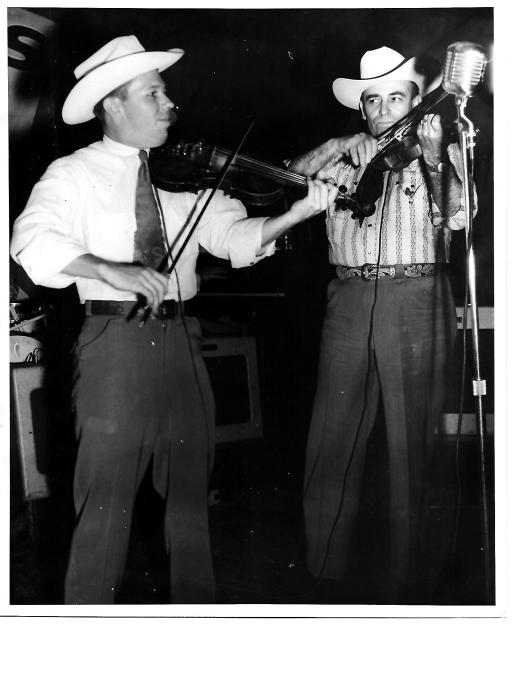
The fiddle he played was the very same his father had procured from a pawnbroker’s in Los Angeles; though it possessed a certain charm, it lacked the warmth and volume of a fine-made instrument. In a generous gesture, Bob often invited Johnny to perform with the Playboys and, in turn, gifted him a fiddle crafted by an esteemed Luthier from Fort Worth, Joseph H. Stamford, in November of 1947. Bob, ever the pragmatist, rarely ventured without two or three backups, ever mindful of the fragility of strings. His hands, though skilled, bore testament to a life of rough play, leaving this instrument with its fair share of scars—gouges and scrapes that contributed an unrefined but slightly brutal beauty to its sound. One gouge near the bridge was never repaired because it may have affected the tone, which, to a fiddle, is its purpose. I have preserved a few sepia-toned photographs of him and Bob weaving harmonies on twin fiddles, and that particular instrument, worn yet noble and soaked in history, remains in my care; I am now, even at the old age of seventy-seven, revisiting its strings, having been sidetracked by the allure of guitar since I was twelve and discovered rock n’ roll music. I was like most boys, wanting to be Elvis Presley or Carl Perkins, and neither of them played a fiddle. Young men make foolish decisions, yet my father let my folly continue.
Eventually, Bob approached my father, inviting him to join the Texas Playboys as his second twin fiddle. Without a moment’s hesitation, he accepted this incredible offer, much like a weary traveler might grasp at the hope of a warm meal or a sidewalk found wad of cash rolled in a rubber band.
My mother, embodying the spirit of countless wives of musicians, shared whispers with the other wives, and the tales spun on the circuit painted Bob and his crew as a band of unfettered ruffians and rapscallions ahead of their time. Yet, reality was far from those fabrications; Bob placed strict boundaries on his band, allowing only a few swigs of hooch on the bus after a show, to ease their restless hearts during long nights of travel. It was mere gossip, yet it fueled a storm within her; she planted her feet firmly, unleashing a tempest of emotion, declaring that if he chose that path, she and I would be far away when he returned. My father, grappling with the weight of his choice, made his decision, and there were tears in both men’s eyes as he told him that he must prioritize family, even though such a venture would have freed us from the clutches of borderline poverty by giving him fame and fortune. Bob chose another young fiddle player from Tyler, Texas, Johnny Gimble, who was eventually inducted into the Country Music Hall of Fame posthumously in 2018. In later years, as adults, Father and I would share a scotch while he told me stories from his life on the road as a musician. I sensed that deep within him, he never quite forgave my mother for forcing an imagined and selfish decision on him. I believe that her having to deal with his addicted mother was the only reason for her reluctance.
Through the late forties and fifties, the old fiddle led the way, weaving melodies through the life of a musician. There were evenings filled with the long hours of playing for a thousand dancers with Ted Daffan’s band at Ted Daffan’s Crystal Springs Ballroom on Lake Worth, the beer joints on Jacksboro and Belknap Highway, and the Big D Jamboree in Dallas. where the laughter of dancing feet accompanied the day’s tunes. Western swing was more popular than Benny Goodman.
The stork left me on the front porch in September of 1949, so time was of the essence for a young man of talent to mark his spot in life’s grass.
Then came a call from an old friend in Nashville, the renowned guitarist Grady Martin, who rang in with an invitation to join Red Foley’s national television show, The Ozark Jubilee, cast in the heart of Springfield, Missouri, on ABC every Saturday night. Those were the transformative years for country music in the mid-1950s. We packed our lives into the car and found ourselves in Springfield in less than twenty-four hours, eager and wide-eyed, ready to embrace the unknown that awaited us. Grady and my father became fast friends, as did their wives. On the days they didn’t rehearse for the weekend show, Grady and he would drive to Nashville and do studio work for the top recording stars of the day. Grady brought my father into the tight fold of the A-Team, the country music version of The Wrecking Crew in L.A. He was not a full-time member yet, but since he and Grady were tight friends and his musicianship carried him, he was accepted. The old fiddle sensed the importance and, as always, pulled through. Grady worked on all of Marty Robbins’ records, as well as Patsy Cline’s, Loretta Lynn’s, Johnny Cash’s, The Browns, Hank Snow, Eddy Arnold’s, and almost every popular artist in Nashville. Chet Atkins ran the show like a drill sergeant, with no tolerance for unprofessionalism. I was a child and met most of these famous musicians and singers, but my memory is worn out. I can’t recall who or when, though I do recall the famous country singer Wanda Jackson cleaning my ears with a napkin and her spit, and standing in the wings of the Grand Ole Opry stage, watching the performers of the day weave their magic.
In no time, the sporadic phone calls and daily letters from my grandmother reached Springfield. She had ensnared my father in this manner throughout his existence; he was her chosen instrument of enablement, and escape was merely a mirage. The dosing of the popular medicines had now changed to hard-core hooch, and her demons were back livelier than ever. His older sister had flown the frazzled nest by marriage early on, but was now a raging hypochondriac who harbored every fatal disease known to humanity. I knew little of the contents of those missives, yet I recall their power, enough to unravel his career through mental grief and dismantle his bond with Grady.
An alcoholic parent can lay waste to a child, wielding either fists or cruel words, leaving scars that echo in the silence. The line of love and hate is often melded into one, and there is no choosing which to cross.
I awoke in the back seat of our worn car, under the gaze of the night sky, the hum of tires on asphalt a constant reminder of our hurried retreat from Springfield, leaving behind Grady, Red Foley, and even the unpaid milkman without a proper farewell. The weight of unspoken words lingered in the air, a testament to the unbearable tension that had twisted my father’s heart. Once again, his spirit was broken by his mother and her addictions. My mother knew this brutal betrayal was the worst yet, and it permanently dissolved the artificial, fragile peace with her mother-in-law into a hatred that would never be repaired.
Upon returning to Texas, the Light Crust Doughboys arrived with a proposition that seemed even more enticing than that of Bob Wills and his esteemed band. They would travel, but only for a few days each week, keeping most of their appearances local in the heart of Texas. My father, with his fiddle and mandolin, joined and played with them until 1994, when the cruel hand of brain cancer compelled him to step away from the music he so loved. Whenever the opportunity arose, I would accompany them, driving the band van, assisting with equipment, and playing bass or my five-string banjo. In the mid-1980s, Smokey Montgomery honored me as a member of the Light Crust Doughboys. He gave my father and me a chance to record a cut of Old Joe Clark on the album, “One Hundred Fifty Years of Texas Music.” This recognition, to this day, still leaves me breathless, profoundly aware of the historical gift bestowed upon me. That old fiddle, now repaired, sits in the warmth of its case, waiting for me to catch some of the magic my father left me.
 Notes From The Cactus Patch