I wrote this story a while back and decided It needed a recall for those who may have missed it.
Pictured are Aunt Bee, Lester Munroe the IV, and Hunny Bee. Photo by Jay Sebring
My late father’s late Aunt Bee and her late sister, Hunny, had the most unique beauty parlor in town. Happy Texas was, and still is, not known as anything but a place you wind up if you get lost. In the 1950s, it was so small it wasn’t shown on road maps, so most of Texas didn’t know the village existed. The one gas station in town always had a father behind the wheel of a station wagon full of screaming kids and barking dogs, asking directions to anywhere but there. Any wrong turn within twenty miles always puts you in the middle of Happy.
In the 1950s, some oil tycoon from Lubbock started a bank there. The Happy Texas State Bank was born so the caddie-driving cowboy could embezzle from himself instead of the big banks. The feds couldn’t arrest him because he always managed to pay back the money before they could move in. Then, in the 1960s, a bunch of Hollywood boys came to town and made a movie. All the citizens were used as extras. Aunt Bee and Hunny found themselves genuine movie stars. Their beauty shop was used in many of the scenes.
The movie was about a little cowboy kid who lived on a cattle ranch with his grandparents after his Daddy, Jake, was stomped by a bull, and his Mama ran off with his Daddy’s brother. Little cowboy Gabby also got kicked in the head by a mean Shetland pony. He was a real slow after that, so his Granny had her ranch dog trained as a service animal to watch after her addled grandson so he wouldn’t wander off onto the prairie and get eaten by Coyotes or Dingo’s. However, there aren’t Dingo’s in Texas, it was a movie, so no one cared.
The dog hired for the movie was a relative of the famous Lassie, but it developed a prima-donna attitude and wouldn’t do anything but chase chickens and bite the movie-set boys. They were in a spot and needed a four-legged actor, pronto.
Aunt Hunny Bee happened to have a cattle dog named Lester Munroe the IV, who was a female. She named all her dogs after her favorite uncle, Lester Munroe, who got himself trampled to mush by a Brahma bull when she was a child. Being the only trained dog in town, Lester was hired to replace the star. Unfortunately, the movie script called for a male dog, so the poor canine had to wear a prosthetic penis and gonads, which didn’t jee-haw with Lester Munroe the IV.
Lester had to spend two hours every morning in make-up and then was sedated so the movie vet could apply the prosthesis, turning Lester Munroe, the IV, into a male dog.
After a few weeks of filming, Lester started hiking her leg to pee and humping the actor’s legs. The pooch was a nervous wreck.
Finally, Hunny Bee took poor Lester to her beauty shop and gave her a set and curl, one of the dogs’ favorite things, but it didn’t help; the dog had gone through the change. The vet decided to leave the prosthesis on Lester because it wasn’t worth getting a bit bit to try to remove it. He said it would eventually fall off.
After the movie crew left town, Lester Munroe IV pranced around town for a few days, as if she owned the place; he was the big dog in town. Then one day, it rained, the prosthetic gonads fell off, and the fake penis followed. After that, Lester Munroe the IV got moody and depressed and really squirrely, so the town vet had to give her Valium, Xanex, and some hormones to help her out. The picture above is after Lester Munroe the IV returned to the beauty shop for her weekly curl and set.
The makeshift sunblock my father had fashioned from a tarp and four cane fishing poles wasn’t beautiful, but it worked fine. Sitting under the contraption was my little sister, mother, and grandmother. I was eight years old. He and my grandfather were not far away, holding their fishing rods after casting into the rough surf. Whatever they caught would be our supper that evening. I wasn’t invited to fish with them; I was too young, and the surf too dangerous. Besides, my small Zebco rod was only strong enough to catch a passing perch.
The visit was our annual summer fishing trip to Port Aransas, Texas, a small fishing village on the northern tip of Mustang Island. I don’t remember my first visit, but my mother said I was barely one year old. After that, the Gulf of Mexico, the beach, and that island became part of my DNA
I’m an old man now, but I can recall every street, building, and sand dune of that small village. Over the decades, it became a tourist mecca for the wealthy, destroying the innocent and unpretentious charm of the town. Gone are the clapboard rental cottages with crushed seashell paving and fish-cleaning shacks. Instead, rows of stores selling tee shirts made in China sit between the ostentatious condominiums, restaurants, and hotels. I prefer to remember it as it was in the 1950s when families came to fish, and the children explored the untamed beaches and sand dunes.
Born in 1891, my grandfather was an old man by the time I was eight years old. Tall and lanky, with white hair and skin like saddle leather. He was a proud veteran of World War 1 and as tough as the longhorn steers he herded as a boy. He lost part of his left butt cheek from shrapnel and was gassed twice while fighting in France. Nevertheless, he harbored no ill feelings toward the Germans, even though he killed and wounded many of them.
On the contrary, he disliked the French because they refused to show proper gratitude for the doughboys saving their butts from the Krauts. As a result, he wouldn’t allow French wine in his home. He preferred Kentucky bourbon with a splash of branch water or an ice-cold Pearl beer. He left his hard-drinking days in Fort Worth’s Hell’s Half Acre decades ago. He told a few stories about the infamous place, but he was careful to scrub them clean for us youngsters.
His one great joy in life was saltwater fishing with my father, playing his fiddle, and telling stories to whoever would listen. The recounting of his early childhood and life in Texas captivated my sister, cousins, and me for as long as the old man could keep talking. He told about being in France but never about the horrors of the war. He lived a colorful childhood and, for a while, was a true Texas cowboy. Half of it may have been ripping yarns, but he could tell some good ones. My mother said I inherited his talent for recounting and spinning yarns. If that’s true, I’m proud to have it.
He could have been in a Norman Rockwell painting while standing in the surf, a white t-shirt, a duck-billed cap, and khaki pants rolled to his knees. I was in awe of the old man, but I was too young to know how to tell him. My grandmother said he was crazy for wearing his gold watch while fishing.
The timepiece was a gift of gratitude from his employer when he worked in California during the Depression years. A simple gold-plated 1930s-style Bulova. It was an inexpensive watch, but he treated it like the king’s crown, having it cleaned yearly and the crystal replaced if scratched. He called that watch his good luck charm and wore it when fishing for good juju. It was a risk that the salt water might ruin it, but he took it. He caught five speckled sand trout and half a dozen Golden Croaker that day, so the charm worked. Add the three specs my father snagged, joined with the cornbread and pinto beans my mother and grandmother cooked, and we dined like the Rockefeller’s that night.
The next few days were a repeat of the same thing. I rode my blow-up air mattress in the shore break and caught myself a whopper of a sunburn on my back. The jellyfish sting added to my discomfort. I was miserable and well-toasted, but I kept going, determined to enjoy every second of beach time. We returned to Fort Worth as a spent and happy bunch. The family would give it another go the following year.
Two years passed. One day, my father told me my grandfather was sick and would be in the veteran hospital in Dallas for a while. He mentioned cancer. I was young and didn’t understand this disease, so I looked it up in our encyclopedia and then understood its seriousness. One week, he seemed fine, sitting in his rocking chair playing his fiddle and telling stories, and the next week, he was in a hospital fighting for his life. His doctor said being gassed in the war was the cause of his cancer. It was not treatable and would be fatal.
Near a month later, he was not the same man when he came home. His face was gaunt; his body, which was always lean and wiry, was now skin and bone. The treatments the doctors ordered had ravaged him as much as the disease. My grandmother’s facial expressions told it all. There was no need to explain; I knew he would soon be gone. My father was stoic, if only for his mother’s benefit. His father, my grandfather, was fading away before our eyes, and we couldn’t do a thing to change the outcome.
A week after returning home, Grandfather found his strength, walked to their living room, and sat in his rocking chair. He asked me for his fiddle, which I fetched. He played half of one tune and handed it back to me. I cased it and returned it to the bedroom closet; he was too weak for a second tune. His voice was raspy and weak when he spoke, but he had something to say, so I took my position on my low stool, as I often did when he recounted his tales. I noticed his gold watch was loose and had moved close to his elbow. His attachment to the timepiece would not allow removal. It was a part of him. He spoke a few words, but continuing was a painful effort. My grandmother helped him to his bed. He removed his watch, placed it on the nightstand, and lay down. He was asleep within minutes. From that day on, he would sleep most of the time, waking only to be helped to the bathroom or to sip a few spoonfuls of hot soup. I would visit after school, sitting next to him while he slept, cleaning his watch with a soft cloth, winding it, and ensuring the time was correct. I felt he knew I was caring for this treasured talisman.
I came home from school on a Friday, and my grandfather was gone. I could see the imprint in the bed where he had laid, and his medication bottles and watch were missing from the nightstand. Mother said he took a turn for the worse, and my father took him back to the veteran’s hospital.
The following day, my father came home and told us my grandfather had passed away during the night. I noticed he was wearing his gold watch. I thought if the timepiece was such a lucky charm, as I had been told all these years, why had it not saved my grandfather?
Life continued on Jennings Street; for me, some of it was good, and a little of it was not. Father wore grandfather’s watch in remembrance and respect. He waited for the magic to come. He gave me his worn-out Timex, which was too big for my wrist, but I wore it proudly.
The magic of the watch began to work for my father. He acquired two four-unit apartment houses near downtown, fixed them up a bit, rented them out, and sold them. We then moved to Wichita Falls, where he started building new homes. A year later, we moved to Plano, Texas, where he continued to build houses. It appeared the good luck of the watch was working overtime. I became a believer in this talisman. The hard days in Fort Worth were well behind us now. The future held promise for our family.
On a day in 1968, riding with my father to lock his homes for the night, we had a long overdue father-to-son talk. I rarely saw him because of his work, so I welcomed the time. Had I thought about college? What was going on in my life? I played in a popular rock band, so that was a point we touched on. He didn’t want me to become a professional musician as he had been. I assured him this phase would end soon. He and my mother were worried I would be drafted and sent to Vietnam. We talked for two hours. He remarked that as long as he wore his father’s watch, everything he touched turned gold. My father was successful, so how could I doubt his beliefs?
In the summer of 1969, the band on the old watch broke while we were fishing for Kingfish in the gulf off Port Aransas. While gaffing a Kingfish, my father bumped his wrist against the side of our boat. The watch fell into the water, and in a flash, it was gone. He said that if he had to lose it, this was a fitting end, lost to the water his father loved so much.
I’m an old-school reader. An Amazon tablet sits in my desk drawer, but it has gone untouched for four years. Electronic devices don’t allow me the same experience as holding a book made from cardboard and ink printed on recycled paper. Technology is fine for some but for the written word.
It starts with the jacket. Most are now in color, printed on shiny paper, with the author’s name as large as the title, a nice photo or drawing, and a few lines of publisher praise to capture your attention and make you feel that the $30 or more you paid wasn’t in vain. It’s a dance of sorts, but our money has been collected, so it’s best to continue the waltz.
Then comes the preface or the dedication to loved ones, friends, or contributors. Some are short, sweet, and curt and fail to credit the deserved; others ramble on until I lose interest.
Truman Capote snubbing Harper Lee’s dedicated research with “In Cold Blood” comes to mind. A few excluded words of thanks ruined a lifelong friendship. He wasn’t the first, but his pettiness was unforgivable.
I notice the typeset and spacing information, the font, the Library of Congress notes, the printing dates, and then the first paragraph, which sets the tone for the next few hundred pages or more.
Ernest Hemingway said a book should begin with ‘one true sentence.’ He knew it was a waste of the author’s and their readers’ time if it didn’t. His advice has taught me well.
My wife, Momo, a Registered Nurse, retired last August. Soon after, she underwent major back surgery, and during her recuperation, she re-discovered her love of reading. Now, instead of watching television until late hours, we both retire early, prop ourselves up on our bed pillows, and read our books late into the night.
I recently revisited ” In Cold Blood,” Capote’s masterpiece that so affected his life that he never fully recovered to write another novel. I enjoyed it more this time than I did thirty years ago. It was a butt-whooping to the end. Every chapter contained a piece of his soul.
Anthony Doerr’s two newest novels are commanding reads. My wife and I have read both, and she is on the verge of starting his third. I am reading Amor Towels and find his storytelling to be in the style of Steinbeck and Hemingway. I was once a James Elroy fan, but his last two books were an effort from start to completion. He is on my rest list for now.
Besides ” Fun With Dick and Jane,” the first real books I read were Mark Twain’s ” The Adventures of Tom Sawyer” and then his follow-up “The Adventures Of Huckleberry Finn.”
I come from a family of non-readers, so my love for books comes from somewhere, possibly my elementary school librarian or my father’s sister, Norma. She was a voracious reader who leaned toward romance schlock, Cormack McCarthy, and Micky Spillane noir. I am thankful to both for their influence and guidance. It was Aunt Norma who introduced me to Thomas Wolf. I returned the favor with Joseph Heller and Kurt Vonnegut.
My wife and I are relieved that the year 2024 is behind us. It won’t be missed. No tears from this household, only two middle fingers pointed skyward. Our ages allow us to forget what we wish to and remember the best. I believe 2025 will be our year of reading dangerously. We may, holding hands and a frosty cocktail, step out onto that literary ledge and take the leap, attempt to leave our comfort zone, and take a chance or three. Time is of the essence, my eyesight is on the fritz, I have a blister on my thumb, and the books keep coming.
Over the years, I’ve spotlighted the storytelling skills of my two late Uncles, Jay and Bill. They remain in good standing and are the best liars and yarn spinners I have met. Each could have been as popular as Will Rogers, but they chose the farmhouse porch as their stage, shunning the spotlight and life as a celebrity.
Around the age of nine, I was convinced that the spirit of Mark Twain had somehow entered my body, and my destiny was one he had lived. My teacher, an older woman of little patience, was convinced that I was dropped on my head during infancy, which led to my outlandish literary behavior. She couldn’t see that I was destined to be a writer of some importance. Mathematics was a mystery I loathed, but I perked up when the curriculum came around to History and English. To me, everything became a story and originated from my grandparents’ farm, my extended street-rat crazy family, or neighborhood antics, and included made-up tales of ridiculous origins. Mrs. Badger, ever the suffering teacher, labeled me an insufferable pathological liar and called my mother in for the dreaded parental meeting, which included my school’s principal, who sat with a wicked wooden paddle in his lap, poised to administer punishment. Mother handled it well until we reached home. There was no butt whooping, but she did corner me in the kitchen, put her face nose to nose with mine and in a seething saliva spewing accusation said,
“You are one of them..my loathsome, worthless brothers have ruined you: I forbid you to associate with them, ever again.” She was right, they had, and I wore that tawdry badge proudly. All those nights sitting on the farmhouse front porch listening to their beer-infused tall tales, yarns, and lies formed me. I was spoiled, but happy goods. My family lacked the foresight needed to distinguish a liar from written fiction. My Aunt Norma, a tarnished angel, is the gal who taught me to read, write, and imagine. She understood my affliction.
Preacher Little, to the left, addresses his small congregation with a firm reminder that the sky is not a-falling and that it’s high time they get a grip on the wild ride we call life. An hour later, a raucous band of Fire Ants laid siege to the squishy Peeps, and thus, the service came to an untimely end. My wise old Grandfather, or maybe it was an old-man neighbor, once opined, “Son, you can’t go traipsing about with your head aimed at the clouds, waiting for a disaster to drop from the sky. Best keep your eyes peeled to the ground, lest you unwittingly find yourself knee-deep in a nest of Fire Ants.”
For my birthday a while back, my wise and thoughtful wife, Momo, gifted me a classic 1970 Underwood 310 manual typewriter. It is a wonderful present I would never have purchased, although I have yearned for one for a while now.
For some time, possibly five years or so, I have been whining and casually threatening to go “old school” with my writing and get away from this demon laptop. It’s too easy to keep on tapping and spit out a page or two of gibberish that has more words than needed and makes no sense. It’s not about speed and what your program does; it’s about the content. A typewriter makes you think before striking that key. The delete button does not exist.
Hemingway would tap for hours on end, and then if he wasn’t pleased with his effort, it went into the waste basket. Using a typewriter to transpose your thoughts to paper is a commitment, and not an easy one.
There was a typewriter in our household when I was a child. It was a large black beast of an Underwood, all pure American heavy metal, requiring a grown man and a hefty child to lift it. I would peck on it for hours and eventually come up with something legible. I never once saw my parents use it, so its presence in our home was a mystery. I heard from my older cousin, Cookie, that it was my grandmother’s when she lived in California, and she spent all of her waking hours tapping away letters and movie script ideas. It caused a good bit of drama and injury within the family, so it was banished to our household for safekeeping. My father wasn’t pleased when he would find me chicken pecking away.
My love of the machine started at an early age, and came into full blossom as a teenager in the 1960s, when I started to write stories. I took typing in high school to sharpen my skills and learn the keyboard. I studied two years of journalism, and learned to love the written word. My teacher was my mentor. She pushed me to excel. It all paid off well. When computers came about in the late 90s, I was a good typist and had no problem adapting.
I will keep you posted on how this “old school” project turns out. I typed a page on my Underwood, and my fingers are throbbing.
An old friend of mine passed a few months ago. We had been apart for years, yet he held a distinct place in my thoughts. I sometimes borrowed fragments of his vivid life for my short stories, which pleased him. His name was simply Junior. He believed a last name was of no consequence and cared little for family ties.
In 1957, he opened a coffee house in the heart of downtown Fort Worth, Texas. Although they will tell you that “The Cellar” was the first, the “Hip Hereford” came first by a full year.
Junior was born to be a cowboy. His father, grandfather, great-grandfather, and all the uncles and cousins wore the same boots and lived by the code of the West. There were more cowboys in his bloodline than in a John Wayne film. It should have been his fate. But then, his favorite horse, Little Bill, kicked him hard in the head. After that, he turned his back on the rugged ideals of the West. He became the owner of a coffee house club, a renaissance man, a poet, and a man who lived life like a Stetson-wearing beatnik. He said a life spent on a sweaty saddle, inhaling the stench of cattle farts, was not the life he dreamed of.
The opening night for the coffee house was Halloween 1957. Junior hires two street winos to help run the door and do odd jobs. They were reluctant to give him their birth names, so he christened them Wino 1 and Wino 2. They were good to go as long as Junior paid them and kept the booze flowing. The following is an excerpt from the unfinished story.
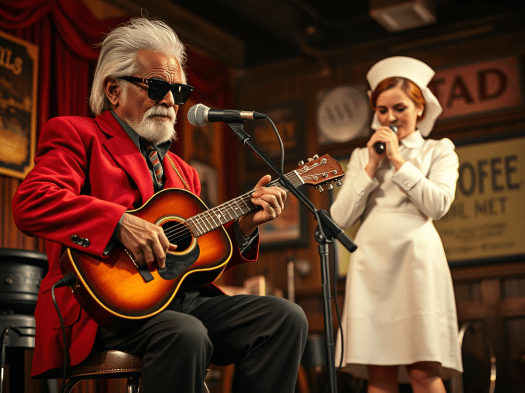
Around 7:15, Wino 2 informs Junior that the first performer has arrived and takes the stage for the introduction. He steps to the mic and, in that pleasant voice, says, “Ladies and gents, please welcome to the stage, Mr. Blind Jelly-roll Jackson and his nurse Carpathia.”
An ancient black man with hair as white as South Texas cotton, holding a guitar as old as himself, is helped to the stage by a prim female nurse dressed in a starched white uniform. The old man wears a red smoking jacket, a silver ascot, and black trousers. Dark sunglasses and a white cane complete his ensemble. The old fellow is as blind as Ray Charles.
The nurse gently seats the old gentleman in a chair provided by Wino 1 and lowers the large silver microphone to a height between his face and his guitar. She then stands to the side of the stage, just out of the spotlight. Blind Jelly Roll starts strumming his guitar like he’s hammering a ten-penny nail. Thick, viscous down strokes with note-bending riffs in between. His frail body rocks with every note he coaxes out of his tortured instrument. He leans into the mic and sings,
“We’s gonna have us a mess o’ greens tonight…haw..haw..haw…haw…gonna wash her down with some cold Schlitz beer..haw..haw..haw..gonna visit ma woman out on Jacksboro way…gonna get my hambone greased”. This was Texas blues at its best.
On cue, his nurse steps into the spotlight, extracts a shiny Marine Band harmonica from her pocket, and cuts loose on a sixteen-bar mouth-harp romp. Her ruby-red lips attack that “hornica” like a ten-year-old eating a Fat Stock Show Corndog. The crowd loves it. They dig it. When Blind Jelly Roll finishes his song, Wino 2 passes a small basket through the group for tips. Jelly Roll and his nurse take their kitty and depart. He’s due back at the old folk’s home before midnight.
Momo and I are gearing up for our yearly trip to the Texas Bermuda Triangle: Marfa, Fort Davis, and Alpine. Strange lights, strange people, and a weird town full of characters out of a 1950s sci-fi western movie. We love the place. So in honor of our love for this quirky village, I’m revisiting a post about our last journey into the Chihuahuan Desert, the twilight zone of Big Bend, Texas.
In the days of COVID-19, when darkness, despair, and lemming-like stupidity seemed to envelop the world, every soul, human and animal alike, found themselves confined to their homes, forbidden to roam: even the wandering Buffalo was home-bound. It was then that Momo and I made a pact to evade the restrictions and set out on a clandestine journey to the remote Chihuahuan Desert, with our sights set on the enigmatic and quirky town of Marfa, nestled in the vast expanses of big sky West Texas. We had no idea that a small blurb of a village in the middle of the desert would be so ghosted. It was eerie in an Alfred Hitchcock movie way. We did find a small burrito hut, grabbed a few, and returned to Granbury. The trip was an utterly bummerited loss.
I wrote an unkind, snarky post about our Marfa visit in my hour of exasperated, irritated, and agitated gloom. The older I get, the more the little things in life send me into a combat zone of petulant whining and unforgiveness. So we were both surprised that, having a cocktail on our patio one evening, we decided to give little ole’ Marfa a second chance. We plotted a trip that would take us into the Chihuahuan Triangle, which, from what I have read, is a dry land version of the one-off of Bermuda. Marfa, Alpine, and Fort Davis make up the Texas twilight zone. Ghostly lights in the mountains, shooting stars that stop and change directions, and strange-looking young people wearing Keep Austin Weird tee-shirts that wander the streets at night searching for live music: it’s all there.
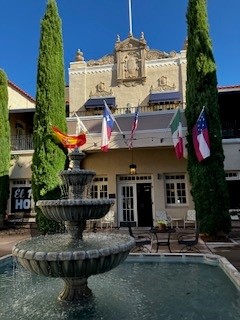
Hotel Piasano
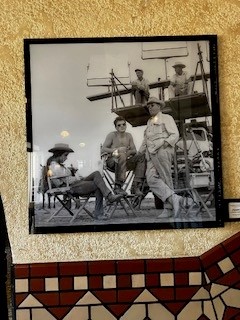
Being a fan of the great Texas movie “Giant,” the Hotel Piasano, where the cast stayed during the 1955-56 filming, was our only historical option. Arriving in the afternoon, the lady at the check-in desk was gracious and friendly. She gave us the “classic” room, which in the hotel language means one that had not been renovated since the 1930s. That’s fine with us; we are interested in the historical value and feel of the place. I noticed some of the rooms were the star suites, so I asked about those. The concierge told us that the Rock Hudson room is available for around half a grand a night and includes a lighted display cabinet featuring the original book of wedding photos from his make-believe marriage. We passed. The Liz Taylor suite was priced the same and included a small lighted curio cabinet showcasing a dainty Italian crystal decanter filled with her spit. Momo said no. The James Dean suite showcased his favorite toiletry in a glass cabinet, his comb, and a half-used tube of Brylcream. No, on that one, too. The concierge did say that our room is rumored to have been the one that Chill Wills occupied, so we gave it a go. She added that the entire hotel is extremely haunted, so beware of ghostly appearances and personal items being relocated.
Liz, Rock, and Houston in Marfa 1955
Considering all the warnings about ectoplasmic phenomena, we unpacked in our classic room, which includes a 1930s-style bathroom with a corner shower and a drain in the sloped tile floor. I know damn well that Chill Wills could not have got his big ole Texas boy butt into this shower. French doors opened to a private walled patio with an outside stucco fireplace. How nice is that? I could picture Chill and Dennis Hopper sharing a whiskey by the fire. We enjoyed a cocktail while observing a thunderstorm roll over the mysterious mountains.
Our dinner at Jett’s Grill was nothing to text back home: My pork chop was too pink, and Momo’s chicken surprise lived up to its name; she was surprised it tasted like cardboard and cost thirty dollars. I enjoyed a Jameson Irish Whiskey on the rocks for almost twenty dollars, and Momo had a whiskey with ginger ale for twenty-one dollars; they charged her for the ginger ale. After paying the check, we felt a bit violated. We spent the rest of our evening in the classic room, waiting for another distant thunderstorm from over the mysterious mountains.
Planet Marfa
Local Marfites at Planet Marfa enjoy a brew, and Sagebrush Sonny is seated far left.
Planet Marfa became our next foray into the Big Bend Twilight Zone. The place took up half a city block. Inside was a genuine transcendental Indian meditation TePee, a full-size school bus dedicated to dogs, a modest kitchen offering the renowned Red Barron Pizza, and a bar bustling with locals partaking in their afternoon meet-and-greet. I found myself at the bar’s edge, ready to place an order, when I noticed an elderly gentleman perched on a stool beside me. Out of a sense of camaraderie, I motioned to the bartender to pour the old man another beer, my treat. He acknowledged the gesture gratefully, and we exchanged pleasantries as we shook hands and introduced ourselves. Resembling a character straight out of a Gabby Hayes movie, he embodied the quintessential oddity one might encounter in Marfa. Sagebrush Sonny Toluse, as he called himself, had called Marfa home for nigh on sixty years, having relocated from Presidio, Texas, a town situated right on the Mexico border and reputed to be the hottest spot in Texas.
I noticed Sagebrush Sonny had a wooden peg leg where his right-side human leg would normally be. He noticed me staring and felt compelled to explain his missing appendage. He asked if we were planning to visit the desert and view the famous Marfa lights. I said yes, we intend to do that tonight. He said they were quite a sight, but he warned me not to get caught out there after midnight: bad things happen in the desert.
He said he got caught out there after midnight about thirty years ago after his truck broke down. He decided to walk to town since he was close enough to see the glow of town lights, and that’s when a large pack of mongrels set upon him. He asked me if I had ever wondered why the desert was called the Chihuahuan Desert. I had no idea, so he explained. After the atomic bomb was built, the Army needed a place to dump the nuclear waste, so they chose a spot way out there, stashed some drums of goop, and left them to the elements. Over in Mexico, a fella was breeding Chihuahua dogs, and two of them got lost in the desert; of course, they found the nuclear waste site and lapped up some of the contaminated oozes, which did some crazy things to their DNA. Doing what dogs do, they had some pups, and then the pups met up with some Coyotes and had some more pups. The dogs kept on breeding until there were three or four thousand of the critters, except they weren’t regular dogs. They were all muscled up with shark-like teeth, and some had a fifth leg that allowed them to run like a greyhound dog. The mutts were still small, like a Chihuahua, but they were mutants and mean as hell. That’s how I lost my leg. A pack of them set upon me out there in the dark. I was trying to run, dragging some of them that had hold of my dungeree’s and then they started chewing my right leg. Since they were small, they could only reach up to my knee, and that’s where they stopped eating on me. A highway patrol came along and shot a few of the stragglers and took me to the hospital over in Presidio, where the doctor amputated what was left. That’s why I have the peg leg, and they are the reason it’s called the Chihuahuan Desert. The story alone made the trip a success.
My grandfather, in 1917-18, served in the Army and the war to end all wars: World War 1. He fought in the mud and bacteria filled trenches in France: wounded twice and gassed once. He killed Germans in close hand to hand combat with a bayonet and a knife, never forgetting the look on the faces. He lost friends in vicious battles. There was no time to grieve or pay respects. That would come later in life.
Looking back through my childhood relationship with him, he likely suffered from what we now call PTSD. My Grandmother said he was a different man after that war, and at times, not a good one.
He refused to talk about the fighting and killing until I was around ten-years-old, and he was dying from Lymphoma cancer. His doctors at the VA Hospital said it was caused by the gassing he received in the war. He knew that I might someday go to war, so he wanted to let me know it was not like the movies.
We sat for a many hours one afternoon a few weeks before his passing. His descriptions of battle and the things he had done for his own survival was beyond anything I could imagine. I was young, and war to me was black and white movies. James Cagney in “The Fighting 69th,” or John Wayne and a host of others playing army, like my neighborhood friends and I did. No one really died, and when shot, there was no blood or screaming.
The last few days of his life were spent in and out of reality, reliving those battles as he lay in a veteran’s hospital in Dallas. My father, a veteran himself, was the recipient of my grandfathers last horrors. Those days my father sat by his bed, listening to the nightmare his father had carried for all those years, had a profound effect on him.
John Henry Strawn made sure I knew what real honor and duty were about. It followed him for a lifetime.
My grandfather, John Henry, walked to his job at the furniture shop. Years ago, the same place had closed down, driven by the Depression, forcing him to move his family to California for work. Now, twelve years later, he has taken giant steps back, from a good job in Los Angeles to once more building furniture for an hour’s wage. Defeat weighs heavily in his heart. Middle age has come, and the future is murky. So, doing what men do, he keeps walking, counting his steps to nowhere. There are many to blame, but he alone bears the burden of his failures.
The iced ground crunches under his shoes. The cold goes to his bones. His jacket is no match for this weather. He favors the feel of the ground beneath his feet over the Ford sedan in the garage, which is idle most of the time and now a home for mice and other wandering critters.
After the upsetting homecoming with his father, Johnny walked a few blocks to the small neighborhood grocery store to call his best friend, Dick Hickman. His father remained firm in his decision about the telephone, vowing to never have one in the house. The old man viewed the contraption as a rattlesnake in a bag. Lousy news reached him in time enough; no reason to expedite misery.
Two sisters from Germany ran the store, always open, even when the ice storm howled outside. They preferred work to idleness; a dollar was worth more than knitting by the stove. They missed their homeland, but not the darkness that had settled under Hitler’s shadow. Johnny walked in and felt the warmth; they had known him since he was a boy. Following a few hearty hugs and cheek kisses, he was offered a mug of coffee, hot and strong with bourbon and a hint of cinnamon, a taste of what once was.
Dick and Johnny had forged a bond on the playground one morning; Dick was trapped by older boys, their intentions were dark, and Dick knew he was in for a ruckus. Johnny, a full head smaller than Dick, added his small fist for ammunition. A few busted lips and a bloody nose ended the altercation, and the boys would be bound for life by bloody noses and skint knuckles.
Dicks mother, a woman of stern Christian resolve, lived simply, her heart full of faith. Father Hickman was a ghost of a man, suddenly appearing from nowhere, then off again to somewhere. Mother Hickman, as she was called, gave what little extra money they had to Preacher J. Frank Norris, the charismatic leader of the First Baptist Church of Fort Worth.
Nice clothes were a luxury during the Depression, and most children at R. Vickery’s school wore hand-me-downs or worse. Dick wore the yellow welfare pants distributed by the Salvation Army, a sign that his folks were poor. Mother Hickman saw nice clothing as a sign of waste, except when it came to her Sunday fashions. Johnny had a pair of those detestable canvas pants but refused to wear them; the old dungarees with patches did just fine.
Both boys felt the weight of loss when the Strawn family left for the promised land. They exchanged a few postcards during the years in California. Nevertheless, they adhered to the unspoken rule that young men did not write to one another. This was a relic of manly notions of the time. A line or two every six months was enough. Both joined the Navy around the same time, meeting briefly in Pearl Harbor. Then came the seriousness of war. Young sailors, they carried on.
Dick arrived at the two sisters’ store to fetch Johnny. His transportation was a rattle-trap Cushman motor scooter. It refused to stop on the icy street. The scooter slid on its side into the curb and threw Dick off of the beast. The ride to Dick’s apartment was a jolt, far worse than the taxi. Johnny vowed to buy a car when the weather cleared, maybe one for his buddy, too. He held a tidy wad of cash from Hawaii.
A brotherly deal was struck. Johnny would share Dick’s large apartment on Galveston Street, splitting the rent and bills evenly. They were friends again, but now men, and they had different thoughts, dreams, and needs. Dick was courting a young woman from Oklahoma and doing a miserable job of it. Still, marriage lingered in the air, heavy like the rich aroma of brewing coffee, the kind they both drank too much of. Dick took his poison with cream and sugar; Johnny preferred his black and strong.
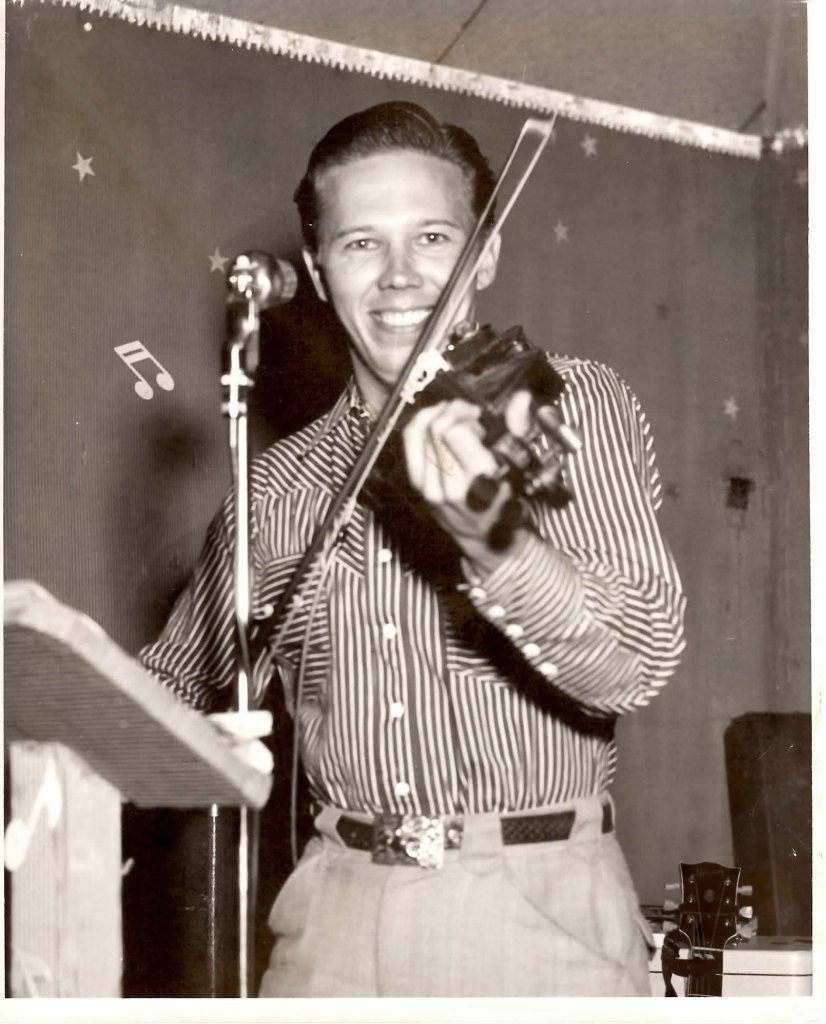
Johnny’s goal was to play music for a living, and this was the right city to make that happen. He joined the musicians’ union and sent a message to Bob Wills that he was back in Fort Worth.
Wills was now the celebrated band leader of the western swing band, The Texas Playboys. He remembered that meeting at the radio show in Bakersfield, California, long ago. The boy stood out. It was no small feat because Wills was the finest fiddle player in country music.
Bob Wills was not a man known for kindness. He could be brash and indifferent to fans and bandmates alike. Yet, for Johnny, he made an exception. Bob took the young man under his wing, becoming a mentor to my father. A few calls were made, and the boot was in the door. Johnny secured auditions at some of Fort Worth’s best clubs, and each went well. Bob invited him to rehearse with the Playboys. It was there he met men who would soon be legends in country music. A few years later, he would find himself in that circle.







 Notes From The Cactus Patch