I received two emails a few days ago; one from Family Search and the other from Ancestry, both genealogy websites. I’m more well-connected than I thought.
It appears that on my mother’s side of the family tree, I am related to Belle Starr, the infamous female outlaw, Cheif Quannah Parker, the famous chief of the Comanche Nation, and son of Cynthia Ann Parker and Peta Nocona. My great-grandmother was on friendly terms with Quannah when she lived on the Indian reservation and before she met my great-grandfather, Love Simpson, who was a Cherokee and a Deputy U.S. Marshall for the Indian territory in Oklahoma. My grandmother would often hint that maybe they took a few long walks in the misty moonlight and things may have gotten out of hand. She also possessed an old ratty-assed wig and would pull the thing out ever so often and show it to us kids. She said it was Chief Parker’s long ponytail after it was cut off when the soldiers arrested him. We believed every word of it. It gets better. I am also related to the infamous Texas outlaw killer, John Wesley Hardin. For some unknown reason, Bob Dylan was intrigued with outlaws and killing for a while, so he wrote a song about Hardin. This was before his Nashville days. I’m waiting on that royalty check, Bob.
I had no idea that Davy Crockett was in my family tree, yep, also on my mother’s side. That explains my over-the-top childhood obsession with the Alamo, flintlock firearms, long sharp knives, and coonskin hats. I would have been picked for membership in the “Sons of the Alamo” lodge if I had known this forty years ago. Captain Kangaroo, Buffalo Bob, and Shari Lewis are also cousins; so that makes Shari’s puppet Lambchop a family member too. Howdy Doody is not mentioned, nor is Mr. Greenjeans, although he was my favorite.
Family Search, the site run by the Morman Tabernacle Church, and choir, says that on my father’s side, I am related to our first president, General George Washington, Elvis Presley, Jerry Lee Lewis, Waylon Jennings, Will Rogers, Wild Bill Hickock, Buffalo Bill Cody, Billy the Kid, Doris Day, Mary Martin, Tiny Tim, Roy Rogers, Ray Charles and a fifty-fifty chance, to Rin-Tin-Tin and Sasquatch. Damn, son, now that’s a list. I’m getting a big head just writing this.
My mother always told me that our family goes way back and has lots of closets and skeletons. My father, always said that his family has a whole scrapyard of bones and is bat-shit crazy on top of that. Now I have to figure out how to tell my friends about my relations without sounding like a deranged liar.
On the third day of summer vacation, the euphoria of no school for three months had lost its sparkle. Our gang of sweaty-smelly boys spent most of the day sitting under our neighbor, the Mister’s Mimosa tree, drinking grape Kool-Aid and eating home-baked oatmeal cookies baked by our mom-mentor, Mrs. Mister. Saturday couldn’t get here fast enough; that was the first day of official practice for our second-year little league team, “The Jets.”
This year, as a group, by a special vote in Skipper’s garage, we decided to let Cheryl and Ann play on the team, putting Freckeled Face Bean and Georgey on the bench for a few innings. Mr. and Mrs. Mister were in agreement; the girls were better at catching fly balls. In 1957, teams didn’t award participation trophies; it was all about winning the game. Cheryl played some last season, and we put Ann through the try-out wringer at recess. and she passed every test, so we will be the first and only team in the Fort Worth Little League system to have two girls on a boy’s team. We “broke on through to the other side” and didn’t know what we had done. I believe our assistant coach, Mrs. Mister, was secretly proud, being a former Air Force officer and ball player herself.
Saturday arrived, and our practice time on the diamonds was at noon, right when it was cooking like a griddle at a balmy 98 degrees. Mr. Mister worked with our two pitchers, and Mrs. Mister took the rest of us heathens to the field, hitting flys and grounders and yelling at us when we messed up. Ann and Cheryl caught every fly ball, and me, at shortstop, only missed two grounders and tosses to first. It was going to be a good season. Georgy and Bean sat on the bench, sulking. I guess I would, too, if I lost my spot to a girl. We were kids, but back then, even boys were a bit manly men, only smaller.
After practice, Mr. Mister told us that the coach from the Trimble Tech area team had been spying on us, hiding behind the concession stand and taking notes. It was a known fact that any team from that area of Fort Worth would be known as ” the hard guys.” We figured he was scouting out whose legs to break if they caught any of us out of our neighborhood and alone.
Our first game was a week later, and damn if it wasn’t the “hard guys” team. We watched from our dugout as they warmed up, fearing the worst. The pitcher had a five-o’clock shadow and arms so long that he left knuckle furrows in the infield dirt. Most of their team was a head taller than us and had to be old enough to drive. These guys can’t be Little League? Many had likely spent time at the Dope Farm or jail; they had all the markings of experienced delinquents. Their coach was a walking mugshot. We were doomed and knew it.
Bottom of the seventh, and we were down by two runs. Skipper was throwing his hardest and slipping in some calculated peppered pitches Mr. Mister had taught him. The “hard guys” weren’t even swinging hard, and all their balls went to the fence line and a few over it.
Our coach, Mr. Mister, suspected something for some reason and asked the umpire to examine their bats. The umpire was equally suspicious, so he grabbed a few of their bats, pulled a pen knife from his pocket, dug out a wad of wood filler, and emptied four large ball bearings into his hand. The little mobsters were using fixed bats. He then checked their cleats and found all of them to have been filed to a sharp edge. He confiscated their bats and shoes, making them play in sneakers or barefoot. He gave them a beat-up Rawlings bat to use. They were caught, and the crowd of parents booed them into the next county. After that, they couldn’t buy a ball past second base, and we scored three runs and beat them. Strike one up for the good guys. Mrs. Mister informed us that their team had been dissolved a few days later, and the players were suspended. Their coach was likely on his way back to Sing-Sing.
The rest of our season was memorable. Our two girls got a write-up in the paper, along with a cute picture. Skipper got bonked in the forehead and missed four games, and Freckled Face Bean caught a case of Polio and was out for the season but expected to make a full recovery. We missed the championship by two games, but hey, it was a great season.
The Misters gave the team a backyard cookout a few days before school started. Parents, siblings, dogs, and the whole shebang crowded into their backyard. At the end of the party, with fireflies drifting around us in the summer evening, our team gathered in a circle for a moment of recollection. We had been so wrapped up in months of baseball no one noticed that we all had changed. The school fat was gone, replaced with dark suntans and sinewy arms and legs. Baseball was our game, America’s game. At that brief moment, as we stood in the dark, silent, we were the boys and girls of summer.
If you were a kid in the 1950s, there is a good chance you had to endure the “home haircut.”
My father, also known as “Mr. Cheapass,” became a barber almost overnight. A friend had given him a pair of worn-out electric barber clippers, and he saw a way to save that $1.50 flat top haircut I received once a month. My mother, bless her heart, tried to intervene and save her only son from the humiliation of the shearing, but the old man won the battle, and I found myself sitting in our kitchen with two phone books under my butt, just like the real barbershop.
No cape, no tissue around my skinny neck, no talcum powder, no Lucky Tiger Hair Tonic, just a worn-out towel with a clothespin holding it in place. My mother sat at the kitchen table, misty-eyed, crossing herself despite being a Baptist.
My father tried to act like a “real live barber” by making small talk, asking me about my baseball team, the weather, and my dog. It didn’t work; I knew I was in for a massacre.
He didn’t know which guide to use, so naturally, he picked the wrong one, flipped the switch, and tore into my nice, thick seven-year-old hair. Gobs of dark hair were spilling onto the towel and the floor. My mother sat there with a shocked look on her face. The more he buzzed me, the worse it got. Finally, he removed the guide and put the clippers on my scalp, rendering me bald except for a tuft of hair in front for the application of Butch Wax.
The deed was done. I was scalped, mutilated, disfigured, and humiliated. Lucky for me, it was summer, and by the start of school, I would have a normal head of hair. My father was rather pleased with his handiwork and strutted around the house for an hour or so. I happened to catch my mother tossing the clippers into the garbage can in the alley the next day. When school started, she took me to my regular barber and paid half the buck from her grocery stash.
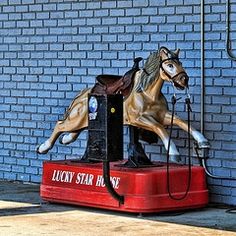
I was young, barely talking, so I couldn’t say Trigger. It came out as Twigger. The other little buckaroos in the neighborhood mocked my speech impediment. I was three years old, so what. I rode the wilds of Sycamore Park, ducking under low branches, hearing Indians in the trees and Buffalo calling. I rode the banks of the swollen creek, watching turtles feed on the carcass of a carp. I was, in my intended element, a cowboy. Then, the owner of the Little Pony Picture Service lifted me off and put the pony in the trailer. Bummer.
Every visit to the grocery store found me hounding my mother for a nickel or two so I could ride the stationary pony to nowhere. She always gave in and handed me a few nickels to keep me riding the range while she shopped. In my kid’s mind, the wilds of Texas stretched before me, Indians around every corner, wild critters stalking me on my trusty steed. When the coins ran out, I would sit quietly on Twigger until my mother fetched me. I missed my pony, but I was glad when she changed stores, and the new one had a rocket ship to nowhere.
A Typical Beer Joint on Jacksboro Highway, photo by a local Wino
I’ve known old buddy Mooch for around fifty years and thought I knew everything about the man, but now I know I don’t
I rode with Mooch to Fort Worth to pick up a load of mulch. It’s one of those places where a tractor drops a bucket full in the bed of your pickup truck. Cheap and efficient. When Mooch picked me up, I assumed his Chihuahua, Giblet, would be in the front seat next to Mooch. Giblet was in the back seat strapped into a child carrier wearing Apple Air Pods, held in place with scotch tape. I didn’t want to appear stupid, so I said nothing about a dog using Air Pods. I did ask what Giblet was listening to. Mooch said, “He likes those Tibetian Dog Chants; it keeps him soothed, and he doesn’t break out in hives or crap in the seat. Chihuahuas are a nervous type, you know.” He’s right; the little shit has bitten me numerous times; once, while trying to steal my Whataburger, he bit my bottom lip, and I needed stitches. The dog is so damn old; he’s probably broken some kind of Chihuahua life record.
Since we were near Jacksboro Highway, Mooch asked me how about dropping by his favorite bar for a beer. Sounded good to me, it was over a hundred degrees, and there’s nothing like a dark, cold bar in the summer.
Only a few bars are left on the old Hell’s Highway; they’ve all been dozed, and shopping centers and fast food joints have taken their place. We drove until we were in the country, then pulled into a gravel parking lot in front of Big Mamu’s Bar And Grill.
” This is my favorite bar in my whole life,” says Mooch. ” I’ve been coming here since I was of legal age to drink beer. This is where I got my first taste of the nightlife and other things I can’t discuss.” We ambled in, sat at the bar, and a female bartender brought us two ice-cold Lone Star longnecks. Mooch introduced her as Little Mamu. Her mama, Big Mamu, sold the place to her some years ago and retired back to Chigger Bayou, Louisiana, her hometown. Little Mamu and her husband, Budraux, run the business. Little Mamu, after a closer look, was darn rough. She’s seen some action in her bar years, probably shot or cut a few folks and busted some heads. Bottle blond hair and a hefty figure with arms like Popeye, I wouldn’t want to mess with her. The songs say the gals look better at closing time, but I doubt Mamu would improve by 2 am.
This bar was right out of the 1950s. Red naugahyde booths with little jukeboxes at each table. The rest of the furnishings looked to be original as well. The old Wurlitzer JukeBox in the corner was an antique but was pumping out Merel Haggard like a champ. The neon and backlit beer signs were old and likely worth a fortune. The Ham’s Beer bear was there, the Miller High Life man fishing for trout, and a revolving Jax Beer sign. This was a man’s bar. It dripped dive and beer joint like a dimestore Siv.
Mooch pulled a small flashlight from his pocket and sat on the bar. ” You about ready, Little Mamu?” he says. Mamu grabbed a step stool, climbed onto the bar, and walked over to where Mooch and I sat. I didn’t know if she would do a Hoochi Coochi dance or drop-kick one of us in the face. Mooch turned on the flashlight; Little Mamu raised her skirt a bit, and Mooch shined the light up her dress, bent over, and took a peek upward. ” Yep, everything looks just fine, gal,” he says, handing her a twenty-dollar bill. ” When did you start wearing those Fruit of The Loom underwear? ” Little Mamu didn’t miss a beat, ” I would have worn my Fourth of July ones if I had known you were coming; you haven’t been here in months,” she says. I’m not sure what I just saw; Mooch looking up a woman’s dress with a flashlight? I’ve seen some things, but this is the best one yet. We finished our beer and left.
I first met Billy Roy on a Monday morning in September of 1957 when Mrs. Edwards, our third-grade teacher, introduced him to our class. He stood next to her, arms crossed with a sour-ball look on his face.
I knew this kid was trouble. He hadn’t done a thing to anyone yet, but he had that weaselly look about him; beady eyes, no chin, partially bucked front teeth, and a bad haircut giving him the appearance of a hillbilly.
Our teacher says he is from Hamburg, Germany, and his father is an officer out at Carswell Air Force Base. Billy Roy, she says, is a German and an American citizen but doesn’t speak good English quite yet. So then, what is he, an all-American boy or a Nazi transplant? We, kids, knew all about those guys, watching World War II movies on channel 11 and playing war with our BB guns. We always whopped the Nazis and the Jap’s. We also took care of the Mexican army when we defended the Alamo.
As luck would have it, Billy Roy now lives in my neighborhood, three houses down from my best buddy, Skipper, so after school, the gang calls an emergency meeting to figure out how to deal with this infiltrator.
It’s decided to give the “new kid” a chance to prove his salt; he would be allowed to hang with us until deemed worthy or fell flat on his face.
Our parents got word of our secret plan and told us, “We had better be nice to Billy Roy, or we would wind up at the “Dope Farm.” Someone ratted us out; most likely, it was Georgie; he’s afraid of everything and can’t keep a secret. He is also a known titty-baby.
“The Dope Farm” is a juvenile detention institution that our parents use as a threat when we act up. It keeps us in line. The stories about the place give us nightmares; it’s Sing-Sing for children. One of my older cousins spent some time there, and later when he was supposedly rehabilitated, he robbed a Piggly Wiggly dressed as a woman.
Saturday came our day to ride our bikes to Forest Park diamonds for pick-up baseball games. Our group of eight departed from Skipper’s house at 8:30 am. Billy Roy is standing on the sidewalk as we approach his house.
Skipper stops and asks Billy Roy if he has a bike and a glove; in broken English, he states he has neither of those items.
Georgie, the titty-baby, then says in a snarky tone, “if you don’t have a bike and don’t play baseball, you can’t be part of our gang.” The word’s spoken, the gauntlet laid. It looks as if Billy Roy might be out. Everyone gives him “the look” as they ride by. I feel a little bad for the kid.
Billy Roy keeps to himself during the next school week, eating his sack lunch alone and staying inside during recess. We can care less. He can’t tote his salt.
Saturday morning, 8:30 am, the same scenario. We leave Skippers’ house on bikes, heading for the ball diamonds. As we approach Billy Roys’s house, he comes flying out of his garage on a brand-spanking-new Schwinn Hornet bike. A chrome headlight and taillight adorn the bright red and white bike—the sun’s reflection off the chrome fenders that cover the white sidewall balloon tires is blinding. Hanging on the handlebars is a new double-stitched “Plug Redman” Rawlings baseball glove, and sitting on his little head is a genuine New York Yankees ball cap.
Skipper skids to a stop, and the rest of our bunch almost wrecks our bikes, trying to miss him. What is going on here?
The gang is in awe and more than a tad envious. This kid’s been here two weeks, doesn’t play baseball, can’t speak English, is likely a German spy, and here he is riding the Cadillac of bikes and now sports new ball equipment. Some snot-nose in our neighborhood is as rich as King Faruk, and it isn’t us.
Skipper, the wise leader of our bunch, surveys the scene, then tells Billy Roy that he can come along with us to the baseball diamonds since he now has the required items. So he rides at the end of our pack and struggles to control his expensive bike. He crashes a few times but catches up. Unfortunately for our intern, things don’t go well at the ballpark.
After educating Billy Roy on holding and swinging a bat, he’s bonked square in the forehead with a 40-mile-per-hour hardball. He’s out like a corpse.
The umpire, some kid’s father, drags him over to the bleachers and pours a cup of cold water on his head. Billy Roy wakes up, staggers for a minute, and acts like nothing happened. We are impressed; he’s tougher than we thought.
Around the fourth inning, Billy Roy tells us that he is going home. He’s a bit dizzy and wobbly after his bonk and can’t participate in the rest of the game. We get it. He departs, driving his fancy bike from curb to curb like a blind drunk.
After the game, which we won, we gathered our stuff left in the dugout.
Stevie says he can’t find his Cub Scout knife. Freckled Face Bean can’t find his Roy Rogers watch, and Skippers’ decoder ring is missing. My almost new pack of Juicy Fruit is also gone. Good Lord! There’s a thief amongst us. Georgie, the titty-baby, is the likely culprit; but he says he can’t find his dental retainer, so he’s cleared. That makes Billy “the Nazi” Roy, the perpetrator. There is an ass-whoopin’ brewing. With retribution in our hearts, we haul ass to Billy’s house.
Mrs. Roy answers their door. We demand to see Billy, so she brings him to face us. He stands behind the screen door for protection. But, of course, he denies it all until Skipper tells him to step onto the porch so he can whoop him. Billy steps onto the porch, but before Skipper can get a lick in, Billy pulls a switchblade knife from his pocket. He pops the blade and waves it at Skipper. Yikes! Not only is the little Nazi a thief, but he’s also a West Side Story hoodlum. We leave the porch and the guilty Billy Roy to his young life of crime.
After the incident, Billy Roy, to us kids, is a fart in the wind.
Having ruined his reputation in our neighborhood, he starts hanging with some older hoodlum boys from across the railroad tracks; we call them “The Hard Guys.” We are sure they will wind up at “The Dope Farm” sooner or later, and now young Billy will join them.
Billy Roy has been missing from school for almost a week, a few days before Christmas vacation. We figure he has the bird flu or polio.
The next day, a rumor around the neighborhood, and now our school, is that Billy Roy and two of the “Hard Guys” were pinched for holding up our small neighborhood grocery store with a Mattel Fanner 50 cap pistol.
We all agreed that the bonk from the baseball injured his kid’s brain and turned him into a criminal. Last we heard, Billy and the two “hard guys” were off to the “Dope Farm.”
Left to Right; Danny Goode-lead vocals and bass; John Payne-vocals, lead guitar, fiddle, mandolin, and keyboards; and probably some more instruments I’m leaving out. Phil Strawn-vocals and rhythm guitar, banjo- Jordan Welch- drums and bongos, cowbell, and sings like Roger Miller.
Track 4 covers Jerry Jeff Walker’s “Navajo Rug.” I’m new to SoundCloud, so I cut off our heads in the pictures. Why do these apps make it so darn hard to move anything over? WordPress won’t allow WMV files, so I had to upload the tunes to SoundCloud, which converted it to an MP3.
Track 1, “For What It’s Worth,” is our cover of Buffalo Springfield’s song about the riots on the Sunset Strip in 1967. The CD was cut at Wavelight Studios in Haltom City, north of Fort Worth. Larry Dylan was the sound engineer and owner of the studio.
Danny and I, back in 67-69, played together in “The Orphans” and “The A.T.N.T.,” which I posted our record a few weeks ago. John Payne played with the “Fabulous Sensations” out of Lubbock, Texas. He also got to sit down and visit with Buddy Holley’s parents in Buddy’s childhood home, so he has been close to musical royalty. Jordan Welch played with The Coachmen, another great popular band in the DFW area, back in the 1960s.
If you haven’t noticed, I discovered background colors today, so bear with the experimentation. It doesn’t take much to entertain me these days.
Bugs and Marvin The Martian, courtesy of Mel Blanc
Since childhood, I knew we were not alone in this universe. A steady diet of space movies on channel 11 made a believer out of me. “The Forbidden Planet” with the robot and that hubba-hubba Ann Francis chick, and “Invaders From Mars,” where kidnapped folks had a red glowing jewel drilled into their neck, became zombies, and were sucked into the Martian cave via sand dunes. Those are the two that gave me screaming assed nightmares but piqued my still-forming juvenile imagination into what it is today. Certain that I saw a UFO over the Gulf of Mexico when I was eight years old, a run-in with small grey alien beings when I was abducted from my warm bed, taken aboard a mother ship, and implanted with a device that tracked my life and gave me superior mental powers over my childhood friends. I was hooked like a crappie on a purple people eater jigamajig spinner.
Now, all of these decades later, our slippery when-wet government confirms that the spaceships and little green men are real, and we have many of these crafts in our possession. I am relieved to know my beliefs were correct. The next time I drive through Roswell, New Mexico, which will be next month on our way to Ruidoso for some mountain air and horse racing, I will feel relieved that I was right all along. May the force be with you, and all that goes with it.
My father, Johnny Strawn, on the left, playing twin fiddles with Bob Wills
In the early fifties, my Father, Johnny Strawn, owned the Sunset Ballroom, just a stone’s throw off Jacksboro Highway in West Fort Worth, Texas. A country fiddle player by profession, he soon realized that trying to play nightly gigs at other clubs and managing his own business didn’t work, so he hired, as his club manager, his childhood running buddy, best friend, and my God Father, Dick Hickman.
Dick and my Father had grown up together in depression era Fort Worth and remained best friends to their last day. Decades later, they often reminisced, over a good glass of scotch, that “they didn’t know they were poor because everyone had the same amount of nothing that they did.”
Dick, besides being the new manager, was also pulling double duty as the club’s bouncer. A job he deplored but accepted and performed well when required. Being a family man and a peaceful sort, he soon became weary of kicking unruly customer’s rears every night, so my father, in a lapse of good judgment, hired one of the local tough guys to take Dicks place as the official bouncer and security, A mean little cat, that went by the name of “Toes Malone.” If he had another first name, he kept it a secret.
Toe’s was a likable two-bit-north side thug that had experienced one too many run-ins with the Fort Worth mob. The boys in the mob liked him and thought he was a funny guy to be around, so when Toe’s tried to horn in on their action or crossed them in any way, instead of just killing him outright like anyone else, they would shoot, or remove a body part to teach him a lesson.
After a few major discussions in a back ally with his admirers and the loss of an ear, three fingers, and an arm, “Toe’s” got his new name.
He didn’t give up being a tough guy. Being the mean little son-of-a-gun that he was, he had the local boot shop install two small pen knife blades into the toes of his Justin cowboy boots.
He was pretty agile for a one-armed cat and could carve you up like a Winn Dixie rib-roast before you knew what happened to you.
No one messed with Toes. He was the original Bad Leroy Brown of the South.
The patrons loved Toes so much that they would ask him to show his little “toe knives” to their wives just for laughs. He would gladly hoist his boot up on their table, proudly display his shiny little blades to anyone who asked, and tip a buck or two. The wives, giggling like school girls, would open their pack of Lucky Strikes on his boot tip blades.
He was part of the entertainment, sort of a hoodlum head waiter that would kill you if you complained about anything.
My father said his presence increased business, so he kept Toe’s own despite his reputation. In later years, he admitted that firing Toe’s would have likely led to his own early demise.
Toe’s, being a hoodlum to the core, couldn’t help himself and finally crossed the mob boys one too many times. On a cold December night in 1953, out by Crystal Springs Ballroom, they blew him in half with a shotgun blast.
My Father, saddened by the grisly demise of his entertaining employee, was relieved that he didn’t have to fire him.
Toes had no true friends to speak of, so it was that the memorial drew only a sparse gathering of musicians, the very mobsters whose hands bore the stain of his demise, and a handful of patrons from the Sunset.
On top of his casket sat his little knife boots and a nice framed picture of a 10-year-old Toe’s. A very fitting end. And once again, Dick had his old job back.
The Sunset, as the legend goes, was where the famous Roger Miller goosing incident occurred.
It’s been said it happened at Rosas or any number of clubs in Fort Worth, but I have it from two witnesses, my father, and Dick, that it happened at the Sunset.
Roger Miller, one of future “King of the Road” fame, grew up around Fort Worth and Oklahoma and, like many stars, struggled many years in the joints before making it big in Nashville. He was worse than a half-assed fiddle player but a promising songwriter, scraping out a living by frequenting the Sunset Ballroom, Rosas, Stella’s, The Crystal Springs Ballroom, or any other club that would let him sing and play for a few bucks.
One August night at the Sunset, he sang a few tunes onstage and tortured his fiddle for the less-than-appreciative crowd. The dance floor was full of sweaty “tummy rubbing” dancers doing their best to “not pass out” from the oppressive Texas heat that saturated every corner of the un-air-conditioned joint.
An attractive couple took to the floor, the lady in her fitted peddle pushers moving her backside with a careless grace that drew the attention of the young musicians on stage.
She got that jiggling backside near the edge of the stage, and Roger Miller, being the pre-Icky Twerp idiot that he was, couldn’t resist reaching out with his fiddle bow and goosing her tush.
She jumped.. pushed her dance partner away, and slugged him in the nose. Under the influence of numerous whiskey and cokes, the injured fellow stumbled and fell into a table full of visiting mob boys who turned out to see Roger torture his fiddle and sing a few tunes.
The ensuing brawl lasted a good ten minutes, clearing out the club. Dick carried the fighters out by the collar, two at a time. The mob boys “whooped up” on most everyone within a three-table area, and the rest of the people just whooped each other. The Fort Worth police came in, assessed the situation, sat at the bar, had a free Coke, took their pay-off money, and left.
Roger was banned from playing his fiddle at the Sunset, and soon after that incident, he went on to Nashville and started writing better tunes and working in better joints.
My Mother, fed up with my father’s teetering on the fringe of certain death, finally told him to sell the place or he would be living there by himself.
Dad sold it to Dick, who, after a few months, realized the nightclub business was not for him. He sold it to a steady patron with a questionable reputation, and the club, after becoming an illegal gambling joint in the late fifties, finally ceased to exist and was demolished in the mid-seventies.
Despite its well-deserved reputation, most of the great entertainers did manage to play there; Lefty Frizzle, Marty Robbins, Bob Wills and The Texas Playboys, Bill Boyd and the Cowboy Ramblers, Willie Nelson, The Lightcrust Doughboys, and a long cast of other impressive country music acts.
One Saturday night, a few weeks before Dad sold it to Dick, Bob Wills, and his band had a show in Weatherford, Texas, that was canceled due to bad weather. Not wanting to make the night a complete loss, he stopped at the Sunset on his way back into town. Being good friends with my Dad and his mentor, Bob took the whole band on stage and did a knocked-out impromptu show. Word on the Jacksboro Highway spread fast; within an hour, the place was packed to capacity. I have an old 8×10 black and white picture of Bob and Dad playing twin fiddles on San Antonio Rose. It was a night he was profoundly proud of and, over the years, spoke of it often.
The old place may have carried a less than stellar reputation, but that long demolished building hosted some of the greatest musicians in country music.