Driving Lessons from Grandpa: A Childhood Memory


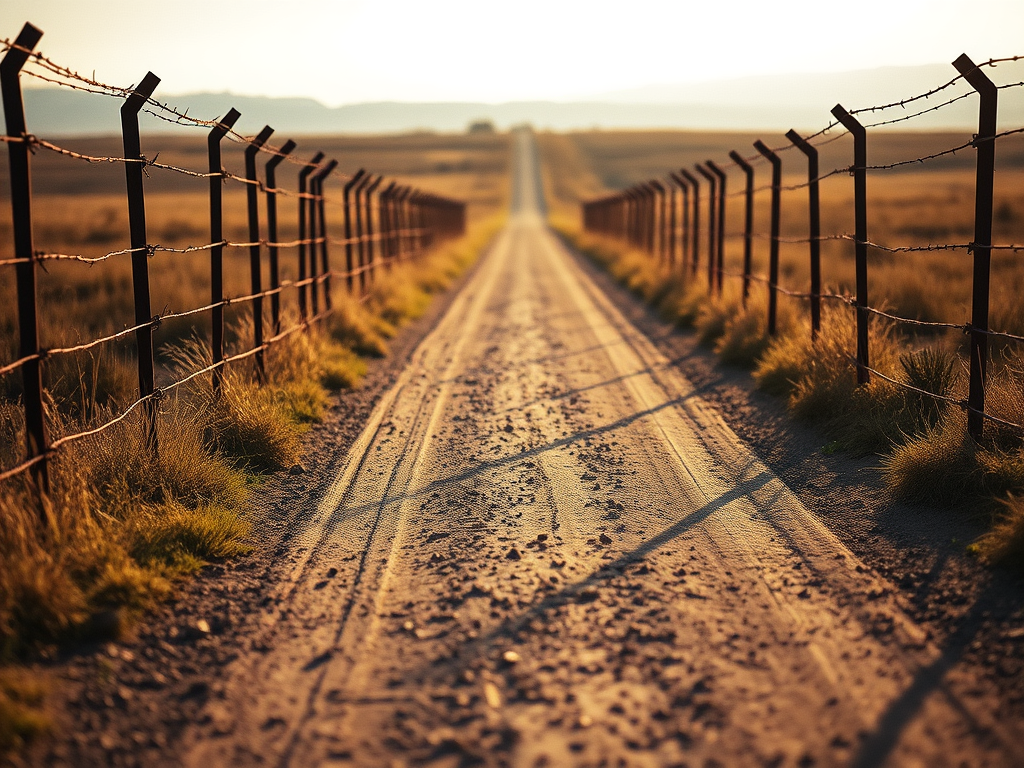
The dirt road was not much to speak of, so most folks didn’t. It was rutted, the kind of nasty ruts that could swallow a small child whole, never to be seen again.

No signs marked its path until my uncle Jay painted a small board with an arrow and the family name and attached it to a fence post with baling wire. People simply referred to it as the road to the Manley farm, the first right turn after crossing the bridge. It was a quiet, dirt path that meandered past Mrs. Ellis’s house and abruptly ended at a gargantuan cactus patch about a block past the railroad bridge.  

  My visits to the farm were during the summer, and I usually stayed for three weeks. I vividly remember the chickens, a noisy five hundred or so troupe circling the farmhouse, scratching the dirt, and being ever-busy. I also remember that almost everything on that farm wanted to kill me. The Mountain Boomers, Coyotes, and Rattlesnakes were my first worry, so I carried my completely ineffective Red Ryder BB Gun as protection.

     My grandfather Jasper decided it was time for me to drive a car, as most farm kids did out of necessity. At ten years old, I had mastered the tractor well enough to tear down parts of his barbed-wire fence without a second thought. He believed I was ready for his old stick shift V8 Ford. My grandmother fretted about his failing eyesight and knew better than to step into the driver’s seat herself: driving cars and deep water haunted her dreams, and she wouldn’t face either. My grandfather needed a chauffeur, skilled or not, for his trips to the domino parlor in the town’s only cafe, The Biscuit Ranch. I was his first and only choice.

     My first excursion behind the wheel was chilling, at least to me. What sort of adult would let a ten-year-old kid drive a car? If Grandfather was apprehensive, he hid it well.

  Turning out of the farm gate, hitting a hard left, clutching and shifting to second gear, working the accelerator, and attempting to steer the metal beast without running us into a ditch was all I could handle. By the grace of God, we made it to the railroad bridge where the hobos gathered, so we stopped so Grandfather could visit a spell. He enjoyed chawing with the hobos, swapping stories, chewing and sharing his Red Man tobacco, and telling dirty jokes: things that weren’t allowed at home. One of the hobo’s remarked that I drove exceptionally well for a little kid, and he and his buddy could hitch a ride into town. My grandfather was out of chewing tobacco, so he invited the hobos into the back seat for our first trip to the feed store in town.

  I was feeling optimistic and a bit cocky about my driving skills by the time we pulled up to the highway intersection. Grandfather checked for traffic and, finding none, told me to hit it, which I did: skidding out onto the pavement in front of the large truck he didn’t see coming; my small PF Flyer-covered foot floored the beast and hit second into third gear, squealing the tires like a stock car driver. The hobos in the back seat laughed and said I was the best kid driver they had ever known. The Ford made it to the feed store; then, we stopped at the Domino parlor, where I was introduced as the main chauffeur for the Manley family. When my mother came to collect me toward the end of July, I was car-driving Jessie. My grandmother marched me to the barn while my mother threw the grandest hissy fit ever after her father bragged about my good driving.
A Small Miracle


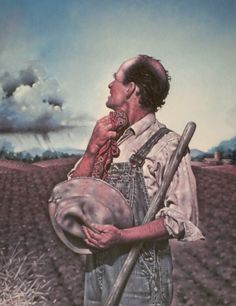
My Grandfather was a farmer. His life was a hundred seventy-five acres of cruel, rocky land in Southwest Texas. He would not have had it any other way.

On a scorching July afternoon in 1955, I stood next to him at a fence row along the south pasture, watching anvil thunderheads form in the West, behind the Santana Mountain Peak, the namesake of his town, Santa Anna.


Little rain had fallen the past few years. The stock tanks were dry, animals were suffering, crops were dead or dying, and the town’s soul was faltering. The prayers on Sunday were plentiful and to the point: Please bring rain.

There was talk of bringing in a rainmaker at the domino parlor, but the town had little money for such a wild idea. The town folk felt as though the good Lord wasn’t listening. A miracle was needed, even if it was a small one.

We had been standing at that fence row for a good hour, Grandfather not flinching or diverting his eyes from those clouds.
I wanted to see what he was seeing, but I couldn’t. He seemed to be taunting those thunderheads to come over that mountain, staring them down, challenging those clouds to bring what they had to his farm.
Looking away from the clouds for a moment, I looked at his weathered face. Just like his land, deep furrows everywhere. It’s as if each wrinkle was his reminder of a furrow that hadn’t produced a crop. He was only sixty, but his face looked decades older.
He glanced down and caught me staring. Embarrassed, I said the first thing that came to mind,

“Grandfather, why are you a farmer?”


Still staring at the clouds, he cleared his throat and said,

“I’ve always been a farmer boy; it’s all I ever knowed. One night, when I was about your age, the good Lord sent a tiny angel to my bed. She lit on the quilt and said Jasper, you’re going to be a farmer, and you will grow food to feed the children and the beast. This will be your life. How can you argue with the Lord boy? So, here I am.”


Until then, we had never had a real conversation, and I liked the kindness in his voice. I wanted to know this man who had been so elusive and indifferent to me.


“Does the good Lord always tell people what they will do?” I asked.

He replied, It’s what I here’d,” Now you best go tell Granny to get the cellar ready; it’s going to come up a cloud tonight.”

And with that, our first visit was over. Even though it was short, I now felt a closeness to him that hadn’t been there before, and I was eager for the next time.


I came round the barn and saw Granny carrying an armful of quilts and pillows to the storm cellar. She already knew a storm was coming. She always knew.


Grandfather missed supper, unwilling to leave that fence row, afraid those thunderheads would retreat if he did. They didn’t. The first crack of thunder shook the walls and sent me and Granny running for the storm cellar.


Grandfather wouldn’t come with us. He stood at that fence row until the hail stones pounded the cellar door. Only then did he come down, wet and bleeding from the cuts on his scalp. Granny fussed over him for a few minutes, and then he laid down on a cot and fell asleep.
We passed the night in that damp cellar. Granny, sitting, reading her Bible by the light of an oil lantern, Grandfather snoring, and me slumbering between fitful dreams of thunder and lightning. The storm did what it was sent to do.

At dawn, we came out to a sea of water. The fields, flooded, reflected the sunrise like a new jewel. The farm animals rejoiced in unison. Grandfather checked the rain gauge on the fence,

” Seven inches” he yelled.

Granny cried into her cupped hands, and I can’t remember why, but I cried with her.


Around lunchtime, we loaded into the old Ford and drove into town. People lined the sidewalks. Women hugged each other, old farmers patted one another on the back, dogs barked, and children laughed. The town had regained its spirit and hope overnight.


The Biscuit Café was alive, as was the domino parlor and the feed store. Everywhere, the people of Santa Anna rejoiced and gave open thanks for this small miracle.


At the café, Grandfather treated us to a nice chicken lunch. Pastor Bobby and his wife came in and, standing in the middle of the café, offered a prayer of thanks for the rain. Grandfather, not a church-going man, bowed his head and gave a hearty “amen” along with the rest of the patrons.

As we returned to the car, Granny’s old friend Miss Ellis came up to Grandfather, hugged him tight, and in a weepy voice said,

“it’s a miracle Jasper, God gave us a miracle.”

He politely endured her hug for a minute, then we moved on towards home.


That seven-inch rain didn’t end the drought for Santa Anna, but it gave the farms enough relief for the crops to stand tall again and the stock to survive that summer and fall. Grandfather became a church-going man, never missing a Sunday, and his farm produced the best crop in years.


Sixty-seven years later, my wife and I took a day trip back to Santa Anna. I was curious if the town had grown and prospered. It hadn’t. The Biscuit Café, the feed store, the domino parlor, and most of the other shops I remembered were gone. The old church still stood, showing its age but still holding its head high.


We drove out to the old farm. The house, the barn, and the smokehouse are all gone, lost to a fire. The only thing left was the windmill and the cellar. The fields were taken by scrub brush and weeds. Not a furrow survived.


I stood at that old fence line and looked west to the Santana Mountain. Just like that day in 1955, thunderheads were building behind the peak. It was going to “come up a cloud.” I never forgot that conversation with my Grandfather that day, and sadly, I never got to know him better before he passed away a few years later.


I have always believed that the power of prayer can produce miracles, and on that day, standing at that fence line, Grandfather and the Lord struck up a deal. The town got their small miracle, and Grandfather got religion.

The Three Mouthkateers Ride Again


Pictured are my three Texas rootin-tootin-cowboy cousins circa 1956. Right, to the left are “Little Bit O’ Lunch” Lunch Kit,” and “First Aid Kit .” I believe the horses are Butterfinger, Twigger, and Furi’ous. The Daisy BB guns they carried are not shown in this photo.

My grandmother was the original Texas chicken lady, calling her farm the Chicken Ranch of Santa Anna: not to be confused with the infamous Chicken Ranch and the best little whore house in Texas.

In 1955, after consuming half a dozen Pearl Beers, my uncle counted, more or less, 1500 hens and 50 noisy, aggressive Roosters. The cousins rode the chicken ranch range all day keeping the fowl in line. Any chicken employee not doing their only job of laying eggs got a BB to the rear end. Grandmother was thankful that the little cowpokes liked to ride the chicken range because they constantly ran their mouths about everything and nothing at all. She called them the “Three Mouthkateers,” not to be confused with the kids wearing the mouse ear hats also while singing and dancing about nothing.

The West Texas Wooly Booger


My grandparent’s farmhouse front porch was made for storytelling. It wrapped around half the old home and was covered with a sturdy roof so we could sit out during any weather. Summer or winter, after dark, under the moonlight or stars, it was fertile ground for swapping yarns.

My two long-deceased uncles, Bill and Jay, were the best liars and yarn spinners I have known. I am proud to have inherited, to some degree, their ability to recount and or mold loads of total chicken crap into something believable.

Christmas Eve of 1957 found our family visiting the Santa Anna, Texas farm. The weather that day was mild with thunderstorms expected in the evening. In Texas, Indian Summer often shows up at Christmas time leaving us kids sad because Santa won’t have any snow for his sleigh. We assumed he could still land on rocks and hard dirt, or we wouldn’t get any presents while at the farm. My grandfather cut down a small Cedar tree in his pasture, and my parents brought some of our home ornaments, or we would have been treeless and nowhere for Santa to put our gifts.

After supper, some of the family would gather on the front porch to listen to our two Uncles spin their eloquent yarns of life growing up on a farm in rural Texas. Uncle Jay carried the metal Coleman cooler full of ice and Pearl Beer to the porch, and Bill rolled some cigarettes and brought out a pack of Red Man Chewing Tobacco. The stories wouldn’t start until the third or fourth beer was consumed. Uncle Bill said beer is a required fuel for any storyteller to practice his craft.

The lightning to the Northwest was flashing behind the Santa Anna mountain. Uncle Jay remarked that it reminded him of shells exploding miles away at night while he was onboard a battleship in the Pacific. That was the first time he mentioned his time in the war to us kids. We wanted to know more, but he changed the subject. We were years away from him sharing those times with us. The conditions on the porch were perfect. My cousins and I sat around our uncles in a circle, waiting for the first word.

Sitting at the opposite end of the porch, my granny piped in, ” Jay, did you ever tell the kids about the Wooly Booger’s?”

“The what boogers, “my cousin Margurite squealed. No, they had failed to mention them.

Uncle Jay took a swig of Pearl, looked at the lightning, and in a hoarse whisper said, “We got West Texas One-Eyed Wooly Booger’s right here in Santa Anna, and they are partial to eating kids.”

There, it was out. First, it was Pole Cats, then Coyotes, Bobcats, Feral Hogs, Rattle Snakes, Copperheads, and the giant Mountain Boomer, and now One Eyed Wooly Boogers. Sum bitch, everything around this farm wanted to kill us kids; no wonder we were a nervous wreck and lost weight every time we visited. At that moment, I was ready to go back to Fort Worth. At least there, I only had to worry about getting smacked by a car while riding my bike to school.

Uncle Bill chimed in: ” I saw one about forty years ago. I was sleeping on the screened-in porch with my dog, Giblet when one of them got through a hole in the screen and jumped on my chest. It was the size of a house cat with one big red eye in the middle of it’s skull. I was paralyzed with fear and couldn’t move; I guess the big red eye hypnotized me. Old Giblet killed the critter, and Granny took a picture of it with her Brownie camera. Then, we buried the little demon in the back pasture. I hear tell that they are attracted to the smell of nose boogers, which kids usually have a lot of. They go for the nose and chew it right off of your face, then the ears and eyeballs if you don’t die from the nose wound. I happened to have a cold that night, so that’s why the creature tried to get me.”

My cousin Jerry, even in the dark, was pale as a baby’s butt; he had a winter cold and a big-time snotty nose. He was a goner, and I had to sleep beside him on a pallet on the screened-in porch. I would be the second to get it.

I slept with my Daisy BB Gun and Cub Scout camping knife for the next few nights. I wasn’t going down without a fight.

Texas Lore And Legends


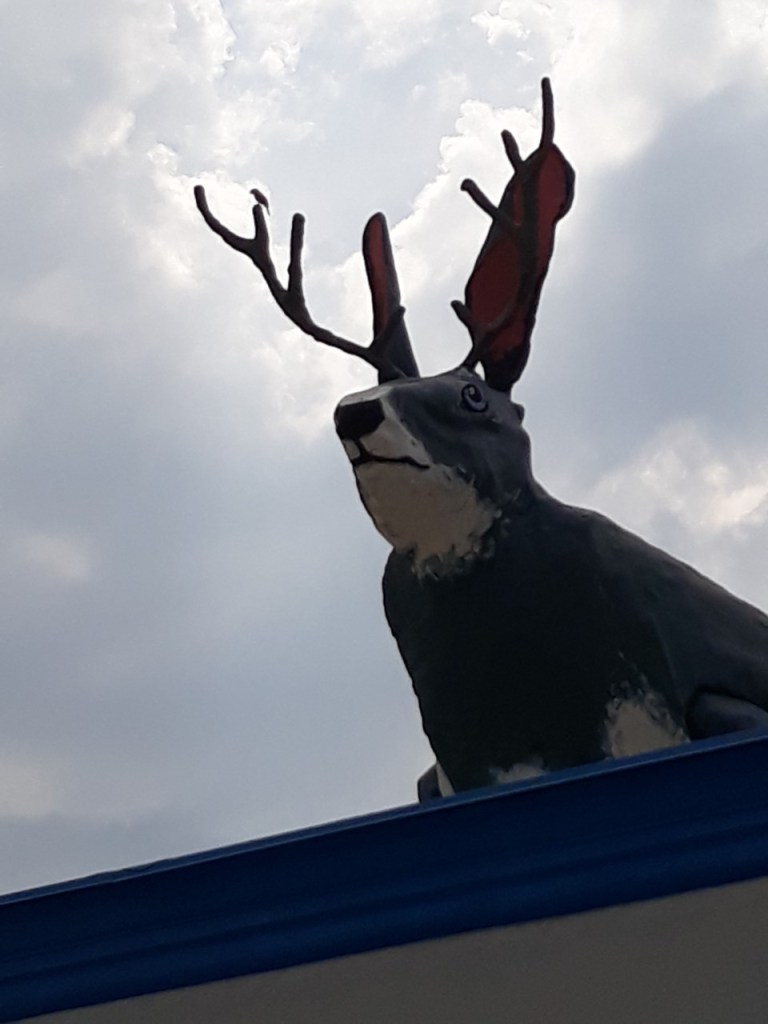
The Jackalope

I first learned of the “Jackalope” from my late Uncle Bill Manley. Summer nights on the porch of my grandparent’s farmhouse were ripe for spinning yarns and swapping lies. Uncle Bill was a masterful storyteller; my cousins and I were young and ready to believe anything he dreamed up.

The Jackalope is part Jack Rabbit and part Antelope and is a staple of Texas lore; is it real or a yarn? No one knows for sure, but many have claimed to have seen one, Uncle Bill among them.

After three or four ice-cold Pear beers, he begins his recount.

His voice lowers an octave; he leans over, rests his elbows on his knees, and begins,

” Back in 1948, when myself and the missus were visiting down from Chicago to this here farm, I was looking for my doggy that escaped the screened-in porch. It was almost dark, and I was walking through the back pasture, making my way into a grove of Mesquite trees, and there it was, sitting, chewing on a big blade of Johnson grass. He was a big critter, about the size of a big old lazy dog. His horns stuck up like a West Texas Antelope, his eyes glowed ruby red, and his pupils were yellow like a big summer squash. I was scared the varmint was going to gore me with those big horns, but I stayed real still and began to talk to the critter. I knew it was a Jackalope right away. The more I talked, the critter seemed to like what I was saying, and it began inching closer to me. I went on for a while, and when I took a break, the varmint was right next to me, looking up at my face with those crazy eyes. Then he did something funny; he nuzzled me with his head, and not knowing what was up, I reached out and scratched him behind his long ears. He made a funny sound, sort of a cat purring. I knew we were buddies now.” Wow, what a story! My cousins and I were delighted; we wanted more, so I asked, ” Uncle Bill, what happened to the Jackalope?”

Uncle Bill always had a dramatic end to his tales; this one was no different. He takes a giant slug of his Pearl Beer and says,

” There was a pack of wiley Coyotes roaming around the farm making a ruccus and killing Granny’s chickens. I went out hunting them one night and found the Jackalope all chewed up over behind the hen house; the Coyotes got him. He put up a good fight because there was two dead Coyotes laying beside him, all gored up from the horns. I took him to the taxidermist in Brownwood and had his head mounted, and that’s him hanging on the wall of the Biscuit Cafe.” Twenty years later, I stopped at that cafe, and the Jackalope was still there.

The Easter Chickens of Brown County


“Western history is bizarre because of the nature of what it has got. Historians and other writers do what men have always done in the desert. They make the best of what little they do have. Westerners have developed a talent for taking something small and blowing it up to a giant size like a photographer blows up a photograph. They write of cowboys as if they were noble knights and cowmen, kings. They do biographies of bad men, Billy the Kid, The Plummer gang, and Sam Bass, of bad women like Calamity Jane, of gunmen like Wyatt Earp and Wild Bill Hickock. They blow the abandoned saloon up into an art museum and Boot Hill into a shrine for pilgrims. In Montana, Charlie Russel is better than Titian, and in the Black Hills, Fredrick Remington is greater than Michelangelo. Custer, who blundered to his death and took better men with him, found a place in every saloon not already preempted to that travesty on decency and justice, Judge Roy Bean.”  As quoted by J. Frank Dobie, Texas Author, and Historian

I have no qualms or embarrassment about growing up in Texas. I am a native son and proud of it. If the Alamo needed defending again, I would fight the attackers on top of its wall with a yard hoe and my typewriter as weapons. At times, my unchecked pride borders on braggart, but I don’t interact with many folks that are not Texans, so it’s a moot point.

 Storytelling and tall tales run in my family. Uncles, grandfathers, and sometimes grandmothers filled my head with tales I remember today. I’m writing as fast as I can before I forget them. My son and grandchildren will be better educated once they have them in print. No one in my family wrote down what was told around the supper table or the front porch. I can assume that they figured the spoken version was good enough, and for decades, it has been, but now it’s my quest to put them to paper and pass them on. It doesn’t matter that many of them are about half true and could be considered a “tall tale.”  

The revered Texas author, historian, and master of tales, J. Frank Dobie understood the flow of Texas and its people. He told of the hardscrabble farming of the hill country, horse and cow trading, lost gold mines and Indian fighting, and of the Texas Rangers and their heroic and often ghastly behavior because he had lived and seen it as a child and young man and procured the tales, though many tall by nature, from cowboys and characters around campfires or leaning on the bar-rail of a saloon. He himself was considered a character, but with a top-notch university education. Spoken tales, true or not, are as much a part of Texas as our majestic bovine, the Longhorn.  

From my two late uncles, who were brothers Bill and Jay Manley, I heard stories that, on some nights, made sleep impossible, either from fear or captivation. They were the two best liars and storytellers I have met. Often, there would be a discussion and a following challenge to witness something they had heard about at the feed store or domino hall. They thirsted for the unordinary and would drive fifty miles or more to view a three-legged chicken or a pig that saved a farmer’s family from a house fire; things that sane and educated people would pshaw. My cousin Jerry and I were backseat passengers on many of these excursions.

Their preferred stage was summer nights on the farmhouse front porch. My grandparents had no air conditioning or television, and the radio only sometimes worked, so listening to their stories and trying to catch a cooling breeze was the only entertainment. The occasional yip of the Coyote added flavor to the moment. A Coleman cooler of iced Pearl Beer sat between the two orators, and the cold beverage allowed the tales to spill from them, most times like Will Rogers, other times like Saturday nights inebriated cowboy. I am a lucky man to have retained them for all these years. I credit my grandfathers’ advice to “keep your mouth shut and listen.” I was a good listener when I wasn’t yammering on to hear myself talk.

In the summer of 1957, my cousin Jerry and me were sitting with some of the family on the front porch of my grandparent’s farmhouse when my two uncles argued about something they had heard at the domino hall. A lady in Bangs, a small village about eleven miles away, is said to have a flock of hens that lays colored eggs. She calls them her “Easter Chickens.” Uncle Bill, ever the pragmatic questioner but still a believer in the oddities and unexplained, stated that “it was impossible for chickens to lay colored eggs” Jay, his brother, heard from three farmers playing dominos that it is the by-God truth. The argument concluded with the promise of a trip to Bangs in the morning to investigate. As usual in these challenges, a wager of five dollars was attached.

After directions from the local feed store, the source of all directions in Texas, our party proceeded to our destination. Detailed directions said to go five miles on the second dirt road out of town, turn left at the “Jesus Saves” sign on the tree trunk, and go about a hundred yards or so, and you’ll see the farm, a white house with red shutters, and lots of Holstein cows wandering around.

The lady that answered the door, Thalia McMurtry, figured we were there to purchase her “Easter Chicken” eggs. She wasn’t amused that all my uncles wanted to do was confirm if it were true; still, she led them back to the hen house. Her husband, Sonny, joined us. Around a dozen speckled hens were inside a cute little hen house, sitting on their box nest. Thalia stepped inside and retrieved a few eggs, placing them in her apron pocket. Two were bright red, one yellow, and one a deep blue. Uncle Bill sighed; he knew he had lost the wager. The eggs were beautiful; it was as if she had dropped them into a boiling stove pot of egg dye. She told Jerry and me, “go ahead and peel one; they’re ready to eat just as they are, already hard-boiled and everything.” Uncle Bill called BS; no chicken in this world lays hard-boiled eggs, and he accused Thalia and Sonny McMurtry of fakery to the highest degree and to explain how they did it.

Thalia, not a bit rebuffed, said, “I started mixing my own mash feed using different stuff from the kitchen cabinet with the regular store-bought mash, and the hens started laying yellow eggs, so I tinkered around a little more, and they started laying blue eggs, then a bit more, and red ones appeared. We’re not sure why they are hard-boiled, but maybe it’s caused by the heat lamps we use to keep my little beauties warm has something to do with it.” My two uncles, feeling like the village idiots, purchased a few dozen mixed colors and took them back to the farm. My grandmother, faking surprise at their discovery, had eaten a few of them some months back, given to her by a friend, but she didn’t tell her sons. Once again, another adventure of the absurd to remember.

Years later, I read a blurb in the Texas Farm Almanac about a lady in Bangs, Texas, who ran a farm called “Easter Chicken Acres.” Her hens laid hard-boiled multi-colored eggs just in time for Easter. She was also mentioned in the famous book “Ripley’s Believe It or Not” and made Bangs a place to visit. They came really close to putting the Easter Bunny out of business.

“The Legend of The Mountain Boomers of Santa Anna Texas”


My childhood vision of a Mountain Boomer

Every so often, I feel a story or a rousing recount should get a second visit and be shared again. I wrote this one a few years ago because it made it’s way back to me in a dream. I watched one of the Jurassic movies earlier in the week. I had a squirmy nightmare for a few nights in a row, which usually results in me making a hot cup of Ovaltine in the microwave and reading for an hour or so to quieten my brain a bit. The problem was, it wasn’t a nightmare; it was a true account from my childhood. I swear on a stack of good books, not the Bible, of course, but maybe a few by Hemingway and Steinbeck. My two long-deceased and loveable uncles were the best storytellers, beer drinkers, and liars I have known. I never knew where the realism ended, and the bullcrap started, but they both swore, in between gulps of cold Pearl beer, sitting there on top of their Coleman coolers out on my grandparent’s front porch, that this one was as real as a bad case of chickenpox.

At seven years old, I learned of my first, but far from the last Texas legend. One of the best storytellers and liars I ever knew, my uncle Bill told my cousins and me about Santa Anna’s “Mountain Boomers.”

Supposedly, man-size lizards that ran on two legs came down from the Santa Anna mountain searching for food. Anything would do, but they were partial to goats, chickens, and tiny humans. If you were caught outside in the wee morning hours, it was a sure bet a Mountain Boomer would get you. Us kids were scared shitless of even going out after dark.

With no air conditioning in the farmhouse, we were forced to sleep with the windows open and would lay in our beds shaking all night, waiting for the monsters to break through the window screen and carry us away. Our Granny was no help; her standard goodnight to us was ” sleep tight and don’t let the Mountain Boomers bite.”

Summer evenings on the farm were made for sitting on my grandparent’s covered porch, watching lightning bugs dance, listening to the crickets chirp, and catching the far away howels of an occasional Coyote pack running the pastures.

The sky was black as pitch, the Milky Way as white as talcum powder, and heat lighting in the West added to the drama of the evening. We kids were ripe for a big one, and my uncles never disappointed. First, homemade ice cream was eaten, then the cooler of Pearl Beer came out, and the stories commenced.

Already that June, my cousin Jerry and me had been to see the hero pig and the three-legged chickens, so we needed a new adventure. But, unfortunately, the hobos had left the railroad bridge down the road, and our summer was losing air like a punctured tire.

“Did you kids see that over there in the trees? I think that might have been one of them Mountain Boomers,” says uncle Bill, in between swigs of Pearl. Then, of course, we strained our eyes to see what he said he saw, but nothing. Then a few moments later, ” there it goes again, I tell you kids, that was one of them sumbitches running on two legs carrying a goat.”

He had us hooked and scared. Then he starts in on the story.

Uncle Bill took a swig of Pearl and says, ” Right down this road here, about twenty-years ago, a families car broke down. The daddy, a man I knew well, walked into town to find some help. He left his wife and small son in the car. It was late at night, so he figured they would sleep until he returned. The little boy, got out of the car to pee along side the road. His Momma heard him scream and came out of the car in a hurry, there was a 7 foot Mountain Boomer standing there with the little kid in it’s mouth. The poor boy was almost chewed in half already. His guts were hanging out and dragging on the ground. The big lizard took off running with the Momma chasing it. Another of them Boomers was hiding in the scrub brush and got her too. A few days later, the sheriff found their bloody remains up on the mountain. They knew a Mountain Boomer had got em because they found their tracks. That’s why we never go outside after midnight around here.” Jerry and I were almost pissing our pants.

When we stayed at the farm, I don’t believe either of us ever slept well again after that night. But, even after we were adults, my Uncle Bill swore the legend and the story was true. I still dream of them.

Blueboy The Pigeon


My grandmother loved her critters. She shepherded about five-hundred chickens on her farm in Santa Anna, Texas. A scroungy stray cat or dog would show up, and she would feed it and give it a place in the smokehouse to stay. They usually were soon gone, thanks to Coyotes and Bobcats, but she wouldn’t let them go hungry.

She couldn’t place the day, month, or year the pigeon showed up. It flew down from a bright blue sky and commenced pecking at the chicken feed my granny had thrown on the ground for her hens. It was a beautiful bird, blue-grey with white markings; she called it Blueboy, not knowing if it was male or female, so to her, it was a boy pigeon.

Blueboy took a liking to granny and followed her around the farm while she did her daily chores. He would walk a few feet behind her, even when she was in the barn or the smokehouse. He would perch on the front porch railing if she was sitting outside. He became her pet. After a while, she could reach down and pick him up, which for a wild pigeon, was something to see. She carried him around like a pet chicken and would feed him in his own dish by the giant oak tree that shaded their farmhouse. Blueboy slept in that tree most nights, but in the cold winter, she would crack the smokehouse door, so he could roost inside out of the weather. She and that pigeon understood each other. Farm people know critters and how to communicate with them. It’s a natural talent you are born with. The bird thought he was a dog, and she treated him as such.

Blueboy started following the cousins and me around the farm. Always a ways behind us, curious about what we were up to. We could never touch him or get too close; only granny had that honor. He was always there for years when I visited the farm in the summer and at Christmas or Easter. I guess that pigeon was a big part of the family as the grandchildren.

Just as he had shown up one day, he was gone. Granny figured he or she had met another pigeon and started a family, or at least that is what she told us. Years later, she said she found some of his feathers by the barn. Probably a Bobcat got him while he was strutting around instead of sitting in his tree. She never got over losing Blueboy and talked about him often in her old age. I saw a pigeon a few days ago, and it took me back there.

“Weather Days and Weather Nights”


A few nights back, I was awakened by bright static flashes against my eyelids. Lightening from afar brings a storm.

I lay in my bed, eyes now open for most of an hour, cataloging the most intense flashes through the window curtains, waiting for the following thunder to announce the wind and rain. The anticipation of a storm is pure dope for a weather nerd. I’ve been addicted for most of my life.

The television weather folk had been hawking this storm for days prior. Warnings, interviews with people on the street, getting every drop of drama out of their forecast. The cute weatherwomen and stern weathermen called for Apocalyptic conditions favorable for tornadoes and various end times hi-jinx. This would be no more than a typical spring supercell thunderstorm. Texans take their weather as seriously as the Alamo, Willie Nelson, and BBQ.

It’s a well-known semi-historical fact that Colonel William Barrett Travis predicted the cold and rainy weather during the siege of the Alamo. General Santa Anna, relying on his hungover weathermen, expected spring break conditions in San Antonio, and didn’t dress accordingly.

My first solid memory of bad weather happened when my grandmother carried me into her storm cellar as a vicious thunderstorm attacked the family farm; I was four years old. Every summer after that, there were numerous trips to the safety of that dank dirt storm cellar. Two cots, a pile of quilts, and a kerosene lamp were enough to see us through a siege. Shelves of canned fruit and vegetables lined the walls. Winters food pantry for when the land is at rest and for us to dine if the storm lasted more than a day.

If you are a farmer in Texas, the weather “is your life.” It will make or break your crop season with no warnings or apologies.

My Grandfather was a typical old-school pioneer farmer that possessed an active and painful weather bone in his left leg and a working man’s knowledge of the stratosphere. My grandmother was equally blessed with a pinky toe that swelled when a storm was brewing. Together, not much got past the two.

Grandmother would stare at a tiny cloud in a pure blue sky and remark, ” it’s gonna come up a cloud tonight.” She was rarely wrong.

During my summer visits to the farm, against my young will, I was dragged by my Grandfather to the domino parlor daily and subjected to hours of bullshit and weather talk from the old farmers in Santa Anna, Texas.

Old men in straw hats, bib overalls, and a cheek full of Redman tobacco ruled the world in those times. It was all about the weather and when will it come, how bad will it be, and how much rain could be expected? I usually fell asleep with drool running down my cheek after an hour. Then, it was back to the farm while my grandmother limped around the house because her weather toe was swollen. Good Lord. The family was a meteorological wreck.

Thank God, the family gene skipped my sister and me, so we depend on our local televisions weather personalities.

A Chicken And 88 Keys


Photo by; Colonel Sanders

Marjorie Mae has a dozen chickens living on her small farm on the outskirts of San Angelo, Texas. Normal Texas folks don’t think much of chickens except when they eat their eggs or have a piece of it fried or baked. Marjorie Mae is different; she treats her chickens like real folks; all of her fowl have first names and are somewhat educated.

Gilda, Ruby, Tootie, Francis, Lucille, Ethel, Jessie, Rea, Poochie, Piddle, Bebe, and Poteet. Call any one of them by their given name, and they come running like a spotted pup. She rather prides herself on being the keeper of educated farm fowl. She isn’t sure about the depth of their education, but they seem smarter than most run-of-the-mill barnyard chickens.

One day, walking by her barn on the way to the chicken coops to gather eggs, she hears piano music. She instantly recognizes the out-of-tune sound of her ancient broken-down upright piano that’s been stored there for ten years. Unfortunately, her husband Wilfred doesn’t play, so she figures a hobo or possibly an escaped felon from the prison farm must be hiding in her barn, twinkling the ivories. She grabs a 20 gauge from the house and marches off to confront the interloper.

As she gets closer, she realizes this is not some rube pecking around on her piano, but an educated musician, like herself, that knows their way around the 88 keys. So she slows her advance to a near stop to listen a bit more. She can’t be sure, but that sounds like Mozart’s Concerto No. 3 in B minor, but the piano is old and out of tune, so it could be anything short of a barn cat walking on the keyboard.

When she reaches the barn door, the music stops, then starts again. The beautiful haunting notes of Moon River float from within the dark depths. Whoever this trespasser is, she wants to meet them and have a bite of lunch at her kitchen table; hobo or felon, she opens the sliding door and enters the barn.

Thirty steps to the center of the barn, behind the frozen-up Ford tractor, is her dust-covered piano. The tarp cover is haphazardly thrown to one side. In the low light of the barn, she can’t see anyone, yet the playing continues. Finally, the culprit is discovered when she gets within five feet of the piano.

Her Sussex Speckled Hen, Rea, is standing on the keyboard, pecking the keys with her beak and both feet. Not the corny huckster trick pecking you see the chicken at the county fair playing on the toy piano for a quarter, but calculated and coordinated movements that are producing beautiful music. The first thing that comes to her mind is, “I’m going to be rich.”

I’m into the second week of my month-long summer visit to my grandparent’s farm in Santa Anna, Texas. It’s a hot night, and everyone is sitting on the covered front porch drinking sweet iced tea and Pearl beer. My two uncles, Jay and Bill, are visiting for a few days from Fort Worth and are putting the finishing touches on a case of beer they bought this morning at the Dino station. July is beer drinking season around here. It’s considered a main food group but must be served iced-cold to gain the nutritional value from the barley and hops.

Bill gets up from his chair and reaches into the Coleman cooler, extracting another Pearl; he uses his feed store church key and a pen knife to pop the cap. Then, looking out over the Santa Anna mountain, he says to no one in particular, ” I heard this morning there’s a piano-playing chicken over by San Angelo.” Uncle Jay, his brother, immediately replies, ” bull-shit, there ain’t no such thing as a piano-playing chicken. I bet you twenty dollars it’s a can of crap.”

The two brothers are the biggest storytellers and liars in Southwest Texas and will bet on anything. The more far-fetched and unbelievable, the better. Uncle Bill says we are leaving for San Angelo in the morning. I’m excited about this one.

After getting directions from the feed store and a man standing on a street corner, we head towards the farm of Miss Marjorie Mae. She is already a local celebrity and is the gossip fodder of the town. We arrive at her farm around 10 AM.

Marjorie answers her screen door, and uncle Jay states that we are here to see the piano-playing chicken. She says, ” it’s ten bucks a carload and I can’t promise you she will be a play’in if there are eggs to lay, she will most likely be doing that first; she’s a chicken you know.”

We are led to the barn, the door is opened, and there, glistening in the sunlight is a hand-polished upright piano. A silver candelabra and swirled glass vase of fresh flowers rest on top. Marjorie collects the ten bucks from uncle Bill. Jay pokes him in the ribs and whispers, “this is all bull-shit so you might as well pay me now. ”

Marjorie emerges from the barn carrying a fat Sussex Speckled Hen. This chicken is downright gorgeous for a barnyard critter. Its feathers are fluffed up into a fuzzball, and its toenails are painted bright red. A gold nametag hangs around the fowl’s neck. I can tell my uncles are duly impressed, as I am.

The hen is placed on the keyboard and immediately launches into a jive-inspired rendition of Glen Miller’s” In The Mood.” Finishing that tune, she plays a classical number and then goes right into ” Moon River, ” closing with the theme from ” A Summer Place.” My uncles are tapping their feet and laughing like deranged mental patients. Finally, the hen hops down from the keyboard and struts back into the barn; the show is over.

Uncle Bill thanks the lady for her hospitality. As we leave, he asks her name. She replies, “Marjorie Mae Mancini.” Bill inquires if the chicken has a name. She says, “oh yes, that’s Hen-Rea Mancini.” I kid you not.