What Say’s It’s Summertime..More Than Political Violence?


1968 Democratic Convention In Chicago

It was quite a weekend for us average Americans. A former and possibly future president was almost assassinated by a twenty-year-old anti-social nut-job, the recipient of school bullying. Take note of anyone who was ever bullied, pushed, or spoken to in a demeaning manner in your high school days. Shooting people is not the panacea.

The present commander-in-chief hesitated for two hours before delivering a statement. When it finally came, it was a brief, confused jumble, possibly crafted by (not a medical professional) Jill Biden. It urged for a reduction in the aggressive language and insinuated that this was the result of America’s conservative faction. Now that’s damn sure taking it down a notch or two, Mr. President..keep it up.

You know those individuals on the right side? They are the regular, hardworking, blue-collar folks driving the pickup trucks they use in their trade. They build our homes and buildings, repair our plumbing and electrical, check out our purchases at the grocery store, pave our roads, support their kid’s little league and soccer teams, and tithe what they can to their church. These folks are struggling to afford basic necessities under Biden’s economic H-bomb. I highly doubt they have time for violence. Just getting by consumes all their energy and money. The welder with a family of five now has to saddle the debt of some woke child’s college loan for a worthless degree in Social Media Posting or perhaps Taylor Swift Music Theory. The parents want the dependent swindler out of their home; they require the kid’s room for their podcast studio. And let us not forget the ten million illegals that have invaded our country; they are living in luxury hotels and receiving hefty benefits for being criminals. All the Democrats ask is that they vote for their candidate when they are allowed to cast a ballot. Ask the homeless mother with a few children, living in a cramped shelter, or perhaps on the streets or in her minivan how she feels about the invasion of foreign grifters draining our social services when she can’t get a damn dime, a meal, or a room at Motel 6.

I’m an old fella turning 75 come September, and I ain’t liking it at all. Every joint aches, and the fear of major organs giving out is as real as can be. Momo, my missus, is a few years behind me and is dealing with many of the same issues.

We both grew up in the 1950s and were teenagers in the 1960s. I remember I was in seventh grade when Kennedy got shot in Dallas. The teacher wheeled in a portable black and white Zenith TV, and the class watched those news fellas with their sleeves rolled up, cradling a black dial phone to their ear, a cigarette in each hand, and a stiff drink of bourbon just out of camera sight, doin’ their job. They broke the news to the world that our president, John Kennedy, was deceased from a shot to the head. Our little 1950s happy-happy world was shattered. The innocence was gone in a blink, and Dallas, Texas, would always be known as the city that killed Kennedy.

In 1968, as a high school junior, I discovered the power of the written word might actually be used to facilitate change. This era sparked within each of us the belief that we could possess the strength to change the world. We all felt we had something significant to say. During this period, I began to approach my writing with a newfound sense of earnestness. I channeled my thoughts and ideas into not only opinions for my school newspaper but also into the creation of short stories, a pursuit that became my primary focus. I would never be a Steinbeck or Twain, but I could give it one hell of a try.

When Nixon ascended to power, politics ensnared my attention. Lyndon Johnson and his Great Society pipe dream left the country in turmoil, bitterly split by his failed policies and the Vietnam War. It’s no coincidence that Joe Biden idolized Johnson and patterned himself after the arrogant bully from Texas. The familial supper table transformed into a platform for deliberating the condition of our nation. My folks remained unwavering Roosevelt democrats while I vacillated like a reed in the wind, embracing liberalism one day and conservatism the next. My loyalty belonged to no single ideology. Politicians appeared nefarious and tainted; the entirety of the government left a bitter taste in my mouth. I was not a Hippie or a Yippie, or a Yuppie, or a Guppie. Then Martin Luther King was assassinated. The good work he had done vanished within hours of his death. The lines between black and white grew wider, and violence was in the wind.

Shortly thereafter, Bobby Kennedy, the Democratic candidate for the presidency, met his tragic end in the kitchen of the hotel mere minutes after delivering a triumphant speech. The perpetrator of this heinous act, an Arab kitchen worker wielding a 22-caliber pistol, answered to the name of Sirhan Sirhan.

The Black Lives Matter movement, Antifa, and the Palestinian protest movement are powerful forces of tension in today’s society. Their intemperate assaults on our cities and citizens are vividly portrayed on our 4K television screens. Yet, when measured against the tumultuous events of the sixties, these groups appear to be more petulant young college students than Marxist terrorists.

During that era, we witnessed the emergence of formidable terrorist entities like the Symbionese Liberation Army, The Weathermen (the Weather Underground), The Students For Democratic Society (SDS), The Black Panthers, and the Ku Klux Klan, in addition to numerous other fringe groups originating on college campuses across the nation. Tossing Molotov Cocktails didn’t require a degree. These folks bombed buildings and wielded guns against Police and citizens. Patty Hearst, once the beautiful and cherished debutant darling of the Hearst publishing empire, underwent a remarkable transformation following her abduction, attributing her radical shift to the influence of the SLA’s brainwashing techniques. No, Patty, you got off on the whole terrorist ideology. Today, she is a wealthy matron with more money than she could ever spend. It leaves me pondering whether she still possesses that automatic rifle and beret from her revolutionary days.

Daddy’s little girl

The upcoming Democratic Convention is scheduled to be held in Chicago, reminiscent of its 1968 counterpart. During that time, a multitude of protesters, guided by the aforementioned organizations, flocked to the city, turning its streets into a battleground as they engaged in confrontations with Mayor Daley’s police, igniting buildings and police cars. The majority of the demonstrators aligned themselves with the Democratic party, displaying discord within their own ranks. It seems that this forthcoming convention is on track to mirror the tumultuous events of 1968.

Would You Paint Over A Rembrandt?


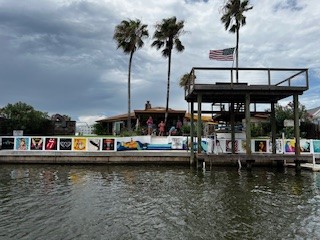
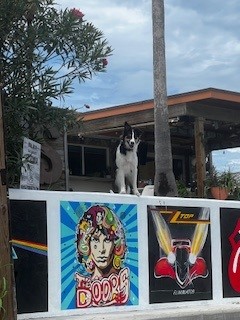
Recently, the saltwater faction of the Strawn clan—my son Wes, his wife Yolli, and grandsons Jett, hired a friend, local artist Jenn Seymour, to paint a mural on their backyard canal bulkhead in North Padre Island, Texas. My oldest grandson, Johnathon, now resides in Corpus, and my granddaughter, Madalyn, was on hand to bolster everyone’s spirits. It’s not their first venture into suburban art; another famous local Corpus Christi mural artist and surfer, John Olvey, painted a large surf mural on their home’s streetside view before he passed away in 2022. Now, the POA, HOA, or whatever this group of whiners calls themselves these days, served my son a letter of violation and demanded the mural be painted over, claiming it is an advertising sign, which is prohibited per their bylaws. The word ‘serve’ is a stretch; they actually taped it to his nice mid-century modern front door, “too yellar” to actually hand it to them in person. I don’t believe this coterie of malcontents thought this one out. Now, it’s taken on its own life form and is spreading like “Pod People.”

The artwork in question is paintings of the covers of the most classic albums in rock music history: Led Zepplin, Jimi Hendrix, ZZ Top, The Beatles, Bob Marley, The Rolling Stones, Willie Nelson, Selena, Nirvana, and a few others. We picked the albums from his extensive collection, and the artist did her magic aided by acrylic paint, Petoli incense, Red Bull, and 1960s good vibrations. Folks from all over the island, Corpus, and far-away lands have made a pilgrimage by boat, foot, and car to view the masterpieces. Wes and Yolli, being gracious hosts, offer a cold bottle of Texas water and a bite of food and lead them through their home to the backyard bulkhead and dock for a better view of the art. Piper, their border collie, happily greets everyone.

The wheels of justice turned quickly when the downtrodden art connoisseurs were wronged. Within a few days, the local paper, The Island Moon, published a rousing piece praising the artwork and exposing the troglodytic POA. One local television station, KRIS, dispatched a top-notch reporter to shoot film and interview Wes, his kin, the artist Jen Seymour, and Piper, the Border Collie. Momo and I spectated the whole shindig from the covered patio and were mightily entertained by the publicity of the whole affair.

This is the last surface in the compound suitable for decoration. So what now? Maybe three large Mariachis playing frogs on the roof? It could happen…it’s the island.

Ob-La-De-Ob-La-Da Life Goes’ On Brah…La-La-How The Life Goes’ On


Yes, Dear Hearts, as the Beatles say, life does go on. As of today, I’m five years cancer-free. I’m expecting a face time phone call from Sir Paul and Ringo anytime now.

Remembering the 4th of July 1957


The whirling of the push mower blades sings a song of torment as I strive to advance the heavy beast forward. I missed cutting the grass by two days: now, it’s akin to whacking my way through a South American jungle. I’m eight years old, and it’s the 4th of July 1957.

Later this afternoon, folks and kin will come over for a backyard cookout and fireworks. A watermelon is chilling in the ice-filled tub, while a supply of Cold Pearl beer and soft drinks occupy another. Both tubs rest in the refreshing shade of our backyard Mimosa tree. My old man’s cherished Leonard Brothers all-steel Master Chef charcoal grill sits on the driveway, brimming with Mesquite briquettes freshly bought from “Little Bills Cookout Ranch” in Eastwood Texas.

Many of the kinfolk invited to the family gathering have long found themselves on my father’s “Naughty List,” but being a kind man, he extends the invitation year after year, including on Christmas Day. They always come, and before long, the reasons for their past banishments come to the fore. Cold beer, followed by a belt of Old Crow whiskey, seems to grant them the audacity to make a truly remarkable spectacle of themselves. They can be quite entertaining, but only for a short while. As a young one, their antics matter little to me. My mind is set on handling dangerous fireworks and causing grandiose explosions.

Folks start moseying in as the sun starts its descent. A few cousins near my age will make the shindig bearable. My tomboy cousin Ginger brings her bow and target arrows, while I tote a bag full of steel-pointed lawn darts. Ginger wastes no time in shooting my cousin Jok in his left buttock. My father yanks out the arrow, and a band-aid does the trick. Kids were made of sterner stuff back then. Only a speeding bullet might have given us pause. We then move on to firecrackers, cherry bombs, and sparklers.

Burgers are served along with “tater salad” and watermelon. Pearl beer gives my father’s uncle Orum the ability to talk like Will Rogers. His home-spun recounts of past family gatherings captivate the adults. Without the lubrication of beer, he is as humorless as a cardboard box.

Cousin Ginger finds her not so well-hidden bow and arrows in our garage and sends an arrow through a bedroom window glass. Her father, Jake administers a well-deserved butt whooping. It’s not often I see a girl get a spanking. Jok and I egg our uncle Jake on. Ginger does the one-arm escape dance, screaming for mercy, as her father delivers the blows.

I obliterate every ant hill in our alley using Black Cat firecrackers before launching a tin can into the stratosphere with a Cherry Bomb. Cousin Jok places a Cherry Bomb on the front tire of his older brother’s new MG convertible to gauge the velocity of the blast. The firework creates an outward dent in the fender, serving as a foreboding omen for Jok’s impending doom; he is well aware of the retribution that awaits him upon his return home.

Darkness comes, and we twirl sparklers in figure-eight shapes. Sticks of metal ablaze at 3,000 degrees. Children clutching a welding torch; what could possibly go wrong? Cousin Jok miscalculating the burn duration of a sparkler, singes his hand, leading him to release the little torch, igniting a yard blanket upon which his mother was seated, prompting her to drop her beer and hot dog. My father douses the blaze with a garden hose. Jok is surely on track to set a new standard for butt whooping’s when he gets home.

Ten o’clock arrives, and I’m lying in bed after my bath. The soft whir of my bedroom fan lulls me into La-La Land. The adults are still in the backyard. I hear their laughter and catch a few words of some dirty jokes.

Drowsiness comes; sleep is but a minute away; then I hear my mother singing God Bless America, and the others join in. It feels good to be a kid on the 4th of July.

A Young Scholar Among Jabbering Idiots


Thanks to my late favorite aunt, Norma Lavender, I became a scholar early in life.

Five-year-olds are stuck between that titty-baby stage and graduating to sandlot baseball and comic books. If life got tough, I could still console myself with a grimy thumb to my mouth, and a skinned knee sent me squalling to momma. I couldn’t tie my own sneakers or button a shirt.

My pushy aunt realized my floundering ways and rescued me with books. She got her hands on the first two years of Fun With Dick and Jane, the books the Fort Worth school system used to teach kids to read; comic books would have to wait; Micky Spillane and Mike Hammer were calling me.

Aunt Norma quizzed me like a Perry Mason for a year, teaching me to write and read. By my sixth birthday, I was a reading Jesse, a child phenom, and a leper to my neighborhood gang. They could barely write and couldn’t read a lick of anything. Here I was, a young Shakespeare among a crowd of jabbering idiots.

Having given her parenting rights to her sister-in-law for a year, my sainted mother has now stepped in to reacquaint herself with her young scholar. I still couldn’t tie my sneakers and applied too much Butch Wax to my flat-top haircut. My mother was a hard-core Southern Baptist, and I didn’t understand why when I colored outside of her parental lines, she would cross herself and say a prayer right before she administered a righteous butt whooping with her favorite weapon; a 9inch by 12-inch Tupperware cake holder. To this day, I won’t touch a piece of Tupperware.

I was assigned a weekly Micky Spillane paperback and expected to read the entire book. Looking back, those trashy, noir detective books were not fit for a child or an educated adult, but Aunt Norma would read a book in 24 hours and was quite an educated gal. I didn’t understand most of what I read, but a few phrases stuck with me: “Is that a pistol in your pocket, or are you just happy to see me?” “A hard man is good to find?” Mike Hammer was always in trouble with a trashy broad. I shared my new vocabulary with the gang, and they dug it.

Mother started receiving phone calls from the other moms, blaming me, her little boy, for teaching their uneducated idiots smutty language. The Tupperware storage pan came out of the cabinet, and my butt burned for a week. Aunt Norma gave me Mark Twain and Huckleberry Finn to reprogram me. I dreamed of someday becoming Mark Twain, a kid with a Big Cheif tablet and a handful of Number 2 yellow pencils stored in a Tupperware container.

A Small Miracle


My Grandfather was a farmer. His life was a hundred seventy-five acres of cruel, rocky land in Southwest Texas. He would not have had it any other way.

On a scorching July afternoon in 1955, I stood next to him at a fence row along the south pasture, watching anvil thunderheads form in the West, behind the Santana Mountain Peak, the namesake of his town, Santa Anna.


Little rain had fallen the past few years. The stock tanks were dry, animals were suffering, crops were dead or dying, and the town’s soul was faltering. The prayers on Sunday were plentiful and to the point: Please bring rain.

There was talk of bringing in a rainmaker at the domino parlor, but the town had little money for such a wild idea. The town folk felt as though the good Lord wasn’t listening. A miracle was needed, even if it was a small one.

We had been standing at that fence row for a good hour, Grandfather not flinching or diverting his eyes from those clouds.
I wanted to see what he was seeing, but I couldn’t. He seemed to be taunting those thunderheads to come over that mountain, staring them down, challenging those clouds to bring what they had to his farm.
Looking away from the clouds for a moment, I looked at his weathered face. Just like his land, deep furrows everywhere. It’s as if each wrinkle was his reminder of a furrow that hadn’t produced a crop. He was only sixty, but his face looked decades older.
He glanced down and caught me staring. Embarrassed, I said the first thing that came to mind,

“Grandfather, why are you a farmer?”


Still staring at the clouds, he cleared his throat and said,

“I’ve always been a farmer boy; it’s all I ever knowed. One night, when I was about your age, the good Lord sent a tiny angel to my bed. She lit on the quilt and said Jasper, you’re going to be a farmer, and you will grow food to feed the children and the beast. This will be your life. How can you argue with the Lord boy? So, here I am.”


Until then, we had never had a real conversation, and I liked the kindness in his voice. I wanted to know this man who had been so elusive and indifferent to me.


“Does the good Lord always tell people what they will do?” I asked.

He replied, It’s what I here’d,” Now you best go tell Granny to get the cellar ready; it’s going to come up a cloud tonight.”

And with that, our first visit was over. Even though it was short, I now felt a closeness to him that hadn’t been there before, and I was eager for the next time.


I came round the barn and saw Granny carrying an armful of quilts and pillows to the storm cellar. She already knew a storm was coming. She always knew.


Grandfather missed supper, unwilling to leave that fence row, afraid those thunderheads would retreat if he did. They didn’t. The first crack of thunder shook the walls and sent me and Granny running for the storm cellar.


Grandfather wouldn’t come with us. He stood at that fence row until the hail stones pounded the cellar door. Only then did he come down, wet and bleeding from the cuts on his scalp. Granny fussed over him for a few minutes, and then he laid down on a cot and fell asleep.
We passed the night in that damp cellar. Granny, sitting, reading her Bible by the light of an oil lantern, Grandfather snoring, and me slumbering between fitful dreams of thunder and lightning. The storm did what it was sent to do.

At dawn, we came out to a sea of water. The fields, flooded, reflected the sunrise like a new jewel. The farm animals rejoiced in unison. Grandfather checked the rain gauge on the fence,

” Seven inches” he yelled.

Granny cried into her cupped hands, and I can’t remember why, but I cried with her.


Around lunchtime, we loaded into the old Ford and drove into town. People lined the sidewalks. Women hugged each other, old farmers patted one another on the back, dogs barked, and children laughed. The town had regained its spirit and hope overnight.


The Biscuit Café was alive, as was the domino parlor and the feed store. Everywhere, the people of Santa Anna rejoiced and gave open thanks for this small miracle.


At the café, Grandfather treated us to a nice chicken lunch. Pastor Bobby and his wife came in and, standing in the middle of the café, offered a prayer of thanks for the rain. Grandfather, not a church-going man, bowed his head and gave a hearty “amen” along with the rest of the patrons.

As we returned to the car, Granny’s old friend Miss Ellis came up to Grandfather, hugged him tight, and in a weepy voice said,

“it’s a miracle Jasper, God gave us a miracle.”

He politely endured her hug for a minute, then we moved on towards home.


That seven-inch rain didn’t end the drought for Santa Anna, but it gave the farms enough relief for the crops to stand tall again and the stock to survive that summer and fall. Grandfather became a church-going man, never missing a Sunday, and his farm produced the best crop in years.


Sixty-seven years later, my wife and I took a day trip back to Santa Anna. I was curious if the town had grown and prospered. It hadn’t. The Biscuit Café, the feed store, the domino parlor, and most of the other shops I remembered were gone. The old church still stood, showing its age but still holding its head high.


We drove out to the old farm. The house, the barn, and the smokehouse are all gone, lost to a fire. The only thing left was the windmill and the cellar. The fields were taken by scrub brush and weeds. Not a furrow survived.


I stood at that old fence line and looked west to the Santana Mountain. Just like that day in 1955, thunderheads were building behind the peak. It was going to “come up a cloud.” I never forgot that conversation with my Grandfather that day, and sadly, I never got to know him better before he passed away a few years later.


I have always believed that the power of prayer can produce miracles, and on that day, standing at that fence line, Grandfather and the Lord struck up a deal. The town got their small miracle, and Grandfather got religion.

Polio Days


Polio was coming to get us: that’s what me and my neighborhood buddies believed. Our mothers could talk of nothing else but the dreaded affliction. My mother would check my temperature at breakfast and right before bedtime.

Fort Worth in 1956 was smack-dab in the middle of the Polio epidemic.

The walls, the baseboards, and every door handle were scrubbed clean. My mother had declared war on the Polio germ, and thanks to that, I didn’t see a swimming pool or movie theater for my entire summer vacation. We, kids, weren’t afraid of the Polio germ: we continued to share a cold Coke or a popsicle; swapping spit didn’t phase us; we had been exposed to every germ in the galaxy, so we figured we were immune.

Halfway through July, and being the hottest summer my folks could remember, a kid two streets over came down with the Polio. Of course, our mothers overreacted and quarantined us until it was deemed safe to venture outside. I knew the kid; his name was Jeremy Pullium, and he was in the fifth grade and played baseball on one of our city’s Little League teams. His little brother, Stevie, sometimes played ball with us and was an official gang member.

The neighborhood mothers thought visiting Jeremy and taking him some cupcakes would be nice. Mrs. Mister made the treats, and she and her two Poodles, Fred and Ginger, would accompany us on the visit.

A quarantine sign was stuck in Jeremy’s front yard, and another was on the front door. We were led back to Jeremeys’s bedroom, where Mrs Mister held the pan of cupcakes.

There was baseball-playing Jeremy lying in a large metal tube that took up most of the bedroom. He seemed happy to see us, even though he couldn’t escape his contraption. Skipper, our neighborhood wiz-kid, checked out the machine called an Iron Lung. We thought it was nifty. The cupcakes were passed around, and Jeremy’s mother fed him one with a fork. Everything but his head was trapped inside the machine. We didn’t get it; he could talk like nothing was wrong and move his head around, but the rest of him was paralyzed and trapped in the Iron Lung. Jeremy’s mother explained how the machine kept him alive by breathing for him, and the doctors said he might be in the lung for a year and was likely to recover.

On the way over to Jeremy’s house, Mrs. Mister warned us about being polite, and she meant it. All the mothers had deputized her, and she was allowed to administer a butt whooping if needed.

Georgie is usually the one that gets us in trouble; he can’t contain his mouth. Looking into one of the machine’s windows, he asks Jeremy,

” What do you do if you gotta pee or poop?”

Before Jeremy’s mother could answer the delicate question, Jeremy says,

” I just do it, and the nurse cleans me up. I don’t have to do nothing. Pretty cool.”

The visit abruptly ends. Once we reach the sidewalk, Mrs. Mister, using her open hand, pops Georgie upside his mouthy little head several times. We heard that later that day, Georgie got a well-deserved butt whooping from his mother while Mrs. Mister enjoyed a glass of iced tea and observed her technique.

“Ain’t Scared”


This, Dear Hearts, should scare conservative Americans to death.

CHILLING: Biden Regime Declares Trump Supporters Domestic Terror Threats in Newly Released Internal Documents, Sought to Set Up DHS Intel Unit to Target Them

Here in Texas, we have more down-home sayings than cattle. “Ain’t Scared” is one of them, and it sort of says it all about how we Texans feel about the crap that our government fan throws our way. The above title is real, and Dear Hearts, this time we should be scared…real scared. If the title doesn’t hit you in the gut, perhaps the picture will.

How I long for the presence and the voice of the esteemed Paul Harvey. His ability to provide perspective on our nation’s turmoil and division would be invaluable.

Good day.

It’s 1968, And We Are In A Recording Studio


By request, I am again publishing this post, including my 1968 recording of the band I was part of, The A.T.N.T.; formally, we were the Orphans but changed our name at the suggestion of Mark Lee Productions, our manager. Enjoy.

The year was 1968, and the rock band I played in, The A.T.N.T., recorded a 45 at Summit Sounds in Dallas, Texas. The band had been called The Orphans, but a copywriting dispute resulted in a name change. Our then-manager, Mark Lee Productions, wasn’t keen on the idea because we had been under his management and promotion for a year.

The A side is “Cobblestone Street,” written and sung by myself and our drummer Barry Corbett. The B side is ” No One Told Me About Her,” written and sung by our lead singer and bass player, Danny Goode. The two producers, Marvin Montgomery and Artie Glenn, suggested we add horns to get a Chicago Transit Authority sound. Before the brass was added, Cobblestone Street was loud and raw with loud guitars and organs. After adding the horns, we returned to the studio and tweaked the cuts. I purposely untuned my Gibson 335 a bit to give the guitar break a bit of an out-of-tune carnival sound. Marvin, who went by the name of Smokey, was a member of the Light Crust Doughboys since the 1930s and played with Bob Wills. He produced Paul and Paula and Delbert McClinton. Artie Glenn wrote the famous Elvis hit “Crying In The Chapel” and many others; he was also a Light Crust Doughboy western swing musician. These two men were top-shelf record producers, so we listened when they suggested.

The A.T.N.T. at Flower Fair 1968

Our band members in the above picture are: foreground right John P. Strawn ( me ), then Jarry Davis on rhythm guitar, Barry Corbett on drums, Danny Goode on bass, and Marshall Sartin on keyboards. Barry and Marshall have passed on, but Danny, Jarry, myself, and our wives met for lunch a few weeks back in Fort Worth. It’s obvious why we all have severe hearing loss from the large amplifiers turned up to 11.

We introduced the songs at Flower Fair 1968 but without the horns. The Doors were supposed to play the event, but last-minute scheduling got sideways, and they couldn’t make it. This was the Spencer Davis Group without Steve Wynwood in the band. LeCirque ( The Smell Of Incense Fills The Air ) was formally known as The Southwest F.O.B. with members England Dan and John Ford Coley, who would later go on to fame as a duo, both local Texas boys. Kenny and the Kasuals were also a local group managed by Mark Lee.

The record received good airplay, but we never made much money. Distribution was the key, although the local radio personalities gave it positive chatter. Hope you enjoy the tunes.

“Getting Zapped…Brown Shoes Don’t Make It” And A “Beach Party On The Ganges”


It would be a shame if I didn’t include some local 1960s rock musical history by spotlighting our drummer, Barry Corbett, otherwise known in our tight little musical circle as ” Li’l Spector.” The moniker came about because the boy, at age 15 years old, was a musical genius in the same vein as Brian Wilson, Leonard Bernstein, and Phil Spector: thus his earned nickname. We would never know why he chose the drums as his primary instrument: the guy played an assortment, including Bongo drums, kazoo, paper and comb, Dog House bass, violin, Hurdy Gurdy, guitar, keyboards, Vibes, Trumpet, Piccolo, Harmonica, Juice-Harp, Spoons, Autoharp, Dulcimer, French Horn, Tabla, finger cymbals, gasoline-powered Lawnmower, and Sitar. I’ve probably left a few out; it’s been a while since I thought about this. Barry’s original drums were worn out, so his father purchased him a set of Slingerlands. The finish was all swirling and psychedelic, and if we wore those cheesy 3D glasses from 7-Eleven, we could see the Summer of Love a full year before it happened.

In 1966, our repertoire consisted of The Beatles, The Rolling Stones, Hollies, Paul Revere And The Raiders, The Turtles, and The Byrds. We also played a handful of Beach Boy songs. Our voices were still high, so the Brian Wilson falsetto wasn’t a problem.

The 1966 Orphans in our Paul Revere boots

Unknown to Jarry and I, Barry secretly listened to weird underground music: “Frank Zappa And The Mothers of Invention.” These guys were so whacked out that the radio refused to play them, but Barry would. He adored Zappa and wouldn’t wear brown shoes in brotherhood to the song ” Brown Shoes Don’t Make It.” He was also a newbie-semi-devout disciple of East Indian music, mainly Ravi Shankar and his droning Sitar, thanks to George Harrison and the album Rubber Soul.

We knew Barry had purchased a Sitar from “Pier One,” a Dallas specialty store loved by the Hippies. The store hawked strange goods from India and the Middle East. He called one day and asked that Jarry and myself drop by to hear him play his sitar.

We were surprised when he could coax the part to “Norwegian Wood” out of the goofy instrument, so we agreed to learn the song and let him play it during our next gig at the Richardson Recreation Center the coming Saturday evening. He failed to mention that he had two additional musicians accompany him. He was a tinkerer, so he removed the electric pickups from his Gibson Melody Maker guitar and installed them on the sitar, creating the first electric East Indian instrument. Two Electrovoice condenser microphones were used to amplify his additional musicians.

Our gear was set up, and sound checked an hour before the dance, and in strolls Barry, dressed in a Nehru suit: his girlfriend and a guy about Barry’s age in tow. His followers, wearing a white Sari and a Dhoti, trolled behind him: they carried a small bongo-like drum called a Tabla and two tiny Zildjian cymbals on cute little stands. The guy was carrying an instrument that looked like a cross between a fiddle, a guitar, and a Dulcimer. All three had bright red Bindi dots on their foreheads. Barry was lugging his sitar, drum kit, and a Vox AC30 amplifier. After he set up his drums, he ran a sound check on the electric sitar and stuck the other mic inside the Tabla drum, one next to the little cymbals and the frankeninstrument. They sounded pretty good for a Rube Goldberg rigged setup. The three of us were duly impressed but leary of what might happen. Chaos followed Barry like an afternoon shadow.

The band played the first set to about 300 sweaty teenagers. The building’s air conditioning couldn’t keep up: it was a typical July in Texas.

Barry and the two musicians rolled out a Persian rug, which was likely stolen from his mother’s dining room, and positioned it in front of his drums. The girl lighted incense sticks held in large brass holders. Barry lugs his sitar from behind the stage, plugs it into the Vox amp, and sits in the traditional Shankar crossed-legged position. He is ready to rock. We break into Norwegian Wood, and the three-piece Hindi band sounds darn good but a bit loud. The teenagers move in close and surround the trio. Who are these weirdo-freaks? We finished the tune and received polite applause. A better reception than we had hoped for, but then…

For their second tune, Barry announces they will play Ravi Shankers’ biggest hit: “Beach Party On The Ganges,” a snappy little number sounding like Brian Wilson, and the boys meet Ghandi and crew for a cookout on a crocodile-infested beach. The sitar starts to feedback, and the Tabla drummer and Frankenguitar lose their tempo, not that there was one ever established, and Barry, now in a musical trance, is all over the sitar. The crowd of surrounding teens is transfixed, awed by his Zen Zone musicianship. The two other musicians, lost and toasted, have stopped playing. Lil Spector drives onward in his moment of musical adulation.

The Sitar feedback was incredible, so Barry, still locked in his “Ravi sitting position,” leaned back to reduce the volume on his amp. He leans too far, loses his balance, and falls backward, causing the head of his Sitar to catch a mic stand and break off the long body of the instrument. No one knew that Sitar strings were wound to a deathly tension. When the Sitar broke, the strings popped, winding around Barry’s head into his hair and then into his two other musicians’ long hair. It was a disaster. All three were incapacitated on the rug, unable to move. The crowd hooped and hollard, thinking it was part of the show. The poor Sitar wound up in the dumpster, and his musical disciples left the fold, throwing their red-dot makeup tin at Barry as they stormed out of the Rec Center. At his request, we dropped Norwegian Wood from our setlist.