Polio Days


Polio was coming to get us: that’s what me and my neighborhood buddies believed. Our mothers could talk of nothing else but the dreaded affliction. My mother would check my temperature at breakfast and right before bedtime.

Fort Worth in 1956 was smack-dab in the middle of the Polio epidemic.

The walls, the baseboards, and every door handle were scrubbed clean. My mother had declared war on the Polio germ, and thanks to that, I didn’t see a swimming pool or movie theater for my entire summer vacation. We, kids, weren’t afraid of the Polio germ: we continued to share a cold Coke or a popsicle; swapping spit didn’t phase us; we had been exposed to every germ in the galaxy, so we figured we were immune.

Halfway through July, and being the hottest summer my folks could remember, a kid two streets over came down with the Polio. Of course, our mothers overreacted and quarantined us until it was deemed safe to venture outside. I knew the kid; his name was Jeremy Pullium, and he was in the fifth grade and played baseball on one of our city’s Little League teams. His little brother, Stevie, sometimes played ball with us and was an official gang member.

The neighborhood mothers thought visiting Jeremy and taking him some cupcakes would be nice. Mrs. Mister made the treats, and she and her two Poodles, Fred and Ginger, would accompany us on the visit.

A quarantine sign was stuck in Jeremy’s front yard, and another was on the front door. We were led back to Jeremeys’s bedroom, where Mrs Mister held the pan of cupcakes.

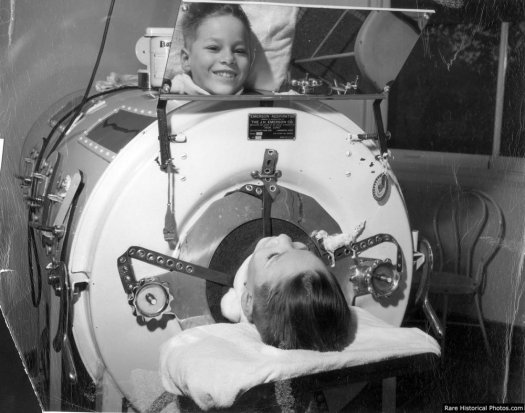
There was baseball-playing Jeremy lying in a large metal tube that took up most of the bedroom. He seemed happy to see us, even though he couldn’t escape his contraption. Skipper, our neighborhood wiz-kid, checked out the machine called an Iron Lung. We thought it was nifty. The cupcakes were passed around, and Jeremy’s mother fed him one with a fork. Everything but his head was trapped inside the machine. We didn’t get it; he could talk like nothing was wrong and move his head around, but the rest of him was paralyzed and trapped in the Iron Lung. Jeremy’s mother explained how the machine kept him alive by breathing for him, and the doctors said he might be in the lung for a year and was likely to recover.

On the way over to Jeremy’s house, Mrs. Mister warned us about being polite, and she meant it. All the mothers had deputized her, and she was allowed to administer a butt whooping if needed.

Georgie is usually the one that gets us in trouble; he can’t contain his mouth. Looking into one of the machine’s windows, he asks Jeremy,

” What do you do if you gotta pee or poop?”

Before Jeremy’s mother could answer the delicate question, Jeremy says,

” I just do it, and the nurse cleans me up. I don’t have to do nothing. Pretty cool.”

The visit abruptly ends. Once we reach the sidewalk, Mrs. Mister, using her open hand, pops Georgie upside his mouthy little head several times. We heard that later that day, Georgie got a well-deserved butt whooping from his mother while Mrs. Mister enjoyed a glass of iced tea and observed her technique.

Are You A Boy..Or Are You A Girl?


So now the Boy Scouts of America have put on their make-up, styled their hair, and inserted their tampons in the appropriate orifice.

I was a Boy Scout and a Cub Scout. My grandson was a Cub Scout and is now a Boy Scout, and my son is his troop leader. I can tell you, they are not a bunch of whiny-assed pansies like we are reading about in the news. What a disgrace to America. All those years of honor flushed like a happy bear toilet wipe.

Yeah, I get the lawsuits and all that, and the payouts, and girls wanting to be boys instead of their biological gender, and the little sissy boys wanting to be a girl scout in a boy scout uniform; it’s where the world is at this day.

How about drinking some Ovaltine, putting your hand between your legs and feeling what God gave you, and go shoot your Daisy BB gun and shut the hell up.

A Nickle Will Save Your Soul


My first dose of old-time Texas religion came at six years old. Up until then, my sainted mother deemed me too young, fidgety, and stupid to grasp the complexity of the Southern Baptist philosophy. She was right, and I finally gave up when I became an Episcopalian.

The Polytechnic First Baptist Church in Fort Worth, Texas, was rumored to be the place to go if you wanted a direct line into Heaven. On Sundays, the pews were packed, and folks lined the walls while the children sat in the aisles. Christmas and Easter, the church opened its doors at daylight so the longest-standing members could claim seats. My father’s large extended family, around thirty members and their relatives by marriage and accidents, lived in Poly, and they all attended the PFBC, as it was called by the congregation. My two cousins and I, being the same age, were the newest lambs to enter the flock.

My first Sunday arrived in September of 1955, the week after my sixth birthday.

September weather in Texas is no different than August, July, or June: it’s miserable hot. Dressed in a heavily starched, long-sleeved white shirt, a kid-sized clip-on tie, black trousers, and shiny new Buster Brown shoes, I was a styling child and feeling pretty good about my debut. By the time my father skidded his Buick into the church’s gravel parking lot, my new duds were sweat-soaked, and I smelled like a beer-joint ashtray: our car had no air-conditioning, and my parents smoked Lucky Strikes two at a time. My sister was five months away from making her appearance, so my mother was chain-smoking for two.

Once in the church, my cousin Jock joined me, and we seated ourselves next to my mother so she could control our behavior with her patented one-eyed stare or a motherly, open-handed whack to the back of our flat-top-haircut-wearing little heads. She gave me a gentle swat before entering the church, just to let me know what awaited me if I acted like a fool.

Most of my father’s aunts and uncles took the first rows closest to the preacher. Their warped reasoning was that the closer to the pulpit and the preacher, the better the chance of forgiveness for last night’s debauched beer-fest and the slight chance of possibly slipping past the pearly entrance gate guarded by Saint Peter. They’ve all been gone for decades, so no one knows if their plan worked. The promised contact from beyond has yet to materialize.

My grandmother, her four sisters, and one brother were hard-drinking, two-stepping, championship-cussing Baptists and had no use for Presbyterians, Methodists, and especially Catholics. PFBC: Our church was so bright-white that you needed sunglasses to kill the glare.

The leader of our church, the exalted flamboyant Reverend Augustin Z. Bergeron, a transplant Cajun from Chigger Bayou, Louisiana, was a certified autograph-signing local celebrity. He wore expensive mohair suits from Leonard Brothers Department Store, retained a personal hair stylist who kept his wavy locks immaculate, and sported custom-made footwear from Larry’s Shoes. He was likely the inspiration for the outrageous 1950s ex-preacher turned comedian Brother Dave Gardner. The man commanded the pulpit and the stage like a Broadway entertainer. With a lighted cigarette in one hand and a Tupperware tumbler full of iced-sweet tea in the other, he paced and screamed like a detained mental patient, cursed the Devil and his minions, admonished the sinners in the congregation, strutted, shuffled, stomped, rolled on the floor, crawled on his hands and knees, and wept like a middle-aged housewife going through the change of life. The choir of big-haired ladies standing behind him punctuated every nuance with an “Amen, Hallelujahs, or Praise the Lord.” It was expected that two or three of the older singers would faint dead out during his sermon. It was cast in newsprint that if Reverend Bergeron’s bombastic sermons couldn’t bring a sinner to Jesus, no one could, not even J. Frank Norris or “By-Gosh” Billy Graham.

An hour into his fiery sermon, Reverend Bergeron took a potty break, and the ushers passed the silver plate down each row of pews. My mother gave Jock and me a nickel to contribute. I was reluctant to part with the change; a nickel was a lot of money, and by selling a few soda pop bottles, I would have enough for a Superman comic book. The plate came to me, and without hesitation, in went the prized coin: my first tithe. Jock dropped his nickel but pulled a sleight of hand and took a beautiful fifty-cent piece in exchange. Looking back, that might have been the start of his slide into petty crime that would find him, on his sixteenth birthday, a resident of the local detention facility known as “The Dope Farm.”

Our young lives took different paths: mine a bit boring but safe, and Jock’s loaded with excitement but long on trouble. I would like to believe that by giving up that coveted nickel, I was blessed with a thumbs-up from above.

Growing Up In The 1950s. Threats Used By Parents To Keep Kids In Line


Pictured is the infamous “Dope Farm” in Fort Worth, Texas. A facility built to house drug addicts and high-profile bad guys. If you grew up in Fort Worth in the 1950s, chances are good that your parents used this place as a threat to keep you in line.

My neighborhood buddies and I were a bit on the bad side; nothing severe, just minor kid things like blowing up mailboxes with cherry bombs, setting garages on fire, raiding the milkman’s truck while he was taking the bottles of milk to a doorstep, dropping firecrackers down rooftop vents, fun little things like that.

These minor infractions usually ended with one or all of us getting a butt whooping with a belt, flyswatter, Mimosa tree switch, a tennis shoe, or a Tupperware cake pan. The Tupperware hurt more than any of the other weapons our mothers could find. When our hijinx got to be too much, our mothers would pull out the dreaded threat of “Okay, that’s it, either straighten up or I’m sending you to the Dope Farm.” That’s all it took to turn us into practicing angels for a few days. All the kids knew about this place. The narcotics users, gangsters, and local children who misbehaved went there. None of us actually knew anyone who had been incarcerated within those walls, but the thought of going there scared the liver out of us.

In the late 1950s, a cousin of mine turned into a genuine hoodlum, robbing a grocery store dressed up like Mr. Greenjeans from the Captain Kangaroo show. Greased back hair, black work boots, dirty Levis, and a white tee-shirt with a pack of Camels rolled into the sleeve, and he rode a junked-out motorcycle. When my mother spoke of him, she crossed herself. My poor cousin was added to the ever-present threat because he spent a year of his teenage life at The Dope Farm, living in a small cell, eating Wonder Bread and Bologna samwithches, and watching the old movie “Boys Town” every Saturday night. There wasn’t a Father Flannigan on the premises, only guards with guns and a Baptist preacher.

I was pretty good for a year while my cousin was locked up. We received a Christmas card with a picture of him dressed in his striped pajamas, slicked-back hair, and a Camel dangling from his snarly mouth. All this while perched on Santa’s knee. It was a nice little card, similar to the ones we made in school from construction paper and paste. Some bad words and threats were written below the photo, but my mother wouldn’t let me read them. She cut the bad word part off and taped the card on the ice-box, so every time I opened it, the threat was there, and it worked.

The only kid, other than my hoodlum cousin, who was dragged off to the place was our baseball team center fielder, Billy Roy. Billy started hanging out with our nemesis across the track, The Hard Guys, and became a regular James Cagney by the fourth grade, robbing a local convenience store with a Mattel Fanner 50 cap pistol. You guessed it, he went to the Dope Farm for six months. He learned some good stuff there because when he came out, he went directly into a lucrative life of hoodlummanity and crime. Last I heard, he was in Sing Sing.

Dispatches From The Cactus Patch 3/9/24


My late cousin, Chumly, is pictured above after he found his calling in shark training. Steven Speilberg employed him to wrangle his pen of sharks used in the movie Jaws. This is the last photo of Chum after he thought he had made friends with the lead shark. The only parts of Chum recovered were the sneakers and sunglasses.

My mother’s late uncle Zap was considered the inventor of the family. His most famous contribution was the ” Home Personal Hair Removal Wand,” which was the forerunner to Nair and other hair removal products that became household staples in the 1950s. Zap and his lovely wife, Yippie, a Harpers Bizzare hair model, are pictured here, demonstrating the device for the Fort Worth Press in their backyard pool in 1957. Her hair from the waist down was zapped away, but when she fell backward into the pool, she was rendered bald as a cue ball. The divorce came shortly afterward.

Pictured above is my cousin’s niece, Fifi, who, since the age of 16, has identified as a dog. After years of expensive therapy, her parents gave in and presented her with a custom-made Serta dog bed. The last report is that all was going well except for letting her out to pee twice a night and holding an umbrella over her when it’s raining.

Pictured above is my grandson’s Boy Scout Troop 33 1/3 of the Texas Longhorn Division, arriving at the Texas/Mexico border to support the National Guard. After arrival, they were issued Daisy BB guns and a towsack full of chunkable river rocks to fend off the invaders. Jesus Navidad, an illegal, after crawling through the razor wire, said, “Those Boy Scouts are mean little shits, and man, those BB guns and rocks hurt, I texted all my relatives and told them to stay home until they can catch a free flight to New York.”

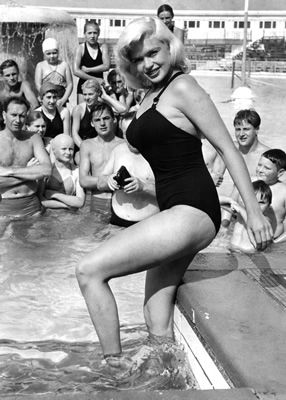
My childhood neighbor, Mrs. Mister, in 1956, posing for the Fort Worth Star-Telegram after becoming the only female swimming instructor at the parks and recreation’s Forest Park Pool. Swimming lessons hit an all-time high that summer and the pool had a record year. I’m the goofy kid, bottom right, second up behind our right fielder, Rhonda.

Pictured above, around 1954, is my neighborhood milkman, Mr. Rock Pint. He was a swell guy who gave all of us kids free chocolate milk and ice cream sandwiches during the hot Texas summers. All the moms loved him, and many of the younger kids resembled Mr. Pint; must have been something in the milk?

Pictured above is a crowd photo from the Texas International Pop Festival, August 1969. I am in the center of the crowd, about thirty people back; Momo, my wife, is just to the right of the center, about forty people back. My buddy, Jarry, is the blond guy with the severe sunburn that required hospitalization, but the paramedics wouldn’t transport him until the Grand Funk Railroads set was over. I survived one-hundred-degree temperatures for three days and got to meet Janis Joplin one late night when this nice gal with a Texas twang asked me if she could cut in line as I was waiting to buy a hot dog. It took a minute for me to realize it was her, but I was cool; it was the sixties, man. That night, ole Janis “took a little piece of my heart, now baby.” Momo and I still get a good laugh and a few wheezes when we revisit those times. Our children and grandchildren will never be as cool as we were.

“Come And Take It” The Story of The Alamo Brisket


This Tall Tale is from 2021. With the anniversary of the final battle of The Alamo upon us, I figured a re-visit might be welcomed.

Tex R. Styles learned the art of grilling at a young age. His father, an expert, medal-winning griller, and smoker, proudly and meticulously teaches six-year-old Tex the art of cooking everything from burgers to ribs on his cast-iron Leonard Brothers charcoal grill. The family lineage of grilling over an open flame can be traced back to the British Isles and their ancestral home of Scotland, where a Styles family member cooked meat for Celtic warriors, the King of England, and Mary, Queen of Scots.

When Tex turns eleven, his father conducts a tiki-torch-lighted ceremony in their backyard and passes the sacred grilling tools to his only child. Father Frank, the local priest, attends the party and lays down a righteous blessing on Tex and the family grill.


When young Tex fires up the charcoal on summer evenings, the neighborhood gathers in his backyard to watch the boy genius at work.
Once he has entered his “Zen-cooking zone,” he serves up a better T-Bone than Cattlemen’s, and his burgers are known to bring tears to a grown man’s eyes. Around Fort Worth, the word is out that some little kid over on Ryan Ave is a “grilling Jesse.”

Tex receives a bright green Weber grill for his thirteenth birthday and a professional cooking apron with his name embroidered across the front. The Star-Telegram newspaper takes his picture and writes a glowing article that appears in the Sunday food section. Over on Channel 5, Bobbie Wygant mentions him on her television show and sends him a congratulations card. He is now a local celebrity. Dan Jenkins, the hot-shot sports writer at the Telegram, does a piece on Tex for Sports Illustrated, and just like that, young Tex is officially a “big deal.”

When Tex turns sixteen, like his father and grandfather, he is inducted into the “Sons Of The Alamo” Masonic Lodge. To become a member, your family tree must include one direct family member who fought and died at the Alamo. Tex’s great-great-great-grandfather was a defender and was killed in the siege. He was also the head cook and griller for the Texian Army and a rowdy drinking buddy of Jim Bowie and Colonel Travis.

New members must speak before the lodge elders, recounting the siege from their family’s history. Since childhood, Tex had heard this family story a hundred times and can repeat it word for word, but tonight, he is drawing a blank on some critical details and decides to wing it a bit. In the mind of a sixteen-year-old, his modernized recount of the battle makes perfect sense.

He stands in front of the assembled elders, leans into the microphone, and begins;
“In late 1835, my great-great-great-grandfather, Angus Styles, traveled from the Smokey mountains of Tennessee to the dangerous plains of Texas with David Crockett and his band of long-rifle toting buckskin-clad rabble-rousers. Angus was in the dog house with his wife most of the time, so he figured a year or two in the wilds of Texas would smooth everything out with the Mrs.

Before immigrating to America, Angus was the chief griller and top dog chef for the Duke and Duchess of Edinburg in Europe. David Crockett knew Angus was a master griller and wanted him to travel with his men so they would eat well. Crockett and the men killed the meat, and Angus grilled it to perfection.

Arriving in Texas, Crockett tells Angus they are making a stop-over for a few days at a mission called The Alamo in San Antonio De Bexar. A buddy needs help fighting off a few Mexican soldiers; it shouldn’t take more than two days.

Once at the Alamo, arriving in the dark, entering via the back gate, Angus realizes Crockett was wrong in his evaluation. The rag-tag Army behind the walls would be no match for the thousands of Mexican soldiers sitting on a riverbank a few hundred yards away, eating tortilla wraps and polishing their long bayonets. Mariachi music floating on the breeze gave the scene a weird party-like atmosphere.

Angus locates and converts an old Adobe oven to a smoker griller, working on some chow for the Texians. Brisket, ribs, and sausage, along with his secret sauce, will be on the supper menu.

A young pioneer woman from northern Texas is there with her father, a volunteer. Veronica Baird is busy baking bread and cinnamon rolls in another adobe oven and lends Angus a hand stoking his fire. A prominent German fellow, Gustav Shiner, wanders over and offers Angus a mug of his homebrew beer. It’s looking like the Army will eat and drink well tonight.

A chilly March wind is blowing toward the Mexican Army camp, and the troops smell the delightful aroma of cooking meat and baking bread. Having marched 1500 miles with little food, they are famished, and the wafting perfume makes them salivate like an old hound dog.

General Santa Anna and his officers also smell the same heavenly aroma and, having not much to eat in the past few days, hatch a scheme to get their hands on that meat and freshly baked bread. Santa Anna sends a white flag rider with a note to the gates of the Alamo.

Standing in the courtyard, surrounded by hundred-plus fighters, Travis reads the letter, ” Dear Sirs and Scurrilous Rebels, on behalf of our large and overpowering Mexican Army and of course, myself, General Santa Anna, we would be willing to offer you a general surrender of sorts if you would share your delicious meat and bread with my troops. Looking forward to a good meal. Yours until death, General Santa Anna.”

The men, in unison, yell, “hell no,” we are not sharing our chow. Being a bit smart-ass, Travis orders two 20-pound cannons to fire a rebuke into the Mexican camp.

The first cannonball destroys the Mexican’s chuck wagon and what beans and flour the troops have left. The second cannonball blows up the cantina wagon, vaporizing numerous cases of tequila and wine. Now, the officers and troops have no food and no hooch. Santa Anna is as mad as a rabid raccoon and screams, “that’s it boys, we are taking the mission pronto.”

The battle started that evening, and as we all know, it didn’t turn out well for the Texians. Veronica Baird survived the massacre and said that Angus Styles and Gustav Shiner fought off the advancing soldiers with carving knives, a keg tap, and her sizeable wooden baker’s Peel. They fought to their death.


As the women and children of the Alamo were escorted out of the mission, Veronica Baird spots Santa Anna, sitting on his black horse, about to take a bite from one of her captured Baird Cinnamon rolls. She chunks a rock and knocks it out of his hand. General Santa Anna’s Great Dane dog, Mucho Perro, gobbles it down before it hits the ground. Sweet revenge.

She later wrote a book about the battle, which sold pretty well here in Texas. Not only is the Alamo our sacred national treasure, but it was also the first BBQ joint in Texas. Thank you, and I hope you enjoyed the story of my grandfather Angus dying at the Alamo.” And with that, Tex takes a seat next to his stunned father.

God Bless The Alamo


A few more days until we solemnly recognize the fall of the Alamo, March 6th, 1836. It’s not a day that will live in infamy like Pearl Harbor, the battles of Gettysburg and Yorktown, but for us native Texans, it’s a day of retrospect that deserves the reverence we bestow upon it.

The blog-es-phere is chock full of opinions about Travis and his men; poor old Santa Anna only wanted to get along, move along and be friends, but had to kill all the defenders because he was forced to. Bullshit, he was a murdering dictator and knew full well what he was doing. Three thousand plus soldiers against less than two hundred poorly equipped pioneers and farmers. Not much brotherly love was present in San Antonio that February and March. There are even stories, one of which I read today, that swear black slaves were picking Texas cotton outside the gates of the mission before the Mexican army invaded. If it’s on the internet, it’s got to be true. Right?

Starting in the first grade, I was taught the history of the Alamo. My teacher made sure my classmates and I knew the story of the battle, the events that led up to it, and the aftermath at San Jacinto. Mrs. Edwards, my teacher, was a native of San Antonio, so she was a bit “ett” up with the whole thing. Us six year- olds, although slightly lacking in historical proficiency, understood the enormity and the importance of the battle. We regularly staged a neighborhood reproduction of the battle a few times a month, using my parent’s garage as the besieged mission.

Walt Disney and his television series Davey Crockett, King of The Wild Frontier, turned every boy, and most girls, in my grade school into a rabid Texian defender, ready and willing to fight the battle a second time using our Daisy BB guns and Cub Scout knives for arms. Having a native Texan and hometown boy, Fess Parker, in the role of old Davey didn’t go unnoticed in Fort Worth. Fess, dressed in full buckskin and coonskin cap came to Fort Worth to promote the show and the schools had to declare a holiday because they were empty. That is how serious we are about our history. Yes, we are all braggarts, insufferable most of the time, and onery as a Honey Badger, but pound for pound, put us against any enemy, and we will get the job done. My fellow members at The Sons of The Alamo Lodge, of which I am a member in good standing, can attest to our state of readiness.

Keep your powder dry; God Bless The Alamo, Goliad, San Jacinto, William Travis, Sam Houston, Juan Sequin, Davey Crockett, Bob Wills, Willie Nelson, and George Strait.

WordPress Is Now Facebook, Twitter And Instagram


Oh My! Say it ain’t so, Sheriff!

Yes, Dear Hearts, the best blogging site out there, has been discovered by the cancel crowd. They now think WordPress is Facebook, Twitter, Instagram, and all the other platforms where they can hide behind a keyboard and burn down the mission with hateful, moronic verbiage. In the past 14 years I have been blogging, there have been only a handful of inappropriate comments thrown my way; some I responded to, others got the trash can symbol. My most recent post, ” High Noon At The Border,” must have caused folks to lose some brain cells and hide in their safe rooms.

Sure, it’s comedy; anyone with half a brain can see that, although I now know there are folks out there who take it seriously. I received one comment from a former Texan who was dragged to California at a young age. She wrote an alternate scenario about the border, which was snarky, well-written, but full of venom. I can picture her at her Apple laptop, tapping away, sipping on a latte’ in between sobs. You can bet she is a Garrison Keillor fan and listens to NPR. I hope the crazed woman doesn’t have access to an assault rifle, most folks know I live in Granbury, Texas, and I wouldn’t be too hard to find. Out of respect for my readers, I ditched her cute little reply, as well as a few others that started with an F and ended with a k..you get the message. I must be on the right path if it offends the ones that cause all the trouble in this country. I’m rather enjoying this.

Dispatches From The Cactus Patch Feb. 28th, 2024


One of the by-products of becoming a senior citizen is the onset of boredom. I can only watch so much Wheel of Fortune, although Momo would sit for days watching a pre-recorded loop of the same episodes and keep guessing all the puzzles, waiting for old Pat to send her a check or a vacation voucher to Ukraine. I want to slit a vein.

The Beatnik thing didn’t work out; I was too old, forgot all the best verbiage, and couldn’t stand to wear turtleneck sweaters anymore. Revisiting “On The Road” stirred an interest, but then I took a nap and forgot about it. When I have a good idea, it’s best to avoid daytime naps; they tend to act as a mental reset button for us folks.

Momo suggests I try my hand as a social influencer on TikTok or YouTube. She might be onto something. I have an abundance of white hair, much like those TV preachers from the 1980s when a person could lay their hands on top of their Motorola console color unit and be healed, but only after you gave the call-in number person your credit card number: no donation, no cure. I have the schtick and the suaveness to pull it off. I imagine it would be more like a Brother Dave Gardner comedy album. Speaking of, Brother Dave was my idol back in the late 50s and early 60s. But then, the portable record player broke. My comedy stint was over before it started. But I have the hair: you be the judge and let me know; my phone number is BR-549. A coinsedense how much I resemble Brother Dave.

In Remembrance: Mrs. Mister Makes A Killing


A Tall Texas Tale For Those With Wrinkles…

Pictured above is none other than my childhood neighbor, Mrs. Mister, pouring her revolutionary beauty concoction, “Mrs. Mister’s Transforming Beauty Soak And Wrinkle Eradicator,” into the swimming pool at Colonial Country Club in Fort Worth, Texas, circa 1956. After emptying the last magnum of this magical elixir into the pool, every female club member over the age of fifty plunged into the water and adamantly refused to emerge until they attained Mrs. Mister’s enviable wrinkle-free appearance. Admittedly, a few of them came close to the mark, but, alas, the majority remained, shall we say, in dire need of further miraculous intervention.

Being the shrewd entrepreneur she was, Mrs. Mister struck a deal with Avon and pocketed a tidy sum for her creation. The miracle potion was rebranded as “Avon Skin So Soft,” renowned not only for its beautifying properties but also for its ability to repel those pesky “no-see-um” gnats. After all, why not fend off insects and look fabulous while doing so?