I’ve recently sprouted a beard, and much to my surprise, not a single dark hair dares to intrude upon my snowy facial wilderness: the scruffy testament to my frothy mirth matches the proud hue atop my head, a delicate white crown. As a son of Cherokee lineage, I stood astonished, finding myself transforming into an old man with pearly locks in my forties. This change, I suspect, is the handiwork of my father’s Scotch-Irish heritage—a rowdy clan of kilted revelers who seemed to navigate life with laughter and a touch of mischief. They must have commandeered a ship, setting sail for New York, then onto Pennsylvania, where the merry-making reached promising heights. My grandfather would neither confirm nor deny the wild tales of our kin. This speaks volumes about my love for Irish Whiskey, while the Cherokee blood in my veins draws me to large, sharp knives. Hand a drink to an Indian, and trouble isn’t far behind. History whispers of how Little Bighorn ended for Custer. Loose chatter suggests that Sitting Bull and Howling Wolf snagged a wagon load of drink the night before the fray, bestowing upon the braves a reckless spirit. Had they chosen an early night with a hearty breakfast of Buffalo tacos, perhaps the bloody disaster would have been averted.
As a boy of nine, I dreamt of writing like Twain. In my innocence, I thought I was his spirit reborn, dropped into a different time: September of 1949, the last year of the baby boomer generation. With a Big Chief Tablet and a number 2 pencil, I set out to capture the simple chaos of childhood mischief. There were four of us, bold and reckless, stealing cigarettes, hurling water balloons at police cars, and fighting with the tough kids across the tracks. The local papers laughed at my tales as if a child’s imagination could not hold weight. My aunt, wise and educated, introduced me to Spillane and Steinbeck. Spillane turned me into a wise-ass, insufferable child, resulting in numerous mouth cleansings with Lifeboy soap. Steinbeck felt right—my family had lived a life like Tom Joad’s, migrating to California during hard times of the Dust Bowl and the 1930s. I had stories in me, maybe even a book. A therapist dismissed it as a childish fantasy, saying it would fade. Yet here I am, much older, still tethered to that innocence. Now, I’m in my Hemingway phase, my looks echoing the rugged man who lived wild in Cuba, writing furiously while embracing the chaos of life.
There is more sand in the bottom of my hourglass than in the top. I feel the end approaching. I do not wish to know the day or hour. I can only pray it is a good one, resulting in a trip to Heaven, which is better than the alternative. I am not the writer Twain, Steinbeck, or Hemingway was. They had talent, and they had time from youth to hone their craft and find their voices. Yet, I will still give it a try.
This is an oldie but a goody. If any of you knew who Brother Dave Garner was, you’d appreciate my bringing him back for an earthly bow.
This morning, I shuffled into the kitchen at 4 am, chastising myself for not getting enough sleep, which I will pay later in the day. I figure a nap will take me down around noon. But, when my country and our laws are under assault from evil men, I take it seriously, even though there is little I can do except pray for divine intervention or a selective lightning bolt from Heaven. My dreams were filled with political discourse, and sleep was fitful at best. I awakened sweaty and fearful of what lay ahead. “Our ship is foundering in seas of discontent, and the ominous rocks are within sight. The sails are in tatters, our rigging is failing, and we are destined to be dashed to pieces on the jagged rocks of an unknown land.” I paraphrase that description; it came from someone important, maybe Mark Twain or Confusious.
Last night, Mrs. MoMo and I watched the final seasonal episode of “The Chosen,” the story of Jesus and his disciples. The program is filmed in North Texas and Montana, and the cast is exceptional as well, as the writing takes the scripture and uses it as real folks would have heard and spoken it in those times, making it realistic and not words printed in the Holy Bible. We are fans. It’s as if I am attending a church service without the peripheral distractions of bad music and wailing children. I assure MoMo that I am not a heathen knuckle-dragging Neanderthal chewing on a Brontisaures leg bone, but a bonafide Christian who seeks Biblical truths and inspirations differently. She understands.
I spent too many hours on the hard wooden pulpits the Baptists prefer to be anything else. I knew that just below my pew, Hell awaited, and raging demons could pull me down through the wooden floorboards by my small legs if I faltered in faith. I equated faith with fear. Folks today are not fearful of God. Doing good deeds is commendable, but they won’t buy you a stairway to Heaven. Maybe Led Zepplin was onto something?
My zealous preacher, resembling a frothing-mouthed Bulldog pacing the stage, arms waving, and holding a large silver microphone to his dripping lips, advanced the service to a dramatic interpretation featuring hysterical heights that made the congregation swoon with the vapors. He reminded me of Brother Dave Gardner, the preacher turned comedian. I heard a few soft chuckles from my father occasionally; he was a fan of Brother Dave. Lofty condemnations, browbeating, and blanket accusations kept the flock in line; Amens were as plentiful as the women’s Beehive hair du’s, and the basket, when passed, was always overflowing with dollar bills and personal bank checks. I proudly gave my dime, which my mother pressed into my hand at the last moment. I was a kid and had no currency of my own to tithe. The little money I got from selling soda pop bottles went to candy bars, comic books, and Dr Peppers, the staples of child sustenance. Those unsettling experiences are burned into my conscience and come to me in dreams when I least expect them. Perhaps our country needs some of that “old-time religion” to scare the hell out of us.
My grandmother hailed from a sizable brood: four sisters and a solitary brother. Their formative years were spent in the sun-drenched fields of south Texas, toiling on the family produce farm. The patriarch, Grandfather Duncan, regarded his children as mere hired hands and didn’t pay them a dime. Every child born saved him from hiring a lazy field hand to pick his watermelons and oranges.
Upon the completion of their high school years, one by one, the siblings, usually in the dead of night and with assistance from the others, embarked on a journey, whether by bus, train, hitchhiking, or on foot, seeking their own version of freedom from the farm. Miraculously, within a few years, they and their new spouses found themselves settling in Fort Worth, Texas, mere blocks apart.
The transition from Texas to California proved to be arduous. My grandfather, possessing the toughness of weathered leather and an insensitivity to female emotions, saw the move as a blessing and a chance for a new beginning. However, for Bertha, it felt more like a forced abduction. John Henry appeared oblivious to her distress, or perhaps he believed it would pass in due time. Yet her sorrow lingered until she stumbled upon a seeming panacea: alcohol, fashioned into the magical healing elixirs hawked on the radio and in the newspapers. From anemia to tremors, from insomnia to weight loss, from night sweats to antisocial behavior, there existed a bottled pharmaceutical remedy for every affliction, no doctor’s visit required. Countless bottles of happy juice lined the shelves of the local drugstore, catering to the myriad conditions that afflicted my grandmother, a certified hypochondriac.
When not self-diagnosing herself that she harbored every disease known to man and convinced that her death was mere hours away, Bertha was quite the letter writer. Every day, seated at her kitchen table, her fountain pen full of blue ink, she’d churn out missives to her sisters in Texas. Fueled by her newfound self-assurance courtesy of those magic elixirs, she didn’t see any harm in embellishing the truth a bit about her new life out in California: alone in a strange land, who could blame her? It’s not as if her family would ever drop by for a visit. As time went by, her letters became creative works of fiction, painting the picture of a grand Beverly Hills home in place of her modest stucco house and a swanky Duesenberg convertible instead of their old Ford. According to Bertha, even the legendary Clark Gable was a neighbor, and Sister Aimee McPherson, the radio firebrand preacher gal, became a dear friend, and the two of them often enjoyed lunch at Musso and Franks Grill, mingling with the movie stars. Bertha was dead set on landing an audition with MGM or writing a grandiose screenplay, all thanks to that magical elixir of hers. Not thinking of how she would explain her fabricated world when they returned to Texas, she continued, and the more she wrote, the more she believed her own stories.
When Johnny turned thirteen, he approached his father with a request to pursue a professional career in music. John Henry, harboring doubts about the practicality of such a proposal, pondered the unlikelihood of anyone hiring a boy for such a venture, much less paying him with real money. Nonetheless, three of Johnny’s older schoolmates had extended an invitation to join their string band, which often performed at birthday parties and school events for a small fee, which was usually a coke and a plate of food. Their need for a fiddle player in the Bakersfield-style hillbilly tunes they favored aligned perfectly with Johnny’s musical talents. That evening, seated on the front porch after supper, Johnny revealed his decision to his father — he had embarked on a professional journey with his newfound band. Despite his initial surprise, John Henry offered his warm congratulations to the young boy venturing into this new vocation.
Their first official rehearsal was an epic disaster. The guitar player knew four, maybe five chords on his out-of-tune instrument, the bass player, using a beat-up dog house bass fiddle, couldn’t get the beast anywhere near in-tune, and the tenor banjo picker was worse than the other two. After massacering a dozen or so tunes, Johnny floated an option. He knows of a genuine black blues singer who burns up a guitar when he plays. The other three were wagging their tails like a hungry dog and voted to bring this fellow into the fold. Now, Johnny had to convince Blind Jelly Roll Jackson to play with a bunch of borderline musicians.
Church on Sunday was a rousing spectacle. Sister Aimee, after singing a handful of beautiful songs and just enough preaching to make sure the offering plates were full, called for souls that needed saving to approach the altar and receive Jesus. This was part of every service; a few folks would come down to be blessed and saved. With the orchestra playing, the choir singing, and a contingent of Hollywood-style dancers on stage, a hundred folks rushed the front in need of salvation. Sister Aimee, not knowing how to handle a worked-up mob that scared her out of her witts, retreated stage right and hid in her dressing room. Her assistant preacher and a few ushers administered to the flock while Sister Aimee gulped a handful of Carter’s nerve pills, washing them down with “Father Flannigan’s Holy Healing Tonic,” which was around 80% alcohol and claimed to be brewed from the holy waters of the River Jordan.
New friends, a fresh vocation, and a fine abode for an extended stay. The Strawns couldn’t reckon their good fortune. Were they in the midst of a reverie, or was it a heavenly intervention from on high? My grandmother continued casting glances over her shoulder, half-expecting to glimpse the Guardian Angel who was running this show. Sister Aimee and her mammoth church would require some acclimatization, at least on John Henry’s part.
After the church service, which was more of a Hollywood show than a religious sanctuary, John Henry ambled backstage in search of Blind Jelly Roll Jackson. He rapped on a door marked “orchestra,” but receiving no response, he turned the unlocked knob and proceeded inside. There sat Jelly Roll on a red velvet setee while Sister Aimee fervently laid her hands on his cotton-top head, offering a vigorous prayer of salvation. Pancho Villa stood behind her, firmly attached, growling like a small lion and tugging hard at the bottom of her satin robe. Upon catching sight of John Henry, Sister Aimee hollered,
“Clear out, sinner! Can’t you see I’m rescuing this wretched man’s soul?” John Henry promptly shut the door and made his way back to his family, wanting no part in the strange affairs of that place. This church wasn’t through with him quite yet.
Two weeks into his new job, John Henry felt comfortable enough to open the case of his fiddle. During his time in Texas, he had earned the reputation of a “campfire fiddler,” skilled enough to keep up with any string band in Fort Worth. Nevertheless, this was not the path he aimed to follow. For nearly two years, Young Johnny had shown a deep interest in mastering the art of playing the instrument. The time had come to pass on this skill to the eager young man.
A visit to a local pawn shop produced a fifth-hand fiddle. It wasn’t much of an instrument, but for $5.00, case and bow included, it was good enough for the boy. Johnnie, when given the instrument, almost keeled over from joy. He took the fiddle to his back porch bedroom and began to torment every dog and cat in the neighborhood with his playing, which was more screeching than music.
Miss Angel Halo, a retired high school music teacher, resided a few houses away. She recognized that sound, having heard the screech of strings from her students for most of twenty years. Her Basset Hound, Baby Dog, cowered beneath the back porch while her feline companion, Miss Greta Garbo, made a hasty exit to escape the noise. Miss Halo made her way to the offending house and exchanged pleasantries with the Strawns. Over a cup of coffee, some neighborhood gossip, and a large slice of warm bundt cake, she offered her aid in schooling young Johnnie in the ways of musical notation and the art of the violin; she was a cello player herself. If the boy would mow her grass twice a week, and pull any pesky weeds in her flower beds, she would instruct him in learning the instrument.; no charge. The pact was sealed, and harmony was restored to the neighborhood.
Six weeks into his son’s tutoring, John Henry, not having heard the boy play, was curious if he had learned to play the fiddle. At his teacher’s insistence, Johnnie’s practice sessions were daytime only, and he was confined to the garage, door down, so as not to upset the neighbors.
Saturday evening found John Henry on the front porch, nursing a cold beer and coaxing a few tunes from his beloved fiddle. He asked Johnnie to fetch his instrument and join him, and in a swift instant, the boy returned, fiddle in hand, eager to display his skills to his father. To John Henry’s amazement, as he played an Irish jig, his son effortlessly intertwined harmonious notes with his own, giving the old man a partnership in the form of twin fiddles. A father’s pride has no bounds, and he played on, ignoring the tears on his cheek. In time, that instrument and the dreams of a child would take young Johnnie to the pinnacle of country music.
Moving day from the migrant camp fell on a Saturday. There wasn’t much to transport apart from the car and the personal belongings they had brought from Texas. Knowing that John Henry had very little, the landlord had left behind some furniture: a kitchen table, an icebox, two beds, and a well-worn couch. The screened-in back porch extended across the entire width of the house. In one corner, a roll-away bed and a standing lamp stood, and it was there that Johnny made his claim to the porch as his bedroom. Meanwhile, Lady ventured out to explore the expansive backyard, complete with an Eucalyptus tree that was home to a resident squirrel.
My grandmother Bertha had come across newspaper stories about the firebrand woman preacher, ‘Sister Aimee, ‘ holding court at her downtown church. She aimed to grace the Sunday service, eager to unravel the mysteries that had stirred up such a commotion among the camp folks. Ever the agreeable sort, John Henry consented to accompany her and young Johnny, perhaps harboring a hope to cross paths with Blind Jelly Roll Jackson and Pancho Villa.
The faithful congregations formed a line that stretched down the block, twisted around, and continued for another block. It seemed this preacher lady possessed a special magnetism to draw such a crowd. As they reached the doors, they discovered the church was once a theater with a plush red carpet and a winding stairway leading to the balcony. Climbing the stairs, they found seats near the balcony’s edge. With an eagerness to feel the Holy Ghost passing through her, Bertha was in stark contrast to John Henry, who simply yearned for a cup of black coffee and a nap.
The house lights dimmed, and the red velvet stage curtains slowly drew back to reveal an orchestra and a singing choir, all adorned in purple velvet robes. The orchestra boasted horns, a piano, violins, and a drummer, and right up front sat Blind Jelly Roll holding a shiny black guitar. His seeing-eye dog, Pancho Villa, was seated on a chair next to him, wearing a small matching robe. In a moment of confusion, Johnny, unaware of his surroundings, called out Pancho’s name, causing the dog to excitedly tumble off the chair. Jelly, recognizing the voice, offered a warm smile and a friendly wave as he reseated Pancho.
A slender woman with short blonde hair stepped into the center of the stage, enveloped by the spotlight’s glow. She was draped in a white silk robe, and a sizable golden cross hung at her breast, casting a mesmerizing reflection across the congregation. In that divine light, she took on an ethereal quality, almost angelic, as if transported from the pages of a biblical tale.
The singer, whom everyone now recognized as ‘Sister Aimee,’ suddenly turned into a musical whirlwind, belting out a heartfelt religious hymn that could make even the angels jealous. How did this powerful voice project from such a small woman? The orchestra performed as if they were on a mission from above, and the choir sounded so otherworldly that even the congregation wondered if they were in the presence of celestial beings. As tears flowed freely and some brave souls rose to join her in song, Bertha found herself on the verge of a melodramatic meltdown; young Johnny was bored and on the verge of sleeping, while poor John Henry remained steadfast in his pursuit of a good nap. It seemed like the lengthy two hours ahead were shaping into a divine comedy of sorts.
After two more songs just as rousing as the first one, Sister Aimee spoke.
” Dear Hearts, recently, a lost soul came to our church. He had wandered in the wilderness for years. Blind since birth and led by his small seeing-eye dog, he came to me seeking repentance and personal guidance. He is now walking the straight and holy path of our Lord. A formidable blues guitarist and singer, he has agreed to share one of his songs of atonement. Please welcome Blind Jelly Roll Jackson.” The crowd applauded.
A stagehand stationed a large silver microphone before Jelly. The spotlight shone on his hair, white as an East Texas cotton field. He tugged and twisted his guitar through eighteen bars of mournful blues without a moment’s pause. The audience was spellbound, the majority never having encountered a blind black bluesman. Leaning towards the mic, he growled deeply as he sang,
” I gots me a woman, haw-haw-haw-haw, she don’t mean a thang, squeezes my lemon picks my peaches from my trees, gonna go see that gal and get my hambone greased, haw-haw-haw-haw.”
Sister Aimee lunged for the microphone, but a stagehand beat her to it. He grabbed the microphone and carried it away. Jelly Roll was still singing and playing when the stage curtain closed. Blind Jelly Roll Jackson’s official California debut was history.
Don’t touch that dial or turn that computer off; there is more to come in Chapter 6
Ten or so miles past the Needles California border station, my grandfather, John Henry Strawn, encountered a stooped, raggedy-dressed black man and a small dog walking along the side of the road. The man’s attire resembled that of a poorly dressed scarecrow. Without hesitation, he slowed the Ford, performed a swift turnaround, and approached the traveler. After stopping the car, he offered the old fellow a ride. Without hesitation, the traveler gratefully accepted, ensuring that his dog was settled in first, followed by his knapsack, a guitar case, and then himself.
A few miles down the road, the man broke the silence, introducing himself as *Blind Jelly Roll Jackson from the Deep Ellum Dallas, Texas, and his seeing-eye dog, a Chihuahua named Pancho Villa, who is blinded in one eye. The result of a dog fight with a Coyote, so he wears tiny sunshades because the bright sunlight hurts his good eyeball. Jelly says he is a blues man and is headed to Los Angeles to stay with a cousin and find work in a juke joint, and he, by accident, shot a fella in Dallas four times over a pay dispute. He said it was all Pancho’s fault because the dog said the man had a knife, so what else is a body to do. He pulled a leather Bolla from his knapsack, took a jolt, poured a little liquid into his palm, and let Pancho Villa lick it up. John Henry was sure it was whiskey, and after the dog drank it, he fell over and started snoring. Jelly’s chin found his chest, and he slept the sleep of the weary.
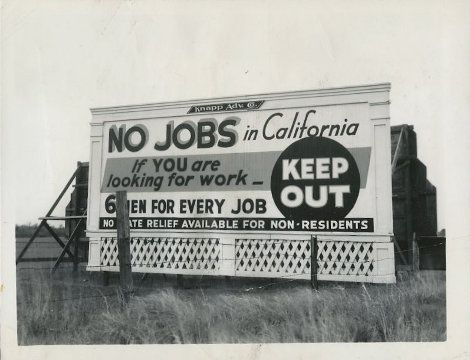
On the eastern outskirts of Los Angeles, they saw the first billboard, “No Jobs in California, Keep Out.” John Henry paid no attention to the sign; he was certain he could find a job on the docks in Long Beach. He was an artisan, not an Okie fruit picker. The next sign was for a migrant campground, $.25 per day, running water, showers, and clean grounds; John Henry took the turn off Route 66, drove a few miles, took two more turns, and found himself at a tidy campground guard shack. Unlike the border boys, the guard wore a clean, crisp uniform and was pleasant. The three-day fee was paid with small change from the small stash in grandmother’s purse. Their assigned camping slot was shaded by a tall Eucalyptus tree. This would do until a job was found. Jelly and Pancho Villa wandered down the main lane, stopping to let the children pet and scratch Pancho, who nipped a few fingers and chased the local feral cat.
Travel to the eastern outskirts of Los Angeles, past the city limit sign. This is where a well-manufactured fantasy meets reality. Families living in tents or shanties of plywood and canvas. The city fathers, embarrassed to call them shanty towns, label them “migrant campgrounds.” Men walk the roadways for miles into the city looking for day labor or something better. These are hardworking, proud people who have been dealt a hand of misfortune. Los Angeles is becoming a city of “haves and have-nots.”
The Los Angeles of 1934 is a city unlike any other in the country. The motion picture industry paints it as larger than life. Hollywood, where dreams are made and shattered, is the engine that powers this city. Oil and shipping will defend their role, but Hollywood fuels the beast.
At first glance, commerce appears untouched by the depression. Polished cars parade on Santa Monica Boulevard. People fill the sidewalks as if on holiday, smiles on their faces, knowing they are fortunate to live in this unique land of opportunity. The manufactured facade so completely obscures the reality that, in fact, California suffers, but not quite as much as the rest of the country. It’s hidden so well that thousands of hopeful migrants genuinely believe this is the “Promised Land.”
At dawn, John Henry, with Blind Jellyroll, drove into Los Angeles to search for work. He and a few thousand others had the same idea. A long line of men and women walked in unison as if Moses were leading the Jews from Egypt along the dusty highway. Men wearing patched overalls, sewn-up khaki pants, and shirts as white as a wash tub could get them. A few wore a dirty Fedora or a worn sweat-stained Stetson. Some real Okies wore frayed straw hats and cracked work boots. Their clothes hadn’t seen a wash tub of water in months. It was an army made of misery. The cloud of roadside dust told the folks in town they were coming—”NO WORK HERE” signs went up in every window along their route.
John Henry drops Jellyroll and Pancho Villa at the downtown mission run by Sister Aimee McPherson, the celebrated firebrand radio preacher. Jelly’s cousin works for the preacher and has assured him that the good sister has a place for him. John Henry wonders how a blind man and a one-eyed dog made it from Texas to here. Perseverance and Moxy, some folks have it, but most don’t.
Lost and asking directions to Long Beach every mile or so, John Henry made a wrong turn and found himself on a residential street. Tidy bungalows with mowed green yards and colorful landscaping lifted his spirits. Back in Fort Worth, you only saw streets like this where the rich folks lived. He could tell by the cars in the driveways and houses that needed paint that these folks were plain working people, getting by better than most.
Half a block up, he sees an older man and woman losing the battle to unload a large chifforobe from the back of a pickup truck that should have been in a scrap yard. The rear end of the old truck sat on the concrete, and both leaf springs shot to hell. They are struggling and on the verge of dropping the piece of furniture when John Henry stops and, without asking, jumps in and grabs the end the woman is about to lose. The man thanked him for his help as they carried the furniture into their house. The home smelled like the fragrant gardenias growing around the front porch.
More in Chapter 3. * Note; My father couldn’t remember the name of the fellow or his dog, so I used the name of a character from an earlier story. A dog named Pancho could be nothing else but a Chihuahua.
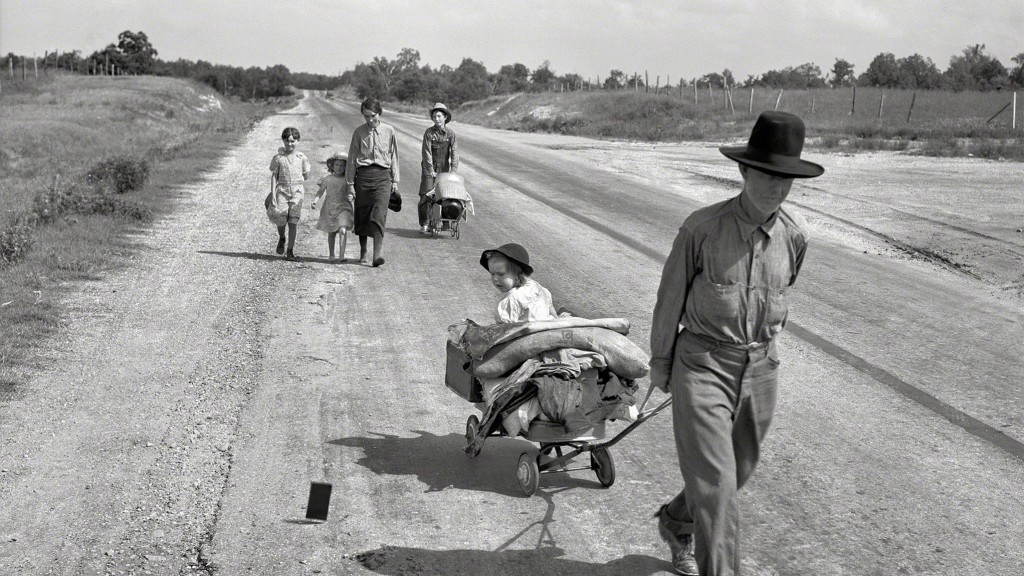
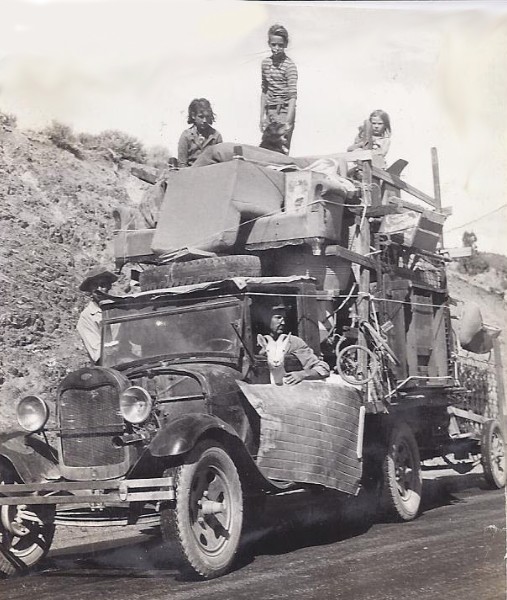
My grandparents, my father, and my aunt migrated from Texas to California in 1934 because there were no jobs available in Fort Worth or Dallas. When reaching the desert town of Needles, CA, they were immediately labeled “Okie’s” by the border guards. My grandfather, a man of few but choice words, mostly curse ones, did his best to convince the guards that he was a Texan and had visited Oklahoma once for a funeral, which made the situation worse because the guards then labeled them Texas Okie’s, which was a double insult, and to boot, they weren’t welcome in the land of pleasant weather and movie stars. Grandfather turned himself into a poor man’s Will Rogers, with plenty of aw-shucks, dirt-kicking, and head-scratching, which made the guards laugh, so the family was admitted. He forgot to mention the three pistols, the sawed-off shotgun, and his pet Rattlesnake, stashed in a burlap bag under the front seat of his Ford.
The whirling of the push mower blades sings a song of torment as I strive to advance the heavy beast forward. I missed cutting the grass by two days: now, it’s akin to whacking my way through a South American jungle. I’m eight years old, and it’s the 4th of July 1957.
Later this afternoon, folks and kin will come over for a backyard cookout and fireworks. A watermelon is chilling in the ice-filled tub, while a supply of Cold Pearl beer and soft drinks occupy another. Both tubs rest in the refreshing shade of our backyard Mimosa tree. My old man’s cherished Leonard Brothers all-steel Master Chef charcoal grill sits on the driveway, brimming with Mesquite briquettes freshly bought from “Little Bills Cookout Ranch” in Eastwood Texas.
Many of the kinfolk invited to the family gathering have long found themselves on my father’s “Naughty List,” but being a kind man, he extends the invitation year after year, including on Christmas Day. They always come, and before long, the reasons for their past banishments come to the fore. Cold beer, followed by a belt of Old Crow whiskey, seems to grant them the audacity to make a truly remarkable spectacle of themselves. They can be quite entertaining, but only for a short while. As a young one, their antics matter little to me. My mind is set on handling dangerous fireworks and causing grandiose explosions.
Folks start moseying in as the sun starts its descent. A few cousins near my age will make the shindig bearable. My tomboy cousin Ginger brings her bow and target arrows, while I tote a bag full of steel-pointed lawn darts. Ginger wastes no time in shooting my cousin Jok in his left buttock. My father yanks out the arrow, and a band-aid does the trick. Kids were made of sterner stuff back then. Only a speeding bullet might have given us pause. We then move on to firecrackers, cherry bombs, and sparklers.
Burgers are served along with “tater salad” and watermelon. Pearl beer gives my father’s uncle Orum the ability to talk like Will Rogers. His home-spun recounts of past family gatherings captivate the adults. Without the lubrication of beer, he is as humorless as a cardboard box.
Cousin Ginger finds her not so well-hidden bow and arrows in our garage and sends an arrow through a bedroom window glass. Her father, Jake administers a well-deserved butt whooping. It’s not often I see a girl get a spanking. Jok and I egg our uncle Jake on. Ginger does the one-arm escape dance, screaming for mercy, as her father delivers the blows.
I obliterate every ant hill in our alley using Black Cat firecrackers before launching a tin can into the stratosphere with a Cherry Bomb. Cousin Jok places a Cherry Bomb on the front tire of his older brother’s new MG convertible to gauge the velocity of the blast. The firework creates an outward dent in the fender, serving as a foreboding omen for Jok’s impending doom; he is well aware of the retribution that awaits him upon his return home.
Darkness comes, and we twirl sparklers in figure-eight shapes. Sticks of metal ablaze at 3,000 degrees. Children clutching a welding torch; what could possibly go wrong? Cousin Jok miscalculating the burn duration of a sparkler, singes his hand, leading him to release the little torch, igniting a yard blanket upon which his mother was seated, prompting her to drop her beer and hot dog. My father douses the blaze with a garden hose. Jok is surely on track to set a new standard for butt whooping’s when he gets home.
Ten o’clock arrives, and I’m lying in bed after my bath. The soft whir of my bedroom fan lulls me into La-La Land. The adults are still in the backyard. I hear their laughter and catch a few words of some dirty jokes.
Drowsiness comes; sleep is but a minute away; then I hear my mother singing God Bless America, and the others join in. It feels good to be a kid on the 4th of July.
Thanks to my late favorite aunt, Norma Lavender, I became a scholar early in life.
Five-year-olds are stuck between that titty-baby stage and graduating to sandlot baseball and comic books. If life got tough, I could still console myself with a grimy thumb to my mouth, and a skinned knee sent me squalling to momma. I couldn’t tie my own sneakers or button a shirt.
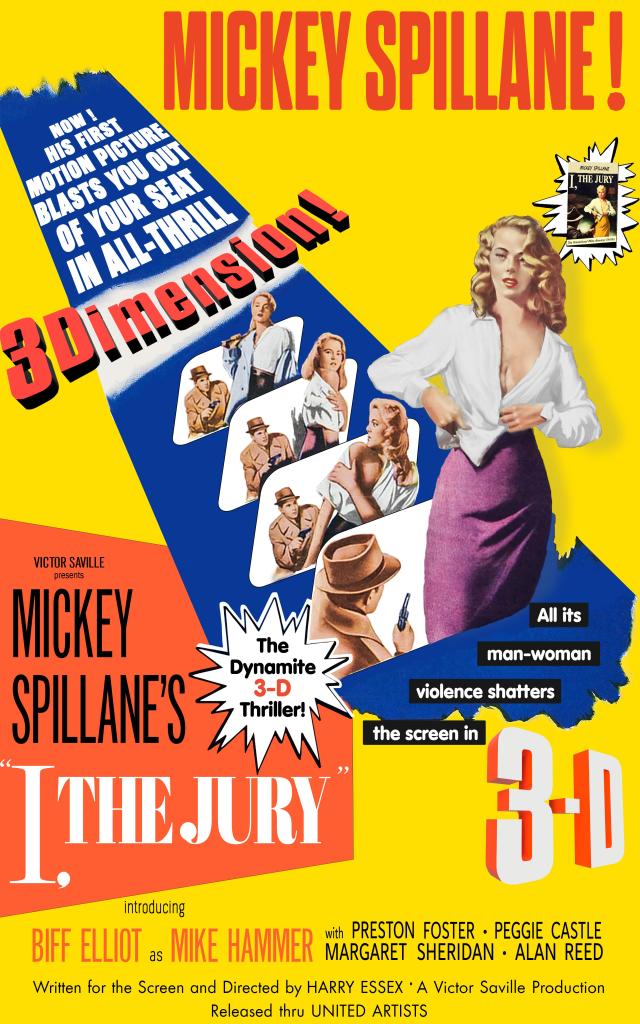
My pushy aunt realized my floundering ways and rescued me with books. She got her hands on the first two years of Fun With Dick and Jane, the books the Fort Worth school system used to teach kids to read; comic books would have to wait; Micky Spillane and Mike Hammer were calling me.
Aunt Norma quizzed me like a Perry Mason for a year, teaching me to write and read. By my sixth birthday, I was a reading Jesse, a child phenom, and a leper to my neighborhood gang. They could barely write and couldn’t read a lick of anything. Here I was, a young Shakespeare among a crowd of jabbering idiots.
Having given her parenting rights to her sister-in-law for a year, my sainted mother has now stepped in to reacquaint herself with her young scholar. I still couldn’t tie my sneakers and applied too much Butch Wax to my flat-top haircut. My mother was a hard-core Southern Baptist, and I didn’t understand why when I colored outside of her parental lines, she would cross herself and say a prayer right before she administered a righteous butt whooping with her favorite weapon; a 9inch by 12-inch Tupperware cake holder. To this day, I won’t touch a piece of Tupperware.
I was assigned a weekly Micky Spillane paperback and expected to read the entire book. Looking back, those trashy, noir detective books were not fit for a child or an educated adult, but Aunt Norma would read a book in 24 hours and was quite an educated gal. I didn’t understand most of what I read, but a few phrases stuck with me: “Is that a pistol in your pocket, or are you just happy to see me?” “A hard man is good to find?” Mike Hammer was always in trouble with a trashy broad. I shared my new vocabulary with the gang, and they dug it.
Mother started receiving phone calls from the other moms, blaming me, her little boy, for teaching their uneducated idiots smutty language. The Tupperware storage pan came out of the cabinet, and my butt burned for a week. Aunt Norma gave me Mark Twain and Huckleberry Finn to reprogram me. I dreamed of someday becoming Mark Twain, a kid with a Big Cheif tablet and a handful of Number 2 yellow pencils stored in a Tupperware container.
Polio was coming to get us: that’s what me and my neighborhood buddies believed. Our mothers could talk of nothing else but the dreaded affliction. My mother would check my temperature at breakfast and right before bedtime.
Fort Worth in 1956 was smack-dab in the middle of the Polio epidemic.
The walls, the baseboards, and every door handle were scrubbed clean. My mother had declared war on the Polio germ, and thanks to that, I didn’t see a swimming pool or movie theater for my entire summer vacation. We, kids, weren’t afraid of the Polio germ: we continued to share a cold Coke or a popsicle; swapping spit didn’t phase us; we had been exposed to every germ in the galaxy, so we figured we were immune.
Halfway through July, and being the hottest summer my folks could remember, a kid two streets over came down with the Polio. Of course, our mothers overreacted and quarantined us until it was deemed safe to venture outside. I knew the kid; his name was Jeremy Pullium, and he was in the fifth grade and played baseball on one of our city’s Little League teams. His little brother, Stevie, sometimes played ball with us and was an official gang member.
The neighborhood mothers thought visiting Jeremy and taking him some cupcakes would be nice. Mrs. Mister made the treats, and she and her two Poodles, Fred and Ginger, would accompany us on the visit.
A quarantine sign was stuck in Jeremy’s front yard, and another was on the front door. We were led back to Jeremeys’s bedroom, where Mrs Mister held the pan of cupcakes.
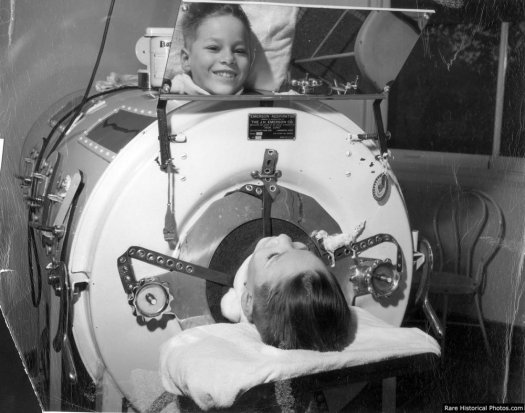
There was baseball-playing Jeremy lying in a large metal tube that took up most of the bedroom. He seemed happy to see us, even though he couldn’t escape his contraption. Skipper, our neighborhood wiz-kid, checked out the machine called an Iron Lung. We thought it was nifty. The cupcakes were passed around, and Jeremy’s mother fed him one with a fork. Everything but his head was trapped inside the machine. We didn’t get it; he could talk like nothing was wrong and move his head around, but the rest of him was paralyzed and trapped in the Iron Lung. Jeremy’s mother explained how the machine kept him alive by breathing for him, and the doctors said he might be in the lung for a year and was likely to recover.
On the way over to Jeremy’s house, Mrs. Mister warned us about being polite, and she meant it. All the mothers had deputized her, and she was allowed to administer a butt whooping if needed.
Georgie is usually the one that gets us in trouble; he can’t contain his mouth. Looking into one of the machine’s windows, he asks Jeremy,
” What do you do if you gotta pee or poop?”
Before Jeremy’s mother could answer the delicate question, Jeremy says,
” I just do it, and the nurse cleans me up. I don’t have to do nothing. Pretty cool.”
The visit abruptly ends. Once we reach the sidewalk, Mrs. Mister, using her open hand, pops Georgie upside his mouthy little head several times. We heard that later that day, Georgie got a well-deserved butt whooping from his mother while Mrs. Mister enjoyed a glass of iced tea and observed her technique.





 Notes From The Cactus Patch