The Art of Writing: Going Old School with Typewriters


Old Ernest is tapping away on another good book.

For my birthday a while back, my wise and thoughtful wife, Momo, gifted me a classic 1970 Underwood 310 manual typewriter. It is a wonderful present I would never have purchased, although I have yearned for one for a while now.

For some time, possibly five years or so, I have been whining and casually threatening to go “old school” with my writing and get away from this demon laptop. It’s too easy to keep on tapping and spit out a page or two of gibberish that has more words than needed and makes no sense. It’s not about speed and what your program does; it’s about the content. A typewriter makes you think before striking that key. The delete button does not exist.

Hemingway would tap for hours on end, and then if he wasn’t pleased with his effort, it went into the waste basket. Using a typewriter to transpose your thoughts to paper is a commitment, and not an easy one.

There was a typewriter in our household when I was a child. It was a large black beast of an Underwood, all pure American heavy metal, requiring a grown man and a hefty child to lift it. I would peck on it for hours and eventually come up with something legible. I never once saw my parents use it, so its presence in our home was a mystery. I heard from my older cousin, Cookie, that it was my grandmother’s when she lived in California, and she spent all of her waking hours tapping away letters and movie script ideas. It caused a good bit of drama and injury within the family, so it was banished to our household for safekeeping. My father wasn’t pleased when he would find me chicken pecking away.

My love of the machine started at an early age, and came into full blossom as a teenager in the 1960s, when I started to write stories. I took typing in high school to sharpen my skills and learn the keyboard. I studied two years of journalism, and learned to love the written word. My teacher was my mentor. She pushed me to excel. It all paid off well. When computers came about in the late 90s, I was a good typist and had no problem adapting.

I will keep you posted on how this “old school” project turns out. I typed a page on my Underwood, and my fingers are throbbing.

Senior Moments: The Importance of Social Filters


A few days back, my wife and I visited one of the big box stores looking to replace the water filter in our fancy refrigerator.


After reading the directions that came with the stainless beast, I realized that the filter is two years past its recommended change date, and it should be changed every six months. That explains why our ice tastes like garlic and smells like a stinky foot.

I told my wife, ” don’t get me started on why a two-thousand dollar refrigerator needs a water filter. Back in the day, we got cold water from an aluminum pitcher that sat in the icebox and our ice from trays, and that was plenty good enough.” She agreed and knew better than to push the matter when I use the term “back in the day.”

The orange store didn’t stock the filter but said they could order one, which may take up to six months to arrive. That got under my skin, but good, because we bought the sickly beast from them. We moved on to the other box store, the blue one.

The young lady at the blue store was no help. We gave her the part number and the model. She took a picture of the instruction page with her cell phone, then took a selfie and said she would be right back. Twenty minutes later, we are left standing in the appliance department, and the young lady is missing in action. My blood pressure is now up at least twenty points, and my hypoglycemia has kicked in, so I’m officially pissed, and dangerous.

I find the kiosk for the appliance department, and the young lady is sitting at the desk, talking on her smart-ass cellphone. The conversation was much too personal and not related to customer service. I stand directly in front of the kiosk, hoping to catch her attention when she holds up one finger and shushes me away. I don’t mind my wife doing that, but when a total stranger does it, it’s pure audacity. I can’t tolerate impertinence and rudeness, especially from youngsters.

I am now in full meltdown mode. My face is burning hot, my back is itching, and this seasoned body is trembling like a dog trying to crap a peach pit. And, of course, I have to pee. The bladder of a senior has no conscience or timeline, so I hustle off to the men’s room.

Returning to the kiosk, the young, “essence of rudeness” little moron is now texting. I snap and reach for her cell phone with the grace and speed of Mr. Miyagi teaching young Daniel-San to wax on, wax off. I remove the phone from her fingers. I then throw the device on the floor and stomp the smart-ass piece of technology to pieces. Miss Moron of the year, is too stunned to react.

I don’t remember the few minutes that followed the killing of the phone, but my wife said it was the most epic display of cursing, fit throwing and thrashing around that she has witnessed. Rightly deserved, she added.

While driving home, my wizened mate tells me, “you are going to see Doc Bones tomorrow.”
Still shivering and twitching from the effects of the demon that possessed me earlier, I ask,” why?”

She leans over, pecks me on the cheek, and says, “Darling, I believe your social filter is about twenty years past its change date.”

Just Another Day Full Of Things


Before I kicked the smoking habit, I look better now

Old people do odd things: I know this firsthand. I’m good at it. A few months ago, the urge to gather and distribute my personal items to family and friends took hold. 2 am in the wee hours, wide awake, I wrote a list of my treasures and who might be the recipient when I assume room temperature. I found that over the years, I have accumulated more useless crap that no one would want.

My tool shed, art studio, storage shed, and junk pile will likely go to the nice folks at the local Goodwill store. The handicap shower chair and the two walkers will stay. The nice walker, the one with four wheels, a handbrake, and a seat, will likely be my new ride. Some guys get a Corvette; I get a souped-up walker. My friend Mooch says he can add a battery-powered motor to make the baby run 30 MPH.

A few weeks back, I bought back one of my acoustic guitars that I sold to Mooch when Momo and I moved to Georgetown, Texas in 2008. It’s a real beaut: a Gibson-made Epiphone E J160 e. Only fifty of them were made in Bozeman, Montana, likely by some of the Yellowstone Dutton family. Now, I have one guitar for each of my three grandchildren, of whom two play guitar.

Us’un humans collect things throughout our lives; it’s our nature. At the time, we might have needed them, but eventually, the things become useless “things” taking up space.

Momo and I are taking a road trip in mid-April. Back to Marfa and Fort Davis, Texas, the Big Bend Chihuahuan Desert. God’s country, big sky and brilliant stars. Marfa is our go-to escape. The town is full of eccentric street-rat crazy folks, and we enjoy interacting with them. I plan to interview a few while sitting at the bar in Planet Marfa, where most of them congregate nightly to swap lies and tell tall tales. I fit right in, my kind of folks, and I need fodder for my stories and yarns. I may fill my pickup full of “things” and give them to the characters I meet. Folks like free stuff and can give the things to their friends down the line.

Chapter 18. Fort Worth Legends: A Young Musician’s Rise Under Bob Wills


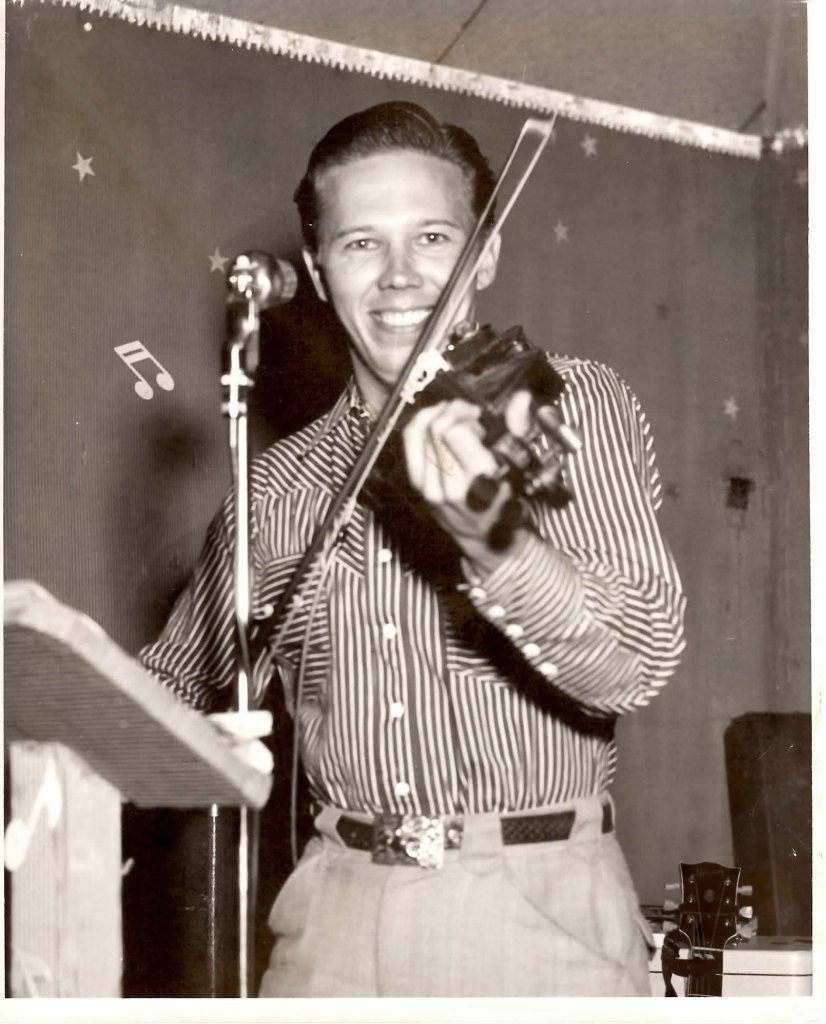
Johnny Strawn, around 1948, Fort Worth, Texas

My grandfather, John Henry, walked to his job at the furniture shop. Years ago, the same place had closed down, driven by the Depression, forcing him to move his family to California for work. Now, twelve years later, he has taken giant steps back, from a good job in Los Angeles to once more building furniture for an hour’s wage. Defeat weighs heavily in his heart. Middle age has come, and the future is murky. So, doing what men do, he keeps walking, counting his steps to nowhere. There are many to blame, but he alone bears the burden of his failures.

The iced ground crunches under his shoes. The cold goes to his bones. His jacket is no match for this weather. He favors the feel of the ground beneath his feet over the Ford sedan in the garage, which is idle most of the time and now a home for mice and other wandering critters.

After the upsetting homecoming with his father, Johnny walked a few blocks to the small neighborhood grocery store to call his best friend, Dick Hickman. His father remained firm in his decision about the telephone, vowing to never have one in the house. The old man viewed the contraption as a rattlesnake in a bag. Lousy news reached him in time enough; no reason to expedite misery.

Two sisters from Germany ran the store, always open, even when the ice storm howled outside. They preferred work to idleness; a dollar was worth more than knitting by the stove. They missed their homeland, but not the darkness that had settled under Hitler’s shadow. Johnny walked in and felt the warmth; they had known him since he was a boy. Following a few hearty hugs and cheek kisses, he was offered a mug of coffee, hot and strong with bourbon and a hint of cinnamon, a taste of what once was.

Dick and Johnny had forged a bond on the playground one morning; Dick was trapped by older boys, their intentions were dark, and Dick knew he was in for a ruckus. Johnny, a full head smaller than Dick, added his small fist for ammunition. A few busted lips and a bloody nose ended the altercation, and the boys would be bound for life by bloody noses and skint knuckles.

Dicks mother, a woman of stern Christian resolve, lived simply, her heart full of faith. Father Hickman was a ghost of a man, suddenly appearing from nowhere, then off again to somewhere. Mother Hickman, as she was called, gave what little extra money they had to Preacher J. Frank Norris, the charismatic leader of the First Baptist Church of Fort Worth.

Nice clothes were a luxury during the Depression, and most children at R. Vickery’s school wore hand-me-downs or worse. Dick wore the yellow welfare pants distributed by the Salvation Army, a sign that his folks were poor. Mother Hickman saw nice clothing as a sign of waste, except when it came to her Sunday fashions. Johnny had a pair of those detestable canvas pants but refused to wear them; the old dungarees with patches did just fine.

Both boys felt the weight of loss when the Strawn family left for the promised land. They exchanged a few postcards during the years in California. Nevertheless, they adhered to the unspoken rule that young men did not write to one another. This was a relic of manly notions of the time. A line or two every six months was enough. Both joined the Navy around the same time, meeting briefly in Pearl Harbor. Then came the seriousness of war. Young sailors, they carried on.

Dick arrived at the two sisters’ store to fetch Johnny. His transportation was a rattle-trap Cushman motor scooter. It refused to stop on the icy street. The scooter slid on its side into the curb and threw Dick off of the beast. The ride to Dick’s apartment was a jolt, far worse than the taxi. Johnny vowed to buy a car when the weather cleared, maybe one for his buddy, too. He held a tidy wad of cash from Hawaii.

A brotherly deal was struck. Johnny would share Dick’s large apartment on Galveston Street, splitting the rent and bills evenly. They were friends again, but now men, and they had different thoughts, dreams, and needs. Dick was courting a young woman from Oklahoma and doing a miserable job of it. Still, marriage lingered in the air, heavy like the rich aroma of brewing coffee, the kind they both drank too much of. Dick took his poison with cream and sugar; Johnny preferred his black and strong.

Johnny’s goal was to play music for a living, and this was the right city to make that happen. He joined the musicians’ union and sent a message to Bob Wills that he was back in Fort Worth.

Wills was now the celebrated band leader of the western swing band, The Texas Playboys. He remembered that meeting at the radio show in Bakersfield, California, long ago. The boy stood out. It was no small feat because Wills was the finest fiddle player in country music.

Bob Wills was not a man known for kindness. He could be brash and indifferent to fans and bandmates alike. Yet, for Johnny, he made an exception. Bob took the young man under his wing, becoming a mentor to my father. A few calls were made, and the boot was in the door. Johnny secured auditions at some of Fort Worth’s best clubs, and each went well. Bob invited him to rehearse with the Playboys. It was there he met men who would soon be legends in country music. A few years later, he would find himself in that circle.

The Legend of Little Audie Murphy: A Pig’s Heroic Journey


The farm. Santa Anna, Texas. July of 1955. My two uncles, Jay and Bill, need more to occupy their time. I need them away from me. I’m a six-year-old kid, and their influence is ruining my childhood. They told me Howdy Doody is not real, Santa Claus is dead, and Captain Kangaroo hates kids. I cried for days.


The chaw of Red Man chewing tobacco behind the smokehouse was the last straw. Seeing a kid puking for two hours seemed funny to them.


My grandfather told the two grown kids that a man in Coleman has a pig that won the ” Purple Paw” award. Every year, the governor of Texas bestows the prize on an animal that has performed a heroic act. Who knew there was a hero nearby?


Of course, my two uncles have to see this pig, so they head for Coleman with my cousin Jerry and me in tow. Arriving in Coleman, we stop at the feed store for directions and a Coke.
The owner tells my uncles to be very respectful of the pig since he saved the farmer and his family’s lives. In appreciation, the farmer named the pig “Little Audie Murphy,” after the famous World War 2 hero and movie star. I am more than impressed. This pig is the real deal.

Arriving at the farm, we are met at the gate by the proud farmer. My uncle Bill has a $10.00 bet with Jay that this is a load of bullcrap. They never stop.

Jay wants to hear the pig’s story, so the farmer is more than happy to recount.

The farmer takes a chaw of Red Man and begins, ” I was plowing one day, and my old tractor hits a stump and tips over, trapping me underneath. I’m yelling for help for an hour, and finally, my old pig shows up. The pig grabs a timber and scoots it underneath the tractor, then stands on it so’s the tractor tilts up, and I can scoot out. That porker saved my life.”
I can tell by the look on my uncle’s faces that they think this is B.S.
The farmer continues, ” about a week after that, I’m in town at the domino parlor, and my house catches on fire. My wife and kids are knocked out by the smoke, and the pig pulls them out of the burning house and revives them—a true porcine hero, that pig.”
Now my uncles are impressed. I see a tear trickle from Bill’s eye. I got a lump in my throat.

At this point, we want to see this pig for ourselves, so the farmer takes us to the barn. He stands outside the corral and yells, ” Little Audie, come on out.”


A huge Yorkshire pig wearing a ribbon and gold medal around its neck makes its way out of the barn. I’ve seen pigs before, and this wasn’t any normal pig. He was missing an ear and a front and back leg. Where the legs had been, the pig now sported a homemade wooden prosthesis. He seemed to walk fine and was friendly.

My uncle Jay was shocked and asked the farmer what the hell had happened to the poor pig.


The farmer took a minute to answer that question. Then he smiled and said, ” well, a pig this special, we can’t just eat him all at once.”

Speak A Little Louder, I Can’t Hear You


Old man finishing off what hearing he has left…

I visited my Ear, Nose, and Throat doctor today. He wasn’t in the office, so I saw his PA. She escorted me to an exam room, and two techs checked my old ears for wax buildup and performed several tests by blowing air and a vacuum in both ears. Then, the PA took a microscopic robot thingy and stuck the device in both ears. When someone says, ” Hmm, oh my,” that gets my attention. Medical people have their own language. I should know; Momo is one of them. They use big words and have a secret handshake. She knew the gal from her hospital days; they hugged and did the handshake, then said some big words about my condition. When they got around to the hearing test, I was a nervous wreck.

The hearing test was easy: sit in a sound booth with headphones and a little button to push when you hear a beep. I sat there for a while in silence. Finally, I asked the tech when the test started. She said it started ten minutes ago. I failed miserably; I can’t hear jack shit, deaf as a cave-dwelling Salamander.

The PA showed me the results. She and Momo used some bigger words to describe my condition. Almost deaf in the left ear and coming up fast in the right one, my good ear.

” Doc, isn’t there anything you can do, like a transplant or a microchip or something?” She did that hmm thing again and told me to start learning sign language, stat. Crap, I’m going to be like Helen Keller, deaf and mute; it all goes hand in hand. First, the ears go, then the speech, then I’ll go blind and stagger around the family Christmas dinner, grabbing fist fulls of food off my relative’s plates. And to top it off, the PA says folks with severe hearing loss always get Dementia. So I’ll be deaf, blind, and mute, sitting in a chair with a drool sponge under my chin, and Momo will have to pull me around in a Western Flyer wagon. There has to be a better way to checkout.

I didn’t know that back in the day, standing in front of a Fender Duel Showman amp playing rock music at incredible decibels would destroy my hearing? Hell, I was sixteen and heard everything just fine. Alice Cooper once said that rock music will get you, one way or the other. It took a while, and I didn’t learn my lesson; I spent another twenty years doing the same thing in the 2000s. By the end of my tenure in the American Classics rock band, all of us were almost deaf.

The good news is that these new hearing aids have Bluetooth and Wi-Fi. I can talk on my iPhone hands-free, check my voice and email, listen to my stereo, tune into Police radio, listen to air traffic control, hack other folks’ hearing aids, and listen in on their conversations. It also checks my vital signs and brain function and sends reports back to my doctor, and I can still play music with my church praise band. Who knew going deaf could be so interesting.

Bonnie and Clyde: The Glamorous Outlaws’ Secrets


A Girl Has To Look Good When She Goes


Thanks to the new Netflix movie “The Highwaymen,” the two most famous outlaws from Texas are captivating a generation that has never heard of them. I’m referring to those two crazy kids from West Dallas; Bonnie Parker and Clyde Barrow.

Their hijinx and daily run-ins with the law kept many a small-town newspaper in print and propelled the two young delinquents into living legends of their own time.

The car chases, robberies of banks, merchants, grocery stores, five and dimes, gas stations, gumball machines, lemonade stands, produce stands, and just ordinary citizens made spectacular fodder for the papers. They were the new folk heroes of the southwest, and as bad as these two were, their antics were pure journalistic gold. And, they didn’t mind killing a few lawmen and citizens if deemed necessary.

In the 1920s and early 1930s, my father’s Aunt, Katy Eberling, owned and operated a beauty salon on the corner of Rosedale and Hemphill Street in Fort Worth, Texas. For seven years, it was prosperous and allowed her to employ four beauticians and a manicurist. She was thriving and often turned away new clients or referred them to other shops. She wasn’t wealthy but made a darn good living for the times. Then, along comes that pesky old depression and she loses three beauticians and the manicurist because her clients now do their hair at home, or go to Leonard Brothers Department Store for two dollars less per set. Katy is weeks away from closing the doors when a visit from a new client changes her luck.

A cold December Friday afternoon finds Katy sweeping up the shop and preparing to close when a man and women enter through the back alley door.

The women, a frail, bony little thing is dressed in the best clothes that money can buy. A pale yellow cashmere sweater with a beige camel hair skirt. A string of pearls drapes her little neck. The man that accompanies her wears a three-piece pin-striped suit and a black fedora. These two are right out of Macy’s of New York. 

The woman is small, almost child size, no more than eighty pounds. She strides up to Katy, extends her tiny hand and says, “ My name is Bonnie and could you please give me a wash, cut and set. I know its late, but I will pay you nicely if it is not too much trouble.”

Katy, having made little money that day, agrees and escorts her to the shampoo sink. As Katy is shampooing Bonnie’s hair for the third time, she notices the man sitting by the back door holding a shotgun in his lap. It is then, reality sets in, and Katy realizes who this new client might be. She removes her hands from the woman’s wet hair and retreats a few steps.

 Bonnie, sensing her fright, assures her in a kind voice, “ Mam, I am here for a beauty appointment, we mean you no harm and will pay for the service.” Katy assured that she will not be gunned down, completes the shampoo and leads Bonnie to the beautician’s chair.

Once Bonnie Parker is seated, it’s as if she’s a lost Catholic girl returning to confession.

She recounts her childhood, being married young, wanting to be a poet and attend a good university and make her Mama proud. She then makes mention of that mongrel over there by the door and how he has ruined her life beyond repair.

 Once she begins the tales of their lives on the run, she cackles like a mad witch and has Katy laughing along with her. First-hand knowledge makes it all the crazier. Katy knows that Bonnie is leaving out the killing parts to spare her.

Two hours later, the appointment is finished. Bonnie Parker hands Katy six twenty-dollar bills and says she will be back next month around the same time of day if that is alright. Katy says that will be fine, and Bonnie departs with Clyde in tow.

Knowing she has to keep this to herself, she tells her husband Harvey, and no one else. Katy is full of remorse, knowing that the money she accepted is probably blood money or someone’s life savings, yet she took it because it will allow her to keep her shop open for another few months. If she is truthful with herself, she enjoyed the excitement it produced.

The next month, on a Friday, the two most wanted crooks in the land arrive at 4:30 PM. Bonnie receives a wash, trim and set and the confessions continue. Katy earns another six twenty-dollar bills. This time, she is less remorseful and less frightened.

Bonnie visits twice more. The last visit was un-nerving for Katy. Bonnie Parker is unwashed, and her clothes need to be cleaned. She is gaunt and hollow-eyed. There are no confessions or funny stories. Clyde remained in their car and Bonnie, upon being seated in Katy’s chair removes a 38 pistol from her purse and cradles it in her lap as if she was expecting trouble.

When the appointment is finished, Bonnie Parker checks her makeup in the mirror, straightens her skirt and says to Katy, “ My mama always says, a girl’s gotta look good when she goes. How do I look, Miss Katy?” Katy replies, “ You look lovely as ever.”

Bonnie hands Katy eight twenty-dollar bills and says she will see her next month.

A few weeks later, Katy reads in the newspaper that Bonnie and Clyde were killed in a shootout with the law in Louisiana. Katy hopes she looked good when it happened.

This story was told to myself and my cousins many times. When we were young, Aunt Katy left out much of the detail. As we grew older, into teenagers, the story became more graphic and colorful. I had no idea Aunt Katy was so famous.

Hey Kids, It’s Fun Being Sick!


How Kids Beat The Pandemic In The 1950s

Kids are an intelligent species. They know far more about human interaction and theatrical interpretation than their parents suspect. I can’t put a date on when this anomaly was discovered, but people with fancy degrees and a goatee first noticed this behavior in the early 1950s. My neighborhood may have been ground zero for their study.

As a bunch, the kids in my neighborhood were healthy. We ate mouthfuls of dirt, sucked on pebbles, and ingested every foodstuff imaginable without washing our grimy hands. This was perfectly acceptable to our mothers. Our young immune system was that of a caveman: we scoffed at germs, ” away with you foul vermin.” Like Superman on the TV, we were indestructible.

The only malady that affected us, was the dreaded Monday morning tummy-throat-aching body-virus. This malady usually broke-out in after a thirty or forty day incubation period. It spread like wildfire through our four-block coterie and most of the second and third grades, mostly affecting boys, but the girls were losing their immunity at an alarming rate.

The second week in November, close to Thanksgiving, most of our second-grade class was infected and missing in action. The symptoms were: headache, stomach ache, sore throat, and body aches, sometimes we developed a limp and had to crawl from the bathroom to our bed. When our mothers asked how we felt, we would point at the affected areas and groan, eliciting additional sympathy.

The first morning was the worst, then by noon we recovered enough to watch cartoons and eat some ice-cream, then after supper, the symptoms worsened, and mom made the call for us to stay home another day. Sleeping in was mandatory, and if we were recovered by lunchtime, we could go outside for some fresh air. This bug was known to not last more than three days, tops.

A seven year old can’t grasp the enormity of a situation the way their parents can. As a group, we were unaware that our symptoms matched those of the dreaded Polio Virus. Our kindly school nurse, fearing the worse, calls the health department for back-up.

Two blocks away at George C. Clark Elementary, our diligent principal cancels all classes and has the entire building sanitized by a nuclear cleanup team from Carswell Air Force Base. The newspapers are on this like a duck on a June Bug.

Lounging in bed eating Jell-O, and watching Bugs Bunny cartoons, my cohorts and I are unaware of our neighborhood pandemic.

Tuesday, mid-morning, a contingent of doctors and nurses from the Fort Worth health department, arrive to access the outbreak. They plan to visit every affected home around our school and test every sick child for the dreaded Polio Virus. Large syringes and foot-long throat swabs are required. A dozen ambulances stood by to transport the poor ill children to the hospital. The local newspaper was there, as well as the television news folks.

Skipper, my stalwart best buddy, and the elected grand Poo-Bah of our gang, was the first to break. With two syringes sucking blood from his skinny little kid arms, he sobbed and said he was faking it, we all were faking it. He gave us up like Benedict Arnold. Roger Glen ran screaming from his house when he saw the size of the needles, and the smartest girl in our class, Annie, gave a signed confession. The epidemic was over.

Most of us couldn’t comfortably sit for a few days, but we were all healthy until the next school year. That’s when the Asian bird, chicken, rat, and cat flue got us all.

When Petulance Replaces Decorum And Respect


Momo and I are getting on in age these days. I am 75 and she is 70ish, so we’ve done and seen a few things along the way. So, being as socially aware and self-educated as we are, it was a shock to our overly medicated systems to see the entire Democratic coterie of POD people stuck to their chairs during the Presidents address to Congress last night. Marjorie Taylor Green must have applied super glue to their leather chairs before their entrance, she did look a bit guilty.

The mother of the 12 year-old girl killed by illegals, the young brain cancer survivor being made an officer of the Secret Service, the young man being accepted to West Point and a few others. We were sobbing like a baby that lost it’s bippy. You have got to be a purely evil glob of flesh to not react to human kindness and respect. It’s not a political thing, it’s a human thing, a Christian thing. The camera kept showing closeups of Nancy Pelosi as if she might react to something. Momo is an RN and she thought the old hag had an IV going just to keep her breathing and alive. And then the idiot from Texas, Representative Green, shaking his walking stick and shouting the President down, like he was back in Austin attending an HOA meeting. Speaker Johnson had him hauled off the floor by the Sargent At Arms. That hasn’t happened in modern politics, a first for the news media to cover. I bet old Lester Holt will be jumping all over this one tonight. Get the popcorn and Dr Pepper’s ready folks, it’s going to be a fun four years.

The Mooch-O-Matic life Meter


Life Is A Percentage Game

A few weeks ago, my buddy Mooch and I were driving to Glenrose on a little road trip. We often take an adventure when we hear of something worth investigating. The stranger the better to occupy our precious time.

Mooch heard from someone at the feed store that a lady owns a pig that recently received the “Purple Paw,” the most prestigious civilian award an animal can receive for bravery. We have to see this pig for ourselves since Glenrose is right in our back yard.

Two hours of searching, we find the lady and her pig living in the RV Park by the river. This one is a wild goose chase. It seems her little boy didn’t win a prize in the stock show, so she took a purple TCU lanyard and tied a large gold-painted Mardi-Gras coin on the lanyard, making the pig a medal. This satisfied the whining child and turned the pig into a big shot. Now the kid and the pig think they are hot stuff and are raising hell in the RV Park. The expedition wasn’t a complete waste of time, we ate barbecue at the “Squealing Piglet” and topped it off with some pecan pie and Blue Bell ice cream.

Driving back to Granbury, the oil message light came on warning me I had ten percent oil life left on the old Honda. I bragged to Mooch about how smart my car is, and it seems to know everything. I mentioned, jokingly so, that it would be great if some pharmaceutical company could invent a device to tell us, humans, how much life we have left. Mooch, ever the tinkerer, has a small invention lab in his shed and is always coming up with strange things. He said he would look into that. I knew he would.

A week goes by, and Mooch shows up at my door with a white box under his arm. We sit at my kitchen table, and he pushes the box over my way, urging me to open it. Before I could get the lid off, he yells, ” I did it, its the invention we talked about, its a Mooch-O- Matic Life Meter, we are going to be wealthy.”

I open the box and pull out what appears to be a digital children’s thermometer. On the back are a crudely installed USB port and a sticker reading Mooch Matic. I’m impressed that he could invent something like this so quickly. In my book, his rating just increased by twenty points.

Knowing Mooch was about to explode with pride, I ask him,”What’s in this thing and how does it work?”

Mooch proudly exclaims, ” I took a “Tommy Bear In The Summer Sun” children’s digital rectal thermometer, added two chips from a Nokia flip phone, the activation strips from a “Ellen’s Own”digital pregnancy test, a chip from a Martha Stewart Meat Thermometer, a few innards from my old Amazon Firestick and a USB port so you can save the information. Now all that’s left is to test it on a human. I tried it out on my dog Rex, and damn if he doesn’t have 35% life left. The cat saw me testing Rex and is hiding, so now it’s down to you and me. How about you be the next participant?”

I reluctantly agreed to be the first human to test the Mooch-O-Matic. I entered the bathroom, inserted the device into the proper orifice, and waited until I heard the three beeps that signaled the reading was complete. After straightening myself up a bit I exited the bathroom and gave the device to Mooch. He scrolled through a menu and then blurted out, “holy crap, you have 25% life left, you lucky S.O.B.”

Well, there ya go buddy, I’m going to be watching many more Super Bowl’s. Mooch then took the device into the bathroom to test himself. After ten minutes, I’m getting worried so I knock on the door.

In my best-concerned tone, I said, ” Mooch, you okay, little buddy, you didn’t fall and break a hip, did you?” Mooch opened the door, and his face is the color of snow-whites butt. With a shaking hand, he handed me the device. I looked at the reading and was shocked. Mooch has 1.5% life left, which translates to, he could assume room temperature any minute or by morning at the latest. We are both speechless, and Mooch has tears in his old watery eyes.

Without saying a word, he leaves the house, and me holding the prototype of our disappearing wealth. Just for testing sake, I pulled a previously frozen whole chicken from the fridge and inserted the Mooch-O-Matic into the deceased bird’s butt. Three beeps later, the soon to be chicken dinner that has been dead for who knows how long, reads 35% life left.

I thought for a moment about calling poor Mooch to tell him his device is faulty, but he owes me $200.00, so I’ll let him sleep on this until he pays up.