Chapter 10. Wagons Ho To California: Grandmother Is Healed By Sister Aimee McPherson, And Carman Miranda Stops By


Sister Aimee McPherson

As the months stretched into years, the Strawn family flourished financially, finding their footing in California’s golden land. The prospect of permanence hung in the air, and the pull of Texas grew less each year. Johnny’s elder sister, Norma, had begged to remain with one of her aunts to complete her schooling, but destiny had other plans. Completing her education in Fort Worth, she succumbed to the barrage of pleading letters from her mother, who was convinced that her death was only weeks or hours away, but she would try to hold on until her daughter made it to California. Knowing Bertha’s love for drama, her aunts consoled Norma and thought it best that she travel to California and could return if needed. With a small amount of currency in her purse, she embarked on a westward journey with a family bound for Los Angeles, paying for a seat in their car.

After two years of absence from the fold, Norma returned to find her family ensnared in a web of not-so-well-hidden disillusionment. The initial euphoria of their reunion faded, exposing the harsh light of reality. Her father, now a manager, toiled away long hours with little time left for living, while Johnny when not in school, devoted all his time to the members of his string band, Blind Faith. Her mother’s dependence on medicinal elixirs was the worst of it.

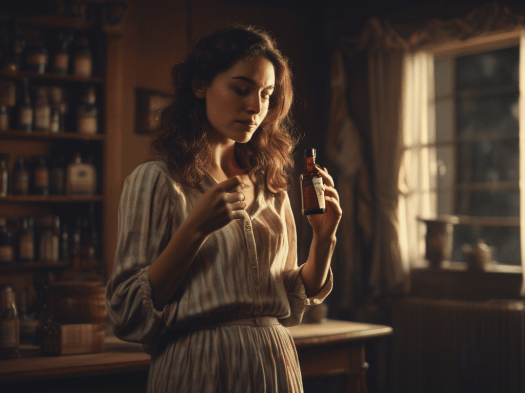
Bertha, a dedicated aficionado of her restorative elixirs, consumed multiple weekly bottles. She has a friendly rapport with the local pharmacist, who considers her his best customer and gives her a discount. She would often be found at the kitchen table for most of the day, dosing her tonics and composing lengthy, nonsensical letters to her sisters. By this time, her siblings had come to understand that the words emanated from the pen of a medicinal lunatic. Norma and Johnny acknowledged the necessity of professional intervention for their mother, and, with assistance from Le Petite Fromage and Blind Jelly Roll, they formulated a plan for Bertha to undergo a holistic religious cure under the guidance of Sister Aimee McPherson.

On that Sunday, a vibrant sermon accompanied by half a dozen show tunes with a dazzling chorus line stirred the congregation as Sister Aimee made her return to the pulpit for three thunderous ovations. Following the service, Le Petite Fromage and Johnny, the fiddler, as he is now called, escorted Bertha to the orchestra dressing room, believing her holiness sought to personally meet her and perhaps bestow a signed copy of her latest literary work, “You Can’t Take It With You When You Go So Give It To Me.” Embracing Bertha warmly, Sister Aimee presented her with a signed book before guiding her to a crimson velvet settee that had previously served as Blind Jelly’s salvation vehicle. With hands upon Bertha’s head, she prayed for deliverance from the grip of elixirs and zealous missives to her siblings. Understanding she had been played by her blood kin, Bertha, teeth-gnashing and fist-squeezed white, surrendered and embraced the moment. The healing transpired in a mere ten minutes as Sister Aimee proudly proclaimed the departure of the demons, assuring that all would be splendid by supper time. As she departed the dressing room, a divine fragrance lingered in the air. Blind Jelly Roll spoke up, ” I smells me some Channel No. 1. ” Leave it to a blind bluesman with the senses of nine cats to figure it out.

With the spoke mended in the family wheel, taut and ready for the road, John Henry indulged the family, comprising of Le Petite and Blind Jelly Roll, to a Sunday supper at a restaurant. Their choice fell upon Treasure Island, a pseudo-swanky seafood establishment under the ownership of the actor Wallace Beery. The best restaurants were on the Sunset Boulevard, known as the Strip. The entrance was the front hull of a sailing schooner, complete with a mast and sail. Johnny noticed the address above the door: 77 Sunset Strip: that address would come up again a bit later. Bertha and Le Petite were giddy, anticipating the prospect of encountering Hollywood movie stars savoring fish and chips washed down with a dirty Martini.

While awaiting their meal, James Cagney and his raucous family were seated a few tables away. Clark Gable and Carman Miranda snuggled in a cozy booth, where they indulged in sips of Martini and beer. Le Petite and Bertha were in a state of apoplexy. Carman Miranda made her way to the lady’s room, passing their table. Pancho Villa sat upon Blind Jelly’s lap, nibbling on a saltine. As the movie star strolled by, she took notice of Pancho and remarked on the adorable little doggie. When she reached out to pet Pancho, she received a vicious bite that tore off the long middle fingernail from her left hand’s digit. Stunned by the sudden attack, she yelled, “Get that little demon dog out of here!” Pancho and Blind Jelly concluded their meal in the comfort of Strawn’s car.

If you missed Chapter 9, click the link below for more amusement.
The Journey to Bakersfield: A Lively Tale of Struggle and Triumph, Chapter 9


My grandfather, John Henry, possessed a mastery of storytelling that filled the room with warmth. When the rain beat against the windowpanes, or the ice or snow kept me inside, I’d perch myself on the floor near his rocking chair, mesmerized by the tales of his youth in rural Texas, his days as a soldier in the US Army, and the harrowing battles in France. With each word, he painted vivid scenes of the struggle and resilience of his family during the tumultuous depression years in 1930s California. Pausing only to adjust his fiddle, John Henry would then draw the bow across the strings, filling the room with a lively jig that seemed to echo the resilience and spirit of those days and family members long ago passed on. When my grandfather passed, my father, as any good son would do, took the helm, recounting those years in California and beyond. A few drinks of good scotch whiskey for us both lit up his memory and released his vivid imagination. The more scotch we consumed, the more colorful his recounts, so parts of this story may be a bit grandiose.

Bringing Blind Jelly Roll Jackson and Le Petite Fromage into the string band’s musical circle infused the fellows with newfound assurance. John Henry found himself utterly taken aback by their musical prowess.

Johnny and the string band continued to improve with each passing week. After six months of playing front porch shows, birthday parties, a few illegal chicken fights, and one funeral, W6XAI Bakersfield, the most influential radio station in California, came calling. The station approached the band with an offer to perform a thirty-minute live show. Le Petite’s Daddy, Baby Boy Fromage, used his questionable connections to secure the band’s spot on the show, as his own band, The Chigger Bayou Boys, were regulars on the hillbilly program hosted by Colonel Bromide A. Seltzer. The esteemed Colonel was famous for featuring the latest talents on his popular daily show, always staying on the lookout for fresh and promising acts he could sign to a strangeling management contract that left him flush with cash and the talent with a pittance. Blind Faith fitted his bill.

Baby Boy Fromage arranged for transportation to and from Bakersfield. The radio station had agreed to pay the boys $75. 00 for the show, which included four commercials for Father Flannigan’s Holy Healing Tonic, Sister Aimee’s Blessed Miricle Face Cream, and Puffy Cloud Lard. In today’s world, that kind of money might buy you a mediocre supper at an Olive Garden, but in the Depression years, it was a small fortune. Of course, Baby Boy would require a chunk for providing the transportation and a meager finder’s fee for getting the band on the show. All said and done, Blind Faith would make $40.00 cash to split six ways. Le Petite had warned the boy that her father’s deals can sometimes border on nefarious, so don’t cry like a freshly born titty-baby if the whole thing flushes down the toilet.

Around noon on Saturday, the stagecoach to Bakersfield arrived at the Strawn residence. Le Petite’s daddy had promised luxury transportation for the haul to Bakersfield. Baby Boy’s idea of a luxury transport was a converted Tiajuna Taxi, complete with no less than a hundred bullet holes along each side of the vehicle. Two church pews nailed to the wooden floor served as seating, and the big stain on the floor was likely blood. The driver was a Mexican chap who didn’t speak English and drove with a bottle of Tequila planted in his lap. His GPS was a ratty map with the route colored in red crayon. Le Petite was furious with her daddy and planned to smack his big head with a *cajun blamofatchy.

Arriving at the station, the band was led into a large room where the broadcast would take place. A small stage covered with short nap rugs and a half dozen microphones placed where each musician would stand. Another band, The Light Crust Doughboys, from Fort Worth, Texas, was packing up, having completed their live show for their sponsor, Light Crust Flour. They were in Hollywood to be in a Western movie with Gene Autry, and this was their last commitment before heading back to Texas. Johnny spotted their fiddle player, made a bee-line over, and introduced himself. The man, Bob Wills, a fellow Texan, wanted to hear youngsters play, so he stuck around for the live show, which was due to start in twenty minutes. The radio technicians placed each member in front of a mic, giving Le Petite her own microphone for singing. The band played 16 bars of music so the man in the sound booth could adjust the volume. Bob Wills sat in a corner, smoking a cigarette and drinking what appeared to be a pint bottle of hooch hidden in a brown paper sack.

The two announcers, a heavy-set fellow wearing a black cowboy hat and his companion, a boney, skittish little gal, also wearing a matching cowgirl hat and white boots, took their positions in front of a microphone next to a nervous Le Petite. The man told the band that when that light on the wall turns from red to green, that means we are live, and you start your theme song while we announce you and our sponsors. Jelly said he couldn’t see the light, but Pancho Villa would give him the queue. The announcer asked Johnny if that man was blind? Johnny said, “Yep, blind as a bat but he’s a pretty good driver and got us here in one piece.”

The boys had no theme song, so Jelly told them to play Red River Valley: You can’t mess that one up. The man at the mic counted down, the light turned green, and the boys let loose on their new theme song. All the time, the two announcers were jabbering about their sponsors.

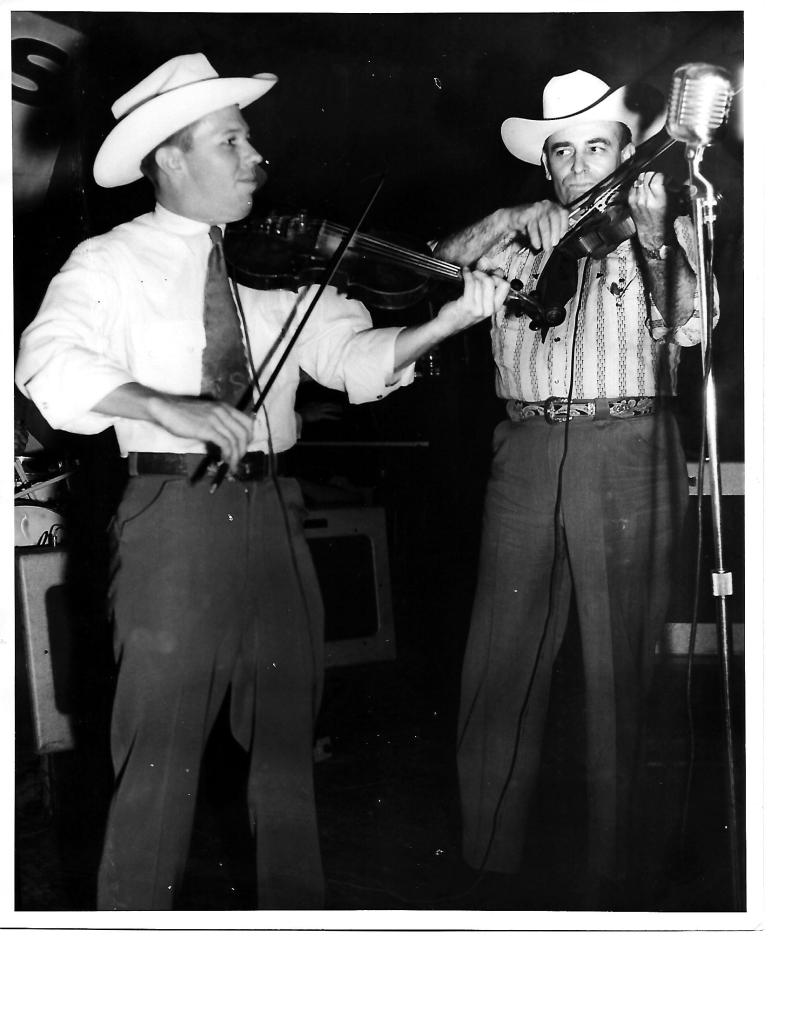
The announcers stepped back from the microphones and gave the boys a thumbs-up to start their show. Le Petite counted off a cajun song about a “Big Mamou” and went into “Will The Circle Be Unbroken” and then “Cold Beer and Calomine Lotion.” The band played every tune they knew, finishing up with Johnny playing a fiddle tune called “Lone Star Rag,” which caused Bob Wills, with a big grin on his face, to rise from his chair and clap along. When the show ended, Bob gave Johnny a few pointers, telling him he had a bright future in country music and to get in touch when and if he returned to Fort Worth. Fifteen years later, back home in Texas and playing country music for a living, Johnny got in touch with Bob Wills, who became his mentor and close friend, gifting Johnny with one of his fiddles, which he is playing in this photo. I have that fiddle as well as my grandfather’s fiddle.

My father, Johnny Strawn playing twin fiddles with Bob Wills. Forth Worth, around 1952.

  • * Cajun Blamofatchy is a piece of wood use

Chapter 7. California And The Magical Elixirs


My grandmother hailed from a sizable brood: four sisters and a solitary brother. Their formative years were spent in the sun-drenched fields of south Texas, toiling on the family produce farm. The patriarch, Grandfather Duncan, regarded his children as mere hired hands and didn’t pay them a dime. Every child born saved him from hiring a lazy field hand to pick his watermelons and oranges.

Upon the completion of their high school years, one by one, the siblings, usually in the dead of night and with assistance from the others, embarked on a journey, whether by bus, train, hitchhiking, or on foot, seeking their own version of freedom from the farm. Miraculously, within a few years, they and their new spouses found themselves settling in Fort Worth, Texas, mere blocks apart.

The transition from Texas to California proved to be arduous. My grandfather, possessing the toughness of weathered leather and an insensitivity to female emotions, saw the move as a blessing and a chance for a new beginning. However, for Bertha, it felt more like a forced abduction. John Henry appeared oblivious to her distress, or perhaps he believed it would pass in due time. Yet her sorrow lingered until she stumbled upon a seeming panacea: alcohol, fashioned into the magical healing elixirs hawked on the radio and in the newspapers. From anemia to tremors, from insomnia to weight loss, from night sweats to antisocial behavior, there existed a bottled pharmaceutical remedy for every affliction, no doctor’s visit required. Countless bottles of happy juice lined the shelves of the local drugstore, catering to the myriad conditions that afflicted my grandmother, a certified hypochondriac.

When not self-diagnosing herself that she harbored every disease known to man and convinced that her death was mere hours away, Bertha was quite the letter writer. Every day, seated at her kitchen table, her fountain pen full of blue ink, she’d churn out missives to her sisters in Texas. Fueled by her newfound self-assurance courtesy of those magic elixirs, she didn’t see any harm in embellishing the truth a bit about her new life out in California: alone in a strange land, who could blame her? It’s not as if her family would ever drop by for a visit. As time went by, her letters became creative works of fiction, painting the picture of a grand Beverly Hills home in place of her modest stucco house and a swanky Duesenberg convertible instead of their old Ford. According to Bertha, even the legendary Clark Gable was a neighbor, and Sister Aimee McPherson, the radio firebrand preacher gal, became a dear friend, and the two of them often enjoyed lunch at Musso and Franks Grill, mingling with the movie stars. Bertha was dead set on landing an audition with MGM or writing a grandiose screenplay, all thanks to that magical elixir of hers. Not thinking of how she would explain her fabricated world when they returned to Texas, she continued, and the more she wrote, the more she believed her own stories.

When Johnny turned thirteen, he approached his father with a request to pursue a professional career in music. John Henry, harboring doubts about the practicality of such a proposal, pondered the unlikelihood of anyone hiring a boy for such a venture, much less paying him with real money. Nonetheless, three of Johnny’s older schoolmates had extended an invitation to join their string band, which often performed at birthday parties and school events for a small fee, which was usually a coke and a plate of food. Their need for a fiddle player in the Bakersfield-style hillbilly tunes they favored aligned perfectly with Johnny’s musical talents. That evening, seated on the front porch after supper, Johnny revealed his decision to his father — he had embarked on a professional journey with his newfound band. Despite his initial surprise, John Henry offered his warm congratulations to the young boy venturing into this new vocation.

Their first official rehearsal was an epic disaster. The guitar player knew four, maybe five chords on his out-of-tune instrument, the bass player, using a beat-up dog house bass fiddle, couldn’t get the beast anywhere near in-tune, and the tenor banjo picker was worse than the other two. After massacering a dozen or so tunes, Johnny floated an option. He knows of a genuine black blues singer who burns up a guitar when he plays. The other three were wagging their tails like a hungry dog and voted to bring this fellow into the fold. Now, Johnny had to convince Blind Jelly Roll Jackson to play with a bunch of borderline musicians.

Church on Sunday was a rousing spectacle. Sister Aimee, after singing a handful of beautiful songs and just enough preaching to make sure the offering plates were full, called for souls that needed saving to approach the altar and receive Jesus. This was part of every service; a few folks would come down to be blessed and saved. With the orchestra playing, the choir singing, and a contingent of Hollywood-style dancers on stage, a hundred folks rushed the front in need of salvation. Sister Aimee, not knowing how to handle a worked-up mob that scared her out of her witts, retreated stage right and hid in her dressing room. Her assistant preacher and a few ushers administered to the flock while Sister Aimee gulped a handful of Carter’s nerve pills, washing them down with “Father Flannigan’s Holy Healing Tonic,” which was around 80% alcohol and claimed to be brewed from the holy waters of the River Jordan.

Wagons Ho to California ! Chapter 2. The Arrival


Ten or so miles past the Needles California border station, my grandfather, John Henry Strawn, encountered a stooped, raggedy-dressed black man and a small dog walking along the side of the road. The man’s attire resembled that of a poorly dressed scarecrow. Without hesitation, he slowed the Ford, performed a swift turnaround, and approached the traveler. After stopping the car, he offered the old fellow a ride. Without hesitation, the traveler gratefully accepted, ensuring that his dog was settled in first, followed by his knapsack, a guitar case, and then himself.

A few miles down the road, the man broke the silence, introducing himself as *Blind Jelly Roll Jackson from the Deep Ellum Dallas, Texas, and his seeing-eye dog, a Chihuahua named Pancho Villa, who is blinded in one eye. The result of a dog fight with a Coyote, so he wears tiny sunshades because the bright sunlight hurts his good eyeball. Jelly says he is a blues man and is headed to Los Angeles to stay with a cousin and find work in a juke joint, and he, by accident, shot a fella in Dallas four times over a pay dispute. He said it was all Pancho’s fault because the dog said the man had a knife, so what else is a body to do. He pulled a leather Bolla from his knapsack, took a jolt, poured a little liquid into his palm, and let Pancho Villa lick it up. John Henry was sure it was whiskey, and after the dog drank it, he fell over and started snoring. Jelly’s chin found his chest, and he slept the sleep of the weary.

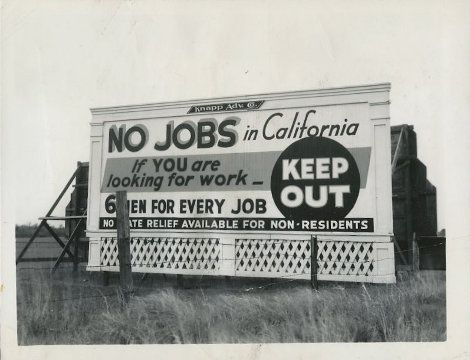
On the eastern outskirts of Los Angeles, they saw the first billboard, “No Jobs in California, Keep Out.” John Henry paid no attention to the sign; he was certain he could find a job on the docks in Long Beach. He was an artisan, not an Okie fruit picker. The next sign was for a migrant campground, $.25 per day, running water, showers, and clean grounds; John Henry took the turn off Route 66, drove a few miles, took two more turns, and found himself at a tidy campground guard shack. Unlike the border boys, the guard wore a clean, crisp uniform and was pleasant. The three-day fee was paid with small change from the small stash in grandmother’s purse. Their assigned camping slot was shaded by a tall Eucalyptus tree. This would do until a job was found. Jelly and Pancho Villa wandered down the main lane, stopping to let the children pet and scratch Pancho, who nipped a few fingers and chased the local feral cat.

Travel to the eastern outskirts of Los Angeles, past the city limit sign. This is where a well-manufactured fantasy meets reality. Families living in tents or shanties of plywood and canvas. The city fathers, embarrassed to call them shanty towns, label them “migrant campgrounds.” Men walk the roadways for miles into the city looking for day labor or something better. These are hardworking, proud people who have been dealt a hand of misfortune. Los Angeles is becoming a city of “haves and have-nots.”

The Los Angeles of 1934 is a city unlike any other in the country.  The motion picture industry paints it as larger than life.  Hollywood, where dreams are made and shattered, is the engine that powers this city.  Oil and shipping will defend their role, but Hollywood fuels the beast.

At first glance, commerce appears untouched by the depression.  Polished cars parade on Santa Monica Boulevard.  People fill the sidewalks as if on holiday, smiles on their faces, knowing they are fortunate to live in this unique land of opportunity.  The manufactured facade so completely obscures the reality that, in fact, California suffers, but not quite as much as the rest of the country.  It’s hidden so well that thousands of hopeful migrants genuinely believe this is the “Promised Land.”
   
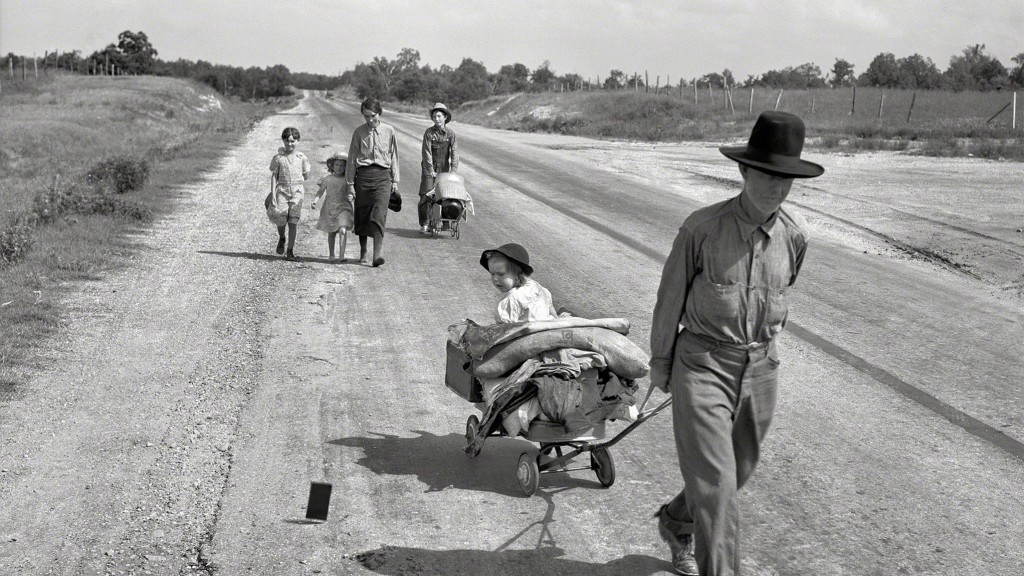
At dawn, John Henry, with Blind Jellyroll, drove into Los Angeles to search for work. He and a few thousand others had the same idea. A long line of men and women walked in unison as if Moses were leading the Jews from Egypt along the dusty highway.      
Men wearing patched overalls, sewn-up khaki pants, and shirts as white as a wash tub could get them. A few wore a dirty Fedora or a worn sweat-stained Stetson. Some real Okies wore frayed straw hats and cracked work boots. Their clothes hadn’t seen a wash tub of water in months. It was an army made of misery. The cloud of roadside dust told the folks in town they were coming—”NO WORK HERE” signs went up in every window along their route.

John Henry drops Jellyroll and Pancho Villa at the downtown mission run by Sister Aimee McPherson, the celebrated firebrand radio preacher. Jelly’s cousin works for the preacher and has assured him that the good sister has a place for him. John Henry wonders how a blind man and a one-eyed dog made it from Texas to here. Perseverance and Moxy, some folks have it, but most don’t.

  Lost and asking directions to Long Beach every mile or so, John Henry made a wrong turn and found himself on a residential street. Tidy bungalows with mowed green yards and colorful landscaping lifted his spirits. Back in Fort Worth, you only saw streets like this where the rich folks lived. He could tell by the cars in the driveways and houses that needed paint that these folks were plain working people, getting by better than most.  

 Half a block up, he sees an older man and woman losing the battle to unload a large chifforobe from the back of a pickup truck that should have been in a scrap yard. The rear end of the old truck sat on the concrete, and both leaf springs shot to hell. They are struggling and on the verge of dropping the piece of furniture when John Henry stops and, without asking, jumps in and grabs the end the woman is about to lose. The man thanked him for his help as they carried the furniture into their house. The home smelled like the fragrant gardenias growing around the front porch.

More in Chapter 3. * Note; My father couldn’t remember the name of the fellow or his dog, so I used the name of a character from an earlier story. A dog named Pancho could be nothing else but a Chihuahua.

Open the link below for Chapter 3

Chapter 1. Wagons Ho-To California!


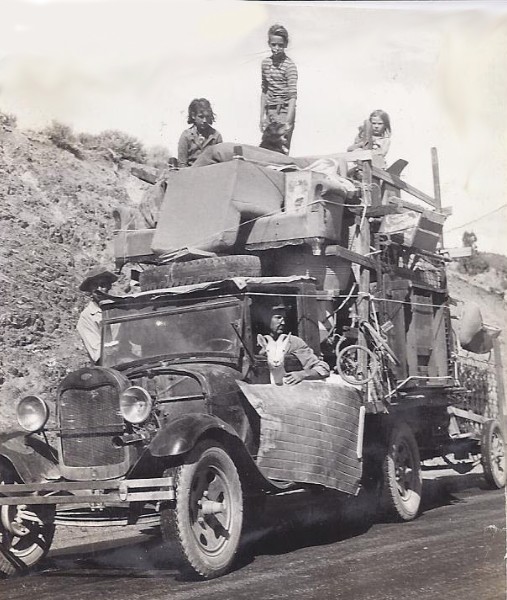
My grandparents, my father, and my aunt migrated from Texas to California in 1934 because there were no jobs available in Fort Worth or Dallas. When reaching the desert town of Needles, CA, they were immediately labeled “Okie’s” by the border guards. My grandfather, a man of few but choice words, mostly curse ones, did his best to convince the guards that he was a Texan and had visited Oklahoma once for a funeral, which made the situation worse because the guards then labeled them Texas Okie’s, which was a double insult, and to boot, they weren’t welcome in the land of pleasant weather and movie stars. Grandfather turned himself into a poor man’s Will Rogers, with plenty of aw-shucks, dirt-kicking, and head-scratching, which made the guards laugh, so the family was admitted. He forgot to mention the three pistols, the sawed-off shotgun, and his pet Rattlesnake, stashed in a burlap bag under the front seat of his Ford.

Click the link below for Chapter

A Young Scholar Among Jabbering Idiots


Thanks to my late favorite aunt, Norma Lavender, I became a scholar early in life.

Five-year-olds are stuck between that titty-baby stage and graduating to sandlot baseball and comic books. If life got tough, I could still console myself with a grimy thumb to my mouth, and a skinned knee sent me squalling to momma. I couldn’t tie my own sneakers or button a shirt.

My pushy aunt realized my floundering ways and rescued me with books. She got her hands on the first two years of Fun With Dick and Jane, the books the Fort Worth school system used to teach kids to read; comic books would have to wait; Micky Spillane and Mike Hammer were calling me.

Aunt Norma quizzed me like a Perry Mason for a year, teaching me to write and read. By my sixth birthday, I was a reading Jesse, a child phenom, and a leper to my neighborhood gang. They could barely write and couldn’t read a lick of anything. Here I was, a young Shakespeare among a crowd of jabbering idiots.

Having given her parenting rights to her sister-in-law for a year, my sainted mother has now stepped in to reacquaint herself with her young scholar. I still couldn’t tie my sneakers and applied too much Butch Wax to my flat-top haircut. My mother was a hard-core Southern Baptist, and I didn’t understand why when I colored outside of her parental lines, she would cross herself and say a prayer right before she administered a righteous butt whooping with her favorite weapon; a 9inch by 12-inch Tupperware cake holder. To this day, I won’t touch a piece of Tupperware.

I was assigned a weekly Micky Spillane paperback and expected to read the entire book. Looking back, those trashy, noir detective books were not fit for a child or an educated adult, but Aunt Norma would read a book in 24 hours and was quite an educated gal. I didn’t understand most of what I read, but a few phrases stuck with me: “Is that a pistol in your pocket, or are you just happy to see me?” “A hard man is good to find?” Mike Hammer was always in trouble with a trashy broad. I shared my new vocabulary with the gang, and they dug it.

Mother started receiving phone calls from the other moms, blaming me, her little boy, for teaching their uneducated idiots smutty language. The Tupperware storage pan came out of the cabinet, and my butt burned for a week. Aunt Norma gave me Mark Twain and Huckleberry Finn to reprogram me. I dreamed of someday becoming Mark Twain, a kid with a Big Cheif tablet and a handful of Number 2 yellow pencils stored in a Tupperware container.

Slouching Away From Bethlehem


I am borrowing a piece of Joan Didion’s famous book title to make a point; I don’t think she would mind. I can’t ask permission because she expired in 2021, but I am a fan of her works.

After yelling and cursing the television screen for a few weeks now, thanks to the pampered and entitled Ivy League students and their new besties, the Palestinian agitators, I began to understand their imagined cause. They hate their parents, they hate their country, they hate you and me, and they hate themselves for hating everything and understanding nothing: the “everybody gets a participation trophy” generation has come of age. The soccer moms and helicopter parents created this pack of little Franken-Children, and us old folks have to suffer their folly.

I’m no Dr. Phil, (although the name affiliation is there) just an old guy that has seen a thing or three and stayed in a Holiday Inn Express a few times, although I prefer Drury Inns. This is my blog, and I can darn sure say what I please, no matter how much it offends, or not. Getting kicked off of Twitter numerous times, only makes me more insufferable.

I remember being a teenager in the turbulent sixties when protest against the Vietnam War and Lyndon Johnson were in full swing. Those were mostly students and a mix of outsiders singing songs and they carrying signs, that mostly say hooray for our side and all that Hippie Dippy Love Love Panda crap. Yes, they burned and bombed some buildings and would have lynched L.B.J. if they had gotten their THC-stained hands on him. Their purpose was to end the war, not end America. As misguided as they were, the strength in numbers and the news media’s coverage gave them a skewed and at times, misguided pulpit, and it did make a difference. Those little Hippie protesters, for the most part, grew up to be productive citizens and parents, although many of them became Devil-Dog politicians, radical teachers and Satanic university professors and they, Dear Hearts, are partially responsible for the turmoil of today. Once our boys in Washington took prayer, God and the Bible out of our schools, the Demon Brigades sallied forth, and the slow walk away from Christianity began. Thank God and Pastor Greg Laurie, it’s resurging with a vengeance never before seen in this country. Is it too little too late? Maybe for some, that are past the point of reason, their minds altered from tiny Demonic brain worms. (a cool phrase lifted from Bobby Kennedy).

Instead of carrying signs and singing songs of praise while marching toward Bethlehem, the misguided young’uns, wearing their backpack full of trophies, are slouching away towards evil.

Stand By For News! And Other Commentary From Texas


I’m so nervous I started smoking again…

Warning! Dear Hearts, the following commentary on social issues is not politically correct in any way. If you are triggered by common words in the English language or by religion and free political speech in the form of comedy, then don’t read any further. I’m warning you one more time.

I attended Momo’s Melody Belle’s choir concert this evening at the Langdon Center in old town Granbury. For a bunch of old gals, they sang well, doing Broadway hits from the 40-50s. I was impressed.

When leaving, the pianist approached me on the front steps and asked me if she could ask a personal question. I said sure, shoot. She says, ” You look like such a free spirit. Are you a Democrat? I said no, and then she told me that she was the chairwoman for the Granbury Democratic Party and asked if I was voting for Trump. I answered yes, and then Momo showed up, and the lady asked her the same. Momo has become a nervous filly lately, and folks should know that the wrong questions are likely to get the wrong answer. I’m the same but with a touch more diplomacy. The encounter did not end well for the pianist.

Free Spirited Momo at The Opera House. She has a 380 Smith & Wesson in that purse

If you have read this far, it’s too late.

A free spirit..now, what does that mean? Maybe because my hair is pretty long, and the mustache makes me look like Wild Bill Cody, or perhaps The Dude, without the bathrobe. The Democrat lady assumed I was an old liberal, burned-out Hippie. Nope, only an old, weird-looking, slightly burned-out ex-rock n-roll musician, conservative. You can’t always go on looks alone: same thing my sixteen-year-old self used to tell my parents.

Old Free Spirit Me at the Opera House. That cane is really a sword and a flame thrower

On another subject dear to my heart: Biden awarded Nancy Pelosi the Medal of Freedom for her courageous behavior on Jan. 6. That’s sort of like making Hitler an honorary Rabbi for his outstanding management of Auschwitz. Old Sniffer has been awfully quiet the past few weeks. Those rioters and anarchists are his voting block, so he has to mollify the little everyone gets a trophy, darlings.

Kudos and salutations to the fraternity young men at UNC and a few other universities for taking it upon themselves to protect our flag. The little candy assed Hamas loving, mask-wearing, latte-drinking, vegan-eating, Birkenstock-wearing, head-scarf-wearing, trans-loving, tongue-pierced, devil-worshiping, police-hating, America-hating grifters were freaked out when young American males told them if they touched the flag, they were dead little Gazaians. We need more of that from the rest of the schools that have been hijacked by socialist teachers and students. A word to the tenured commie professors, ” Don’t mess with Gods chosen people, the Jews. He’s kind of touchy about that.”

The Obama/Biden bunch is trying to pass a sneaky law to allow over a million Gaza refugees into the US. I ask, “Now what in the hell could possibly go wrong with that scenario?” Little terrorist kids in our elementary schools wearing C4 explosive belts. Hamas gunmen rampaging through Walmart? Oh wait…we already know what can go wrong thanks to our open border. This may sound a little over the top, but if these folks come here, it’s likely to happen. But will they be able to vote? Of course, they will.

Hello Dalai…


Dalai “Tex” Lama

My sainted Mother’s second cousin, Elfinian Keebler, owned one of the largest cattle ranches in Texas. Located between Mineral Wells and Ranger, Texas. It took four days to cover the width and another two days or so to ride the length. By Texas standards, it was a residential lot, but 3,800 acres ain’t what it used to be in the 1950s.

Elfinian’s daughter, Cookie, wasn’t into raising cattle, although she was the proverbial FFA queen. She had gone steady with every boy in high school and most of the ranch hands and had been riding horses since she could crawl. Her older brother, Chip, was a knock off the old Keebler block; he was a cowboy to the bone, raised on Roy Rogers and Gene Autry. His mama, Piddle, fancied herself as a debutant who married low and wanted her baby boy to be a doctor of some sort, but Chip was a dunce and had the IQ of a piss-ant: riding the range was about all he was good for, and his horse did most of the thinking. Cookie was the plucky little prickly one and decided she was taking the ranch in a different direction, creating a stink between her and Daddy Elfinian. Cookie wanted to raise Llamas and Highland goats. In Texas, anything but cattle and horses is considered blasphemy, and sheep and goats aren’t welcome except on the supper menu.

A year into her Llama plan, Daddy put the brakes on. One Hundred Llamas, forty donkeys to guard the Llamas against Coyotes, and half a dozen cow dogs to keep the donkeys under control were more than Papa Keebler could swallow. The donkeys and dogs had lost interest in the Llamas and had gone back to hanging out with the cattle. The critters were pretty, but they were no better than a cow: eat, spit, and crap.

A contingent of robe-wearing folks in limousines arrived at the ranch house on a Saturday afternoon. A realtor from Mineral Wells introduced them as followers of the Dalai Lama, most recently of Tibet, a tiny country in Asia. Elfinian had never heard of this Lama guy, but he invited them in for a set down, some of Piddles’s baked cookies, and a drink of Jack Daniels. The head robe-wearing spokesperson was the Dalai Lama’s sister, Deli Lama. She wanted to buy a piece of the Keebler Ranch so the Dalai could have refuge from the Chinese who had booted him out of Tibet, and he wanted to raise a Llama or some hairy sheep, his favorite spirit animal.

Papa Keebler sold the group three hundred acres, including the existing herd of Llamas and all the donkeys and cow dogs. It was a win-win deal. Cookie volunteered to help get the ranch workable and show the tinder-foots the art of Texas ranching.

Eight weeks later, the Dalai Llama arrived in a private helicopter, touching down on the new helipad next to the ranch house an army of Monks and Hari Krishna volunteers had constructed for his holiness. His sister, Deli, her daughter Carol, and The Keebler family were there to welcome him to Texas. He stepped out of the chopper wearing a white Stetson from Leddy’s Western Store over in Fort Worth. The multi-talented Monks also played many instruments, so they broke into a rousing rendition of San Antonio Rose and then The Eyes of Texas Are Upon You. The Dalai felt right at home and immediately asked for a “coldbeer.”

After an all-nighter traditional Texas BBQ and a dozen kegs of Pearl and Tibetian Beer, The Dalai Lama surprised everyone by mounting a horse at sunrise and touring the ranch with Cookie and Elfinian. He had picked up a pair of jeans, some Justin boots, and a 44 Colt pistol in Fort Worth, and like in the movies, he was itching to plug him some Hombres. He also had purchased a twin-engine Cesena T50 airplane like Sky King flew and wanted Cookie to be his sidekick. Elfinian managed to wrangle the pistola from the Dalai before someone wound up planted, and he damned sure didn’t want his daughter flying in a plane with this loco-Lama.

The Dalai’s sister, Deli, and her daughter, Carol, were huge fans of New York musicals, especially Carol Channing. Miss Channing was in Fort Worth appearing at the Casa Manana production of “Hello Dolly,” so the Dalai Lama arranged for Carol and the entire theater company to put on an open-air show at his new Llama ranch. A cast of a hundred, the orchestra and sets were delivered by trucks, rigged, and a portable stage was built near the Llama corral. Half the ranching community was seated on the tailgate of their pickups, beer coolers stocked with Pearl and Mama’s, and babies scurried around the grassy lawn in front of the ranch house. The sun went down, the lights came up, and Carol Channing, as “Dolly,” walked up to the mike and sang, ” Hello Dalai, it’s so nice to have you back where you belong.” This kind of stuff can only happen in Texas.

Snack Time In New Guinea


” Yum Yum eatum up”

The old Chief Sniffer should have been a dime novel author.

“My uncle was eaten by cannibals on the island of New Guinea” is his latest contribution to his resume of fantastical yarns. That could have certainly happened; the tribes in New Guinea are renowned for their culinary skills. Now, come to find out, it’s a whopper of a lie. He was fact-checked in-depth and has told this one before. His poor uncle perished in a plane crash near New Guinea in WW2: And why would Sniffer tell a group of United Steel Workers this story? The fun begins when this guy goes off script or loses a notecard; that’s when he fancies himself to be good old Will Rogers from Scranton, PA.

Behavior like this is quite normal for folks with Dementia or drunk authors. I should know: my two late uncles were masterful spinners of incredible yarns and a few lies here and there. My cousins tell me I am afflicted with the same virus.

Hemmingway never wrote a line without the accompaniment of liquor, and Edger Poe didn’t draw a sober breath for decades: a serious conversation with a Raven made him famous.

President Sniffer is no Hemmingway or Poe, just a mentally ill old man that folks feel sorry for while he destroys our Republic. Maybe Jill should publish his yarns? You know it would be a New York Times bestseller.