Tall Tales and Ripping Yarns from The Great State Of Texas
Author: Phil Strawn
I'm a 7th generation Texan and write about growing up in this great state. Tall tales and ripping yarns are what Texas is about, and I will oblige my readers with these. Most stories are true, some are a total fabrication, and others are a bit of both.
I’ve recently sprouted a beard, and much to my surprise, not a single dark hair dares to intrude upon my snowy facial wilderness: the scruffy testament to my frothy mirth matches the proud hue atop my head, a delicate white crown. As a son of Cherokee lineage, I stood astonished, finding myself transforming into an old man with pearly locks in my forties. This change, I suspect, is the handiwork of my father’s Scotch-Irish heritage—a rowdy clan of kilted revelers who seemed to navigate life with laughter and a touch of mischief. They must have commandeered a ship, setting sail for New York, then onto Pennsylvania, where the merry-making reached promising heights. My grandfather would neither confirm nor deny the wild tales of our kin. This speaks volumes about my love for Irish Whiskey, while the Cherokee blood in my veins draws me to large, sharp knives. Hand a drink to an Indian, and trouble isn’t far behind. History whispers of how Little Bighorn ended for Custer. Loose chatter suggests that Sitting Bull and Howling Wolf snagged a wagon load of drink the night before the fray, bestowing upon the braves a reckless spirit. Had they chosen an early night with a hearty breakfast of Buffalo tacos, perhaps the bloody disaster would have been averted.
As a boy of nine, I dreamt of writing like Twain. In my innocence, I thought I was his spirit reborn, dropped into a different time: September of 1949, the last year of the baby boomer generation. With a Big Chief Tablet and a number 2 pencil, I set out to capture the simple chaos of childhood mischief. There were four of us, bold and reckless, stealing cigarettes, hurling water balloons at police cars, and fighting with the tough kids across the tracks. The local papers laughed at my tales as if a child’s imagination could not hold weight. My aunt, wise and educated, introduced me to Spillane and Steinbeck. Spillane turned me into a wise-ass, insufferable child, resulting in numerous mouth cleansings with Lifeboy soap. Steinbeck felt right—my family had lived a life like Tom Joad’s, migrating to California during hard times of the Dust Bowl and the 1930s. I had stories in me, maybe even a book. A therapist dismissed it as a childish fantasy, saying it would fade. Yet here I am, much older, still tethered to that innocence. Now, I’m in my Hemingway phase, my looks echoing the rugged man who lived wild in Cuba, writing furiously while embracing the chaos of life.
There is more sand in the bottom of my hourglass than in the top. I feel the end approaching. I do not wish to know the day or hour. I can only pray it is a good one, resulting in a trip to Heaven, which is better than the alternative. I am not the writer Twain, Steinbeck, or Hemingway was. They had talent, and they had time from youth to hone their craft and find their voices. Yet, I will still give it a try.
I realize my thoughts might carry as much weight as a thimble in a swimming pool, but at 75, I’ve witnessed more ups and downs than a cheap roller coaster. Lately, though, it feels like our dear old blue planet has taken a wrong turn and is spinning like a top on a greased floor, sending everything straight into a comical disaster!
Momo whisked me away to a swanky birthday supper at a place called 1890—how fancy! We had previously visited there, of course, but on that occasion, our wallets had us seated in the bar, indulging in a drink and a wedge salad that could barely fill a mouse’s stomach. This time, however, we plopped ourselves into the big boy chairs adorned with linen tablecloths and sparkling silverware that made us feel like we were pretending to be someone important. Our waiter—his name was a puzzler, something foreign that I couldn’t grasp, yet I distinctly recall his well-groomed beard and a whiff of patchouli oil wafting about him. It took me back to our youthful days as hippies in the 70s when that scent was all the rage with the hairy-legged hippie chicks. Momo went for a steak that could challenge a cow in size while I, with an empty wallet echoing my woes, settled for saltines slathered in butter and Tabasco—gourmet, I assure you! As we departed, stomachs full and wallet depleted, we spotted a black Greyhound-style bus parked at the courthouse. We mused that perhaps a country band was visiting our quaint township for a hearty meal. But lo and behold, when the door flung open, cats erupted like confetti, scattering everywhere—hundreds, I’d wager, taking over the square as if they owned the place. Nuns, dressed in their required uniform, handed out squeaky toys, kitty litter, and catnip to placate the new arrivals. Curious, I asked the driver what on earth was happening. With a grin, he informed me that the SPCA was orchestrating a rescue mission, whisking away all the cats and some distressed dogs from Springfield, Ohio, to Texas. It was, he said, a noble endeavor backed by a contingent of single cat ladies and a handful of purified nuns forever wed to their feline friends.
Football players are often regarded as the dimmest bulbs in the grand carnival of manly athletics, a parade of brawn where a surplus of testosterone is the secret sauce for getting through the heavy lifting of life. Picture, if you will, poor Travis Kelce, relegated to the bench like a discarded plaything, wearing the kind of woeful hang-dog expression that could bring tears to a Confederate statue. Ah, but even Neanderthals have their emotions, and it seems the Swift One is tucked away in her plush hotel suite, likely crafting a breakup ballad that might just capture the essence of their fleeting romance, a tale as old as time and yet as fresh as a morning breeze. Young love is a fleeting aura that departs on the fickle winds of gastronomical flatulence. He should have taken the strenuous advice of friends and whisked her off to a tar paper shack in deep Appalachia and kept her barefoot and pregnant with annoying little swifties playing small plastic Ukelales.
This is an oldie but a goody. If any of you knew who Brother Dave Garner was, you’d appreciate my bringing him back for an earthly bow.
This morning, I shuffled into the kitchen at 4 am, chastising myself for not getting enough sleep, which I will pay later in the day. I figure a nap will take me down around noon. But, when my country and our laws are under assault from evil men, I take it seriously, even though there is little I can do except pray for divine intervention or a selective lightning bolt from Heaven. My dreams were filled with political discourse, and sleep was fitful at best. I awakened sweaty and fearful of what lay ahead. “Our ship is foundering in seas of discontent, and the ominous rocks are within sight. The sails are in tatters, our rigging is failing, and we are destined to be dashed to pieces on the jagged rocks of an unknown land.” I paraphrase that description; it came from someone important, maybe Mark Twain or Confusious.
Last night, Mrs. MoMo and I watched the final seasonal episode of “The Chosen,” the story of Jesus and his disciples. The program is filmed in North Texas and Montana, and the cast is exceptional as well, as the writing takes the scripture and uses it as real folks would have heard and spoken it in those times, making it realistic and not words printed in the Holy Bible. We are fans. It’s as if I am attending a church service without the peripheral distractions of bad music and wailing children. I assure MoMo that I am not a heathen knuckle-dragging Neanderthal chewing on a Brontisaures leg bone, but a bonafide Christian who seeks Biblical truths and inspirations differently. She understands.
I spent too many hours on the hard wooden pulpits the Baptists prefer to be anything else. I knew that just below my pew, Hell awaited, and raging demons could pull me down through the wooden floorboards by my small legs if I faltered in faith. I equated faith with fear. Folks today are not fearful of God. Doing good deeds is commendable, but they won’t buy you a stairway to Heaven. Maybe Led Zepplin was onto something?
My zealous preacher, resembling a frothing-mouthed Bulldog pacing the stage, arms waving, and holding a large silver microphone to his dripping lips, advanced the service to a dramatic interpretation featuring hysterical heights that made the congregation swoon with the vapors. He reminded me of Brother Dave Gardner, the preacher turned comedian. I heard a few soft chuckles from my father occasionally; he was a fan of Brother Dave. Lofty condemnations, browbeating, and blanket accusations kept the flock in line; Amens were as plentiful as the women’s Beehive hair du’s, and the basket, when passed, was always overflowing with dollar bills and personal bank checks. I proudly gave my dime, which my mother pressed into my hand at the last moment. I was a kid and had no currency of my own to tithe. The little money I got from selling soda pop bottles went to candy bars, comic books, and Dr Peppers, the staples of child sustenance. Those unsettling experiences are burned into my conscience and come to me in dreams when I least expect them. Perhaps our country needs some of that “old-time religion” to scare the hell out of us.
Taylor Swift is back in the news—not that she ever left. I was hoping that her knuckle-dragging boyfriend would have married her by now, moved to a tar paper shack in Appalachia, and kept her barefoot and pregnant. No such luck. The millions of her lemming-like young fans have been breathlessly awaiting her choice for president. The anointed swift-one dropped it on social media. She is supporting the Harris Walz duo. Does she not understand that more than half of America is conservative and controls the purse strings of their children, her fans. Ali wants the new Taylor Swift album priced at forty dollars. I think not. Crafty marketing has turned her into a money machine. She knows the power she wields with the pre-teen and teenage girls. They have made her a billionaire. A tall, leggy blond who writes and sings cartoon music, perfect for a Saturday morning children’s show. Millions of young girls hang on to her every word and march like soldiers to her orders. Say something wrong about their golden idol, and they will unite and come for you in the middle of the night.
Somewhere in Kansas
A quiet suburban street, older homes, well-kept with tidy yards. The car in the drive is going on at ten years old, and the pickup parked next to it is a year older. The mother works at Walmart, and the father is an auto mechanic and a volunteer fireman. Blue-collar, over-taxed, middle-America Christians. Their thirteen-year-old daughter, a swifty, which is what her cult following calls themselves, walks into the kitchen where her parents are seated at the breakfast table, shuffling the monthly bills in two stacks: pay and don’t pay. They are counting their dollars and now counting coins, hoping to have enough to pay for the groceries for the week. In a snotty know-it-all tone, typical for her age, the daughter, in a demanding tone of voice, tells her parents that they must vote for Harris because Taylor Swift endorsed her, and they need to give her five hundred dollars for a ticket to her show next month because Taylor says all Swifties must unite.
Her father looks at her and says, “We are in a financial squeeze, young lady, so to pay the bills and buy food, I will need your iPhone right now, and I am canceling your subscriptions to Spotify, iTunes, your phone service, and the internet. You will also need to get an after-school job, or drop out and work full time, your college fund is no more, we had to use it to pay the mortgage and for your braces. That nice car you wanted for your sixteenth birthday, well, that’s not going to happen. Now, since you are united, call Miss Swift and ask her to send you a check.”
As the months stretched into years, the Strawn family flourished financially, finding their footing in California’s golden land. The prospect of permanence hung in the air, and the pull of Texas grew less each year. Johnny’s elder sister, Norma, had begged to remain with one of her aunts to complete her schooling, but destiny had other plans. Completing her education in Fort Worth, she succumbed to the barrage of pleading letters from her mother, who was convinced that her death was only weeks or hours away, but she would try to hold on until her daughter made it to California. Knowing Bertha’s love for drama, her aunts consoled Norma and thought it best that she travel to California and could return if needed. With a small amount of currency in her purse, she embarked on a westward journey with a family bound for Los Angeles, paying for a seat in their car.
After two years of absence from the fold, Norma returned to find her family ensnared in a web of not-so-well-hidden disillusionment. The initial euphoria of their reunion faded, exposing the harsh light of reality. Her father, now a manager, toiled away long hours with little time left for living, while Johnny when not in school, devoted all his time to the members of his string band, Blind Faith. Her mother’s dependence on medicinal elixirs was the worst of it.
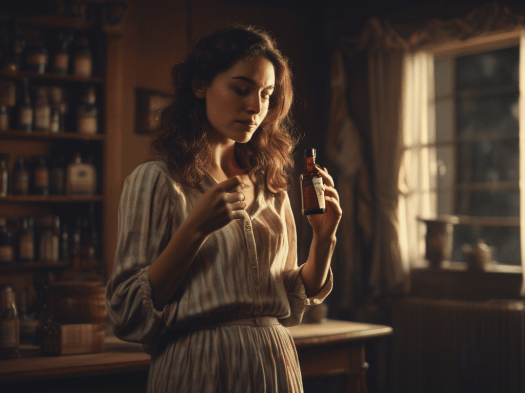
Bertha, a dedicated aficionado of her restorative elixirs, consumed multiple weekly bottles. She has a friendly rapport with the local pharmacist, who considers her his best customer and gives her a discount. She would often be found at the kitchen table for most of the day, dosing her tonics and composing lengthy, nonsensical letters to her sisters. By this time, her siblings had come to understand that the words emanated from the pen of a medicinal lunatic. Norma and Johnny acknowledged the necessity of professional intervention for their mother, and, with assistance from Le Petite Fromage and Blind Jelly Roll, they formulated a plan for Bertha to undergo a holistic religious cure under the guidance of Sister Aimee McPherson.
On that Sunday, a vibrant sermon accompanied by half a dozen show tunes with a dazzling chorus line stirred the congregation as Sister Aimee made her return to the pulpit for three thunderous ovations. Following the service, Le Petite Fromage and Johnny, the fiddler, as he is now called, escorted Bertha to the orchestra dressing room, believing her holiness sought to personally meet her and perhaps bestow a signed copy of her latest literary work, “You Can’t Take It With You When You Go So Give It To Me.” Embracing Bertha warmly, Sister Aimee presented her with a signed book before guiding her to a crimson velvet settee that had previously served as Blind Jelly’s salvation vehicle. With hands upon Bertha’s head, she prayed for deliverance from the grip of elixirs and zealous missives to her siblings. Understanding she had been played by her blood kin, Bertha, teeth-gnashing and fist-squeezed white, surrendered and embraced the moment. The healing transpired in a mere ten minutes as Sister Aimee proudly proclaimed the departure of the demons, assuring that all would be splendid by supper time. As she departed the dressing room, a divine fragrance lingered in the air. Blind Jelly Roll spoke up, ” I smells me some Channel No. 1. ” Leave it to a blind bluesman with the senses of nine cats to figure it out.
With the spoke mended in the family wheel, taut and ready for the road, John Henry indulged the family, comprising of Le Petite and Blind Jelly Roll, to a Sunday supper at a restaurant. Their choice fell upon Treasure Island, a pseudo-swanky seafood establishment under the ownership of the actor Wallace Beery. The best restaurants were on the Sunset Boulevard, known as the Strip. The entrance was the front hull of a sailing schooner, complete with a mast and sail. Johnny noticed the address above the door: 77 Sunset Strip: that address would come up again a bit later. Bertha and Le Petite were giddy, anticipating the prospect of encountering Hollywood movie stars savoring fish and chips washed down with a dirty Martini.
While awaiting their meal, James Cagney and his raucous family were seated a few tables away. Clark Gable and Carman Miranda snuggled in a cozy booth, where they indulged in sips of Martini and beer. Le Petite and Bertha were in a state of apoplexy. Carman Miranda made her way to the lady’s room, passing their table. Pancho Villa sat upon Blind Jelly’s lap, nibbling on a saltine. As the movie star strolled by, she took notice of Pancho and remarked on the adorable little doggie. When she reached out to pet Pancho, she received a vicious bite that tore off the long middle fingernail from her left hand’s digit. Stunned by the sudden attack, she yelled, “Get that little demon dog out of here!” Pancho and Blind Jelly concluded their meal in the comfort of Strawn’s car.
If you missed Chapter 9, click the link below for more amusement.
Tonight, I discovered that my pitching arm doesn’t work anymore. Listening to the debate, I couldn’t tell who deserved my ire. Trump could have done better, and Harris surely had the questions, possibly weeks in advance, so it wasn’t really a debate but a corrugated yuk-yuk party. I started scanning my den for objects to hurl at my flat screen. My Dallas Cowboys honorary brick would go through the set and possibly the wall, so that was out. Maybe a vinyl record album, but then I like them too much. A music CD, nope, I like them too. Maybe a sandal, nope, might ruin the footwear. So I threw an old Texas Highways magazine, and it bounced off: no power in my throwing arm anymore. Trump did bring up the Haitians eating people’s pets, which got a yuk from the moderators, but folks, that is true. I read that one Ohio grandmother watched a hungry Haitian eat her little Yorkie while she still held the leash. Haitians have a new dish, Kitty Tacos, which we’ve likely eaten before if you lived in Texas. I can’t take any more politics, so this will be my last post about the subject. Chapter 10 on Wagons Ho to California is about in the can, so stay tuned for that. May the force be with you…well, maybe not; Luke Skywalker likes Harris. Why did he have to go and ruin my Star Wars memories?
Who says there’s no surf in Texas? Dude, we got plenty of waves to groove on, even in the Big Bend Chihuahuan Desert.
As Momo and me departed from Marfa, Texas, traversing the desert and mountains, an SUV with two long surfboards on its roof overtook us. I gestured the timeless sign of approval to the occupants, and they reciprocated in kind. Perhaps they were bound for the Gulf Coast or returning from a journey to California. The vehicle captured in the photograph belongs to Moon Doggy Dan, a seasoned Texas surfer who ventured to Marfa in pursuit of life’s purpose and all the contemporary spiritual nonsensicality.
My grandfather, John Henry, possessed a mastery of storytelling that filled the room with warmth. When the rain beat against the windowpanes, or the ice or snow kept me inside, I’d perch myself on the floor near his rocking chair, mesmerized by the tales of his youth in rural Texas, his days as a soldier in the US Army, and the harrowing battles in France. With each word, he painted vivid scenes of the struggle and resilience of his family during the tumultuous depression years in 1930s California. Pausing only to adjust his fiddle, John Henry would then draw the bow across the strings, filling the room with a lively jig that seemed to echo the resilience and spirit of those days and family members long ago passed on. When my grandfather passed, my father, as any good son would do, took the helm, recounting those years in California and beyond. A few drinks of good scotch whiskey for us both lit up his memory and released his vivid imagination. The more scotch we consumed, the more colorful his recounts, so parts of this story may be a bit grandiose.
Bringing Blind Jelly Roll Jackson and Le Petite Fromage into the string band’s musical circle infused the fellows with newfound assurance. John Henry found himself utterly taken aback by their musical prowess.
Johnny and the string band continued to improve with each passing week. After six months of playing front porch shows, birthday parties, a few illegal chicken fights, and one funeral, W6XAI Bakersfield, the most influential radio station in California, came calling. The station approached the band with an offer to perform a thirty-minute live show. Le Petite’s Daddy, Baby Boy Fromage, used his questionable connections to secure the band’s spot on the show, as his own band, The Chigger Bayou Boys, were regulars on the hillbilly program hosted by Colonel Bromide A. Seltzer. The esteemed Colonel was famous for featuring the latest talents on his popular daily show, always staying on the lookout for fresh and promising acts he could sign to a strangeling management contract that left him flush with cash and the talent with a pittance. Blind Faith fitted his bill.
Baby Boy Fromage arranged for transportation to and from Bakersfield. The radio station had agreed to pay the boys $75. 00 for the show, which included four commercials for Father Flannigan’s Holy Healing Tonic, Sister Aimee’s Blessed Miricle Face Cream, and Puffy Cloud Lard. In today’s world, that kind of money might buy you a mediocre supper at an Olive Garden, but in the Depression years, it was a small fortune. Of course, Baby Boy would require a chunk for providing the transportation and a meager finder’s fee for getting the band on the show. All said and done, Blind Faith would make $40.00 cash to split six ways. Le Petite had warned the boy that her father’s deals can sometimes border on nefarious, so don’t cry like a freshly born titty-baby if the whole thing flushes down the toilet.
Around noon on Saturday, the stagecoach to Bakersfield arrived at the Strawn residence. Le Petite’s daddy had promised luxury transportation for the haul to Bakersfield. Baby Boy’s idea of a luxury transport was a converted Tiajuna Taxi, complete with no less than a hundred bullet holes along each side of the vehicle. Two church pews nailed to the wooden floor served as seating, and the big stain on the floor was likely blood. The driver was a Mexican chap who didn’t speak English and drove with a bottle of Tequila planted in his lap. His GPS was a ratty map with the route colored in red crayon. Le Petite was furious with her daddy and planned to smack his big head with a *cajun blamofatchy.
Arriving at the station, the band was led into a large room where the broadcast would take place. A small stage covered with short nap rugs and a half dozen microphones placed where each musician would stand. Another band, The Light Crust Doughboys, from Fort Worth, Texas, was packing up, having completed their live show for their sponsor, Light Crust Flour. They were in Hollywood to be in a Western movie with Gene Autry, and this was their last commitment before heading back to Texas. Johnny spotted their fiddle player, made a bee-line over, and introduced himself. The man, Bob Wills, a fellow Texan, wanted to hear youngsters play, so he stuck around for the live show, which was due to start in twenty minutes. The radio technicians placed each member in front of a mic, giving Le Petite her own microphone for singing. The band played 16 bars of music so the man in the sound booth could adjust the volume. Bob Wills sat in a corner, smoking a cigarette and drinking what appeared to be a pint bottle of hooch hidden in a brown paper sack.
The two announcers, a heavy-set fellow wearing a black cowboy hat and his companion, a boney, skittish little gal, also wearing a matching cowgirl hat and white boots, took their positions in front of a microphone next to a nervous Le Petite. The man told the band that when that light on the wall turns from red to green, that means we are live, and you start your theme song while we announce you and our sponsors. Jelly said he couldn’t see the light, but Pancho Villa would give him the queue. The announcer asked Johnny if that man was blind? Johnny said, “Yep, blind as a bat but he’s a pretty good driver and got us here in one piece.”
The boys had no theme song, so Jelly told them to play Red River Valley: You can’t mess that one up. The man at the mic counted down, the light turned green, and the boys let loose on their new theme song. All the time, the two announcers were jabbering about their sponsors.
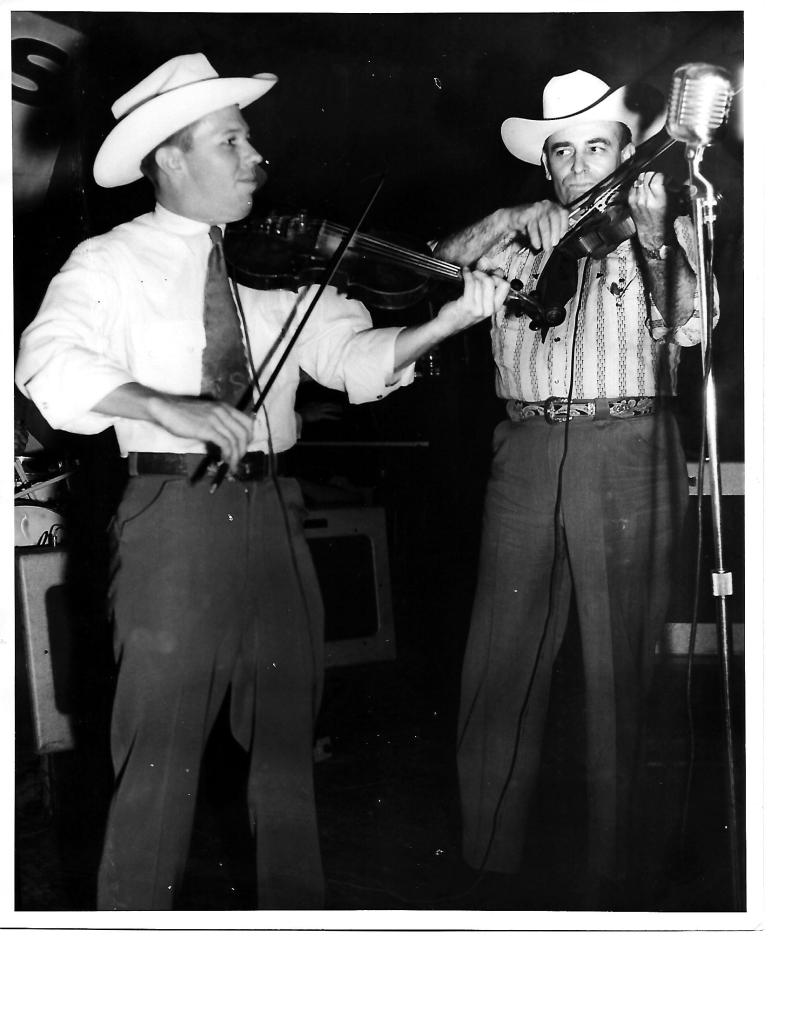
The announcers stepped back from the microphones and gave the boys a thumbs-up to start their show. Le Petite counted off a cajun song about a “Big Mamou” and went into “Will The Circle Be Unbroken” and then “Cold Beer and Calomine Lotion.” The band played every tune they knew, finishing up with Johnny playing a fiddle tune called “Lone Star Rag,” which caused Bob Wills, with a big grin on his face, to rise from his chair and clap along. When the show ended, Bob gave Johnny a few pointers, telling him he had a bright future in country music and to get in touch when and if he returned to Fort Worth. Fifteen years later, back home in Texas and playing country music for a living, Johnny got in touch with Bob Wills, who became his mentor and close friend, gifting Johnny with one of his fiddles, which he is playing in this photo. I have that fiddle as well as my grandfather’s fiddle.
My father, Johnny Strawn playing twin fiddles with Bob Wills. Forth Worth, around 1952.
Young Johnny and the rest of the string band joined the Strawn family for Sunday church attendance. John Henry warned the boys that they were about to witness a religious spectacle, so hang on to your britches. He also told the boys that If Jelly Roll was invited to join their group, all four of them would be standing before him, even though he is blind, for revering one’s elders was of the utmost importance.
Bertha and the boys walked with John Henry to the orchestra dressing room, where they found Jelly Roll and Pancho Villa seated on a red velvet settee, likely the same furniture that Sister Aimee used in the soul-saving of Jelly Roll, who now embraced his savior with religious zeal. Each of the boys introduced themselves, shook hands with Jelly, and gave a guarded pat to Pancho Villa; the banjo player was the only one to get a vicious bite from the foul-tempered canine. After a brief, casual conversation, young Johnny inquired if Jelly Roll would entertain the notion of joining the string band. Jelly Roll pondered the request for a few minutes, then gave them a yes, but a young female singer from the choir he had recently befriended would come with the package. The boys agreed, and a deal was struck.
Jelly Roll produced a tidbit of dried bacon from a pocket and gave it to Pancho Villa; he then directed the pooch to hurry down the hallway and fetch Miss Fromage. Pancho returned with a smallish girl in tow. Jelly Roll introduced the boys to *Miss Le Petite Fromage from Chigger Bayou, Louisiana. Her daddy is Baby Boy Fromage, the famous Cajun singer, so her vocal abilities come from good stock. Miss Le Petite was a diminutive gal, measuring less than five feet, yet possessing the curves and form of a fully grown woman, except for her hands and feet, which were the size of a small child’s: she had little baby feets and hands. When she spoke, her heavy cajun-accented voice was as smooth as honey on a warm biscuit. Jelly Roll and Miss Fromage agreed to rehearse with the boys on Saturday at John Henry’s home. The group left with the boys feeling like something big was about to happen.
On Saturday, John Henry gathered up Blind Jelly Roll and Miss Fromage and delivered them to his humble home. The boys perched themselves on the front porch. They were as nervous as a cat in a dog show, and who wouldn’t be: this was their first foray into professional music. John Henry kindly assisted Jelly Roll and Pancho Villa to a seat while Miss Fromage opted to stay standing.
After assisting the boys in tuning up, Jelly asked, “Are you all familiar with Mama Mabel Carter’s tune, Will The Circle Be Unbroken?”
The lads nodded knowingly. He then tapped his foot, “In the key of G, one ana two ana three ana four-ahh.”
After a lively eight-bar introduction with Jelly Roll bending his guitar strings into a torturous sound and Johnny joining him with his fiddle, Le Petite took a deep breath, stood up on her tiny toes, and belted out the song with such gusto that her boisterous vocals nearly blew the boards off the porch floor. By the song’s end, neighbors had gathered in the front yard, their feet tapping and hands clapping in rhythm to the spirited tune.
Turning to the band, Le Petite declared, “The next ditty is from my dear ole Daddy, Baby Boy. It’s a G-C-D progression with A minor thrown in for color. It’s called Party On The Bayou: Cold Beer And Calamine Lotion.” Step it up, boys; it’s a rapide quick-un”
The band played for two hours, covering Cajun music, Dallas blues, and some Bakersfield Okie-inspired country. It was clear that Jelly Roll and Le Petite were professionals and were teaching these lads a thing or two. The rehearsal was a rousing success. But now, if they were to play for money, they needed a good name for the band. Johnny threw a couple out, as did the banjo picker, but nothing stuck on the wall.
Le Petite said, ” Monsieur Jelly Roll, being a blind fellow, and now a born again unto sweet Baby Jesus with the strong, unshakable faith, why not call this outfit **”Blind Faith?” They liked it, and Le Petite announced, “So let it be written, so let it be done.”
*Le Petite Fromage is a type of French cheese popular in the bayou country of Louisiana.
**Blind Faith was a 1960s supergroup consisting of Steve Winwood, Eric Clapton, Ginger Baker, and Ric Grech. My father couldn’t remember the name of his string band, so Jelly Roll, being blind and embracing his newly found faith, seemed to fit.
My grandmother hailed from a sizable brood: four sisters and a solitary brother. Their formative years were spent in the sun-drenched fields of south Texas, toiling on the family produce farm. The patriarch, Grandfather Duncan, regarded his children as mere hired hands and didn’t pay them a dime. Every child born saved him from hiring a lazy field hand to pick his watermelons and oranges.
Upon the completion of their high school years, one by one, the siblings, usually in the dead of night and with assistance from the others, embarked on a journey, whether by bus, train, hitchhiking, or on foot, seeking their own version of freedom from the farm. Miraculously, within a few years, they and their new spouses found themselves settling in Fort Worth, Texas, mere blocks apart.
The transition from Texas to California proved to be arduous. My grandfather, possessing the toughness of weathered leather and an insensitivity to female emotions, saw the move as a blessing and a chance for a new beginning. However, for Bertha, it felt more like a forced abduction. John Henry appeared oblivious to her distress, or perhaps he believed it would pass in due time. Yet her sorrow lingered until she stumbled upon a seeming panacea: alcohol, fashioned into the magical healing elixirs hawked on the radio and in the newspapers. From anemia to tremors, from insomnia to weight loss, from night sweats to antisocial behavior, there existed a bottled pharmaceutical remedy for every affliction, no doctor’s visit required. Countless bottles of happy juice lined the shelves of the local drugstore, catering to the myriad conditions that afflicted my grandmother, a certified hypochondriac.
When not self-diagnosing herself that she harbored every disease known to man and convinced that her death was mere hours away, Bertha was quite the letter writer. Every day, seated at her kitchen table, her fountain pen full of blue ink, she’d churn out missives to her sisters in Texas. Fueled by her newfound self-assurance courtesy of those magic elixirs, she didn’t see any harm in embellishing the truth a bit about her new life out in California: alone in a strange land, who could blame her? It’s not as if her family would ever drop by for a visit. As time went by, her letters became creative works of fiction, painting the picture of a grand Beverly Hills home in place of her modest stucco house and a swanky Duesenberg convertible instead of their old Ford. According to Bertha, even the legendary Clark Gable was a neighbor, and Sister Aimee McPherson, the radio firebrand preacher gal, became a dear friend, and the two of them often enjoyed lunch at Musso and Franks Grill, mingling with the movie stars. Bertha was dead set on landing an audition with MGM or writing a grandiose screenplay, all thanks to that magical elixir of hers. Not thinking of how she would explain her fabricated world when they returned to Texas, she continued, and the more she wrote, the more she believed her own stories.
When Johnny turned thirteen, he approached his father with a request to pursue a professional career in music. John Henry, harboring doubts about the practicality of such a proposal, pondered the unlikelihood of anyone hiring a boy for such a venture, much less paying him with real money. Nonetheless, three of Johnny’s older schoolmates had extended an invitation to join their string band, which often performed at birthday parties and school events for a small fee, which was usually a coke and a plate of food. Their need for a fiddle player in the Bakersfield-style hillbilly tunes they favored aligned perfectly with Johnny’s musical talents. That evening, seated on the front porch after supper, Johnny revealed his decision to his father — he had embarked on a professional journey with his newfound band. Despite his initial surprise, John Henry offered his warm congratulations to the young boy venturing into this new vocation.
Their first official rehearsal was an epic disaster. The guitar player knew four, maybe five chords on his out-of-tune instrument, the bass player, using a beat-up dog house bass fiddle, couldn’t get the beast anywhere near in-tune, and the tenor banjo picker was worse than the other two. After massacering a dozen or so tunes, Johnny floated an option. He knows of a genuine black blues singer who burns up a guitar when he plays. The other three were wagging their tails like a hungry dog and voted to bring this fellow into the fold. Now, Johnny had to convince Blind Jelly Roll Jackson to play with a bunch of borderline musicians.
Church on Sunday was a rousing spectacle. Sister Aimee, after singing a handful of beautiful songs and just enough preaching to make sure the offering plates were full, called for souls that needed saving to approach the altar and receive Jesus. This was part of every service; a few folks would come down to be blessed and saved. With the orchestra playing, the choir singing, and a contingent of Hollywood-style dancers on stage, a hundred folks rushed the front in need of salvation. Sister Aimee, not knowing how to handle a worked-up mob that scared her out of her witts, retreated stage right and hid in her dressing room. Her assistant preacher and a few ushers administered to the flock while Sister Aimee gulped a handful of Carter’s nerve pills, washing them down with “Father Flannigan’s Holy Healing Tonic,” which was around 80% alcohol and claimed to be brewed from the holy waters of the River Jordan.





 Notes From The Cactus Patch