As a child growing up in 1950s Texas, I never understood the need to put myself behind an eight-ball with proclamation’s I had no way of keeping. New Year resolutions were the worst of them all.
My parents made them by the dozens and broke them without batting an eye.
My mother was the worst of the family bunch. Every year, on the eve of midnight, she would make a grandiose announcement to the family, usually after a few glasses of sparkling Cold Duck wine or too many Old Crow eggnogs. She made many resolutions in her day, but her yearly favorite was “kicking the ciggies.” She smoked like Bogart, one in each hand with a third, lit and waiting in the ashtray. My father, a lesser smoker, was a rank beginner compared to his bride. As a result, our household had more ashtrays than dishes. My sister and I also enjoyed the mild smoke from the ever-present Chesterfield cloud that hung in every room. Mother finally kept her favorite resolution at the age of 74, with some help from emphysema.
So, here I am at 72, and for the first time, I am considering making a New Year resolution or two.
I’ve been kicking around the less painful ones, easy things like giving up red meat or sugar. But then, Ovaltine contains sugar, and there is no way I can sleep without my hot Ovaltine, usually taken between 1 and 2 am, which is also my writing hours so that one is out. But, on the other hand, red meat can give me gastronomical grief, and I like fish more so that one is still doable.
Abstaining from distilled spirits? Now that’s tough, but it seems to be the national favorite.
It’s immensely satisfying to hold a crystal snifter of Jamesons or Tullamore Dew while sitting on my patio admiring the beauty of our local mountain, Comanche Peak. Good Irish whiskey settles my nerves and fuels my literary creativity. Jack Kerouac and Truman Capote will attest to that. Reaching old age without dying is hard work, and suitable rewards are in order. So unless I plan to stop writing and live out my final days as a nervous wreck, that one is kaput.
Attending a non-denominational house of worship with my bride. I can do this one with a few exceptions. Firstly, how does the word “none” go with denominational? There are hundreds of organized religions out there, just pick one and go with it.
Secondly, I’m old school church. I need to hear “the word of God,” not some big-haired pastor with an expensive haircut using the bible as a Cliff Notes report. I don’t dance hip hop in the isles, or clap, or sing songs projected on a screen, or enjoy hearing a choir of off-key screeching women whining about their personal tradgadys to the accompaniment of a Led Zepplin tribute band. I need that old-time religion to soothe my soul. The bubble-haired lady playing that Hammond B3 organ; that old rugged cross hanging on the wall next to the velvet Last Supper painting. A yelling red-faced slobbering preacher that points to me and says I’m going to Hell in a used Honda if I don’t change my sinful ways, and then expects money for admonishing me in front of strangers. Uncomfortable seating is a must. I can’t be a Baptist again, that would require me to give up my Irish whiskey, so it’s best to move on to another resolution or consider becoming a Catholic.
Improving my health. Maybe the easiest one of all, except for the sugar Ovaltine thing and the Irish whiskey thing. I possibly can do this one and make it stick. I beat the snot out of Cancer, so what’s left that could get me?
My doctor is young and hip. He wears one of those Apple watches that keep you alive and listens to TED talks in his wireless earbuds and drives a Tesla. He recommends, walking, hiking, biking, going to the gym, meditating, using fewer medications, and eating less of everything that tastes like food.
I reminded him that I need a knee replacement and major back surgery, so the walking, biking, hiking, and gym are out. Using fewer meds? He’s the idiot that put me on them. Sorry doc, I am not eating bagged weeds, Kale, plant-based meats, or gluten-free anything. Lactose-free milk is as woke as I get. I could only achieve a meditated state after a pipe full of Maui Wowie and Cat Stevens on the stereo.
By writing my resolutions down, I realize that nothing has changed since I was a kid. I’m not standing behind that eight-ball at this age.
Marjorie Mae has a dozen chickens living on her small farm on the outskirts of San Angelo, Texas. Normal Texas folks don’t think much of chickens except when they eat their eggs or have a piece of it fried or baked. Marjorie Mae is different; she treats her chickens like real folks; all of her fowl have first names and are somewhat educated.
Gilda, Ruby, Tootie, Francis, Lucille, Ethel, Jessie, Rea, Poochie, Piddle, Bebe, and Poteet. Call any one of them by their given name, and they come running like a spotted pup. She rather prides herself on being the keeper of educated farm fowl. She isn’t sure about the depth of their education, but they seem smarter than most run-of-the-mill barnyard chickens.
One day, walking by her barn on the way to the chicken coops to gather eggs, she hears piano music. She instantly recognizes the out-of-tune sound of her ancient broken-down upright piano that’s been stored there for ten years. Unfortunately, her husband Wilfred doesn’t play, so she figures a hobo or possibly an escaped felon from the prison farm must be hiding in her barn, twinkling the ivories. She grabs a 20 gauge from the house and marches off to confront the interloper.
As she gets closer, she realizes this is not some rube pecking around on her piano, but an educated musician, like herself, that knows their way around the 88 keys. So she slows her advance to a near stop to listen a bit more. She can’t be sure, but that sounds like Mozart’s Concerto No. 3 in B minor, but the piano is old and out of tune, so it could be anything short of a barn cat walking on the keyboard.
When she reaches the barn door, the music stops, then starts again. The beautiful haunting notes of Moon River float from within the dark depths. Whoever this trespasser is, she wants to meet them and have a bite of lunch at her kitchen table; hobo or felon, she opens the sliding door and enters the barn.
Thirty steps to the center of the barn, behind the frozen-up Ford tractor, is her dust-covered piano. The tarp cover is haphazardly thrown to one side. In the low light of the barn, she can’t see anyone, yet the playing continues. Finally, the culprit is discovered when she gets within five feet of the piano.
Her Sussex Speckled Hen, Rea, is standing on the keyboard, pecking the keys with her beak and both feet. Not the corny huckster trick pecking you see the chicken at the county fair playing on the toy piano for a quarter, but calculated and coordinated movements that are producing beautiful music. The first thing that comes to her mind is, “I’m going to be rich.”
I’m into the second week of my month-long summer visit to my grandparent’s farm in Santa Anna, Texas. It’s a hot night, and everyone is sitting on the covered front porch drinking sweet iced tea and Pearl beer. My two uncles, Jay and Bill, are visiting for a few days from Fort Worth and are putting the finishing touches on a case of beer they bought this morning at the Dino station. July is beer drinking season around here. It’s considered a main food group but must be served iced-cold to gain the nutritional value from the barley and hops.
Bill gets up from his chair and reaches into the Coleman cooler, extracting another Pearl; he uses his feed store church key and a pen knife to pop the cap. Then, looking out over the Santa Anna mountain, he says to no one in particular, ” I heard this morning there’s a piano-playing chicken over by San Angelo.” Uncle Jay, his brother, immediately replies, ” bull-shit, there ain’t no such thing as a piano-playing chicken. I bet you twenty dollars it’s a can of crap.”
The two brothers are the biggest storytellers and liars in Southwest Texas and will bet on anything. The more far-fetched and unbelievable, the better. Uncle Bill says we are leaving for San Angelo in the morning. I’m excited about this one.
After getting directions from the feed store and a man standing on a street corner, we head towards the farm of Miss Marjorie Mae. She is already a local celebrity and is the gossip fodder of the town. We arrive at her farm around 10 AM.
Marjorie answers her screen door, and uncle Jay states that we are here to see the piano-playing chicken. She says, ” it’s ten bucks a carload and I can’t promise you she will be a play’in if there are eggs to lay, she will most likely be doing that first; she’s a chicken you know.”
We are led to the barn, the door is opened, and there, glistening in the sunlight is a hand-polished upright piano. A silver candelabra and swirled glass vase of fresh flowers rest on top. Marjorie collects the ten bucks from uncle Bill. Jay pokes him in the ribs and whispers, “this is all bull-shit so you might as well pay me now. ”
Marjorie emerges from the barn carrying a fat Sussex Speckled Hen. This chicken is downright gorgeous for a barnyard critter. Its feathers are fluffed up into a fuzzball, and its toenails are painted bright red. A gold nametag hangs around the fowl’s neck. I can tell my uncles are duly impressed, as I am.
The hen is placed on the keyboard and immediately launches into a jive-inspired rendition of Glen Miller’s” In The Mood.” Finishing that tune, she plays a classical number and then goes right into ” Moon River, ” closing with the theme from ” A Summer Place.” My uncles are tapping their feet and laughing like deranged mental patients. Finally, the hen hops down from the keyboard and struts back into the barn; the show is over.
Uncle Bill thanks the lady for her hospitality. As we leave, he asks her name. She replies, “Marjorie Mae Mancini.” Bill inquires if the chicken has a name. She says, “oh yes, that’s Hen-Rea Mancini.” I kid you not.
Growing up in Fort Worth, Texas in the 1950s was a great childhood experience. It made me what I am today. Winters were Blue Norther cold with ice storms and the summers were over 100 degrees, capable of turning the front fender of my father’s Nash Rambler station wagon into a griddle. The eggs I fried on said car, turned out perfect. The butt busting not so much.
As a family unit, we would take one vacation a summer. A few times to New Mexico or maybe Port Aransas for some saltwater fishing and beach time. Most summers if money was tight, and it usually was, the go-to trip was to my grandparent’s farm. It was free.
In the summer of 1956, my father purchased a new Nash Rambler station wagon with a factory air conditioner crammed under the massive metal, unpadded dash. In the 50s, an air-conditioned car was a rarity, and I had never seen or ridden in one.
The car was baboon butt ugly, and I wouldn’t have been caught dead inside the beast except for the A.C that gave me a reprieve from the hellish summer heat. If a night was blistering hot, we would sleep in the car with the engine and AC running. Our house was not air-conditioned, as were most in our neighborhood. Attic fans were about the best we could do.
That car air conditioner was so cold, it could be used as a backup refrigerator. Yes, sir, none of that Eco-friendly coolant we have now, this was the real stuff; ozone-earth-killing gas. Eisenhower was no wimpy-ass tree hugger; he and Mamie wanted everyone to be cool in the summer.
My sister and I agreed, the trip that year was going to be an event. Cruising down the highway with the windows up and freezing our toes off while inhaling thick deadly clouds of cigarette smoke from my parents constantly lit Pall Malls. We couldn’t wait.
My mother’s family had a farm a few miles outside the small country town of Santa Anna, Texas. My Grandfather would take his Ford tractor, and plow, then plant diligently for days. Johnsongrass and bull nettle sprouted where Maze should have. Those were the drought years in southwest Texas and growing any crop was a miracle. Granny tended the livestock and chickens, selling eggs to city folk to make ends meet. They had seen tougher times, but no one could remember when.
There wasn’t much to Santa Anna as far as a town goes. A few churches, a school, and the ever-present chickens that inhabited the downtown area. A Dino gas station that never changed their prices on their sign, a feed store, a Dairy Freeze, and a few ma and pa stores, necessary for sustaining a dwindling population. Most of the young folks left during the war to work in Fort Worth at the aircraft plants. Most never returned. It was a town of old people.
The central, vibrant hub of the town was The Biscuit Ranch, a cafe, domino parlor, and gossip emporium. My Grandfather and his farmer buddies spent more time there shuffling dominos than farming the bone dry land. No one had money, so they played for toothpicks.
At the cafe, every order came with a sizeable buttery biscuit flopped on the plate. If you ordered a hamburger with fries and a coke, it arrived with a biscuit crammed next to your burger. It didn’t seem right, but no one complained. In Texas, biscuits are one of our main food groups.
Grandfather usually ate my biscuit because the ones my Granny made were hard within a few hours. They may have been uneatable but darn good for chunking at things. Nothing fly’s like a rock-hard biscuit. Next to my Daisy BB Gun, they were my weapon of choice.
I once knocked a hen dead out with a well-chunked biscuit from my Granny’s breakfast table. The other chickens gathered around the addled hen, making me feel awful for whacking her. I was ready to confess the deed to my Granny when I realized they were not gathered to inquire about her well-being but to peck on the offending weapon. The hen hopped up and strutted away. There is no sisterhood of chickens once you get past the yellow peep-peep stage. They all know that the next stop could be the skillet, so it’s everyone for themselves. There is much to learn from farm-educated chickens.
Over the years, it’s been my observation that there is a favorite uncle, aunt, or cousin in most children’s immediate families that they look up to. It matters not whether the adulation is deserved, kids don’t get twisted up with social, criminal, or married life. All we want is a jovial role model that makes us laugh and gives us things our parents would never approve of. The more eccentric and crazy, the better.
My favorite offender was my Mothers brother, Ray. A hulking piece of humanity with a face as red as a Nehi strawberry pop. His jaw was home to an ever-present plug of Red Man tobacco.
He was a proud veteran of WWII, having served in the Navy. He told us many times that he had thoroughly enjoyed his job of shooting down Japanese planes from the deck of the U.S.S. Hornet. He said it was like shooting a dove in a maze field, leading them a bit, and then blasting them out of the sky. He claimed to have over 50 kills. His brother said that Ray didn’t like to brag, but it was more like 200 kills. He was a hoss.
Uncle Ray drove the obligatory rusted-up pickup truck, but his “Sunday come to visit” ride was a 1955 Chevy Bel Air convertible with genuine Mexican crafted, red and white roll and pleat seats. The body had pinstriping covering every inch, and the money shot was a full longhorn rack mounted on the front of the hood. The interior had little Mattel derringer cap pistols for the radio knobs and a big black and white ivory dice stick shift for esthetics. It was the hands-down most incredible car in the state. My cousin Jerry and I took a ride to town with him one Sunday in June, and it was the highlight of my summer visit.
We piled into the back seat between his two shotguns, a bowling ball, and a Coleman ice chest full of cokes and Pearl beer. Uncle Ray told us to drink all the cokes we wanted, but take the church key and start “popping him some Pearl.” I was struggling to keep up the demand for Pearl because Uncle Ray could drink one in a single gulp. I couldn’t get one sip of my coke down before he was calling for another beer. Those were the days when a real man could enjoy his favorite cold brew while driving a 3,500-pound tank down the highway at 70 miles per hour.
When we rolled into the city limits, the ice chest was void of beer, and Uncle Ray commenced singing. A person would expect a big old farm boy like Ray to sing country tunes or at least a few religious songs. Not this feller. He began belting out Judy Garland, Ethel Merman, and Patty Paige’s songs like nobody’s business. We had no idea he could sing so well or drink so much beer.
When he broke into Judy Garlands’ “Somewhere Over the Rainbow,” he stopped the car, got out, and did a great show tune finish complete with hands held high in the air, hat off, and a bow at the end. Cousin Jerry and I clapped and gave him a bravo for the performance.
He was appreciative, but then turned to us, and in a hurtful voice, said, “my family has no use for the finer things in life such as music, broadway show tunes, and good booze, and, I love all those things, so they have no use for me either.” We didn’t know what in the hell he was talking about but just nodded in kinship agreement.
By then, I guess the beer had kicked in, along with the emotion of the singing performance and his long harbored hurt feelings, so he started bawling like a baby that had lost its bippy. All we could do was stare at the floorboard of the most incredible car in Texas.
After his embarrassing session of bawling and gagging, Ray pulled out a lovely hanky from the glove box and dabbed his tears away.
In a low, growling voice, he told us that he would kick our little scrawny asses and feed us to the Mountain Boomers if we ever said anything about this. Naturally, we nodded in agreement not to say a thing.
Uncle Ray got his gas and more beer at the Dino station, then peeled out in front of the Dairy Freeze, and we headed back to the farm.
Later that afternoon, Jerry and I were sitting under the oak trees talking to my cousin Beverly, who was setting up her playhouse with her collection of 6-inch plastic “Dolly” dolls.
At the age of seven, Beverly was beginning to communicate with humans through her dolls. She was the nontalkative and strange one of the bunch, so no one thought much of it. “Just a kiddy phase,” my Aunt Charmaine would say, “she’ll outgrow it.” I found her behavior scary, but I rather enjoyed speaking to a six-inch plastic doll that talked back. All questions had to route to Beverly through the doll; answers were returned the same way. We were kids; it was fun.
I told the doll, in the strictest confidence, about the incident with Uncle Ray on the side of the road. The doll, in a squeaky mouse voice, said that “Beverly’s mommy thinks that uncle Ray is a big old fruit. I asked the doll what a big old fruit was? The doll said it was a boy that liked to blow kisses to other boys and painted his fingernails. I told the doll that uncle Ray didn’t blow kisses to us, but he sang Judy Garland songs. The doll said it was the same thing; it was a sign from above.
My mothers’ large family was never one to let a gathering of the sisters go to waste. It was agreed that because most of the Fort Worth family had missed Easter at Grandmothers that year, we would celebrate Easter while everyone was here, in June; the hottest part of summer.
Granny and a few cousins went to the chicken coops and gathered eggs for boiling and coloring. Then, Aunt Charmaine drove to Coleman and purchased chocolate to melt for the candy. She came back with a massive bag of Peeps, the little yellow marshmallow chicks that contained enough sugar to keep a kid humming like a top for days. Peeps were something new, and all of us kids thought they were the best candy there was.
Everything was humming along fine until cousin Beverly saw our bag of Peeps. She turned pale, crossed herself, which was strange because she was Baptist, then grabbed her box of plastic dolls, and scooted off to the smokehouse, locking the door.
When we were enjoying the damp coolness of the storm cellar later that afternoon, Beverly, via her talking doll, filled us in on the real and true story of Peeps.
She said that the little marshmallow chicks were the “reincarnated souls” of all the eggs taken from the chickens, and the Peeps were going to get even. After explaining what reincarnated meant, it all made perfect kid sense to us. Peeps were going to kill the whole town. Beverly’s doll made us swear not to eat any Peeps, or they would come looking for us too. We agreed but kept our fingers crossed behind our backs.
Later that evening Jerry and I sneaked some Peeps, went behind the barn, and ate our fill. There was no scream as we bit the little squishy heads off, just the excellent taste of yummy Peeps melting in our greedy cavity-ridden mouths. We agreed that Beverly and her dolls were idiots, and she needed to go see preacher Wilson and get some special prayers. He said his momma took her there, but the preacher said he wouldn’t talk to a darn Dolly Doll, so that was the end of the healing days.
At supper, Granny informed everyone that uncle Ray would be joining us for the egg hunt and celebration the following day, Sunday, the usual day for Easter. It didn’t matter if it was June 15th, 1956; the festival was happening.
After supper, which consisted of buttermilk fried chicken and chunk-able biscuits, we kids retired to the screened-in porch to plan for tomorrow’s egg hunt and the looming Peep attack. Cousin Beverly’s doll, once again, warned us all not to eat Peeps or it would be horrible death for us all. We listened to her doomsday doll, then trudged off to get ready for bed.
Being summer and hot at night, all the cousins slept on the screened-in porch on pallets made from Granny’s quilts. It was a bit scary because being out in the country, there was no city light and that night, no moon, so we used candles to find our beds. The sounds of crickets and the breeze blowing through the Mesquite trees lulled us into la-la land.
Uncle Ray, knowing for once he was almost not in the dog house with his family, decided to drive to San Angelo and get a new suit for the Easter in June celebration. Maybe showing a cleaned-up side to his sisters would raise his respect-o-meter a few bars.
A shopping trip, a chicken fried steak at Woody’s Drive-In, and a visit to the Fishing Shack for a few beers made for a long day. It was around 2 AM when Ray headed back to Santa Anna. In his semi inebriated state, he thought it was morning and he wanted to be at the farm for breakfast, so he stopped on the side of Highway 84 and changed into his new, bright yellow sear-sucker suit. To top off the ensemble, Ray had purchased an orange feed store ball cap. Quite the dresser he was.
Ray parked his Chevy down the road from the farmhouse. Full of beer and looking like the grand marshal of a Mardi Gras parade. He was so tired he didn’t realize that everyone was still asleep because it was 4 AM. He quietly made his way around to the side of the house to the screened-in porch.
Uncle Ray had a devilish side to him that we all knew too well. He was always scaring us kids in some way, so why not now. A moonless night, sleeping kids, it all made perfect sense to him.
Earlier in the day, in San Angelo, he had come across some tiny plastic whistles he bought as an Easter gift for the kids. Thinking that he would scare the fool out of us, he put one to his lips and stepped through the screen door onto the porch where four sleeping kids lay in fitful semi-slumber.
The scene was right out of a movie. We all awoke at the exact same moment, hearing the squeak of the screen door; we froze in fear. The Peeps were coming to do their foul deed. I was so scared I started getting hot and itchy and could hear Jerry whining on the pallet next to mine. We all lay there, stiff as a plank with eyes closed, waiting for the end.
Uncle Ray, a former championship smoker with a prize-winning hack, chose that moment to expel a drunken cough, and when he did, he sucked the plastic whistle down his throat, where it lodged. He was gasping for air and trying to speak, but it came out as a “Peep-Peep-Peep.”
We all sat up at the same time, seeing a “Giant Yellow Peep” standing there with its wings flapping wildly and chirping. That was it. I dove through the screen-in porch into the flower bed, rolling twice then turning on the after-burner. Cousin Jerry and little Charmaine made their own hole in the screen and took off down the dirt driveway screaming.
Cousin Beverly backed into a corner, held up her dolls in both hands, and commanded the big Peep to go back to hell from whilst it came. Ray, arms flailing, was attempting to get her attention for some help.
Seeing cousin Beverly about to get her head bitten off by the giant Peep, I cried out, “I should not have eaten those sweet little Peeps behind the barn I’m sorry Beverly.” I had to save her, so I grabbed a shovel from the flowerbed and ran onto the porch. I made a mighty swat right onto the back of the Big Peep, hoping to take it down in one whack. When I hit the peep, the whistle dislodged from uncle Ray’s throat, and he spits it out. He turned around, ready to kill the one who had whacked him. He then realized I had struck him and possibly saved his life, and he started laughing.
Beverly, too afraid to escape, passed out cold on her pallet.
I was so relieved to see it was Uncle Ray and not a “Giant Peep from Hell” that all I could do was give him a big hug. He was laughing so hard he was crying after realizing what he had done to us.
The whole house was awake and on the porch. The aunties gave Ray Holy Hell for this antic and told him to get out now. He said he would, but first, he had to “clear the air” about some things. High noon was here.
First, he told my mother and her sisters that they all had corn-cobs up their butts and didn’t know “crap from fat meat” about the finer things in life. He then broke out into Ethel Merman’s version of “There’s No business Like Show Business,” followed by Judy Garland’s “Mister Sandman.” We kids sat and listened to some great vocals, and it didn’t matter if it was coming from a Giant Peep.
When Ray stopped singing, cousin Beverly walked up to him and held out her plastic Dolly Doll. Ray bent down on one knee and leaned in close to Beverly. The doll, in her squeaky mouse voice, asked uncle Ray if he was a big fruit? To which he replied, “I’m as fruity as Carmen Miranda’s hat.” Aunt Charmaine yelped, “see I told you so,” to the rest of the cast on the porch. Us kids didn’t care; Uncle Ray could sing his ass off and still had the most incredible car in Texas.
We had a good June Easter that Sunday. Uncle Ray asked that he be allowed to stay for one last celebration and his sisters agreed. He hunted eggs with us, sang show tunes all day long, and even took us behind the barn for a chew of Red Man and a few sips of Pearl.
He drove off that afternoon, convertible top-down, waving and singing Doris Day’s big hit, “Que Sera Sera,” a perfect departure to end a perfect day.
The family stood in the road listening to the fading song until the dust trail settled.
No one said anything; perhaps it was too much to talk about at that time. Supper was quiet that night. Beverly left the dolls in the smokehouse, and Grandmother made a buttermilk pie to comfort everyone. It wasn’t discussed, but everyone felt they wouldn’t see uncle Ray for a long spell. His way of life didn’t fit in Santa Anna, Texas, in those times.
We went back to Fort Worth the next day and didn’t hear much about uncle Ray for quite a few years.
When I was twelve, I received a Christmas package in the mail, which is quite a great thing for a kid. My mother watched as I ripped it open and lifted out a record album.
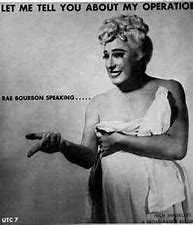
The cover picture showed an overweight woman wrapped in a towel. The title was “Let Me Tell You About My Operation.” This made no sense to me; who would send me this flaky album?
My mother gasped and said, “Oh my God, that’s uncle Ray.” I looked real close, and sure enough, it looked like him, but I still didn’t believe it. I opened the small card in the package and read, “To my favorite nephew Phil, I still have my cool car and like my Pearl. Enjoy the songs”, Auntie Rae. I listened to the album on the hi-fi and fondly remembered that crazy Easter in June of 1956.
Two Catholic boys, Jack Kerouac and Neal Cassidy, are on a road trip by car across the American West to find the meaning of life. The badlands of New Mexico held all the secrets that New York City would never have. It could be a great book are a movie. But, as it turns out, it was a book first. What could go wrong?
Two Catholic boys, Jack Kerouac and Neal Cassidy, are on a road trip by car across the American West to find the meaning of life. The badlands of New Mexico held all the secrets that New York City would never have. It could be a great book are a movie. But, as it turns out, it was a book first. What could go wrong?
It was 1947, and half the country still lived in a Norman Rockwell painting, and the other poor souls struggled with keeping food on their table and a decent job. The war was but a few years ago, and the scars were fresh and raw. As the movies would have you believe, not everyone had the good fortune to live in New York City and shop at Macy’s and Bloomingdales. The Hollywood boys covered everything in Fairy Dust and Unicorn urine, and the commies were coming to your neighborhood. The two young men sensed the growing change and needed to find the “real America”; the wide-open, gritty, in-your-face, working man culture that made their country run on regular gasoline.
“On The Road” was published in 1951. The author, Jack Kerouac, a French Canadian American that didn’t learn to speak or write in English until he was six years old, became an instant literary celebrity and a reluctant prognosticator to the “Beats,” which would become the “Hippies” in the 1960s. He tolerated the Beats and the new intellectuals because he helped birth them, but grew to despise the Hippies before he died. He wrote many times that he was sorry they found his books and used them as their warped ideological drug-addled bible that led to the near destruction of his beloved country. The “beat generation,” another term he loathed, wasn’t meant to survive past 1960. The writings and musings made no sense after 1959. He believed everything had an expiration date.
Ginsburg and Burroughs kept the plates spinning; the publishing cash and the adulation were too strong to walk away just yet. So Kerouac moved on and became a drunkard and pill head. Fame, and all that came attached, was not his bag.
The only comparison to the book that I can think of would be the “road” movies of the 1940s. Two pals and a gal road-tripping to Nirvana. Kerouac would have been Bing Crosby and Cassidy a bi-polar Bob Hope with his girlfriend a sluttish Dorothy Lamour. But, of course, their adventure was adults only. Weed, booze, Minga Minga, and foul language would not have made it with old Bing and Bob.
The two main characters, Sal Paradise and Dean Moriarity, were the essential bad boys before it was cool. Their names alone were enough to make you buy the book. Every teenager that read it could easily place themselves in their universe for a while. Who knows how many ill-fated trips the book influenced.
My cousin and I toyed with the idea. First, to California and back to New York, then home to Texas in his Corvair Monza; then the effects of the pot wore off, we ate a cheeseburger and shit-canned the plan.
James Dean was a disciple, as was Marlon Brando. They wore bad boy cool like a soft leather jacket. The movie boys jumped on it. “Rebel Without A Cause” and “The Wild Ones” sent parents screaming through their middle-class neighborhoods with hair ablaze. Ozzie and Harriet doubled down. Pat Boone turned up the heat. Art Linkletter had a meltdown. The fifties were dying before our eyes.
I may revisit “On The Road” again. It sits on my bookshelf, aging like wine, and needs to be jostled.
Summer afternoons with temps in the upper 90s. There is no air conditioning in your house, and you have a bad case of chiggers you picked up from the vacant lot down the street. Your front tooth is loose, and two toes on your left foot may be broken from being run over by your uncles’ station wagon. Life for kids in the 1950s was hard. But, the one thing that made it all worthwhile was the Ice Cream Man.
You could hear the cheesy music from two blocks away; plenty of time to make it home for some change. It didn’t matter if there was an entire half-gallon of Blue Bunny in the freezer, the Ice Cream Man was coming, and he had what we needed, the good stuff; Popsicles, Dreamsicles, Chocolate Cows, Rockets, Push Up Sherbert, Fudge Bars, and Eskimo Pies.
I thought selling ice cream from a white truck while dressed in a uniform was my career path. So I told my father that’s going to be me in a few years. But, yessir-ree-bob, it didn’t get any better than Mr. Good Humor pushing frozen sweets to kids. Of course, my father was concerned about my plans, but I was 7 years old and likely to change professional aspirations within a few hours. I also thought the Milk Man was a great gig. Half the kids on our block resembled him.
My pal Skipper and I once crawled into the back of the Vandorvorts Milk truck and rode for two blocks before being caught. We drank as much chocolate milk as we could hold before being discovered. It was freezing cold inside, but we did our best. It was worth the butt-busting.
There is nothing quite as funny as a bunch of kids with Popsicles stuck to their tongues running and screaming bloody murder. I always thought that ice cream man had a mean streak.
The Bongo Band at The Hip Hereford. Sargent ( Sal ) York in Stripped shirt
In 1957 there was a coffee house and Beatnik hangout in downtown Fort Worth, Texas called “The Hip Hereford,” named in honor of the owner’s prized champion bull.
Sargent ( Salvatore )Tulane York was related to the legendary war hero, Sargent York, on his fathers’ side of the family, thus his naming after his famous cousin.
Growing up on a vast cattle ranch outside of Weatherford Texas, Salvatore wanted one thing; to be a singing cowboy, like Gene Autry, Roy Rogers, and maybe Tex Ritter.
All-day, every day, from the time he could sit a saddle, Salvatore sat on his shetland pony, “Giblet,” playing a plastic ukulele while singing “Home On The Range” and “Oh Susana.” This behavior went on for years, and his parents finally gave up on the little savant, letting him ride the range singing his two-song songbook to the cattle and the critters. At times, his parents forgot to call him in for supper, or when it rained, and little Salvatore would make camp with the doggies, showing up a few days later as if nothing strange had happened.
When Salvatore turned 17, he began going by his family name of Sargent. It made him feel dignified and a little important. He and a few boys from school formed a little guitar and fiddle band and began playing around Parker County. Chicken fights, church fundraisers, and intermission at the Cowtown Drive Inn were about the only gigs they could get. They knew four songs and were hard to listen to. They called themselves ” The Parker Valley Ranch Boys.” They met Buddy Holley once and asked for his advice. He told them to stay the hell away from him and his Crickets and to get a real job.
The band didn’t work out, so Sargent decided he would try being a Beatnik. It didn’t take talent or an education, both of which he had none of, so he figured he could make it work.
He opened the first Beatnik-type coffee house in Fort Worth near the Majestic Theater. He gave the guitar and fiddle band one more shot but it didn’t fit the atmosphere. He had another idea that would work. Why even have music! Just have a few guys playing bongo drums while people speak or recite poetry. How cool is that? No messy music or instruments, just the gentle beat of the soothing bongo to accentuate the moment.
The picture above is the first incarnation of “Sargent Yorks Lovely Beatnik Bongo Band,” onstage at The Hip Hereford. Sargent York, the band leader, is the dude in the middle wearing the striped shirt.
Word got out about how cool and hip the place was, and soon every performer around wanted to be seen there. Elvis Presley was at Fort Hood serving his time in the Army, so he would come up on Saturday nights and sing a few tunes. Jack Ruby ( yes, that one ) would bring Candy Barr, the famous stripper to do her show, and Lyndon B.Johnson and Lady Bird would stop by to shake a few hands and recite the latest bill he was introducing in the senate. Lady Bird would give gardening advice. Brother Dave Gardner, the famous comedian made a few appearances, as did Lenny Bruce, Joan Rivers, Phylis Diller, Jonny Carson, Alvin, and The Chipmunks, Soupy Sales, and Rabbi Schmolie and his singing dog, Moses.
The place rocked on for another year, then when interest waned, Sargent closed the doors and went to Greenwich Village to become a folk singer.
The rumor that floated around for years, even into the mid-60s, was that some English musician was vacationing in Texas and caught a few acts at the Hip Hereford. He dug the name of the house bongo band and later passed it along to some of his blokes over on Abbey Road. Who knows, it could have happened?
“Do not forsake me, oh my Darlin,” on this our wedding day,” who didn’t know the first verse of that song from the radio? A massive hit from the 1952 movie “High Noon,” performed by everybody’s favorite singing cowboy, Tex Ritter.
In 1957, I was eight years old, and on some Saturday nights, I got to tag along with my father to the “Cowtown Hoedown,” a popular live country music show performed at the Majestic Theater in downtown Fort Worth, Texas. My father was the fiddle player in the house stage band, so I was somewhat musical royalty, at least for a kid.
Most of the major and minor country stars played Fort Worth and Dallas as much as they did Nashville, and I was fortunate to have seen many of them at this show. One, in particular, made a lasting impression on my young self.
I was sitting on a stool backstage before the show, talking to a few kids; who, like me, got to attend the show with their fathers.
My father came over and asked me to follow him. We walked behind the back curtain and stopped at a stage-level dressing room. There in the doorway stood a big fellow in a sequined cowboy suit and a 30 gallon Stetson. I knew who he was; that is Tex Ritter, the movie star and cowboy singer. My father introduced me, and I shook hands with Tex. I was floored, shocked, and couldn’t speak for a few minutes. What kid gets to meet a singing cowboy movie star in Fort Worth, Texas? I guess that would be me.
Tex asked my name and then told me he had a son the same age as me. We talked baseball and cowboy movies for a bit, then he handed me a one-dollar bill and asked if I would go to the concession stand and buy him a package of Juicy Fruit chewing gum. So I took the buck and took off down the service hallway to the front of the theater. I knew all the shortcuts and hidey holes from my vast exploration of the old theater during the shows.
I knew nothing of the brands and flavors, not being a gum chewer, but the words Juicy Fruit made my mouth water. Not having much money, what change I did get from selling pop bottles went to Bubble Gum Baseball Cards, not fancy chewing gums.
I purchased the pack of gum for five cents. Then, gripping the change tightly in my sweating little hand, I skedaddled back to Tex’s dressing room. He was signing autographs but stopped and thanked me for the favor. He then gave me two quarters for my services and disappeared into his dressing room for a moment. He handed me an autographed 8×10 photograph of him playing the guitar and singing to the doggies when he returned. I was in country and western music heaven. He also gave me a piece of Juicy Fruit, which I popped into my mouth and began chewing, just like Tex.
Juicy Fruit became my favorite gum, and now, whenever I see a pack or smell that distinct aroma as someone is unwrapping a piece, I remember the night I shared a chew with Tex Ritter.
I was awake at 2: 45 this morning. I have learned that once my brain engages, there is no time for sleep. I get up, turn off the alarm, turn on Mr. Coffee and my laptop. I don’t bother with television news anymore, but I prefer to read news sites for my information. The coffee brews, a cup is poured, and it tastes darn good. After two cups, I forget about coffee and start making notes for a future blog post. Thirty minutes later, I decide on a third cup. Good grief, the coffee taste like swill, burned, and nasty. I learned this morning that if you leave the coffee on the burner for thirty minutes, it’s ruined, and you might as well pour it down the drain. This makes an excellent argument for using our Keurig machine, but the pods will break your grocery budget, so it stays in retirement. I am meant to suffer for coffee.
I follow many blog sites on WordPress. In turn, some follow mine. It’s an excellent trade-off. For example, this morning, I came across a blog focusing on religion, one of my favorite argument topics.
The writer, a Christian and a Catholic living in the UK, takes offense to music in church. Not so much the white-haired old lady playing the Hammond organ and a choir singing old-time religious songs, but the entire rock band on stage with a trio of singers wailing away about who knows what. He calls it “Jesus Rock.” I get it. I am a musician, and I know how music can move you. A well-played tune can energize your soul or take you to your knees in grief. But, unfortunately, the wrong kind of music can also distract your worship and send me running for the exit. I don’t need a Van Halen tribute band blowing the roof off the house of worship and the congregation holding up Bic lighters as they sway to the music. So I tend to lean more to the liturgical side of prayer. The old-style church service from “back in the day” is what I know. Damnation soothes the soul.
Sunday mornings sitting on a rock-hard pew, sweating, and fidgeting in my starched shirt and slacks while the Baptist preacher tells me I am going to Hell; now that is the real church of my youth. Although at six years old, I have no concept of Hell or why I am going there? My mother tells me to be still and then cleans my ears with a handkerchief and spit. The organist and the choir break into The Old Rugged Cross, the plate comes around and I deposit a dime. I am miserable. It is God’s wish.
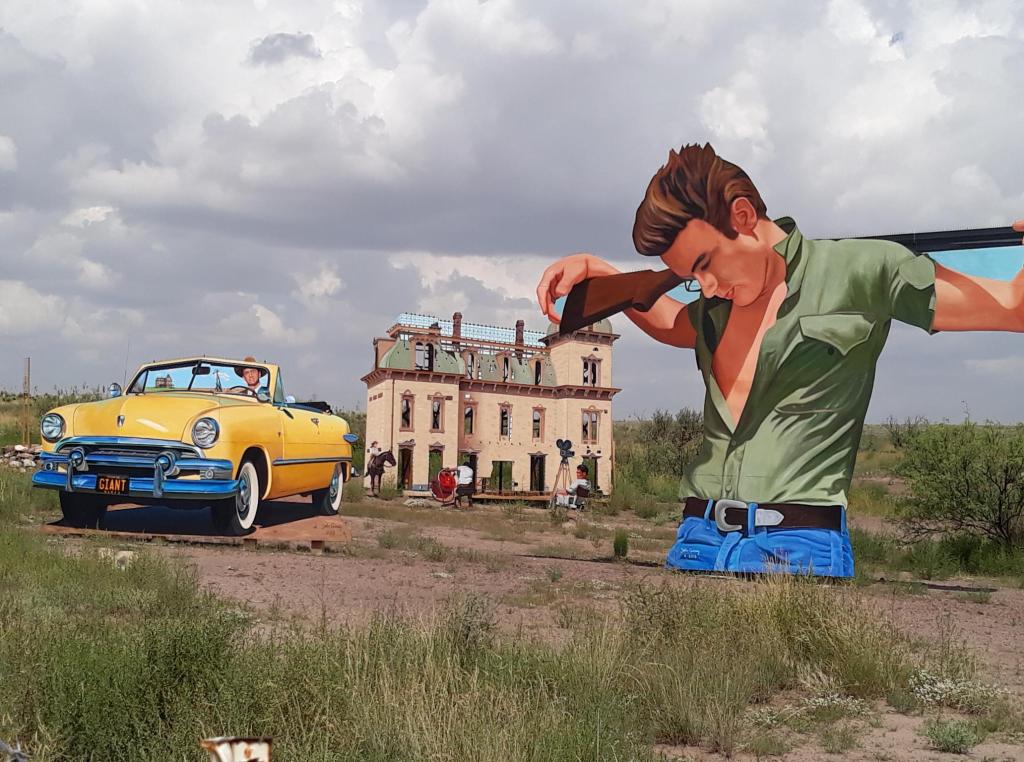
Fifteen years ago I ran across an article in “Texas Monthly Magazine” touting Marfa, Texas as the next “big deal” in the art universe. The author gushed on about Donald Judd, a prolific artist based in New York City who had moved his home base and all his toys to dusty little Marfa. Up until he arrived, Marfa was known as the backdrop for the 1956 movie “Giant.” After the article hit, van loads of weirdo artists from Austin showed up and claimed the town as their own. “Keep Austin Weird” was now “Keep Marfa Weird.” The mostly Hispanic population thought the gates for Hell had opened and released its hipster demons on their quiet township
For reasons I can’t recall, I became a bit obsessed with visiting this desert town and made myself a little Marfa bubble that grew larger with the passing years. I am also an artist and figured there was something life-altering in Marfa I needed to experience. The lure of the Big Bend desert kept calling. Time marches on and I forget about Judd and his art colony until a few years ago. I figured it was time to make the trip to Marfa.
My wife and I decided that after our summer vacation in Ruidoso, New Mexico, we would drive down to Marfa and scratch one item off of my bucket list. At my age, every trip becomes a bucket list item because my shelf life could expire any day now.
Five hours of driving through the Chiuauan desert landed us in Alpine Texas and the 1950s era motor hotel “The Antelope Lodge.” Retro doesn’t begin to describe this place. Very little updating has been done since the 1950s and the stucco cabins reek of the halcyon years of family road trips in large station wagons. I believe that the Cleaver’s may have stayed here. I can imagine The Beaver and Wally sitting in the courtyard eating Moon Pies and drinking RC Cola in the 100 degrees heat.
Marfa is a short hop from Alpine so the next morning we are on the road early, planning to catch breakfast in Marfa. I’m thinking about bacon, eggs, and pancakes Texas-style while Maureen is wanting fluffy biscuits and sausage gravy. Yum Yum.
Driving into town, the scenery is not what we expected or what I had found online. Dilapidated house trailers surrounded by broken down rusted cars line the highway on both sides. Not the best greeting for visitors. My bubble just sprang a leak.
Once in town, we realize that everything is closed. The art gallery is open on Saturday only, the Hotel Paisano lobby is closed until 5 PM, the Hotel St. George lounge doesn’t open until evening, the square is deserted and the only signs of life are some foreign tourists taking selfies in front of a boarded-up hardware store. My bubble is leaking air big time.
Now officially starving, we search for food, and found “Marfa Burritos,” the only restaurant open, and calling it a restaurant is a stretch.
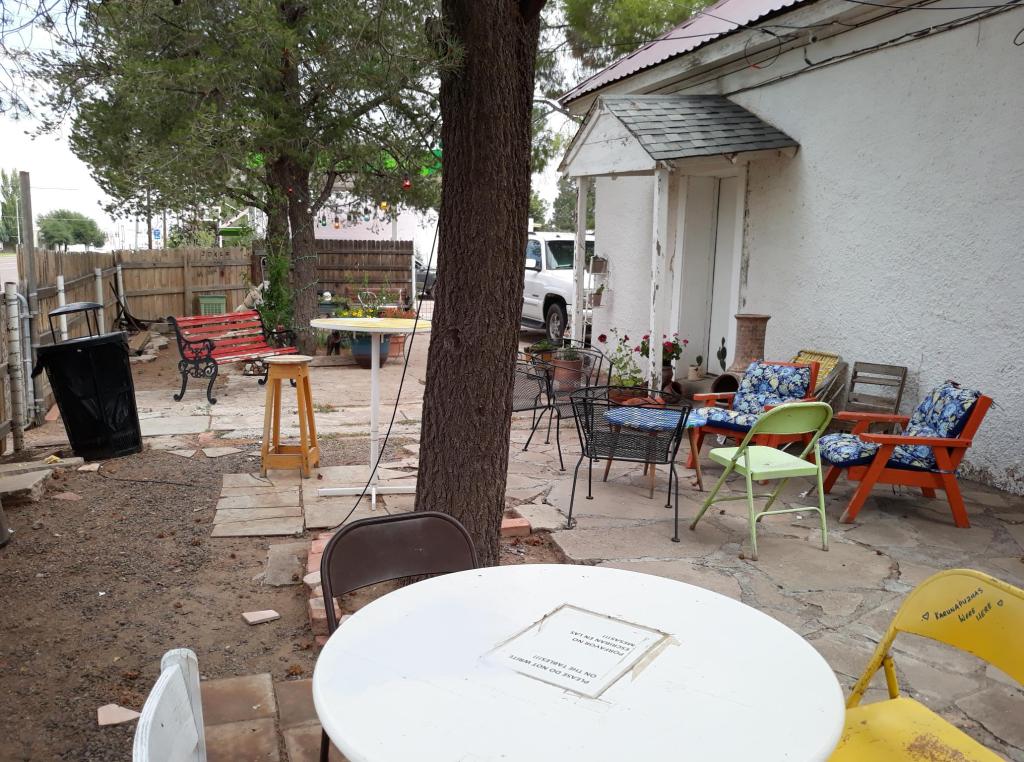
Marfa Burrito dining area
A burrito is $7.00 and a warm can of Coke is a buck. What the hell, it’s food. The kitchen is located inside a ramshackle frame house; peeling paint and rotted siding give it that weathered west Texas appeal.
A young man and woman are ordering their burrito from the cook. They smell like incense and the girl has more armpit hair than the guy. I figure they must be from “El Cosmico,” the transcendental hipster enclave of yurts and vintage travel trailers that everyone online is raving about.
The outside dining area needed a little attention. A feral cat was munching on a half-eaten burrito that fell from an overflowing trash bin, and ants and flies are everywhere. I’m thinking Marfa doesn’t have a health inspector.
After breakfast, we decide to visit the Prada exhibit, which the Marfa website says is located just outside of town. Some years ago, two German artists constructed a small building full of Prada handbags and shoes in the middle of the desert, and it became the main tourist attraction for Presidio County. The other attraction is the Marfa Lights; twinkling orbs that dance around in the mountains east of town. The locals claim the lights are Aliens or maybe disgruntled Indian spirits. Some of the older folks believe they are the ghost of James Dean, Rock Hudson, and Elizebeth Taylor, the long-departed stars of the Giant movie.
We drive for twenty-minuets and no Prada. We check Google maps and find it is another half-hour’s drive to Prada. To hell with that, so we turn around and motor back to Marfa. My fifteen-year-old bubble just popped. We decide to return to Alpine, pack our gear, and head for home. No more bubbles for me.
I saw my first 3-D movie in 1956. The House of Wax had been out for a few years, but this was close to Halloween, so the theater brought it back for an encore. My cousin Jock, Billy Roy, Georgie, my pal who was scared of everything and also our neighborhood firebug, and I rode our balloon-tire bicycles to the 7th Street Theater in Fort Worth. A ticket was 25 cents, and a Coke and popcorn were another 10 cents. We were set. The cheesy cardboard 3-D glasses were free.
I saw my first 3-D movie in 1956. The House of Wax had been out for a few years, but this was close to Halloween, so the theater brought it back for an encore. My cousin Jock, Billy Roy, Georgie, my pal who was scared of everything and also our neighborhood firebug, and I rode our balloon-tire bicycles to the 7th Street Theater in Fort Worth. A ticket was 25 cents, and a Coke and popcorn were another 10 cents. We were set. The cheesy cardboard 3-D glasses were free.
After two cartoons, a message on the screen said “put on your 3-D glasses now!” Man, we were ready. The music was scary, the credits and opening scenes were even scarier. Vincent Price looked about as evil as the devil, and the wax figures looked real, ready to jump through the screen. None of us would admit it, but we were scared to death.
Things started flying around the screen, then into the audience and over our heads. Floating orbs, spears and flying ghost. Old Vincent threw a fiery orb at the front row, and kids ran down the isle screaming, hitting the seats and falling, blind, still wearing their 3-D glasses. It was pandemonium. The manager stopped the film and brought up the house lights. That was it. How did the theater expect a bunch of little kids to react to such a weird movie?
We rode our bicycles home still wearing our 3-D glasses and looking oh so cool.
I wore those glasses for three days, and the world looked darn good in blue and red.





 Notes From The Cactus Patch