Born Without Politics


I came into this world in 1949, a mere flicker of life amidst the portal to the West, Fort Worth. The good nuns who ran the hospital, those stern guardians of order, chose an unconventional method to usher me into my first cries, with a 12-inch wooden ruler upon my fragile backside rather than the customary spank from a soft hand. From that day forward, I held a quiet disdain for nuns, a sentiment my mother echoed with an understanding heart. I emerged into stark confusion—bright lights glaring above, towering figures in black robes scuttling about. A tiny stranger in a bewildering land devoid of any plan, I only wanted to know what the hell just happened and where I was.

I was a happy kid, or so I’m told. My routine was breakfast, playing until lunch, eating a baloney sandwich, washing it down with Kool-Aid, playing some more, eating fresh-baked cookies from Mrs. Mister’s kitchen, watching afternoon cartoons, taking a bath after supper, and going lights out—pretty mundane stuff.

My family rallied behind Roosevelt in the 1930s, their hearts giddy with hope for a better tomorrow. They believed with every fiber of their being that Franklin Delano Roosevelt pulled this nation from the dark abyss of despair during the Great Depression, and perhaps he did in many ways. Pushing the buttons that led the country into World War Two with the Nazis and giving the checkered flag to spank the Japs. The Works Progress Administration sprang forth from his dream, and thousands of men and women found temporary refuge in constructing parks and carving streets in Fort Worth; each brick laid a testament to earning a paycheck. My father had a lovely singing voice, so he filled our home with a constant tempest of musical disdain aimed at Dwight Eisenhower from the first light of dawn until the sun sank low and I was fast under my covers. Eisenhower was a gentle figure, a soft old soul cradling a golf club like a weary king holding his lost crown tightly. Later in life, when I took to the sport, I learned he was a 3 handicapped and was a certified bad-ass who commanded our troops on D-Day.

I was too young to grasp the significance then, but amidst the familiar shouts and wailing, I began carving my political identity. To belong to this raucous, somewhat heathen brood, I learned to hurl adult insults at Eisenhower and shake my tiny fist in solidarity with my kin. It is a truth held dear — a family that goes full bore batshit crazy together stays together. We were a close-knit brood, vowing to all enter the mental hospital together if need be to prop up the sickest of the clan. My father was the first. Politics and his alcoholic mother got the better of his mind, and he was tied down and shocked like Ready Killowwat. He came out of the procedure a Republican, which caused his extended family to shrink back in disgust and horror. The doctors had taken a witty lunatic Democrat and turned him into a pipe-smoking, tweed-jacketed professor of Ryan Street. His demeanor hadn’t changed much, but the burn marks on his temples never faded. I viewed him as a now sophisticated Frankenfather.

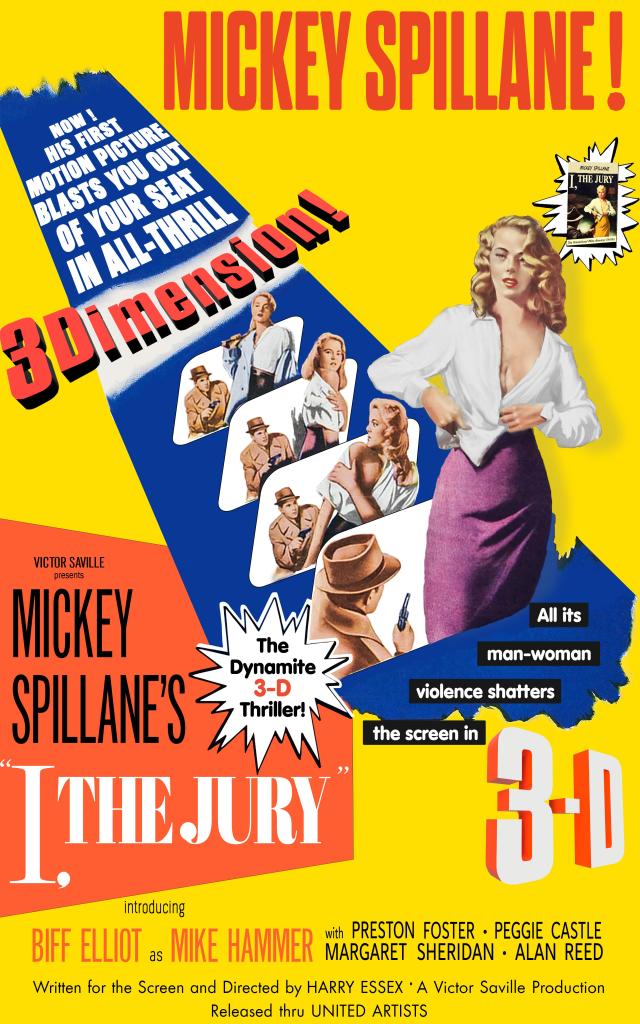
Thanks to my electrically converted Pop, I eventually forgot about old Dwight. I learned to read and write and took to my Big Cheif Tablet, hoping to make a mark, or at least a permanent stain, on this planet. Politics went by the wayside, and I lost interest in gnashing, wailing, and blaming fault. I was becoming a writer thanks to my favorite aunt, Norma, who diligently taught me to read and write before entering first grade. I was a bored child prone to fidgeting while daydreaming about Mark Twain and Micky Spillane while sitting at my tiny desk. I had no interest in the little people around me, uneducated booger eating feral children with no purpose.

When John Kennedy was elected president in 1961, I began reading Life Magazine, my mother’s favorite slick-paged rag. He was a nice-looking fellow with an elegant wife. My mother and her friends went limp, noodle-wobbly-legged when discussing Mr. and Mrs. Camalot. I didn’t get it until the Cuban missile crisis came about. He was willing to risk the population of America just to give Castro and Krushev a butt-whooping and the middle finger; “here Jackie, Hold my 80-year-old Scotch and soda and watch this shit”. JFK had some big ones, as attested by Marylin Monroe. All of us school kids knew we were about to be ashes to ashes and dust to dust. Teachers stepped up the nuclear drills, and we spent the better part of each school day hiding under our desks. Why? If the bomb incinerated our school building, then our tiny desk wasn’t going to protect us. That’s when I realized teachers were as stupid as the rest of us Neanderthal knuckle-dragging children.

When the lovely gentleman with the perfect hair took a headshot in downtown Dallas, Texas, I was like most of my kin and friends. We all felt terrible and mourned for a few days, but then it was “back to the basics of life;Luckenbach, Texas, didn’t exist then, so we made do with Fort Worth.

My cousins and I were heavily into Brother Dave Gardner, the preacher turned comic. His albums were a bulging bag of witty, logical, and borderline racist comedy. America hadn’t learned quite yet to be so easily offended. Brother Dave’s favorite targets were Lyndon Baines Johnson and James Lewis, a fictional black character from the Deep South. LBJ was perhaps the most excellent Politicasterd crook in history, and by damn, he just had to be from the great state of Texas. We agreed; the lumbering goon from the hill country was as slimy as they come.

Around 1965, I began to form my own political beliefs. I was neither a lib nor a conservative, But a white flag on a long stick, wafting in the breeze. Heavily into surfing and playing rock music on my cheap Japanese guitar, I began to listen to the Beatles. I was told that some songs held mysterious political messages. When Sargent Pepper‘s Lonely Hearts Club Band debuted, My bandmates and I recorded the album on a Reel Reel tape machine and played it backward. After that, I was sure the four lads from Liverpool had been sent by Beelzebub to corrupt our nation’s youth. That’s around the same time our drummer, Little Spector, bought into the Hindu religion and found solace in Ravi Shankar and his melodious Sitar. It seemed I was the only one in the band with enough political knowledge to hold a riveting conversation with an adult.

The 1960s found me non-committal to a political party. The long hair and playing in a band were my disguise. Most of my friends and bandmates were in the bag for the liberal side of life; I was a relic, an uncommitted poof in the wind, although I dug Robert Kennedy and was just getting into his mantra when he followed his older brother to the Spirit In the Sky. Now, there was no choice, but “Little Richard” Nixon and his “Five O’clock World” beard shadow and sweaty upper lip creeped me out.

In 1976, I took a direct hit to the head from the mast while sailing my Hobie Cat 16-foot catamaran sailboat in the Gulf of Mexico off the island of Port Aransas. I was sailing by myself, which is not recommended, and was jibing downwind, which is also a no-no, when the mast caught the wind and reversed position, knocking me off the boat. I was wearing a diaper rig attached to the main mast, and that saved my life. What I do remember after the initial shock from that experience was that, like my father and his electrical conversion, I was now a Republican and have been ever since. I wonder if there is voting in Heaven?
Driving Lessons from Grandpa: A Childhood Memory


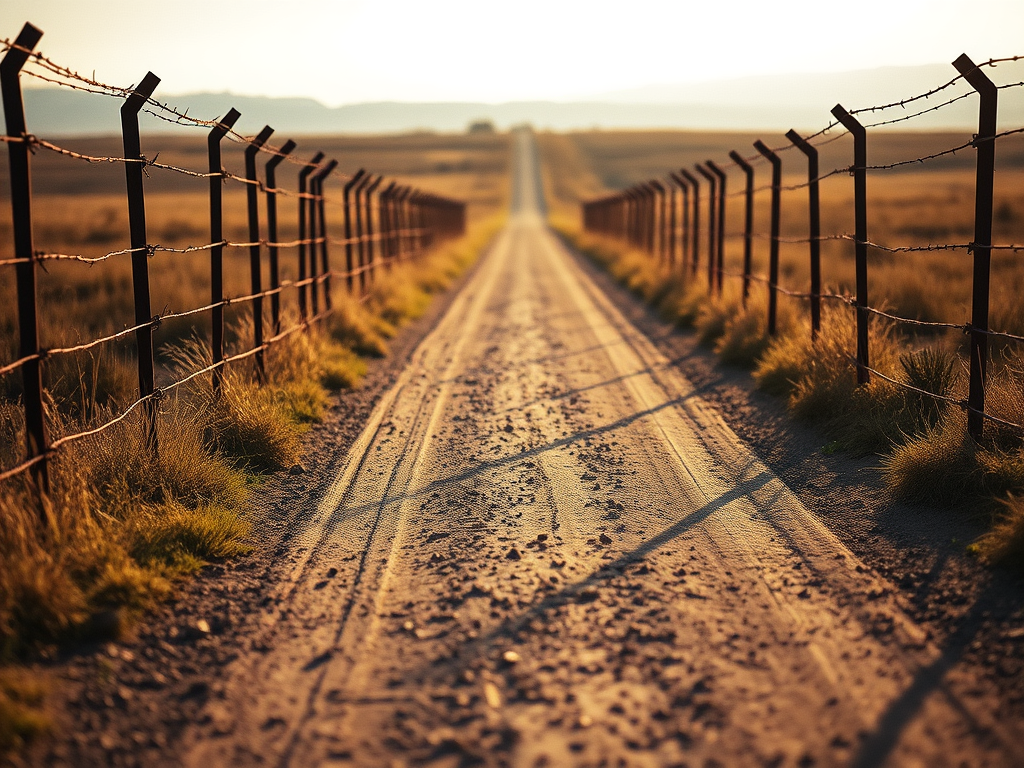
The dirt road was not much to speak of, so most folks didn’t. It was rutted, the kind of nasty ruts that could swallow a small child whole, never to be seen again.

No signs marked its path until my uncle Jay painted a small board with an arrow and the family name and attached it to a fence post with baling wire. People simply referred to it as the road to the Manley farm, the first right turn after crossing the bridge. It was a quiet, dirt path that meandered past Mrs. Ellis’s house and abruptly ended at a gargantuan cactus patch about a block past the railroad bridge.  

  My visits to the farm were during the summer, and I usually stayed for three weeks. I vividly remember the chickens, a noisy five hundred or so troupe circling the farmhouse, scratching the dirt, and being ever-busy. I also remember that almost everything on that farm wanted to kill me. The Mountain Boomers, Coyotes, and Rattlesnakes were my first worry, so I carried my completely ineffective Red Ryder BB Gun as protection.

     My grandfather Jasper decided it was time for me to drive a car, as most farm kids did out of necessity. At ten years old, I had mastered the tractor well enough to tear down parts of his barbed-wire fence without a second thought. He believed I was ready for his old stick shift V8 Ford. My grandmother fretted about his failing eyesight and knew better than to step into the driver’s seat herself: driving cars and deep water haunted her dreams, and she wouldn’t face either. My grandfather needed a chauffeur, skilled or not, for his trips to the domino parlor in the town’s only cafe, The Biscuit Ranch. I was his first and only choice.

     My first excursion behind the wheel was chilling, at least to me. What sort of adult would let a ten-year-old kid drive a car? If Grandfather was apprehensive, he hid it well.

  Turning out of the farm gate, hitting a hard left, clutching and shifting to second gear, working the accelerator, and attempting to steer the metal beast without running us into a ditch was all I could handle. By the grace of God, we made it to the railroad bridge where the hobos gathered, so we stopped so Grandfather could visit a spell. He enjoyed chawing with the hobos, swapping stories, chewing and sharing his Red Man tobacco, and telling dirty jokes: things that weren’t allowed at home. One of the hobo’s remarked that I drove exceptionally well for a little kid, and he and his buddy could hitch a ride into town. My grandfather was out of chewing tobacco, so he invited the hobos into the back seat for our first trip to the feed store in town.

  I was feeling optimistic and a bit cocky about my driving skills by the time we pulled up to the highway intersection. Grandfather checked for traffic and, finding none, told me to hit it, which I did: skidding out onto the pavement in front of the large truck he didn’t see coming; my small PF Flyer-covered foot floored the beast and hit second into third gear, squealing the tires like a stock car driver. The hobos in the back seat laughed and said I was the best kid driver they had ever known. The Ford made it to the feed store; then, we stopped at the Domino parlor, where I was introduced as the main chauffeur for the Manley family. When my mother came to collect me toward the end of July, I was car-driving Jessie. My grandmother marched me to the barn while my mother threw the grandest hissy fit ever after her father bragged about my good driving.

Needing Sleep, Not Finding The Right Reading Glasses And Where Did I Put My Surfboards?


Sleep is a sneaky little thing, often playing hide and seek; some nights, with the right concoction of pain medications, I drift off like a mighty oak, a tree that has finally decided to take a break from standing tall. Just the other night, however, the meds turned their backs on me, and there I was, half awake and befuddled, reaching for my trusty hot Ovaltine to lend a healing hand. With my vision askew from wearing the wrong pair of spectacles, I grabbed my Bible, thinking I’d find some solace in holy verses, only to stumble upon the most thrilling tales of storms, hurricanes, and the odd musings about planting under the October moons, eventually realizing that I’d accidentally opened the pages of the Farmers Almanac instead.

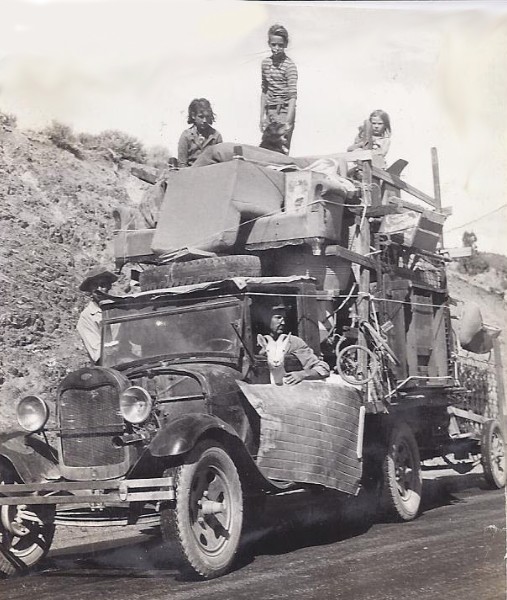
Many of my readers have been transfixed or shocked by the epic tale of the Strawn family, who, in a fit of brave lunacy, decided to traipse from Fort Worth, Texas, to Los Angeles, California, all during that notorious dust bowl of the 1930s. Now, as I wipe the dust from my fingers and finish this latest chapter, I find myself staring into the abyss of forgetfulness. Is my memory playing tricks—after all, reaching 75 isn’t exactly the golden age of recall—or did my father and aunt, long since departed, keep the family secrets tucked away like old socks full of silver coins? You see, I was but a wee lad, soaking up the stories like a dry sponge around the family campfire, spinning yarns until I waded into my twenties. I do recall reading the best of my grandmother’s missives to her siblings, which was the catalyst that started this literary campfire. So, onward, I go, armed with a mighty pen and a healthy dose of ancestral curiosity, ready to dig deeper into the sands of time! If I can locate my shovel.

Last week, Mrs. Momo and I set forth on a meandering journey to the sun-drenched sands of Padre Island, where we sought respite among the company of my son Wes, his wife Yolli, and my spirited grandson Jett, along with my oldest grandson, Johnathan, who had deftly forged a new life in Corpus after escaping the relentless grip of a desolate land rife with crime, situated just east of Fort Worth. Even after the passage of years, the name Dallas invokes within me the primal instinct to spit into the dirt or a sidewalk, a ritual harkening back to the deep-rooted traditions of Amon Carter’s Texas. My grandfather, a quintessential Texan in every sense, would erupt at the mere mention of that city, a sentiment that courses through the veins of my remaining kin. The few ventures I undertook into that sprawling metropolis during my youth were begrudgingly limited to solemn funerals or the obligatory excursions with my father, who charmed the patrons as part of the house band at The Big D Jamboree. But let us return to The Island, as the locals fondly refer to it. Our ambition was to embark on a fishing expedition in my son’s Gulf Coast fishing boat, cradled comfortably in the canal behind his home; yet, as fate would have it, life had scripted a different tale. The weather was hellishly hot, and now, knowing my limitations for physical abuse, the trip will happen another time. We did, however, find the opportunity to journey to Port Aransas, where we reveled in a banquet of seafood and marveled at the garish, towering temples—those three and four-story houses, not erected for the warmth of home but serving as mere rental coffins—sprouting up like unwanted weeds in a fishing village that had cradled myself and my sons childhood, now stripped of its charm and morphed into a pale imitation of Myrtle Beach. I remember driving every road in Port A during the late sixties with my surfboard secured atop my Korean War-era jeep, Captain America. That faithful jeep has since vanished, much like my surfboards, yet Wes has preserved a fine collection of vintage longboards. I will be embarking on these new wonder pharmaceutical supplements I catch glimpses of in commercials; perhaps I’ll summon the energy to paddle out and catch a wave, allowing me to once again sit atop the world. I can already hear the Beach Boys playing my tune.

The Way I See It In The Cactus Patch…And It Ain’t Always Pretty


I realize my thoughts might carry as much weight as a thimble in a swimming pool, but at 75, I’ve witnessed more ups and downs than a cheap roller coaster. Lately, though, it feels like our dear old blue planet has taken a wrong turn and is spinning like a top on a greased floor, sending everything straight into a comical disaster!

Momo whisked me away to a swanky birthday supper at a place called 1890—how fancy! We had previously visited there, of course, but on that occasion, our wallets had us seated in the bar, indulging in a drink and a wedge salad that could barely fill a mouse’s stomach. This time, however, we plopped ourselves into the big boy chairs adorned with linen tablecloths and sparkling silverware that made us feel like we were pretending to be someone important. Our waiter—his name was a puzzler, something foreign that I couldn’t grasp, yet I distinctly recall his well-groomed beard and a whiff of patchouli oil wafting about him. It took me back to our youthful days as hippies in the 70s when that scent was all the rage with the hairy-legged hippie chicks. Momo went for a steak that could challenge a cow in size while I, with an empty wallet echoing my woes, settled for saltines slathered in butter and Tabasco—gourmet, I assure you! As we departed, stomachs full and wallet depleted, we spotted a black Greyhound-style bus parked at the courthouse. We mused that perhaps a country band was visiting our quaint township for a hearty meal. But lo and behold, when the door flung open, cats erupted like confetti, scattering everywhere—hundreds, I’d wager, taking over the square as if they owned the place. Nuns, dressed in their required uniform, handed out squeaky toys, kitty litter, and catnip to placate the new arrivals. Curious, I asked the driver what on earth was happening. With a grin, he informed me that the SPCA was orchestrating a rescue mission, whisking away all the cats and some distressed dogs from Springfield, Ohio, to Texas. It was, he said, a noble endeavor backed by a contingent of single cat ladies and a handful of purified nuns forever wed to their feline friends.

Football players are often regarded as the dimmest bulbs in the grand carnival of manly athletics, a parade of brawn where a surplus of testosterone is the secret sauce for getting through the heavy lifting of life. Picture, if you will, poor Travis Kelce, relegated to the bench like a discarded plaything, wearing the kind of woeful hang-dog expression that could bring tears to a Confederate statue. Ah, but even Neanderthals have their emotions, and it seems the Swift One is tucked away in her plush hotel suite, likely crafting a breakup ballad that might just capture the essence of their fleeting romance, a tale as old as time and yet as fresh as a morning breeze. Young love is a fleeting aura that departs on the fickle winds of gastronomical flatulence. He should have taken the strenuous advice of friends and whisked her off to a tar paper shack in deep Appalachia and kept her barefoot and pregnant with annoying little swifties playing small plastic Ukelales.

Chapter 10. Wagons Ho To California: Grandmother Is Healed By Sister Aimee McPherson, And Carman Miranda Stops By


Sister Aimee McPherson

As the months stretched into years, the Strawn family flourished financially, finding their footing in California’s golden land. The prospect of permanence hung in the air, and the pull of Texas grew less each year. Johnny’s elder sister, Norma, had begged to remain with one of her aunts to complete her schooling, but destiny had other plans. Completing her education in Fort Worth, she succumbed to the barrage of pleading letters from her mother, who was convinced that her death was only weeks or hours away, but she would try to hold on until her daughter made it to California. Knowing Bertha’s love for drama, her aunts consoled Norma and thought it best that she travel to California and could return if needed. With a small amount of currency in her purse, she embarked on a westward journey with a family bound for Los Angeles, paying for a seat in their car.

After two years of absence from the fold, Norma returned to find her family ensnared in a web of not-so-well-hidden disillusionment. The initial euphoria of their reunion faded, exposing the harsh light of reality. Her father, now a manager, toiled away long hours with little time left for living, while Johnny when not in school, devoted all his time to the members of his string band, Blind Faith. Her mother’s dependence on medicinal elixirs was the worst of it.

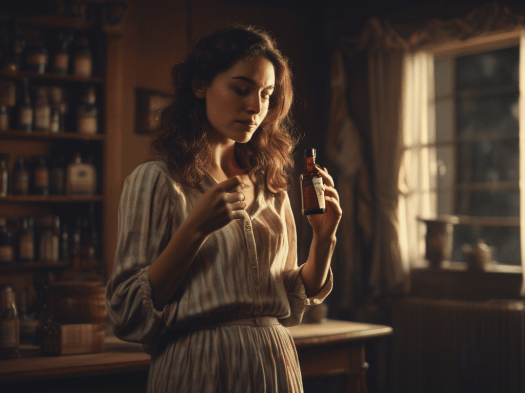
Bertha, a dedicated aficionado of her restorative elixirs, consumed multiple weekly bottles. She has a friendly rapport with the local pharmacist, who considers her his best customer and gives her a discount. She would often be found at the kitchen table for most of the day, dosing her tonics and composing lengthy, nonsensical letters to her sisters. By this time, her siblings had come to understand that the words emanated from the pen of a medicinal lunatic. Norma and Johnny acknowledged the necessity of professional intervention for their mother, and, with assistance from Le Petite Fromage and Blind Jelly Roll, they formulated a plan for Bertha to undergo a holistic religious cure under the guidance of Sister Aimee McPherson.

On that Sunday, a vibrant sermon accompanied by half a dozen show tunes with a dazzling chorus line stirred the congregation as Sister Aimee made her return to the pulpit for three thunderous ovations. Following the service, Le Petite Fromage and Johnny, the fiddler, as he is now called, escorted Bertha to the orchestra dressing room, believing her holiness sought to personally meet her and perhaps bestow a signed copy of her latest literary work, “You Can’t Take It With You When You Go So Give It To Me.” Embracing Bertha warmly, Sister Aimee presented her with a signed book before guiding her to a crimson velvet settee that had previously served as Blind Jelly’s salvation vehicle. With hands upon Bertha’s head, she prayed for deliverance from the grip of elixirs and zealous missives to her siblings. Understanding she had been played by her blood kin, Bertha, teeth-gnashing and fist-squeezed white, surrendered and embraced the moment. The healing transpired in a mere ten minutes as Sister Aimee proudly proclaimed the departure of the demons, assuring that all would be splendid by supper time. As she departed the dressing room, a divine fragrance lingered in the air. Blind Jelly Roll spoke up, ” I smells me some Channel No. 1. ” Leave it to a blind bluesman with the senses of nine cats to figure it out.

With the spoke mended in the family wheel, taut and ready for the road, John Henry indulged the family, comprising of Le Petite and Blind Jelly Roll, to a Sunday supper at a restaurant. Their choice fell upon Treasure Island, a pseudo-swanky seafood establishment under the ownership of the actor Wallace Beery. The best restaurants were on the Sunset Boulevard, known as the Strip. The entrance was the front hull of a sailing schooner, complete with a mast and sail. Johnny noticed the address above the door: 77 Sunset Strip: that address would come up again a bit later. Bertha and Le Petite were giddy, anticipating the prospect of encountering Hollywood movie stars savoring fish and chips washed down with a dirty Martini.

While awaiting their meal, James Cagney and his raucous family were seated a few tables away. Clark Gable and Carman Miranda snuggled in a cozy booth, where they indulged in sips of Martini and beer. Le Petite and Bertha were in a state of apoplexy. Carman Miranda made her way to the lady’s room, passing their table. Pancho Villa sat upon Blind Jelly’s lap, nibbling on a saltine. As the movie star strolled by, she took notice of Pancho and remarked on the adorable little doggie. When she reached out to pet Pancho, she received a vicious bite that tore off the long middle fingernail from her left hand’s digit. Stunned by the sudden attack, she yelled, “Get that little demon dog out of here!” Pancho and Blind Jelly concluded their meal in the comfort of Strawn’s car.

If you missed Chapter 9, click the link below for more amusement.

The Journey to Bakersfield: A Lively Tale of Struggle and Triumph, Chapter 9


My grandfather, John Henry, possessed a mastery of storytelling that filled the room with warmth. When the rain beat against the windowpanes, or the ice or snow kept me inside, I’d perch myself on the floor near his rocking chair, mesmerized by the tales of his youth in rural Texas, his days as a soldier in the US Army, and the harrowing battles in France. With each word, he painted vivid scenes of the struggle and resilience of his family during the tumultuous depression years in 1930s California. Pausing only to adjust his fiddle, John Henry would then draw the bow across the strings, filling the room with a lively jig that seemed to echo the resilience and spirit of those days and family members long ago passed on. When my grandfather passed, my father, as any good son would do, took the helm, recounting those years in California and beyond. A few drinks of good scotch whiskey for us both lit up his memory and released his vivid imagination. The more scotch we consumed, the more colorful his recounts, so parts of this story may be a bit grandiose.

Bringing Blind Jelly Roll Jackson and Le Petite Fromage into the string band’s musical circle infused the fellows with newfound assurance. John Henry found himself utterly taken aback by their musical prowess.

Johnny and the string band continued to improve with each passing week. After six months of playing front porch shows, birthday parties, a few illegal chicken fights, and one funeral, W6XAI Bakersfield, the most influential radio station in California, came calling. The station approached the band with an offer to perform a thirty-minute live show. Le Petite’s Daddy, Baby Boy Fromage, used his questionable connections to secure the band’s spot on the show, as his own band, The Chigger Bayou Boys, were regulars on the hillbilly program hosted by Colonel Bromide A. Seltzer. The esteemed Colonel was famous for featuring the latest talents on his popular daily show, always staying on the lookout for fresh and promising acts he could sign to a strangeling management contract that left him flush with cash and the talent with a pittance. Blind Faith fitted his bill.

Baby Boy Fromage arranged for transportation to and from Bakersfield. The radio station had agreed to pay the boys $75. 00 for the show, which included four commercials for Father Flannigan’s Holy Healing Tonic, Sister Aimee’s Blessed Miricle Face Cream, and Puffy Cloud Lard. In today’s world, that kind of money might buy you a mediocre supper at an Olive Garden, but in the Depression years, it was a small fortune. Of course, Baby Boy would require a chunk for providing the transportation and a meager finder’s fee for getting the band on the show. All said and done, Blind Faith would make $40.00 cash to split six ways. Le Petite had warned the boy that her father’s deals can sometimes border on nefarious, so don’t cry like a freshly born titty-baby if the whole thing flushes down the toilet.

Around noon on Saturday, the stagecoach to Bakersfield arrived at the Strawn residence. Le Petite’s daddy had promised luxury transportation for the haul to Bakersfield. Baby Boy’s idea of a luxury transport was a converted Tiajuna Taxi, complete with no less than a hundred bullet holes along each side of the vehicle. Two church pews nailed to the wooden floor served as seating, and the big stain on the floor was likely blood. The driver was a Mexican chap who didn’t speak English and drove with a bottle of Tequila planted in his lap. His GPS was a ratty map with the route colored in red crayon. Le Petite was furious with her daddy and planned to smack his big head with a *cajun blamofatchy.

Arriving at the station, the band was led into a large room where the broadcast would take place. A small stage covered with short nap rugs and a half dozen microphones placed where each musician would stand. Another band, The Light Crust Doughboys, from Fort Worth, Texas, was packing up, having completed their live show for their sponsor, Light Crust Flour. They were in Hollywood to be in a Western movie with Gene Autry, and this was their last commitment before heading back to Texas. Johnny spotted their fiddle player, made a bee-line over, and introduced himself. The man, Bob Wills, a fellow Texan, wanted to hear youngsters play, so he stuck around for the live show, which was due to start in twenty minutes. The radio technicians placed each member in front of a mic, giving Le Petite her own microphone for singing. The band played 16 bars of music so the man in the sound booth could adjust the volume. Bob Wills sat in a corner, smoking a cigarette and drinking what appeared to be a pint bottle of hooch hidden in a brown paper sack.

The two announcers, a heavy-set fellow wearing a black cowboy hat and his companion, a boney, skittish little gal, also wearing a matching cowgirl hat and white boots, took their positions in front of a microphone next to a nervous Le Petite. The man told the band that when that light on the wall turns from red to green, that means we are live, and you start your theme song while we announce you and our sponsors. Jelly said he couldn’t see the light, but Pancho Villa would give him the queue. The announcer asked Johnny if that man was blind? Johnny said, “Yep, blind as a bat but he’s a pretty good driver and got us here in one piece.”

The boys had no theme song, so Jelly told them to play Red River Valley: You can’t mess that one up. The man at the mic counted down, the light turned green, and the boys let loose on their new theme song. All the time, the two announcers were jabbering about their sponsors.

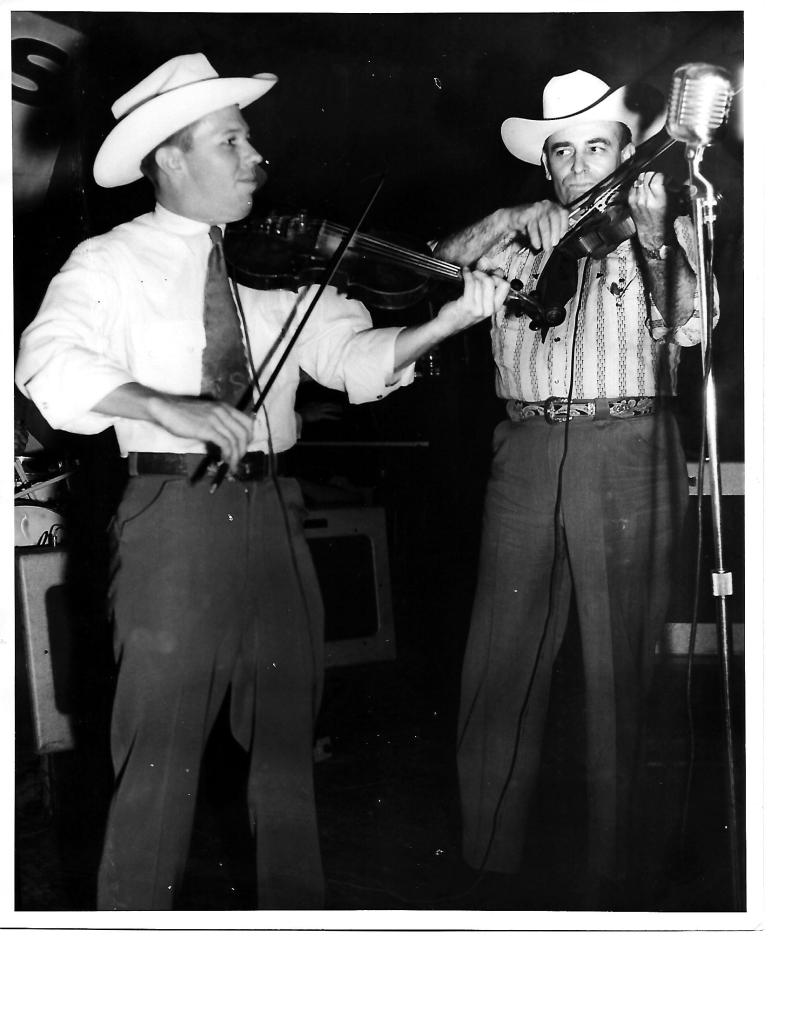
The announcers stepped back from the microphones and gave the boys a thumbs-up to start their show. Le Petite counted off a cajun song about a “Big Mamou” and went into “Will The Circle Be Unbroken” and then “Cold Beer and Calomine Lotion.” The band played every tune they knew, finishing up with Johnny playing a fiddle tune called “Lone Star Rag,” which caused Bob Wills, with a big grin on his face, to rise from his chair and clap along. When the show ended, Bob gave Johnny a few pointers, telling him he had a bright future in country music and to get in touch when and if he returned to Fort Worth. Fifteen years later, back home in Texas and playing country music for a living, Johnny got in touch with Bob Wills, who became his mentor and close friend, gifting Johnny with one of his fiddles, which he is playing in this photo. I have that fiddle as well as my grandfather’s fiddle.

My father, Johnny Strawn playing twin fiddles with Bob Wills. Forth Worth, around 1952.

  • * Cajun Blamofatchy is a piece of wood use

Chapter 7. California And The Magical Elixirs


My grandmother hailed from a sizable brood: four sisters and a solitary brother. Their formative years were spent in the sun-drenched fields of south Texas, toiling on the family produce farm. The patriarch, Grandfather Duncan, regarded his children as mere hired hands and didn’t pay them a dime. Every child born saved him from hiring a lazy field hand to pick his watermelons and oranges.

Upon the completion of their high school years, one by one, the siblings, usually in the dead of night and with assistance from the others, embarked on a journey, whether by bus, train, hitchhiking, or on foot, seeking their own version of freedom from the farm. Miraculously, within a few years, they and their new spouses found themselves settling in Fort Worth, Texas, mere blocks apart.

The transition from Texas to California proved to be arduous. My grandfather, possessing the toughness of weathered leather and an insensitivity to female emotions, saw the move as a blessing and a chance for a new beginning. However, for Bertha, it felt more like a forced abduction. John Henry appeared oblivious to her distress, or perhaps he believed it would pass in due time. Yet her sorrow lingered until she stumbled upon a seeming panacea: alcohol, fashioned into the magical healing elixirs hawked on the radio and in the newspapers. From anemia to tremors, from insomnia to weight loss, from night sweats to antisocial behavior, there existed a bottled pharmaceutical remedy for every affliction, no doctor’s visit required. Countless bottles of happy juice lined the shelves of the local drugstore, catering to the myriad conditions that afflicted my grandmother, a certified hypochondriac.

When not self-diagnosing herself that she harbored every disease known to man and convinced that her death was mere hours away, Bertha was quite the letter writer. Every day, seated at her kitchen table, her fountain pen full of blue ink, she’d churn out missives to her sisters in Texas. Fueled by her newfound self-assurance courtesy of those magic elixirs, she didn’t see any harm in embellishing the truth a bit about her new life out in California: alone in a strange land, who could blame her? It’s not as if her family would ever drop by for a visit. As time went by, her letters became creative works of fiction, painting the picture of a grand Beverly Hills home in place of her modest stucco house and a swanky Duesenberg convertible instead of their old Ford. According to Bertha, even the legendary Clark Gable was a neighbor, and Sister Aimee McPherson, the radio firebrand preacher gal, became a dear friend, and the two of them often enjoyed lunch at Musso and Franks Grill, mingling with the movie stars. Bertha was dead set on landing an audition with MGM or writing a grandiose screenplay, all thanks to that magical elixir of hers. Not thinking of how she would explain her fabricated world when they returned to Texas, she continued, and the more she wrote, the more she believed her own stories.

When Johnny turned thirteen, he approached his father with a request to pursue a professional career in music. John Henry, harboring doubts about the practicality of such a proposal, pondered the unlikelihood of anyone hiring a boy for such a venture, much less paying him with real money. Nonetheless, three of Johnny’s older schoolmates had extended an invitation to join their string band, which often performed at birthday parties and school events for a small fee, which was usually a coke and a plate of food. Their need for a fiddle player in the Bakersfield-style hillbilly tunes they favored aligned perfectly with Johnny’s musical talents. That evening, seated on the front porch after supper, Johnny revealed his decision to his father — he had embarked on a professional journey with his newfound band. Despite his initial surprise, John Henry offered his warm congratulations to the young boy venturing into this new vocation.

Their first official rehearsal was an epic disaster. The guitar player knew four, maybe five chords on his out-of-tune instrument, the bass player, using a beat-up dog house bass fiddle, couldn’t get the beast anywhere near in-tune, and the tenor banjo picker was worse than the other two. After massacering a dozen or so tunes, Johnny floated an option. He knows of a genuine black blues singer who burns up a guitar when he plays. The other three were wagging their tails like a hungry dog and voted to bring this fellow into the fold. Now, Johnny had to convince Blind Jelly Roll Jackson to play with a bunch of borderline musicians.

Church on Sunday was a rousing spectacle. Sister Aimee, after singing a handful of beautiful songs and just enough preaching to make sure the offering plates were full, called for souls that needed saving to approach the altar and receive Jesus. This was part of every service; a few folks would come down to be blessed and saved. With the orchestra playing, the choir singing, and a contingent of Hollywood-style dancers on stage, a hundred folks rushed the front in need of salvation. Sister Aimee, not knowing how to handle a worked-up mob that scared her out of her witts, retreated stage right and hid in her dressing room. Her assistant preacher and a few ushers administered to the flock while Sister Aimee gulped a handful of Carter’s nerve pills, washing them down with “Father Flannigan’s Holy Healing Tonic,” which was around 80% alcohol and claimed to be brewed from the holy waters of the River Jordan.

Wagons Ho to California ! Chapter 2. The Arrival


Ten or so miles past the Needles California border station, my grandfather, John Henry Strawn, encountered a stooped, raggedy-dressed black man and a small dog walking along the side of the road. The man’s attire resembled that of a poorly dressed scarecrow. Without hesitation, he slowed the Ford, performed a swift turnaround, and approached the traveler. After stopping the car, he offered the old fellow a ride. Without hesitation, the traveler gratefully accepted, ensuring that his dog was settled in first, followed by his knapsack, a guitar case, and then himself.

A few miles down the road, the man broke the silence, introducing himself as *Blind Jelly Roll Jackson from the Deep Ellum Dallas, Texas, and his seeing-eye dog, a Chihuahua named Pancho Villa, who is blinded in one eye. The result of a dog fight with a Coyote, so he wears tiny sunshades because the bright sunlight hurts his good eyeball. Jelly says he is a blues man and is headed to Los Angeles to stay with a cousin and find work in a juke joint, and he, by accident, shot a fella in Dallas four times over a pay dispute. He said it was all Pancho’s fault because the dog said the man had a knife, so what else is a body to do. He pulled a leather Bolla from his knapsack, took a jolt, poured a little liquid into his palm, and let Pancho Villa lick it up. John Henry was sure it was whiskey, and after the dog drank it, he fell over and started snoring. Jelly’s chin found his chest, and he slept the sleep of the weary.

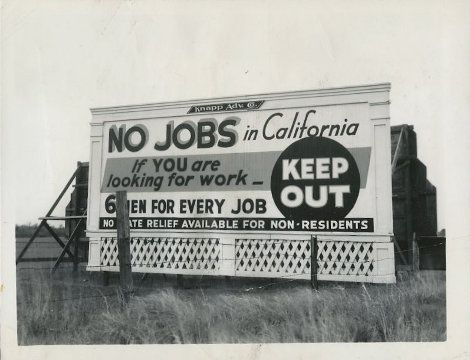
On the eastern outskirts of Los Angeles, they saw the first billboard, “No Jobs in California, Keep Out.” John Henry paid no attention to the sign; he was certain he could find a job on the docks in Long Beach. He was an artisan, not an Okie fruit picker. The next sign was for a migrant campground, $.25 per day, running water, showers, and clean grounds; John Henry took the turn off Route 66, drove a few miles, took two more turns, and found himself at a tidy campground guard shack. Unlike the border boys, the guard wore a clean, crisp uniform and was pleasant. The three-day fee was paid with small change from the small stash in grandmother’s purse. Their assigned camping slot was shaded by a tall Eucalyptus tree. This would do until a job was found. Jelly and Pancho Villa wandered down the main lane, stopping to let the children pet and scratch Pancho, who nipped a few fingers and chased the local feral cat.

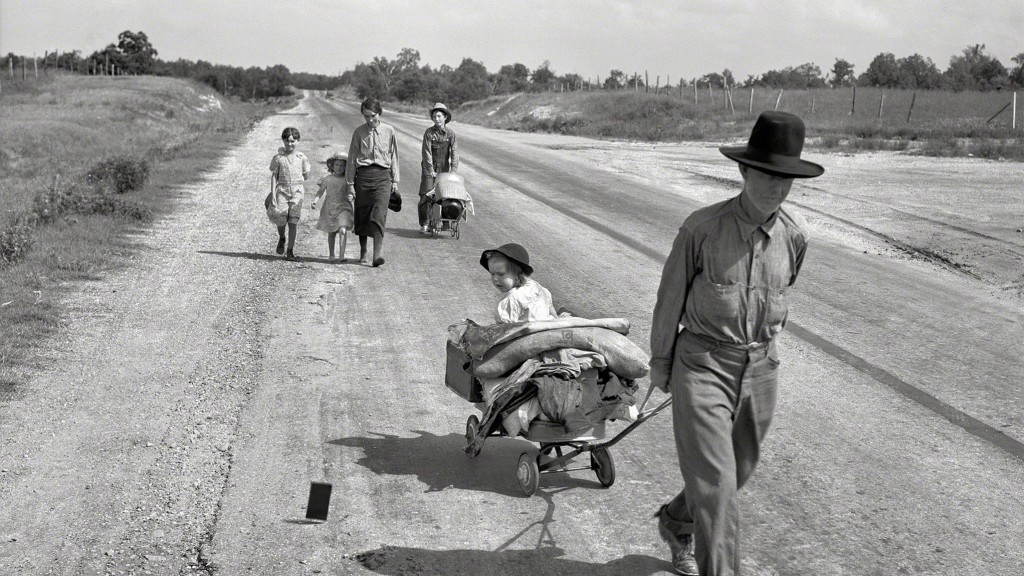
Travel to the eastern outskirts of Los Angeles, past the city limit sign. This is where a well-manufactured fantasy meets reality. Families living in tents or shanties of plywood and canvas. The city fathers, embarrassed to call them shanty towns, label them “migrant campgrounds.” Men walk the roadways for miles into the city looking for day labor or something better. These are hardworking, proud people who have been dealt a hand of misfortune. Los Angeles is becoming a city of “haves and have-nots.”

The Los Angeles of 1934 is a city unlike any other in the country.  The motion picture industry paints it as larger than life.  Hollywood, where dreams are made and shattered, is the engine that powers this city.  Oil and shipping will defend their role, but Hollywood fuels the beast.

At first glance, commerce appears untouched by the depression.  Polished cars parade on Santa Monica Boulevard.  People fill the sidewalks as if on holiday, smiles on their faces, knowing they are fortunate to live in this unique land of opportunity.  The manufactured facade so completely obscures the reality that, in fact, California suffers, but not quite as much as the rest of the country.  It’s hidden so well that thousands of hopeful migrants genuinely believe this is the “Promised Land.”
   
At dawn, John Henry, with Blind Jellyroll, drove into Los Angeles to search for work. He and a few thousand others had the same idea. A long line of men and women walked in unison as if Moses were leading the Jews from Egypt along the dusty highway.      
Men wearing patched overalls, sewn-up khaki pants, and shirts as white as a wash tub could get them. A few wore a dirty Fedora or a worn sweat-stained Stetson. Some real Okies wore frayed straw hats and cracked work boots. Their clothes hadn’t seen a wash tub of water in months. It was an army made of misery. The cloud of roadside dust told the folks in town they were coming—”NO WORK HERE” signs went up in every window along their route.

John Henry drops Jellyroll and Pancho Villa at the downtown mission run by Sister Aimee McPherson, the celebrated firebrand radio preacher. Jelly’s cousin works for the preacher and has assured him that the good sister has a place for him. John Henry wonders how a blind man and a one-eyed dog made it from Texas to here. Perseverance and Moxy, some folks have it, but most don’t.

  Lost and asking directions to Long Beach every mile or so, John Henry made a wrong turn and found himself on a residential street. Tidy bungalows with mowed green yards and colorful landscaping lifted his spirits. Back in Fort Worth, you only saw streets like this where the rich folks lived. He could tell by the cars in the driveways and houses that needed paint that these folks were plain working people, getting by better than most.  

 Half a block up, he sees an older man and woman losing the battle to unload a large chifforobe from the back of a pickup truck that should have been in a scrap yard. The rear end of the old truck sat on the concrete, and both leaf springs shot to hell. They are struggling and on the verge of dropping the piece of furniture when John Henry stops and, without asking, jumps in and grabs the end the woman is about to lose. The man thanked him for his help as they carried the furniture into their house. The home smelled like the fragrant gardenias growing around the front porch.

More in Chapter 3. * Note; My father couldn’t remember the name of the fellow or his dog, so I used the name of a character from an earlier story. A dog named Pancho could be nothing else but a Chihuahua.

Open the link below for Chapter 3

Chapter 1. Wagons Ho-To California!


My grandparents, my father, and my aunt migrated from Texas to California in 1934 because there were no jobs available in Fort Worth or Dallas. When reaching the desert town of Needles, CA, they were immediately labeled “Okie’s” by the border guards. My grandfather, a man of few but choice words, mostly curse ones, did his best to convince the guards that he was a Texan and had visited Oklahoma once for a funeral, which made the situation worse because the guards then labeled them Texas Okie’s, which was a double insult, and to boot, they weren’t welcome in the land of pleasant weather and movie stars. Grandfather turned himself into a poor man’s Will Rogers, with plenty of aw-shucks, dirt-kicking, and head-scratching, which made the guards laugh, so the family was admitted. He forgot to mention the three pistols, the sawed-off shotgun, and his pet Rattlesnake, stashed in a burlap bag under the front seat of his Ford.

Click the link below for Chapter

A Young Scholar Among Jabbering Idiots


Thanks to my late favorite aunt, Norma Lavender, I became a scholar early in life.

Five-year-olds are stuck between that titty-baby stage and graduating to sandlot baseball and comic books. If life got tough, I could still console myself with a grimy thumb to my mouth, and a skinned knee sent me squalling to momma. I couldn’t tie my own sneakers or button a shirt.

My pushy aunt realized my floundering ways and rescued me with books. She got her hands on the first two years of Fun With Dick and Jane, the books the Fort Worth school system used to teach kids to read; comic books would have to wait; Micky Spillane and Mike Hammer were calling me.

Aunt Norma quizzed me like a Perry Mason for a year, teaching me to write and read. By my sixth birthday, I was a reading Jesse, a child phenom, and a leper to my neighborhood gang. They could barely write and couldn’t read a lick of anything. Here I was, a young Shakespeare among a crowd of jabbering idiots.

Having given her parenting rights to her sister-in-law for a year, my sainted mother has now stepped in to reacquaint herself with her young scholar. I still couldn’t tie my sneakers and applied too much Butch Wax to my flat-top haircut. My mother was a hard-core Southern Baptist, and I didn’t understand why when I colored outside of her parental lines, she would cross herself and say a prayer right before she administered a righteous butt whooping with her favorite weapon; a 9inch by 12-inch Tupperware cake holder. To this day, I won’t touch a piece of Tupperware.

I was assigned a weekly Micky Spillane paperback and expected to read the entire book. Looking back, those trashy, noir detective books were not fit for a child or an educated adult, but Aunt Norma would read a book in 24 hours and was quite an educated gal. I didn’t understand most of what I read, but a few phrases stuck with me: “Is that a pistol in your pocket, or are you just happy to see me?” “A hard man is good to find?” Mike Hammer was always in trouble with a trashy broad. I shared my new vocabulary with the gang, and they dug it.

Mother started receiving phone calls from the other moms, blaming me, her little boy, for teaching their uneducated idiots smutty language. The Tupperware storage pan came out of the cabinet, and my butt burned for a week. Aunt Norma gave me Mark Twain and Huckleberry Finn to reprogram me. I dreamed of someday becoming Mark Twain, a kid with a Big Cheif tablet and a handful of Number 2 yellow pencils stored in a Tupperware container.