Interview with Phil Strawn for the Big D 60s website


The ATNT playing Flower Fair 1968, Dallas Texas. Foreground: Johnny (Phil) Strawn, Jarry Davis, Barry Corbett (drums) Danny Goode, and Marshall Sartin

Big D 60s musical humans: My friend William Williams has asked me to scribble some text for his website devoted to rock bands in Dallas during the 1960s. To gather information for the text, I am circulating the following questions (and a few random thoughts) in the hope that they might spark memories and inspire participation.

In my view, the 60s did not “end” until about 1973, and in some ways, the period has never ended. Our “generation,” of course, faces the recurring question: Did the 60s seem such a unique period because of the sweeping social and cultural change of the era? Or was it simply due to our youth? I.e., might every generation feel that the world underwent some sort of major transformation during that generation’s “coming of age” or struggle to find/create its own identity?  Or some combination of the two explanations?

On a separate sheet(s) of paper, answer as few or as many of the following questions as you wish. Email is okay, too, but printed on preferred. If you hate to type but want to respond, dictate your thoughts onto a cassette and send that. Also, feel free to provide answers to questions that I have not been alert enough to include here….

1. Q: Name.

A: Phil Strawn, but I went by Johnny Strawn back in the sixties.

2.Q: Instrument(s)

. A:  In those days, it was strictly guitar, but later on I picked up five- String Banjo and mandolin.

3.Q: In what part(s) of Dallas did you live?

A: I was born, and grew up in Fort Worth Texas, but spent my rebellious and formative teenage years in Plano Texas. My family moved there in 1964 when there was only one red light in the middle of town and the Dairy Queen was considered fine dining. It was the only restaurant in town where your family could enjoy a deep-fried dinner and your dad (or mom) could burn rubber on your way out of the parking lot (after circling three times of course) and no one cared. In the “1964 Plano”, it was a blood rule, If you didn’t live and die football, you better mosey on over to Richardson or Dallas, where all the “city folk lived”.

4. Q: What band(s) were you in?

A:  My first band was with a classmate, and friend, Jarry Davis, or “Jarry Boy” as his buddies liked to call him. We called ourselves, The Dolphins, or Blue Dolphins, or The Laughing Dolphins, depending on the mood of the band that particular week. It included myself, Jarry, Ron Miller on drums, and Warren Whitworth on bass. Warren really didn’t play bass; he borrowed one from a cousin and had the largest amplifier.

The only progressions he knew, were in “E”, so everything was in that key (early power chords).  We used cheap Silvertone, and worse amps, and these god-awful Japanese electric guitars with five pickups, and a cluster of switches that did nothing. It was impossible to keep them in-tune, so we went with something close. The equipment was crying pitiful, but we managed to sound decent. In late 64 and early 65, Jarry and I formed “The Orphans”, with Barry Corbett on drums. The original spelling was “Orfuns”, but our drummer was “on the outs” with his parents, (as usual) and never the ones to pass on “drama”, we became “The Orphans”, as in, “children without parents”. A few years later, there was another band in Dallas with the same name, and things got sticky with attorneys, copyrights and such, so went switched to “The ATNT”, But that’s another story.  We realized during our first practice, that Barry, was “Phil Spector’s twin from a different mother ”. He amazed us with his musical lunacy. This boy could hum notes on a perfect pitch from a dead sleep, and play any instrument or piece of machinery. He once played a song on a lawnmower, and it was pretty darn good! He also was equally versatile on keyboards and Indian Sitar (even had his own makeup tin for the dot on his forehead). On bass guitar, was Johnny Malone, and a keyboard player, Ronny “the frogman”, (can’t remember his last name), both, strong-boned “chicken fried” country boys from McKinney Texas. They were also darn good rockers.

Got to love those jackets and boots

Barry’s father, noticing the improvement in the band, helped us purchase some decent P.A. equipment and new drums for Barry. We begged  “Lil’ Spector” to get the gray Ludwigs that Ringo played, but instead, he purchased these “ LSD looking Slingerlands with a “swirl margarita” 3-D finish.” If you wore those cheesy 3-D glasses from 7-11 while looking at them, and the light was right, you could see the “summer of love” two years before it took place. The new drums were complimented with a 1950’s garage sale, rotating colored light, from an aluminum Christmas tree display. We were so impressed with the setup; it became our first light show.

We all had menial to worthless summer jobs of sorts, so we took our paltry wages, stored in tobacco bags, and visited Larry Morgan, at Arnold and Morgan Music in Garland. Larry, noticing our inexperience (as well as our little bags of gold) helped outfit us with new gear. We purchased huge Fender Showman, Custom and Vox amps and Rickenbacker, and Gibson guitars. We were afraid to look at the total, so we handed Larry the money, signed a note, took our spoils and left. We now had the “proper tools of the trade”, so it was time to make some money to pay the debt.

Along with the fall, came high school football in McKinney, and we lost our bassist and keyboards. We put the word on the street for replacements and were surprised when, two “older musicians”, (again from McKinney) auditioned for the spots.

Danny Goode (brother of James Goode) had recently played bass with The Excels, and Marshall Sartain, who was a classically trained pianist, caught in the “throes of musical and parental revolt”, had just purchased a new Farfisa organ. He was a mix of Van Cliburn and Jerry Lee Lewis, and we never knew who would show up at the gigs. He either came looking a little “too sharp”, or like he had been on a week’s bender in Shreveport with his second cousin. He was one hell of a keyboard player and gave “Lil Spector” some friendly but serious competition.

After Danny and Marshall joined, the sound of “The Orphans” was born. It had been a “stick chewing labor”, but the monster it produced was worth the waiting. The first song we played as a group was perfect! causing us all to take a step back to collect ourselves. It was as if we played and sang together for years.

Miss Alice, our manager(Jarry’s mother) was so astonished; she seated herself in an aluminum lawn chair and summoned a cardboard fan and a stiff drink of Jim Beam. Apparently, she suffered an attack of “rock n roll vapors”. Shortly after that, she discovered Valium and was better at dealing with us, and our music.

Armed with fresh talent, and newly seeded dedication, we committed to practicing three nights a week. First, using an old storefront in downtown Plano (until the merchants ran us out) and then, remodeling Jarry’s large garage into a studio complete with soundproofing and air conditioning. Our practices became a social gathering on summer nights. We would walk outside during a break, and find a full-blown street party in front of Jarry’s house. It was somewhat of a “countrified beach party”, complete with beer, muscle cars burning rubber, rock “n” roll and a trail of teenage broken hearts. We agreed life didn’t get any better than this, at least until later on.

5.   Q: Musical influences

A:  I was raised in a musical family.  My late father, Johnny Strawn played the fiddle (violin if you are from north of the Red River) with the Light Crust Doughboys for over 50 years, and with The Red Foley Show known as the Ozark Jubilee broadcast out of Springfield MO. and with Bob Wills and others.  We didn’t own a record player or a radio, or need one; we had the real musicians! It was common for; Willie Nelson, Roger Miller, Billy Hudson, Glen Campbell, Paul Blount, Carroll Hubbard, Bob Wills, Smokey Montgomery, Ralph Sanford, Ronnie Dawson, and others to be there playing or visiting when my father was home from the road. My musical influences were all over the map, starting with Country and Western, (or hillbilly) Fort Worth Western Swing, jazz and big band.  Later on, with inspiration from Ronnie Dawson and the Big D Jamboree, I latched on to rock n’ roll. I learned an early lesson from Ronnie. If you played guitar on a stage and could shake your ass and sing, you got any girl, any time. It was a simple equation; play guitar and sing, watch girls go “ga-ga”.That’s the real reason Ronnie had that big smile on his face, and any guy that says he didn’t take up guitar to “meet girls”, is a liar. I know.

My sister and I, being babes recently removed from mother’s arms, innocently assumed that everyone lived with a house full of “ goofball musicians” And if you didn’t play an instrument, you “weren’t quite right”. Later on, we learned it was definitely the other way around.

7. Q: What clubs and/or other venues did you play?

A:  Starting out, we played the lightweight gigs; school functions, the battle of the bands and private parties given by students, for students. Sometimes, we were lucky and made a few bucks. The times we didn’t were all right with us, because we always wound up with the cutest girls. We booked better-paying gigs, as we became well known; larger school proms, college fraternity parties, company parties, and street dances.

In later 65 into 66, we started playing clubs in Dallas and Fort Worth. The Phantasmagoria, Studio Club, LouAnn’s, The Box, The Cellar in Dallas, and later on Strawberry Fields, Panther Hall, Bronco Bowel, and some clubs in Houston, Oklahoma and Surfside Beach. We played all of the venues in the area, and now, I now wish I had kept better records of “where and when”, because all of those old venues are gone.

8. Q: Were you ever forced to quit playing early at a gig because you played too loud / played too many original songs / your appearance scared the audience?  A: “Turn it down!” Those were the first words spoken by the “adult in charge” of any function we played. They never asked us to stop, but I do remember a few high school principals diving for the power cords because we were making the chaperones (teachers) “writhe in agony”. It never failed, as soon as we struck the first chords of “Satisfaction” or “Gloria”, the old ladies (teachers who were sorry they were chaperones) grabbed their heads and began staggering around like “zombies” from “Night of the Living Dead”. The louder we played, the more they jumped and wailed. We had no idea that music could inflict such pain on anyone “over forty”. Although now, we have personally“ felt the pain.” We played a few original songs, but mainly the current tunes on the radio. No one gave much attention to the original music. If the songs were not on the radio, they didn’t exist. The kids wanted to dance to the tunes they recognized from KLIF or KVIL.  We were a polite bunch of clean-cut guys most of the time; we didn’t become “scary” until 1969.

9. Q: Describe any other unusual experiences you may have had while playing a public engagement. A:  Good Grief! That could take pages, but I’ll keep it short. Let’s see…playing with strippers at the Phantasmagoria, “musical arson” at Lou Ann’s (these are in the recent recollections on the BigD60’s site). The LouAnn’s weenie roast is my favorite. We were doing Hendrix songs (as were most of the bands in Dallas) and decided to use” real fire” during the song “Fire”. What a brilliant idea that was! Stanley Hall, our equipment manager (pre-roady days) squirted lighter fluid on our drummer’s cymbals so they would ignite when struck with a lighted drumstick. The fluid accidentally dripped onto his drum set, and when it ignited, the drums, as well as cymbals, flamed up. If you can imagine, the crowd, fueled by brown bag booze, whooping it up and urging us on, thinking it was part of our act. We were oblivious to the danger we had created, and kept right on playing, “basking in our moment of artistic adulation”. Lucky for Lou Ann’s, and us, we received a free pass that night. We didn’t burn the place down but learned a life lesson. The wise words of our parents hit us full force, “don’t play with matches, you’ll burn the house down”. The only thing left for us to do was “ shoot our eye out with a BB gun”, and we were working really hard on that one. It was a long time before LouAnn’s asked us back.  I think Mark Lee “paid them” to let us return, but they frisked us for matches and lighter fluid at the door.

Another memorable gig was a time we played the high school Christmas Dance in Ennis Texas. We had recently acquired a new ride in the form of a “ lumbering, black Cadillac Hearse”. To that visual, add this; a psychedelic painted equipment trailer, Nehru jackets, Beatle boots, beads, and peace symbol jewelry, semi-long or ratted up hair, and a newly found attitude. We were, (and very proud of it) a girl’s parent’s worst nightmare.

Upon arriving at Ennis High School for the gig, we were welcomed by the stoic social committee, also known as the “defensive line”. The colorful but “ rock n’ roll illiterate” students thought we were “dirty hippies” from Dallas, and gleefully proceeded to harass the band. It didn’t bother us too much. After all, when you wear paisley Nehru shirts and jewelry, you have to expect a little of that.

This warped adulation went on all evening, and after four hours of relentless name-calling, request for songs from Mars, and some rather amusing and inventive heckling, our rhythm guitar player “Jarry Boy”, (a kinder and more gentle guy you’ll never find), had reached his limit. You never know when someone will snap, one second he’s a normal guy, then with no warning, turns into Norman Bates. The band watched amusingly as Jarry stopped playing, and started to shake like a “Chihuahua dog passing a peach pit”.  He calmly walked to the front of the stage, gripped his beautiful new Cherry Red Gibson 335 guitar like a Louisville Slugger, and swung it like Roger Maris going for the strike zone. He smacked the main antagonist, a “plug” of a fellow, weighing in at around 250 lb. (and standing about five feet tall) up the side of his head, sending the poor boy staggering into the crowd. It was a mighty blow, and we heard the spine of the beautiful Gibson crack as it was delivered.

To our surprise, when the guitar bounced off of “ the plugs ” head, it produced a beautiful thread of feedback that was so sweet. The rest of the band, never ignoring a good dose of feedback, and being the insensitive dip-sticks we were, launched into a Vanilla Fudge song.

We played beautifully, and with such feeling, while the “butt whooping” was in progress at the edge of the stage. We figured it this way; “Jarry Boy “ needed some theme music while he was in the process of destroying his guitar, “the plugs” head, and our freshmen careers with Mark Lee as musicians.  We agreed it was a superior show to the one that The Who had delivered a few months back at Memorial Auditorium. We were positive, Pete Townsend had never assaulted his audience with his guitar. The end of the song signaled the end of the dance, and non-too soon. Ennis was in our rearview mirror in mere minutes with most of the defensive line escorting us out of town. I’m not sure we even picked up or check. We pointed that hearse south, and headed for Dallas, via Houston for more holiday gigs.

Our chaperone, Miss Alice, thought we were “heathen children and should be whooped”. We politely reminded her that it was “her son” who wielded the “Gibson Ball Bat” and administered the “whooping to Opie”. Miss Alice (and the rest of the band) got through that tour and with a lot of help from Jim Beam and branch water.

Arriving back in Dallas a few days later, we rolled up to the Fairmont Hotel, where we were to play a Christmas party for a group of nurses and interns from Methodist Hospital. The concierge tapped on the driver’s window and with a big smile told us to” pick up the body at the loading dock”. We got a lot of funeral jokes. The crowd looked really young, everyone appeared to be well under thirty, and being the “swinging sixties”; they proceeded to act like they were the poster children for “out of control adults gone wild”.

Next door, in a smaller ballroom, a group of Braniff Airline employees (mostly flight attendants and pilots) was having their Christmas shindig… but with no band. Once the music started, it didn’t take them long to crash the party. The tiny airline bottles of booze were everywhere. I had my pockets stuffed like a squirrel’s jaws in October, as did the rest of the band. Adults were dancing on tables, chairs, and even had a “conga line” going on the bar top. We were joined on stage by volunteer go-go dancers (flight attendants and nurses) sort of like the “Sumpin Else” show dancers, but with some moves, Ron Chapman would have censored, and some we hadn’t seen before. The nurses thought we should be more sociable and “have a better time”, so they got the band “commode hugging” drunk. I am sure we sounded awful, but the crowd was so blasted, it didn’t matter. Our drummer and keyboard man turned up missing for a few days. We assumed they were somewhere in Oak Cliff receiving an “intense checkup” or, flying around Texas on Braniff.

10. Q: Contrast the environment for rock bands in the 60s/early 70s with that of today. It appears that originality is encouraged today, whereas “back in the day” it was actually discouraged. Why the heck?  A:  In the sixties, the radio was Top 40 format only. It was AM stations blasting the area with 50,000 Watts of rock music and caffeine crazed DJ’s talking so fast you understood half of what they said. FM “underground rock radio” (as it was tagged) didn’t happen in Dallas until late 67, and then, it was only one station with DJ’s that talked very little and were “oh so cool”.

If a band wanted to work, you played the tunes that were on the radio, and throw in a few of yours in between. The music scene in Dallas was innocent. There wasn’t a “Deep Ellum” to feed and showcase the bands. It was strictly a handful of clubs, private parties, and shows sponsored by the radio stations. A few of the department stores had traveling shows with bands and dancers, sort of a “rock n roll medicine show”, with local DJ’s hawking the store’s products.  A lot of the local “disc jockey’s” like Ron Chapman, Ken Dowe, Johnny Dark, Jimmy Rabbit, Marky Baby, and others, did emcee spots at the local clubs and were helpful in getting the local bands known. We always enjoyed doing shows with them. They built you up with this over the top introduction, and by the time you reached the stage, the crowd thought you were The Beatles. It actually made you try a little harder.

Tom Hanks made a movie a few years ago,” That thing you Do”, an accurate film about a garage band in the sixties, that had a hit record and their fifteen minutes of fame. The scene when they heard their record on the radio for the first time is a classic. They stopped their car, jumped out and were dancing around, acting like the kids they were. All so very “sixties”. I know that our band acted just as goofy the first time we heard our song on the radio, and I’m sure that most guys that had a 45 on the radio identified with that scene in the movie.

11. Q: What popular songs of the 60s/early 70s made you want to puke?

A:  I couldn’t stand most of the girl groups and the bubble gum tunes, The Archies or “ Come on Down to My Boat Baby”, The Royal Guardsman and the Snoopy songs. They made you want to fall on a sword, or run your car into a wall. But, these bands had tunes on the radio, and most of us didn’t, so as much as we slammed them, we were quietly envious.

12. Q: Did you perform original songs or all covers?

A: The majority of the songs we played covered. In 1968, we started playing more original songs, after our record was getting airplay. For a band to carve out their own signature sound, when you were expected to sound like Sam and Dave on one tune and Jim Morrison and The Doors on the next, was tough. It was confusing, but it made us better musicians. We didn’t stop to think that it took “ real musicianship” to pull that off, unlike today’s musicians that depend entirely on distortion for every song. I feel today’s young artists lack the drive to develop their musical ability any more than a handful of power chords aided by the latest distortion effects units. There are exceptions, but not many.

13. Q: What artists/songs did you really like back then which/who you now cannot stand or just aren’t too crazy about? If any.  A: I liked the Beatles, Rick Nelson, Simon and Garfunkel, Tim Buckley, Phil Oachs, Eric Clapton, The Rascals, The Doors, they were just a few. I never could get into the “girl groups” like The Supremes, The Ronettes, etc. it was chick music, and the only reason we ever allowed it on our radios was to pacify our dates. To get to any of “the bases”, you had to suffer through it. Although I dug Dusty Springfield, she had a lot of soul for a blue-eyed blond English girl and great musical arrangements.

14. Q: What, if anything, about being in a rock band in Dallas in the 60s/early 70s was different from being in a rock band during that time in, say, Cleveland, Denver, Seattle, Miami, Baltimore, St. Louis, Atlanta, etc.?

A: We played in Texas and Oklahoma, so I can’t be sure of how different it was in other states. Jarry’s cousin, from Memphis TN, played with The Gentry’s for a while and after hearing us, he commented we were too “hard edge and needed more soul”. Understandable, since everyone in Memphis was rationed a few pounds of it at birth. We always thought our music to be Texas rock n roll. Where else could you hear bands with a singer that sounded like George Jones playing “ Sunshine of Your Love”.

15. Q: Ditto for Dallas compared to the rest of Texas.

A:  Dallas bands appeared to be more polished. When we played in south Texas, we were always well received because we played a different selection of music than the home town bands. I think it was more of a local thing that dictated what you played. Dallas was an “Alice inspired rabbit hole” for Texas rock music, look at all the good bands and players that escaped from here, and moved to Austin. Q: Today, of course, Texas music is widely understood as being a unique genre all its own. So many of our best artists are not easily pigeon-holed as rock or country, for instance, which is refreshing in light of the mind-numbing monotony of corporate radio.

16. As regards Dallas rock bands of the 60s/early 70s, do you feel that you/they contributed to that unique nature or mostly responded to trends originating overseas or in New York and California?

A: It all started in Texas. The roll call would take pages, but most of your rock historians have written, and will testify that Texas was ground zero. Those of us who grew up and played the music here already knew that. Buddy Holly, Ronnie Dawson, Bill Haley, Waylon Jennings, Joe Poovey, Bobby Fuller, they were all known as rockers, but they all grew up playing country and could wear either hat with comfort. It was the same for us in Dallas and Fort Worth. We played rock, but could also play a Buck Owens or Willie Nelson tune, and didn’t mind mixing the riffs and phrases together to create a hybrid that was labeled as the Texas sound. In San Antonio and Corpus, they were infusing the Latino border music and really coming up with some hot stuff. (pardon the pun)

Q: How have your own musical tastes changed, if they have, as you have logged more years on the planet?

A: My taste in music hasn’t changed much. I’m still playing classic rock music in a band. And, I have learned to appreciate the older music as I’ve aged. Since the turn of the century, American music has chronicled every decade with its own style that’s easily recognizable as being from that time.  I think the 60’s experienced the most drastic shift in music, if only because of the meteoric changes in our society. The Vietnam War fueled the protest songs that changed folk music from “ethereal sweet sing-alongs” to caustic social commentaries. Rock music cast aside the innocent “love songs” and became gritty social anthems that mirrored the displeasure of the youth and the growing anti-war sentiment. Our nation’s young were becoming “anti-everything”. The song lyrics changed from “ sweet Mary Lou I’m so in love with you”, to “ what a field day for the heat, a thousand people in the street”. It was heady stuff. Because of those changes, that decade produced many of the best songs and songwriters in the history of music. They set the musical bar for years to come. I have learned to appreciate those songs for what they are; well written, well-played tunes documenting the “ideals” of a generation that “got the changes they wanted…like them or not”.

17. Q: Is there any music from the old days you’ve heard recently that surprised you in some way?

A: I’m assuming the old days, meaning 50’s and 60’? Yes, the music of the Beach Boys has caught my interest again. We didn’t cover any of their songs because the vocals were so difficult. But today, I marvel at what they did on record. The vocal arrangements alone would drive today’s bands to drink, or back to the garage. And, today, when I listen to The Beatles music, it sounds so simple and at times, raw, but try and replicate their songs live, and you realize just how talented and crafty they were. They changed the way we wrote and played. Their work represents songwriting at it’s best, and they challenged a generation of rock musicians to play more than four chords.

18. Q: What factors influenced the breakup of your band(s)? And if you no longer play music, what led to that? Do you ever desire to start again?

A: Let’s just say this, to this day, I have hard feelings about the breakup of our band. My exit was not handled well considering these guys were my friends. The band stayed together a few more months and then our keyboardist left for a commune and the rest drifted away. It usually ends that way with most groups.

I kept my hand in music, playing progressive- country in the ’70s with different people. I played with The Trinity River Band for five years, but that became too demanding, so I quit and laid the guitar down to concentrate on my family and career. I played with the Light Crust Doughboys on occasion and did studio work on the banjo. I didn’t own a guitar and didn’t want one. When I decided to quit, I cut off the appendages. A severe move for a life long musician. But it was a cleansing of the soul is what I sought.

I started to miss music but didn’t have the heart to again commit to it. Then, two years ago, my old bandmate and friend, Danny Goode contacted me via email from ClassMates.com. After exchanging brief histories of our lives to that point, he asked me if I would like to set in with their band for practice. I didn’t own equipment and wasn’t sure I even wanted to re-visit that place. But, after a little encouragement from Danny, I decided to give it a shot. I borrowed one of John’s guitars and an amp. We played a few tunes, and once again, it was as if we had never stopped. Time stood still for a brief moment, and it felt great. So, I joined the band.

We call ourselves the “American Classics”, and we play 60’s and some early 70’s rock. We stay busy enough to make it fun, but not work. Danny and I played in “The Orphans” together in the ’60s, and John Payne (JP) played in “The Fabulous Sensations” out of Lubbock while Jordan Welch, our drummer played in a Dallas band “The Coachmen”. We played the same songs, so re-visiting them was easy.

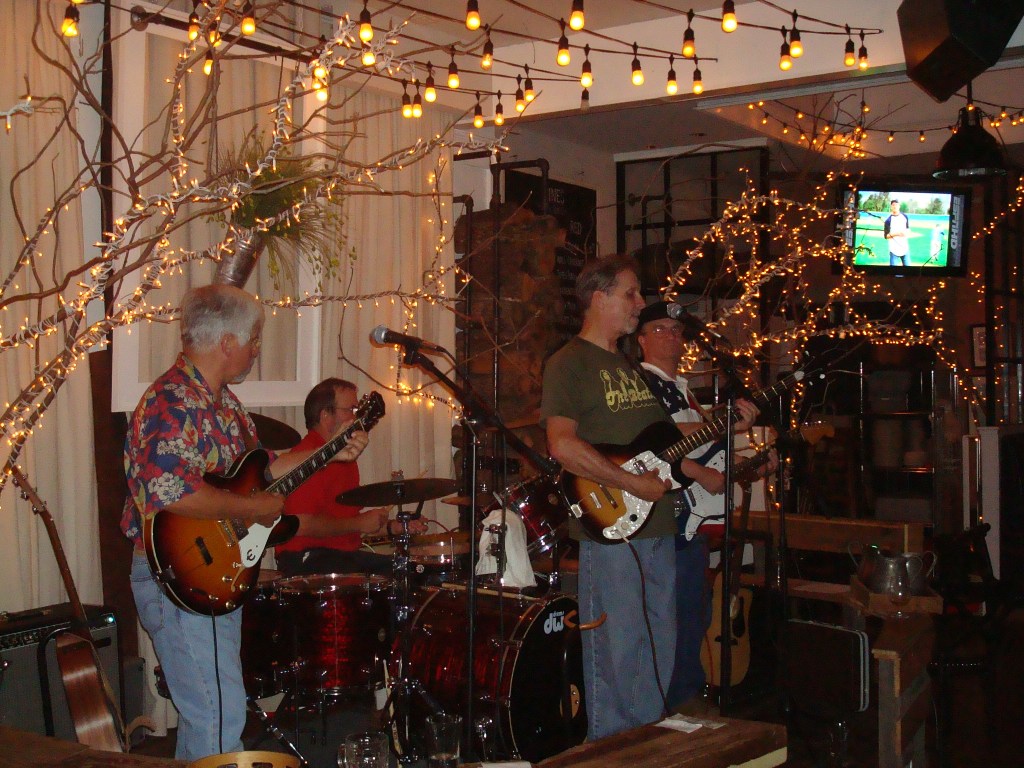
The American Classics today playing Poor Davids Pub, Dallas Texas. Right to left: Phil Strawn on guitar, Danny Goode on bass, John Payne on lead guitar and Jordan Welch on drums

19. Q: As a geezer-in-training, how do you maintain a rock-and-roll attitude?   (If that is something you aspire to do.) (Aside from wishing you had the dough to have a dietician and personal trainer follow you around like Mick does.)

A:  Poor Mick, someone needs to feed that boy a cheeseburger, or a chicken fried steak.  We don’t have a rock-and-roll attitude anymore. We’re having too much fun when we play. To a man, we feel fortunate to still be playing, and doing it well, if not better than back then. We know it won’t last forever so we enjoy every gig and every practice as if it were our last. We figure that we have about five more years before we start to embarrass ourselves. When we need to mount our guitars on our walkers, that’s when we’ll stop.

20. Q: As the years ground by, and punk and grunge and rap and who-knows-what-the-hell-else became popular in the underground and then got co-opted by Madison Avenue, did you ever find yourself wondering what the hell is wrong with kids today? If so, did you wanna slap yourself upside the head?

A: The American  “Pop Music” industry has been in the toilet for the last fifteen years, with the exception of country music and some of the smaller “indie” labels that still find talented musicians to record “real music”. To find “good old rock”, you listen to the country artist. It’s the same licks from the ’60s but they’ve added steel guitars and fiddles. I recently heard Cross Canadian Ragweed and was expecting a country band, but these guys rocked.  They threw out fantastic 60’s fueled licks with hot country lyrics. I swear the ghost of Jimi Hendrix was in them.  Another great band today,“ The Derailers” out of Austin, “rock a billy” with 60’s overtones.

What’s wrong with the music and the kids today?  The destruction of our educational system, also known as “ dumbing down”. “Giving in” to students that are not willing to put forth the effort to learn. Once the kids figured out it was socially acceptable to be stupid, the music naturally, fell to the same level.

Grunge rock, a depressing form of music where every band sounded the same, arrived. It was infused by pathetic, morose lyrics written by boys who couldn’t pass a fourth-grade spelling test. These were the “Pied Pipers” that the record industry crammed down the throats of our children, who, (was so addled by years of playing video games while their minds turned to oatmeal) mistakenly believed that “ life imitates art”. After Grunge got a stranglehold, someone in L.A or New York, opened a sewer cover, and out crawled “RAP”. Which is, in no way related to music in theory or sound.

The numbing beat and gutter- laced words, encourages these kids to embrace hatred for everything good and just. You have seven-year-old children going around talking about killing cops, and “ getting some hoe’s”. The Madison Avenue record machine is no different than Enron or others of their ilk. They go, with no moral regret, straight for the jugular to make the buck, and will walk on the bodies to get to the bank. There is little, if any accountability in the mainstream music industry today. Do I sound mad as hell about this? I’m completely disgusted.

21.Q: What was best about the Dallas music scene back then? What was the worst? Name some of your favorite Dallas bands from back then.

A:  The music scene in Dallas was young and full of excitement. The kids couldn’t wait for the weekends to pack into places like; The Studio Club or LouAnn’s. The Oaklawn area was full of boutiques and clubs. You could visit Lee Park on most weekends, sit on the grass and listen to free concerts by local bands. Oaklawn was re-inventing itself into the “Height Asbury” of Dallas. Most of the local bands that played the “circuit” knew each other. Dallas was a large city, but enjoyed and embraced a small, but sometimes-cliquish music community. I enjoyed the sounds of The Jackals, The Novas, The Southwest F.O.B., The Coachmen and The Chessmen; those were just a few of the many.

22. Q: Were your parents supportive of your musical endeavors? Conflicts?

A:  In our band, all of the parents eventually came around and supported our endeavors. We spent so much time playing that they finally accepted the fact that we were not going to stop. My parents came to our gigs a few times, but usually left doing the zombie head-grab and staggered out the door. They couldn’t take the decibels, and though we would never admit it, we couldn’t either. Everyone in our band now is partially deaf because of the loud music onstage. We play much quieter now.

23. Q: Did rednecks ever pound the dooky out of you for having long hair?

A: Yes they did but in their own inventive way.

I was on the pier one summer night in Port Aransas, 1969.  I was walking with this cute girl I had met earlier in the evening. We had been on the beach with friends, sitting around a campfire picking guitars and drinking beer. I wanted to walk on the pier, to check the waves for the next mornings surfing. I had my Gibson (1940’s) J-45 slung over my shoulder, and was looking really cool. As we ambled down the pier, two “big old boys” made a crude remark to the young lady. I should have let it go, but I couldn’t.

My parents had taught me that you didn’t speak that way to a lady. So, with the girl almost in tears, and me not being in my right mind, I approached the offenders. They were sitting on their bait buckets, drinking Lone Star Beer, and trying really hard to keep it from running out of their mouth from lack of teeth.

I volleyed back with a tirade of “eloquent put-downs” that would have made George Carlin proud. I figured after slick words like that, they couldn’t possibly say anything but “ we’re sorry”.  I stood there, waiting for the apology I knew wasn’t going to come. When those two boys raised up from their “bait bucket lounger’s”, I was staring into the face’s of “Bubba-Zilla” and his spawn. That’s the first time I was ever conscious of sucking air through my lower orifice.

It was “way too late” for apologies, and, I didn’t have anywhere to run, so I stood there smiling like a raccoon caught raiding the trash can. The girl sensed that she was sharing my last minutes on earth, so she hauled-ass down the pier. The smaller of the “Bubba-Zillas” grabbed me  (with my guitar still attached to my body) and did one of these “WWF” moves, spinning me above his head to build up momentum. When I reached launch speed, he sailed me out over the railings, and into the night. For a moment, I had a good form going; spreading out like “Rocky the flying squirrel”. I was hoping to glide toward the beach and lessen the impact into the Gulf of Mexico, thirty feet below.

I was all right with hitting the water; I could swim to the beach if the sharks didn’t get me first. But, In the instant, before I hit, I remembered my Gibson J-45 had taken the flight with me. I was immediately sick.  I hit the water like a cowpie dropped from Babe the Giant Blue Ox. It hurt like hell! After floundering around in the surf for a while, I washed up onto the beach, gripping my ruined guitar. Through the mist, I could see the “Bubba-Zillas” illuminated by the lights, whooping it up and stomping around the pier. For a brief moment, I thought about going back up there and “ kicking some butt”, but then my head cleared, and I figured it was time to get a haircut.

I agree that the sixties didn’t end until the early seventies. No one wanted to let go of the music and the feelings that were so much a part of that short ten years. I had a great time. Thanks for asking me to share my memories.

Thanks!

Gene Fowler

3101 Dancy

Austin, TX – 78722

Ph. 512-322-0602

genfo@email.com

A Ride in A Time Machine


I attended my 50 year high school reunion on Saturday, October 19th. It was held in Plano Texas, the small town where I lived when I graduated a “Plano Wildcat” in 1969. Fifty years on, a town is bound to grow, but Plano has exceeded any of our expectations. Its now a part of Dallas, and that’s not a good thing for our formally small village.

I sent my money to the committee a bit late. Less than thrity days away, I was still unsure if we should attend. Trepidation is one of my worse faults and more often than not these days, it wins more than loses.

My wife, also knowing many of my classmates, urged me to go, or should I say pushed me to attend. She knows me better than myself and what will be good for my soul. She reminded me that I have recently completed cancer treatments and who knows if it will return and then I will have missed this chance. We don’t get many second chances at my age. So, reluctantly, I agreed to strongly consider.

One night, up late, while watching an old black and white melancholy laced movie that reminded me of my childhood, I made the decision to go. My heartstrings were in the right place at the right time, and I just went with it. Trepidation raised its ugly head a few more times in the weeks before, but I fought valiantly and won that battle.

Sitting in the parking lot waiting to enter the venue, once again, I panicked. What if an old friend now looks like the Elephant Man, am I suppose to say “you look great?” What if I don’t remember these people and they don’t remember me? I was to the point of chest pains, but kept that too myself. My wife is a cardiac nurse and I didn’t want her thumping my chest before we entered.

All the doubt and anxiety dissolved the moment we walked through the entry door. I didn’t need name tags to remember names or faces. I assume that during those fifty years, my brain had developed some CGI ability to project how we would look as old folks. There were handshakes, hugs, laughter and reminiscing. The high school antics and experiences were revisited and fondly remembered. There was more laughter than I have heard in years. Prizes, speeches, zingers, they were all thrown about with abandoned.

The ” Memorial” table was the clencher. The pictures of my fallen classmates, forever that age, now gone. Some died early on, some recently, but they were not with us, and that sadden me. Facing mortality is a bitch.

As the class was mounting the stage for the reunion picture, my old friend Jarry fell backward hitting the concrete on his back and taking a hard knock to the head. The jovial mood ceased, and lthough he insisted he was alright, he wasn’t, and 911 was summoned and Jarry was taken away to the hospital for testing. I believe at that moment, the group of us realized that we are not eighteen anymore. We are senior citizens and fragile in this world of hurry up.

God speed to my old classmates, and be careful. I hope to see you again in ten years.

Fruits and Veggies Please


Is there a radio commercial that drives you crazy? There is for me. Its a product called Balance of Nature and it’s on every station I listen to. I can’t escape it. The so-called real users giving testimonials sound like the cast of Seinfeld. There is The Costanzas and the Sienfields arguing about how good they feel and who feels better than the other, and who is going to live longer when they move to Florida. It’s maddening. The doctor that invented this pill sounds Scottish, or possibly British, but is probably from New Jersey.  I wonder if he has a secret lab hidden on the moors. Does he test this product on his sheep? Is he healthy? How did he get the Sienfield actors to push his pills?

A hundred or so years ago, Texas was awash with traveling medicine shows that hawked “cure-alls” for any malady. I suspect this is a more modern and polished version using the airwaves instead of a wagon and a banjo player.

I’m a hardcore skeptic by nature. When my oncologist prescribed my cancer treatment, asked him if he had tried it himself. He hadn’t but said it worked well on his relatives back in Pakistan. They are still up and running. I gave it a shot.

I ran into an old-old friend yesterday at HEB. Fidor is pushing 90 and his wife Elma Ruth is about the same age. I didn’t recognize them. Who are these people? Had replicants been grown in pods?

Fidor now has a full head of black hair, a big mustache, and muscles like Charles Atlas. His teeth are as white as Chicklets. Elma Ruth’s once thin white hair is now blond and flows to her waist. Her ample bosom would make Jane Mansfield envious and she looks like Elke Sommer on vacation. These people are old as dirt and are not suppose to look this way. What the hell I asked, ” what are you people eating and who is your plastic surgeon?”

Fidor, smiling, his white Chicklet teeth casting a glare on the wall, said, ” Elma Ruth and I have been taking Balance of Nature for three weeks now and we feel fifty years younger. She wants to start another family.”

I bid them goodbye, hobbled home, got on my laptop and placed my order.


A 70 Year Lesson


Today, September 17th, 2019 is my 70th birthday. I knew for a decade or two that it was coming but never expected it to show up so soon. It’s like an irritating distant relative that uninvitedly knocks on your door while you’re watching a good movie and now you have to entertain them, share your cheese and crackers, and miss your show. We are courteous in Texas. That’s what we do; even with birthdays, and relatives.

Birthdays, at least for me are personal, and I am often reluctant to share what I write with my followers and friends on social media. People need their privacy. Social media platforms allow and encourage you to give large pieces of yourself away to strangers. It’s too easy to write things you shouldn’t and hit the post button. It allows us all to make fools of ourselves in HD and living color. Hold my beer and watch this.

I convinced myself a few days ago to purchase a manual typewriter and spend less time on my laptop. Hemingway, Harper Lee, Capote, and Steinbeck all wrote longhand then completed their work on a typewriter. I am regressing but I feel in a good way. I am on a mission to complete numerous short stories and a children’s book before my batteries run down. Time is of the essence.

Ken Burns is the best documentary filmmaker in the business. If there is one better in some remote region of the Amazon or the mountains of Tibet, let them come forth. His latest effort on country music is a masterpiece in American history and the way our nation evolved to what we are today.

I love country music. I bleed three chords and a yodel. The old callouses on my fingers remind me that I am a musician and will be until the end. It’s my legacy and I fiercely protect my inherited history.

I grew up the son of a western swing fiddle player in Fort Worth Texas and watching the documentary film and seeing the faces of the people I knew as a child, renews my pride in what I was a part of.

Musicians playing instruments in our home was part of our everyday life. The guitars, fiddles, and banjos warmed the cold walls in the winter and floated on the summer breeze through our open windows to the delight of our neighborhood. I was a child in a crib, absorbing the notes. How could I not become a musician?

The men I knew that played their instruments and sang their songs are gone from this life and have been for some time. I watched them grow old and struggle to play until they couldn’t and graciously accepted their fate

I grew old with them. I walked and carried some of them to their final rest. I am humbled to have been part of their journey. It never occurred to me until decades later, that their journey was also mine. It was much more than classroom learning; it was life lessons. I am a better man because of my father and his country musician friends. The Light Crust Doughboys are on the air.


This Might Be A Little Uncomfortable


Round two of my cancer diagnosis commenced on May 13th at 3:45 pm. Going to UT Southwestern Oncology for treatment was a no brainer: its the best. Their staff radiates positive vibes, so naturally, I feel better. It is battling this evil little demon that has invaded my beloved earthly form with its sights set on the destruction of my body that keeps me focused. This course of action is my main goal and will receive my full attention for the near future.

Today is the ” oh so” specialized 3RDT MRI. I’m amused at the Star Wars comparison to R2D2. At least R2 would show me a hologram of Princess Lea for my entertainment. As with any procedure, it is inserting the word “specialized” into the mix that assures the method will be expensive and painful. I was right.

My bright eyed and bushy tailed MRI nurse accompanies me to my changing room, where I change into a scratchy blue hospital gown accented by yellow non-skid socks. After my wardrobe makeover, he inserts an IV pic into my arm and leaves.

A young woman, maybe twenty-one or so, also wearing the blue gown sits down next to me. She has two IV pics in one arm and appears scared. At this age, my shyness with strangers is minimal, so I ask her, ” first MRI?”.
Without looking over, she says, ” no sir, this is my sixth one, and there’s more to come. It’s Cancer.”
She looks at me and asks, ” how about you.” At this point, I feel like this young girl needs a laugh, even at my expense.
In a deadpan voice, I say, ” complications from the Racoon Flu. My entire body is pulsing with it. Never saw a garbage can I didn’t love. She knows this is total BS and laughs. I crack myself up.

Ten minutes later I lay on the MRI table, IV in place, earplugs inserted, headphones on, and the nurse/tech leans over and tells me “this might be a little uncomfortable.” He smiles and snickers as he says it.
I ask, ” how big is this thing you are inserting into my earthly temple.”
He laughs and says, ” not too big, just enough to get close to the subject and light you up with some good old Radiation.”
I plead, ” let me see it, and I’ll be the judge of that. What kind of Radiation are we talking here?”
Rather proudly he exclaims, ” this is the good old American stuff, came straight from Los Alamos Labs. The same material used to build “the nuke back in 1945. It’s so pure that Dr. Oppenhimer personally endorses it. Its the bomb.”

From behind his back, he produces a probe that looks like a 1/24th scale model of the Hindenburg Blimp. Attached to the business end is an evil pigtail coil that is glowing green. This contraption is right out of the Spanish Inquisition playbook of torture, and it’s going inside of me? Fortunately, for my mental stability, the relaxation drugs I took an hour ago have kicked in, so I am defenseless to attempt escape. I accept fate and brace for the assault.

When the nurse, Mr. Smiley inserts the “little Hindenburg” into my backside, I was convinced I was either in the throes of childbirth or expelling an alien creature from my abdomen. I will never again doubt the painful stories of Alien abductees or women birthing children as “no big deal. ” I am squirming like a brain-hungry zombie, begging for mercy, offering money to end the agony, anything to stop the immobilizing pain. Then, in an instant, the suffering was gone, and I was human again. Listening to some awful hillbilly music, I drifted into La-La land.

I drift back into consciousness hearing George Jones sing ” He Stopped Loving Her Today,” possibly the saddest damn country song ever written. I choke back a tear, then realize where I am and why I’m here. Nurse Smiley congratulates me on a job well done, helps me to my feet and back to the dressing room.

Heading for the waiting room, I realize that scenarios like this will be my life for months to come. I think of a song from The Grateful Dead: I will get by, I will survive. Catchy little tune. Everyone needs a theme song.

See, I Told You I Was Sick!


A true account of why doctors scare the hell out of us, by Phil Strawn

About a month ago I, I started feeling lousy. I couldn’t finger what was wrong, but I felt like crap, all day, every day. At my age, health issues can be expected and are dealt with appropriately. After a week of misery, I did what most people do; I turned to the internet to find out what’s wrong.

I found a medical site, typed in my symptoms and waited for the diagnosis. Within ten minutes, a web site called “Doctor E” sent me an email with his expert diagnosis attached. It’s a good thing I was sitting when I opened the report because I damn near passed out.
I have symptoms of 14 significant diseases including early onset Ebola and the rare Racoon Flu.
Realizing, that I may not last until supper, I called my wife and asked if I should drive myself to the hospital now or wait for her to get home so I can expire in her presence.
My wife, a wise nurse, knows how to handle delicate situations and tells me to “get off the damn internet and book an appointment with Doc Bones.”

The next morning at 9 am, I see my doctor. He prods, pokes, looks into my eyes and ears, takes the blood pressure, and then hands me over to nurse Dracula for a blood draw. I’ve had blood drawn many times, and there is never a problem, but this woman stabbed me four times before finding a vein. Once the suitable vessel is accessed, she proceeds to harvest six vials of my precious elixir for the lab testing. A half-gallon of blood lighter, I head home to await the lab testing.
In a few days, a nurse calls with the results. My PSA is off the charts, so she shuffles me over to a urologist for further diagnosis.

I meet with Dr. Finger, and he tells me there will be a biopsy of the offending gland. First thing I ask is, “will it hurt?” in which he responds, ” you might feel a little prick,” which in medical terms translates to it’s going to hurt like hell, so bring a bullet to bite.

The morning of the biopsy procedure, finds me laying on an exam table with an alien anal probe biopsy vehicle violating my body. Now I know how those poor alien abductees felt, and I thought they were just whiners.
Two weeks pass, and I see Dr. Finger for the follow-up visit. He doesn’t candy coat my diagnosis: prostate cancer #7, moderately passive-aggressive.
“It’s a form that lolligags around for a while, won’t cause a fuss until it gets pissed off and decides to hit back,” he explains.

My options are robotic surgery to remove the little demon, massive doses of radiation for eight weeks or tiny radioactive pellets implanted into the sickly gland.
Doc says, ” the Chernobyl seed implants work well, but I can’t pass through airport security for a year, and pee will glow in the dark for at least a decade. The massive radiation will leave you weak and whiny as a pre-teen girl.”

The robotic thing catches my attention, I say to Doc, ” I’m imagining the Lost In Space robot zipping around the OR, arms flying screaming “danger..danger.” ” Oh, its nothing like that,” he says. “The surgery is performed by a medical robot called DaVinci. Think of it as R2D2 with a grey beard, a velvet beret and cape with an Italian accent. Very efficient and European. When the surgery is over, little ” Leonardo” paints you a small portrait of the Mona Lisa and gives you a gift basket of wine and cheese from the Tuscany valley. You also receive the evil little gland encapsulated in an Italian crystal jar. It makes an unusual conversation piece at parties.”
Doc and I shake hands, and my wife and I depart for home. We have options to consider, but time is of the essence. Like rust, cancer never sleeps.

Father Frank Saves The Church


I visited my local Sun City H.E.B. a few days ago to shop for the week. Just so you know, I loathe shopping for groceries, negotiating the crowded aisles, and pushing a cart that steers hard left while trying to read your shopping list and dodge the blue hairs wanting to run you over. It’s more than any man my age should have to endure.

The geriatric inhabitants of “Clan Sun City” have christened this store as their domain, and they make their own rules of engagement. I’ve had my toes run over, my legs pinned between a grocery cart and the dairy cabinet, rammed from behind for being too slow, and verbally assaulted by an 80-pound octogenarian because I got the last loaf of “dollar bread.” The old bag pulled out an ancient flip-top Motorola cell phone and threatened to call 911 to report me, so I reluctantly handed over the loaf. She shook a bony finger in my face and growled, “And your little dog too.”

Wednesday is the big day for the sample girls to push their wares on the shoppers. You can’t go twenty feet without a chirpy hostess wearing her “Pioneer Woman” apron wanting to stick a food sample in your face. Forget trying to escape; they track you until you stop and thrust the toothpick-impaled morsel into your protesting mouth. I unwillingly managed to taste sushi, sausage roll, carrot cake, cheese whiz, and wine before I could get to the first aisle, and by then, I needed a Prilosec OTC, so I bought that as well.

Shopping completed, I proceeded to the checkout stand, and when rounding a corner near the book section, I bumped hard into a table partially blocking the aisle.

Sitting behind a 6-foot fold-out table was Father Frank, the priest from my church, “Our Lady of Perpetual Repentance.”
On his table is a stack of leaflets, bottles of water, and giveaway key chains shaped like the Virgin Mary. It’s been a while since I have seen the good Father, so we exchange our pleasantries.

After a brief howdy conversation, I asked Father Frank why he was staffing a table at a grocery store.
With a deep sigh, he explained, “The church is losing so many of the flock that the diocese has put me here to drum up new members.”
Not wanting to offend by asking delicate questions, I say, ” I suppose you have to start somewhere, and the crowd here is about the right age to be finalizing their looming Heavenly travel arrangements.” He thought that was prolific and said he would use that phrase in a future sermon.

Now, more curious, I ask him about the giveaways laid out on his table.
With a big smile, he explains, “The bottled water is actually blessed holy water, bottled right in my church by altar boys. We figured if it was good enough to drive out demons and christen babies, it is strong enough to cure the pallet and insides of foul offenses. It has a slight hint of mint so it may be used as an alcohol-free mouthwash in a pinch. I drank a bottle a few days ago and was confined to the rectory bathroom for many hours. Nothing like a happy gut you know”.
I said, “Yes I know that feeling and my cousin Beverly could have used a case of that for mouthwash if you know what I mean.” He said he did and gave me a bottle for her deliverance.

The good Father is on a roll and excitedly explains that they have made considerable changes to his church to attract new members.
He proudly proclaims, handing me the leaflet, “Look at these pictures! We now have a glassed-in section of pews with flat-screen monitors installed on the back of each bench so the young can access their computer games and social media during the sermon, which is piped into the enclosure by a high-powered HD digital audio system.
To save parishioners time, confessions can be uploaded via your home computer or smartphone, and communion has an optional wine flight that, for a nominal fee, comes with a small crystal goblet.”
Am I not hearing him, right? Preteen kids gaming in the pews, computer confessions, wine tasting? How about the singing choirs, the fire, and damnation, the rock-hard pews that make your butt sweat and your legs numb? A church service is supposed to make you miserable, not comfortable.

I tried to interrupt, but the good Father was in over-drive as he continued to exclaim: “The most daring change and the one I’m most proud of is the conversion of the adult Sunday school room to a sports bar for after-service football games. It’s a brilliant concept; come to church, walk across the hall and watch the game on 70-inch flat screens. We call it “The Blue Nun Sports Bar,” with Mother Prudy’s help, I recruited some of the younger nuns from the Abby to come over and wait tables after their service. The sisters are doing a great job but grumbling about the miserly tips and are threatening to hold a sit-in.”
I told them to stop offering a repentance prayer over every beer served, and the tips may improve. It’s best to reserve a blessing for food service only.
Next thing I know, they are wearing t-shirts with “We Aren’t Your Momma’s Nuns” on the back. I don’t know what gives with these younger sisters. The piercings and spiky hairdos are not what I‘m used to. Nuns are supposed to be stoic and mean, not cute and hip.
Well, I say, ” you’re certainly doing everything you can to increase membership, I may have to come to see you next Sunday. I need a good dose of religion and football.”
I shake the good father’s hand, bid him adieu, and shuffle to the checkout.

On my way out of the store I notice, tucked in by the potting soil and flowers, a table staffed by a young, tanned, rock star-haired, frock-clad fellow flanked by two bikini-clad girls handing out free cold beer and hot dogs.
The sign above them read “Rolling Rock Love and Peace Community Church Membership Drive.” I was thirsty, so I scooted on over. Looks like Father Frank may be in trouble here.

” My Sweet Lord”


Driving from Fort Worth to Granbury this morning, the local “oldies” station spun one of the best songs ever; George Harrisons, “My Sweet Lord.” The song, released in 1970, on his album, “All Things Must Pass” is a gleaming gem of music history. Harrison’s beautiful guitar work is a masterpiece to behold. Far better than when he was a Fab Four.

When the chorus comes around, the backup singers begin chanting; “Hare Krishna, Krishna-Krishna, Hare-Hare.” I don’t remember that part, but Harrison was extremely religious and most devoted to all things mystical and Eastern. Hare Krishna’s. I haven’t thought about those goofy folks since 1970.

The Hare Krishna movement danced into Dallas around 1969-1970; flowing robes, shaved heads, Yule Brenner ponytails and a large flock of former hippie-chicks banging on tambourines. They appeared everywhere; Lee Park, McKinney Ave, Oaklawn, the Quadrangle, downtown and especially at the cities airport, Love Field. An organized army of orange robed hippie-converts, dancing down the sidewalk, chanting, swirling in childish abandon and singing gibberish. My parents generation was terrified, believing disciples of the evil Manson family had invaded Big D. Krishna’s are prolific religious messengers, and their foremost message is, ” give us your money or we are not leaving you alone.”

On a hot August day, I taxi my Mother and a few of her relatives to Love Field for a vacation flight to Hawaii. After goodbyes at the gate, I proceed to the terminal lobby. The Krishna’s are on me like the measles; dancing, singing, chanting their gibberish, swirling around while beating their little tambourines. They are smart in one sense; they encourage the Krishna girls to approach men. The pretty ones are recruited to collect the best offerings. Capitalism and sexism seems to be encouraged in their religion of poverty. Someone has to pay for that incense and the Bentley sedans.

I am surrounded, with no way out, short of bulldozing through the throng. A cute young Krishna girl meekly approaches and ask for a contribution, a “love offering” she calls it. Their circle grows tighter; they are uncomfortably close. I can smell the Petiole oil and incense they use instead of soap and water. Short of violence, escape is futile, so I pull a five from my wallet and contribute to whatever they believe in. The circle breaks, and they dance away. No blessing, just take the money and run.

During the war, Love Field, at any time of day, or night is full of service men coming from, or going to Vietnam. Many of the returning boys are less than 24 hours out of battle and more than rattled and raw from being thrust back into real-life with no decompression. The Krishna’s, at this time, are mostly made up of wayward, converted, confused former hippies, and many of them, still possess their anti-war feelings. I can assume that Hare Krishna doesn’t teach their converts sensible logic in dangerous situations.

Two Army Rangers walking through the terminal, duffle bags on their shoulders, are immediately surrounded by the band of frenetic minstrels. Something is said, or implied, and within an instant, olive green arms and “fist of fury” fly like a Texas dust devil, and five male Krishna’s are laying on the marble floor, knocked out cold. Security saunters over, observes the damage and congratulates the two soldiers for a job well done. The young Krishna girl stands quietly for a minute, observing the scene. She drops her tambourine, removes her beads, head scarf and robe and walks away with the two Rangers. Sometimes a good dose of reality hits you like a fist in the gut. True story.


The Legend of Shorty J. Squirrel


On a  sultry Texas afternoon, a group of men gather around a small, flag decorated concrete pedestal just a few paces from the 18th tee box.

They stand in a loose semi-circle, reverent, staring at a small metal figurine of a Squirrel.

From a box, one of the men produces a metal plaque and passes it around to the others for their approval. It makes the rounds, one by one, each man taking a moment to read the inscription, and nod his approval.

This will be their final tribute to one of God’s small creatures that had touched each of their lives.

In the woods of Berry Creek, life for the animals is good. The Deer are safe from hunters, the Ducks are well fed and sassy, and the wily Squirrels rule the forest. The occasional Bobcat and Coyote might pay a visit, but they don’t fancy the closeness of the humans, so they quickly move back to the wooded outskirts. The Skunks are courteous and know their place.

Most mornings, as dawn creeps over the tree tops, life on Lanny’s Pond is already in full swing.

The Ducks congregate to plan their day of begging, and who will get the prime mooching spots. The Mallards usually win the best locations based on their good looks and surly attitude. The other Ducks resort to the equivalent of standing by the cart path with a cardboard sign.

The Squirrels, not ones to socialize with the lowly Ducks, meet at the base of a gnarled oak tree behind the 13th tee box to discuss the previous days events.

Who’s still around, and who’s not?  Who stole somthing from the giants little cars yesterday? It’s always a vibrant discussion, and the main topic usually involves their encounters with the “giants”. In Squirrel language, there is no word for humans, so they simply refer to humans as “giants”.

The Squirrels consider themselves the self-appointed royalty of Berry Creek, and  take no lip or beak from the other critters. They view the Ducks as stupid and clueless, the Deer, beautiful but dangerous, and the Skunks a foul annoyance. The remaining animals are categorized as flagrant opportunist. But not the Squirrels. They always have a plan. They don’t beg, they just take what they need.

In Texas, legends are part of the culture.  Every patch of woods in the state has at least one critter or human that falls into the legend category.

We have Ol’e Rip the Horned Toad, Bob the Bobcat, the Chupacabra, Big Foot, the Jack-a-lope, Pecos Pete, Davy Crockett, William Travis, Ol’e Blue, Ol’e Yeller and Pasquale the horned toad that started the battle of the Alamo. There’s no shortage of legends in Texas, and it’s folks like it that way.

But the woods of Berry Creek, there is but one uncontested legend, Shorty J. Squirrel.

The oppressive Texas heat is tough on all the critters, but Shorty knew how to keep cool. He would find a bare spot beneath a tree, stretch out on his belly, and let the damp earth cool him down.

On one of these cooling off sessions, he fell into a deep sleep and didn’t hear the large black dog creeping up from behind.

Jolted awake by the sense of being flung violently through the air, Shorty realized  something large and vicious had a firm grip on his tail and was swinging him around like a stuffed toy.

After several violent roundhouse swings, the dog lost its prize, when a large piece Shorty’s tail broke off in its teeth.

Escaping to a nearby tree, bloodied, and missing more than half of his familiar rear plumage, Shorty glared down at the slobbering mongrel standing there with a substantial piece of his former beautiful tail protruding from it’s muzzle.

“Stupid inbred animal” he barked.

Shorty knew he was lucky, and thankful to be alive. Many of his extended family had been whisked away by the dog killers.

Squirrels, because they all look-alike, are not prone to personal vanity, but they do have a bit of a rude streak and tend to take notice when one of their own looks a little different.

The few days after the dog incident, Shorty made his morning appearance at the meeting tree, and was greeted not with concern for his brush with death, but by laughter and ridicule focused on his damaged tail.

He explained the attack in animated and vivid detail, wanting the others to know how close he came to death at the jaws of the large dog killer, but the other Squirrels could only point at his damaged appendage and laugh all the louder.

Disgusted and dejected, Shorty made his way over to the sand bunker on the 17th green, sat down and had a good sulk.

While sulking in that sand bunker, Shorty noticed a group of  the “little cars” stopped nearby, and being the breakfast hour, he hopped over to see if there were any hidden morsels worth taking. Creeping ever so quietly, he raised himself into the little car.

Smelling something fragrant and nutty, he climbed into the glove box, finding a nice piece of a half eaten granola bar.

Hidden in the glove box and munching away on his prize, Shorty didn’t notice the little car moving forward. It was too late, he was trapped in the little car.

Shorty, hunkered down in the glove box, frozen in fear, and no way to escape, could only stare up at the faces of the two giants riding in the little car.

When it stopped and  the giants exited, Shorty escaped back to the safety of the sand bunker. He told himself that was a little risky, but well worth the meal, and he would likely try it again.

The next morning, the same group of little cars came again.

Shorty saw one of the giants throw a handful of nuts onto the ground next to the car.

When the giants were on the mound swinging their long sticks, Shorty stole a few of the nuts and scampered back to the sand bunker.

The giants smiled in amusement as they drove away.

A few days later,  the little cars came again, and Shorty bounded over to see what was to be offered.

One of the kind giants sitting in the car, held a nut in his paw and offered it to Shorty. Cautiously, he approached the large paw and took the nut from its grasp. He devoured it, and the large paw produced another nut, then another, and another, until Shorty could hold no more.

After a rousing round of nuts, Shorty was uncomfortably full, and waddled back to the sand bunker. Not having to look for food that day, he relaxed in the sand. ‘This is the life” he told himself.

The other Squirrels, having watched this scenario for a good while, approached Shorty, begging  to learn his technique of training the giants to give him food.

Shorty, being pretty full of himself at this point, and seeing an opportunity to raise his status in the clan, explained that only “he” was able to train the giants.

His newly  deformed tail had bestowed upon him, special powers that allowed magical interaction between himself and the giants.

The other Squirrels, being somewhat ignorant, and naturally superstitious by nature, accepted his explanation without question.

As the days progressed, Shorty, intent on milking this to the end, and starting to believe his own story, would put on his daily show for the clan.

Shorty would approach the little cars, raise up on his hind legs, and staring intensely at the giants, would wave his small paws in a circle, bark a few commands, and the giants would extend a nut bearing paw. The Squirrel clan, watching from the trees would bark in wonderment and approval of their new guru.

The giants enjoyed the unusual antics of the little Squirrel, and noticing his shortened tail, appropriately named him “Shorty”. They thought he was the friendliest Squirrel they had ever encountered.

As the months progressed,  Shorty warmed to the giants and would trustingly climb into the little car and take nuts from an ever-present bag. The giants would speak to him, using his new name and he would respond as best he could with a chatter and the flip of his small tail.

When the little cars would approach the 17th green, the friendliest giant would sometimes yell out Shorty’s name, and he would scamper over to receive his handout.

The other Squirrels in the clan, noticing how completely  Shorty had trained the giants,  unanimously elevated him to “deity status”.

Shorty’s name was now sacred in the woods of Berry Creek.

As Shorty’s legend grew in the woods, it equally grew in the community of giants.

Giants in their little cars would yell for Shorty and throw nuts on the ground as they drove by.

But Shorty was confused. These giants were not “his giants”, and some threw objects at him when he tried to retrieve the nuts. He was always happy to see “his giants”, and they were always happy to be in his company.

One afternoon, Shorty was retrieving a nut that had been thrown from a little car. Dashing across the cement path, he failed to see the little car as it sped toward him, and

Shorty was crushed beneath the wheels of the little car.

His last thought was of his circle of “giant friends”, and who would now train them?

Who would be their friend?

The driver of the little car, thinking it was just a lowly Squirrel, continued on his way. Not caring, not knowing that he had ended the life of a “small legend”.

The life of Shorty J. Squirrel.

One of the kindly friends of the giants found Shorty on the path, took his small broken body home and called Shorty’s “favorite giant” to inform him of his death.

The group of giants were grief-stricken at the passing of their small friend, and vowed to give Shorty a proper tribute to honor their friendship.

As the sun sinks low, one of the men places the small metal plaque on the monument and they silently walk away into the Texas afternoon.

Their tribute, now complete.